

Collective Actions
1976 — Moscow, Russia. Active in Moscow, Russia
The Collective Actions group (Kollectivnye Deistviia, КД, or CA) was founded in 1976 in Moscow by the artists and poets Andrei Monastyrski, Nikita Alekseev, Georgy Kiesewalter, and Lev Rubinstein. Over time, other key participants—including Nikolai Panitkov, Igor Makarevich, Elena Elagina, Sabine Hänsgen, and Sergei Romashko—joined the group, contributing to its evolution. Rooted in the intellectual climate of Moscow’s underground art circles, Collective Actions developed a unique form of participatory, performative art that redefined the relationship between artist, audience, and landscape. Their work was characterized by an interest in time, perception, linguistic structures, and the role of documentation in conceptual art.
From its inception, Collective Actions (CA) engaged with the idea of emptiness—a key concept within Moscow Conceptualism—seeking gaps in Soviet institutional culture where new perceptions and experiences could emerge. Their first project, Appearance, took place on March 13, 1976, in the public park Izmailovo in Moscow. About thirty participants arrived at the site and gazed at a vast, snow-covered field. After some time, they noticed two figures approaching from a distance. When the figures reached the audience, they presented the spectators with certificates confirming their participation in the action. The unusual setting, unclear narrative, and abrupt conclusion—just as the audience expected the event to begin—set the tone for the group’s future aesthetic. Initially conceived by Monastyrski and Rubinstein as a poetry reading, this first action already highlighted the poetic dimension of CA’s performances—their enigmatic and ephemeral nature, fluctuating between text, visuality, and performativity.
CA’s early actions typically took place in open fields on the outskirts of Moscow, outside official art spaces. Participants—often artists, poets, and intellectuals—were invited without knowing what to expect. Though carefully scripted and orchestrated, CA’s events appeared minimal, often unfolding in silence and through waiting: a figure standing in the distance, a rope unspooling across a field, or a banner bearing an obscure phrase appearing before the spectators. These were conceived as “empty actions”—events devoid of overt meaning, emphasizing the spectator’s interpretative role. By focusing on the audience’s perception and phenomenological experience, CA made the journey to the site, the anticipation, and the interpretation integral to the work. From the late 1970s onward, the group encouraged participants to write down their reflections, shifting the locus of the artwork to their experience. During this early period, the group developed its conceptual vocabulary, introducing terms such as the zone of indistinguishability, expositional and demonstrative semiotic fields, emptiness, and unnoticedness. They also formulated key phenomenological actions that structured their events—such as appearing, disappearing, walking, standing, looking at, and listening.
Soon after the first few projects, these actions were collectively titled Trips out of Town (Poiezdki za gorod), a name later given to the samizdat volumes of documentary materials compiled by the group. These volumes followed a structured format, documenting each event with a brief description, location, date, participants, photographs, supplementary materials, and commentaries, along with a general preface by Monastyrski. To date, the group has held more than 180 actions and numerous related projects, compiled into 15 volumes of Trips out of Town. The role of documentation in CA’s art has always extended beyond mere preservation and reconstruction. It was central to what Monastyrski called faktography, a conceptual documentation practice that evolved into a significant artistic method, exploring the performative potential of archival materials to extend the experience of the event and reveal new layers of meaning.
In Slogan-1977, CA hung in the woods a large red banner that read: “I do not complain about anything and I almost like it here, although I have never been here before and know nothing about this place.” While similar red banners with white letters were typically used for official ideological events like demonstrations, this cryptic, metaphysical statement—extracted from Monastyrski’s 1976 poem “Nothing Happens”—disrupted ideological discourse by shifting from collective slogans to subjective experience and by appearing in a tranquil natural setting rather than an urban space. The use of banners with slogans has been a repeating motif in CA’s art, testing the potentials and limitations of text as a cultural tool.
Beyond slogans, CA frequently incorporated text into their works as instructions, extended narratives, audio recordings, and speech-based actions, as seen in The Stop (1983), Voices (1985), Library (1997), and Four Slogans (2018), to name a few. In CA’s art, text functioned not just as a vehicle for meaning but as a tool to examine its construction, challenge conventions, and engage human cognition. This growing emphasis on language culminated in Perspectives of Speech Space (1984–85), an indoor series that departed from the group’s usual outdoor format to focus on discursive practice. More broadly, CA’s increasing engagement with text in the early 1980s reflected general shifts within Moscow Conceptualism, which split into two major waves: the intellectual, text-based performances of Collective Actions and artists of their circle and the more provocative, audience-oriented approach of sots art, aptart, SZ, and Gnezdo.
The collapse of the Soviet Union in 1991 marked a turning point for Moscow’s artistic underground. While many artists sought engagement with newly available international networks, Collective Actions remained dedicated to its unique practice. In the post-Soviet years, the group’s actions became increasingly self-reflective, investigating their own history and the transformations of perception over time. During this period, their actions also engaged with new forms of spectatorship and participation. Some performances incorporated video and sound installations, drone video recordings, or QR codes, acknowledging technological shifts while maintaining the group’s fundamental concerns with time, space, and human perception. Since the 2000s, CA’s actions have been gradually shifting from open fields to forests. Monastyrski attributes this change to the forest’s verticality, which directs one’s gaze upward toward the sky rather than into the distance toward the horizon, as in open fields. He connects this shift to a changing metaphysical search, where the perception of time and existence evolves with the course of life. Their work also found new resonance in a post-Soviet landscape where questions of memory, history, and cultural erasure became central to artistic discourse.
Collective Actions fundamentally redefined performance art by shifting emphasis from spectacle to contemplation, from artist to audience, from action to perceptual experience, and from documentation to discourse. The group’s influence extends far beyond Moscow Conceptualism, shaping contemporary performance and conceptual art in Russia and internationally. Their work prefigured later developments in relational aesthetics and participatory art, positioning them as forerunners of many contemporary artistic practices that challenge traditional modes of spectatorship and authorship. While the original members have moved in different directions (except for its leader, Andrei Monastyrski), Collective Actions remains an active and evolving entity, continuously engaging with its own history and offering new interventions into the fabric of time, space, and thought. Their legacy is not simply in the actions themselves but in the philosophical framework they constructed—one that continues to invite reflection, engagement, and reinterpretation.
Olga Zaikina
Photo portrait: Collective Actions group on its twentieth anniversary, 1996. Photo Credit: Gleb Makarevich. Courtesy of Andrei Monastyrski

Slogan—1978, April 9, 1978. Gelatin silver print on paper mounted on cardboard, 96.7 × 97.2 cm (38 1/16 × 38 1/4 in.). Norton and Nancy Dodge Collection of Nonconformist Art from the Soviet Union. 2013.016.021
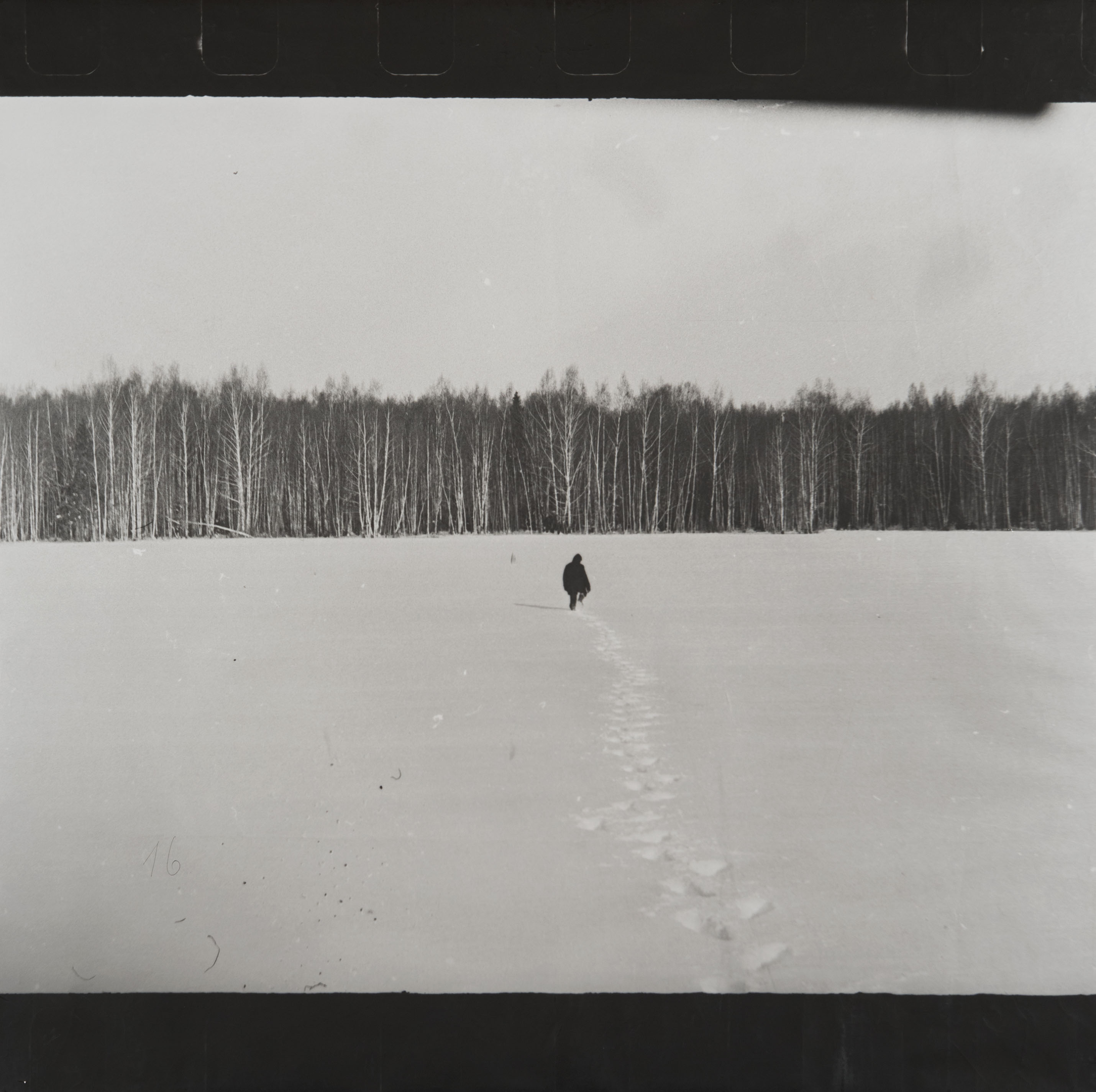
Ten Appearances, February 1, 1981. Gelatin silver print on paper mounted on cardboard, 96.7 × 97.2 cm (38 1/16 × 38 1/4 in.). Norton and Nancy Dodge Collection of Nonconformist Art from the Soviet Union. 2013.016.023

Time of Action, October 15, 1978. Gelatin silver print on paper mounted on cardboard, 96.7 × 97.2 cm (38 1/16 × 38 1/4 in.). Norton and Nancy Dodge Collection of Nonconformist Art from the Soviet Union. D19210
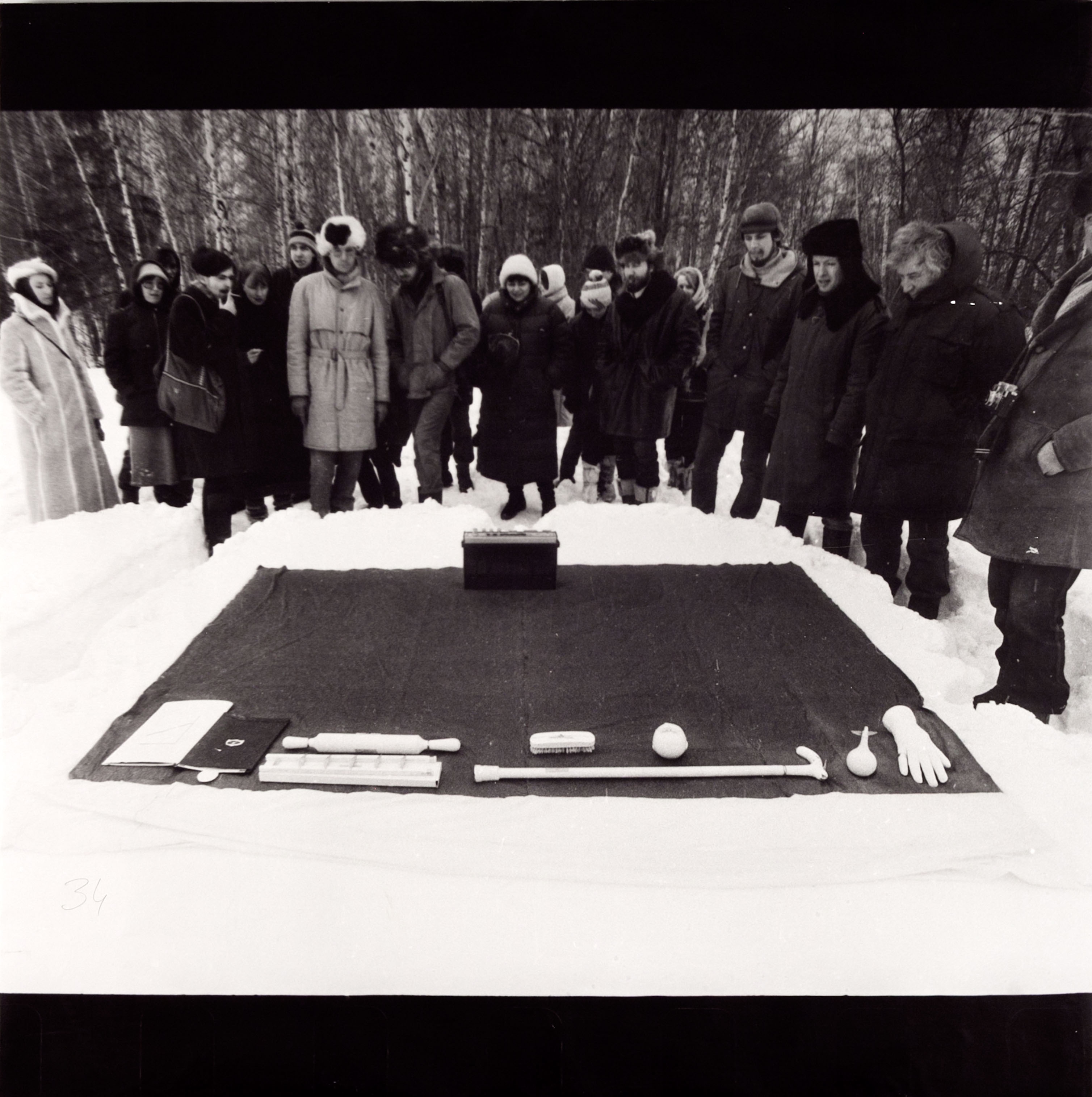
Russian World, March 15, 1985. Gelatin silver print on paper mounted on cardboard, 96.5 × 97.5 cm (38 × 38 3/8 in.). Norton and Nancy Dodge Collection of Nonconformist Art from the Soviet Union. D19242

Voices, January 4, 1985. Gelatin silver print on paper mounted on cardboard, 96.7 × 97.2 cm (38 1/16 × 38 1/4 in.). Norton and Nancy Dodge Collection of Nonconformist Art from the Soviet Union. D19248
Selected Exhibitions
1977 La Nuova Arte Sovietica: Una Prospettiva non Ufficiale, Venice Biennale, Venice, Italy
1989 Investigating Documentation: Photo-Objects of the CA group, Gallery on Kashira Highway, Moscow, USSR (solo)
1997 Collective Actions, Exit Art Gallery, New York, NY, USA (solo)
1999 Global Conceptualism: Points of Origin, Queens Museum of Arts, New York, NY, USA (solo)
2004 Objects in the Art of the Collective Actions Group, EK ArtBureau, Moscow, Russia (solo)
2009 Subversive Practices: Art under Conditions of Political Repression 60s–80s / South America / Europe, Württembergischer Kunstverein, Stuttgart, Germany
2011 Empty Zones: Andrei Monastyrski and Collective Actions, Russian Pavilion, 54th Venice Biennale of Art, Venice, Italy
2011 Virtuosi of Deception: An Insight into the Universe of the Group Collective Actions, Third Belgrade Gallery, Belgrade, Serbia (solo)
2023 Distortions: Moscow Conceptualists Working Today, Hunter College Art Gallery, New York, NY, USA
Selected Publications
Eșanu, Octavian. Transition in Post-Soviet Art: The Collective Actions Group Before and After 1989. Budapest: Central European University Press, 2013.
Gerber, Marina. Empty Action: Labour and Free Time in the Art of Collective Actions. Bielefeld: Transcript Verlag, 2018.
Hänsgen, Sabine. “Sabine Hänsgen: Polaroid – Link – Means for a Series. Three Performances from the Videotheque of the Collective Actions Group: Dedications to Inspection Medical Hermeneutics.” In Extending the Dialogue, ed. by Urška Jurman. Igor Zabel Association for Culture and Theory, Ljubljana; Archive Books, Berlin, ERSTE Foundation, Vienna, 2016: 211–37.
Jackson, Matthew Jesse. The Experimental Group: Ilya Kabakov, Moscow Conceptualism, Soviet Avant-Gardes. Chicago: University of Chicago Press, 2010.
Kalinsky, Yelena, ed. and trans. Collective Actions: Audience Recollections from the First Five Years, 1976–1981. Chicago: Soberscove Press, 2012.
Kalinsky, Yelena. “Drowning in Documents: Action, Documentation, and Factography in Early Work by the Collective Actions Group.” In ARTMargins 2, no. 1 (February 2013): 82–105.
Monastyrski, Andrei, ed. Poezdki za gorod, Tom 1 (1980) [Trips out of town, Volume 1 (1980)]. Vologda: German Titov's Library of Moscow Conceptualism, 2011.
Monastyrski, Andrei, ed. Poezdki za gorod, Tom 2-3 [Trips out of town, Volumes 2–3]. Vologda: German Titov's Library of Moscow Conceptualism, 2011.
Monastyrski, Andrei, ed. Poezdki za gorod, Tom 4–5, 11–13 [Trips out of town, Volumes 4–5, 11–13]. Vologda: German Titov's Library of Moscow Conceptualism, 2016.
Monastyrski, Andrei, ed. Poezdki za gorod, Tom 6–11 [Trips out of town, Volumes 6–11]. Vologda: German Titov's Library of Moscow Conceptualism, 2009.
See also