
Igor Makarevich
1943 — Trialeti (Georgia). Works in Moscow (Russia)
Igor Makarevich is one of the key figures of Moscow Conceptualism and the Russian contemporary art scene. The central theme of his work is the exploration of the transience of existence through the mythologies of Soviet, Russian, and global culture. Many of Makarevich’s works focus on self-observation and reflection, as evident in his reproductions of self-images. His art is both physical and existential, closely tied to rethinking mortality and its pathologies. Since 1990, Makarevich worked in collaboration with his wife, artist and sculptor Elena Elagina (1949–2022). While both continued to develop their individual practices, they produced more than 50 projects as a duo. In 2009, Makarevich and Elagina were featured in the official selection of the 53rd Venice Biennale, curated by Daniel Birnbaum, with the exhibition Common Cause.
Igor Makarevich was born in 1943, during World War II, in Georgia, to architect parents Gleb Makarevich and Tatyana Ganskaya-Reshetnikova. In 1951, the family relocated to Moscow. From 1955 to 1962, he studied at the Moscow Secondary Art School and continued his education at the Gerasimov Institute of Cinematography (VGIK) from 1962 to 1968, studying in the Department of Art under Vladimir Vasin (1918–2006) and Yuri Pimenov (1903–1977).
Like many Soviet nonconformist artists, Makarevich led a dual existence. On one hand, he carried out state commissions, including the design of performances, books, and administrative buildings. On the other, he pursued independent artistic projects, which he shared only with a select group of friends and like-minded individuals.
After graduating from VGIK, he began his professional career as a set designer for the USSR’s Central Television, where he worked from 1969 to 1971. In 1970, he joined the Moscow branch of the Union of Soviet Artists, and in the early 1970s started collaborating with major publishing houses such as Iskusstvo and Kniga, producing illustrations for works by William Thackeray, John Arden, and others.
From 1974 to 1988, he was affiliated with the Decorative and Monumental Art Factory of the Moscow Region Art Fund, a period during which he was actively involved in large-scale monumental projects. These included frescoes for the reception hall of the Soviet Embassy in Morocco, the design of the Cultural Center of the Olympic Village in Moscow, and, in 1982, Florentine-style mosaics for the Politburo meeting hall in the Kremlin, created in collaboration with Elena Elagina. In 1986, he also contributed to the design of the State Miniature Theater under Arkady Raikin. These official commissions ensured a stable socioeconomic framework that made his private artistic practice possible—a practice that extended beyond the ideological limits of Soviet official art and could exist only in semi-underground conditions.
Makarevich’s early individual work in the 1970s was strongly influenced by metaphysical and existential themes, characteristic of unofficial art from the late 1960s and early 1970s. From a young age, he began collecting found objects from abandoned homes. He was drawn to the enigmatic presence of discarded items, their lingering aura of oblivion. Still-lifes depicting decaying objects became part of his artistic universe, rich with mysticism and existential inquiry.
In 1966, during a student internship, Makarevich visited the violin workshop of the Bolshoi Theatre. A magnificent cabinet, filled with violin parts, left a deep impression on him due to its spatial concentration and unique, assemblage-like nature. This moment was captured in the painting The Cabinet in the Violin Workshop (1966, in the artist’s family collection). The combination of this image with a statement by Russian avant-garde and absurdist poet Daniil Kharms—“Art is a cupboard”—turned it into a pivotal element that would shape his subsequent body of work.
Another striking example of Makarevich’s exploration of “hypertrophied materiality” is the painting Surgical Instruments (1978, ZAM, 1996.0701.001-003). A friend, aware of the artist’s fascination with unusual found objects, gave him a box of surgical tools of indeterminate purpose. Their twisted, bizarre forms, gleaming metallic surfaces, and latent aggression found expression in the hyperrealistic rendering on canvas. Later, Makarevich discovered that these were in fact gynecological instruments, used for abortions and childbirth.
Works such as The Corpses of Revolt (1973, ZAM, 1996.0707), showing twelve figures in coffins, and Village Funeral (1974, ZAM, 1996.0708), a reflection on burial rituals, further demonstrate his interest in death, transformation, decay, and decomposition. Makarevich’s friend the artist Andrei Monastyrski noted that “Makarevich’s works are always unexpected—not in form or content, but in the choice of the object he subjects to symbolic ‘killing.’ One never knows who will fall victim next to his fatal, Rhadamanthine touch. … Makarevich kills myths—communal, personal, aesthetic—making no exceptions, not even for himself.”[1] Moscow Conceptualist Nikita Alexeev (1953–2021) added: “In essence, their works [Makarevich’s and Elagina’s] fall within the genre that, in 17th-century European art, was defined as Vanitas vanitatum or Memento mori.”[2]
In 1979, several of Makarevich’s paintings, including The Corpses of Revolt and Surgical Instruments, were in a group exhibition on Vavilova Street. The official response was strongly negative. This event marked a turning point, as the artist crossed into territory deemed unacceptable even within the liberal faction of the Moscow Union of Artists.
Since 1979, Makarevich has been a member of the group Collective Actions, founded by Monastyrski in 1976. At the core of the group’s practice was the metaphorization of language through visual events and the subsequent interpretation of what was seen by the viewer. The space-time actions they staged were based on prewritten scripts, deliberately infused with tautologies, absurdity, boredom, confusion, and an apparent emptiness. These events represented an attempt to escape the ideologically charged social space, offering strategies for discovering inner freedom within the constraints of external unfreedom. Makarevich served as the group’s principal photographer, paying close attention not only to the main events but also to the preparatory stages. His photographs reflect a keen sensitivity to peripheral details and context.
Makarevich’s interest in photography began in childhood when his father gave him his first camera. He would later refer to this passion as the “demon of photography,” a compulsion to keep taking pictures regardless of outcome. His first fully conceptual photo series was Choosing the Target (1977, Centre Pompidou, Paris). Intended as a group portrait of artists at a 1976 apartment exhibition, the photo shoot was interrupted by local residents. The resulting blurred images, altered by the participants’ reactions to the confrontation, were augmented with photographs of dice mirroring the figures’ compositions. The work became a meditation on chance, identity, and visual instability.
Other notable late-1970s works include 25 Memories of a Friend (first version, 1978, ZAM, 2000.1115; second, 1978, AZ Museum, Moscow; third, 2005, private collection) and Transformations (first version, comprising 25 parts, 1978, Centre Pompidou; second version, 16 parts, 1978, State Tretyakov Gallery, among others). These multipart works use grid structures filled with facial casts or photographs subjected to metamorphoses. In Transformations, faces are wrapped in plaster and bandages, evoking ritual. Here, the theme of the “death of the author” (from semiotician Roland Barthes) takes on an especially intimate and tangible form. In 25 Memories of a Friend, facial casts are arranged like columbarium niches, engaging themes of memory and mortality. A similar motif of the box reappears in Case of Sensations (first version, 1978, ZAM, 1996.0691; second and third versions, 1979, Moscow Museum of Modern Art), in which each colorful box holds a cast human torso, stripped of realistic color and individuality. The boxes become hollow vessels—literal cases of sensation.
In Traveling Gallery of Russian Artists (1978, ZAM, 1996.0700), Makarevich presents plaster casts with fingerprints of twenty artists from the unofficial art scene. The work responds to the wave of artistic emigration in the 1970s. The installation includes a plaque stating that identifying the lines of fingerprints allows the public to better understand artistic individuality. With irony, the work questions the myth of the artist’s “masterful hand” and explores the fraught relationship between the artist and the state, control and surveillance.
In 1990, Makarevich created the phantasmagoric installation The Dream of Painting Produces Monsters (1990б State Tretyakov Gallery), referencing Francisco Goya’s engraving The Sleep of Reason Produces Monsters (1799). While Goya’s work depicts a sleeping figure haunted by phantoms, Makarevich replaces the figure with objects: a sofa evoking Freud’s couch, a giant soft palette-mattress, a spring-loaded chair, a shovel, galoshes, and, again, a cabinet—not only as part of his personal artistic mythology but also as a recurring symbol in Moscow Conceptualism, seen in Ilya Kabakov’s (1933–2023) 10 Characters series, specifically Sitting-in-the-Closet-Primakov (1972–75). Later, Makarevich would depict Kabakov sitting in a closet, blurring the line between artist and character. In The Dream of Painting Produces Monsters, shelves in the cabinet hold a toy crib filled with oil-paint tubes, symbolizing the dream of painting—an art form that had given way to new practices like object art, performance, and installation. Painting, having lost its universal status, is placed in sleep mode. The chaotic spread of rubber galoshes disrupts the installation, invading the sleep space and adding to the schizophrenic atmosphere. The entire composition is painted in green—a color that became prominent in several of Makarevich’s later works, including Covered Painting (1988, Nasher Museum of Art), СОТБИС [Sotheby’s] (1988, private collection), and USSR—Bastion of Peace (1989, private collection).
Between 1989 and 1991, Makarevich worked in Paris at the invitation of Norwegian patron Eivin Johansen, creating a lithographic series for Chekhov’s The Seagull. He later collaborated with silkscreen studios in Moscow and lithography workshops in Washington. He received fellowships from the Wilhelmina E. Janssen Foundation (1996), Civita Ranjieri Foundation (1998), and Joseph Brodsky Foundation (1998).
Since the 1990s, Makarevich collaborated extensively with his wife, artist and sculptor Elena Elagina. Their joint works from the 1990s to the 2020s have expanded the scope of Moscow Conceptualism. Marked by an ironic, sometimes darkly humorous view of reality, their projects push serious conceptual gestures to the point of absurdity, exposing their internal contradictions.
Their first joint work, The Closed Fish Exhibition (1990), reconstructed a 1930s show in Astrakhan using only a found brochure. With no images, it concluded with the phrase: “rationally utilize the brush of the artist in the fish industry.” The works were recreated based on their titles and the logic of words typical of Moscow Conceptualism. Four years later, they continued this archaeological approach with Life on Snow (1993–95), inspired by an anonymous 1941 brochure. Released during the height of the war, it contained survival instructions and mythologized the Cold as the last ally in a moment of ideological collapse.
Makarevich and Elagina’s projects form a multilayered artistic system that blends installations, painting, graphic arts, and photography. They create their own mythology, engaging with mystical, ideological, and cultural codes. Developing an open system of interpretations where each element can be reconsidered, expanded, or integrated into new logic, the artists explore the cult of cold in totalitarian regimes, link Soviet utopias with shamanism and psychoactive mushrooms, transform Pinocchio into a sinister archetype, reinterpret the myths of Christ and Prometheus, and create their own cabinet of curiosities—Wunderkammern: Russian Cosmism (1992–2020), Pagan (2003), The Russian Idea (2007), Mushrooms of Russian Avant-Garde (2008–15).
In 1996, Makarevich began Homo Lignum [Wooden man], revisiting the project over several decades. The central character, Nikolai Ivanovich Borisov, a bookkeeper at a woodworking plant, becomes consumed by an obsession with trees after a childhood visit to a furniture factory. This obsession evolves into a belief that he must transform into wood. The project includes various artifacts and documents forming a “Borisov Museum,” alongside diary entries detailing his psychological, physiological, and erotic connection with wood. Homo Lignum explores the transformation of personality in oppressive social conditions, symbolizing the destruction of the human and the transition to the “wooden” beginning. Borisov, a modern iteration of the “little man,” hides from the harsh reality of state, authority, and society through his tree obsession, which functions as a form of escape into illusion.
The project’s first manifestation, Lignomania (1996), was exhibited at the XL Gallery. In 2014, Makarevich added a new dimension by introducing the cabinet as a vessel, when Borisov finds a discarded cabinet and transforms it into various forms: chamber, urinal, guillotine, altar, and coffin. This evolution revisits Makarevich’s symbolism of the cabinet, reinforcing the metaphor of art as a cabinet.
Anastasia Kurlyandtseva
Photo portrait: Igor Makarevich, 1980s. Photo by Lev Melikov. ZAM. D15163
Notes
1. Makarevich, Igor, and Elena Elagina. Обратный отсчёт [(]Countdown]. Moscow: Artguide Editions, 2023: 16.
2. Ibid: 11.
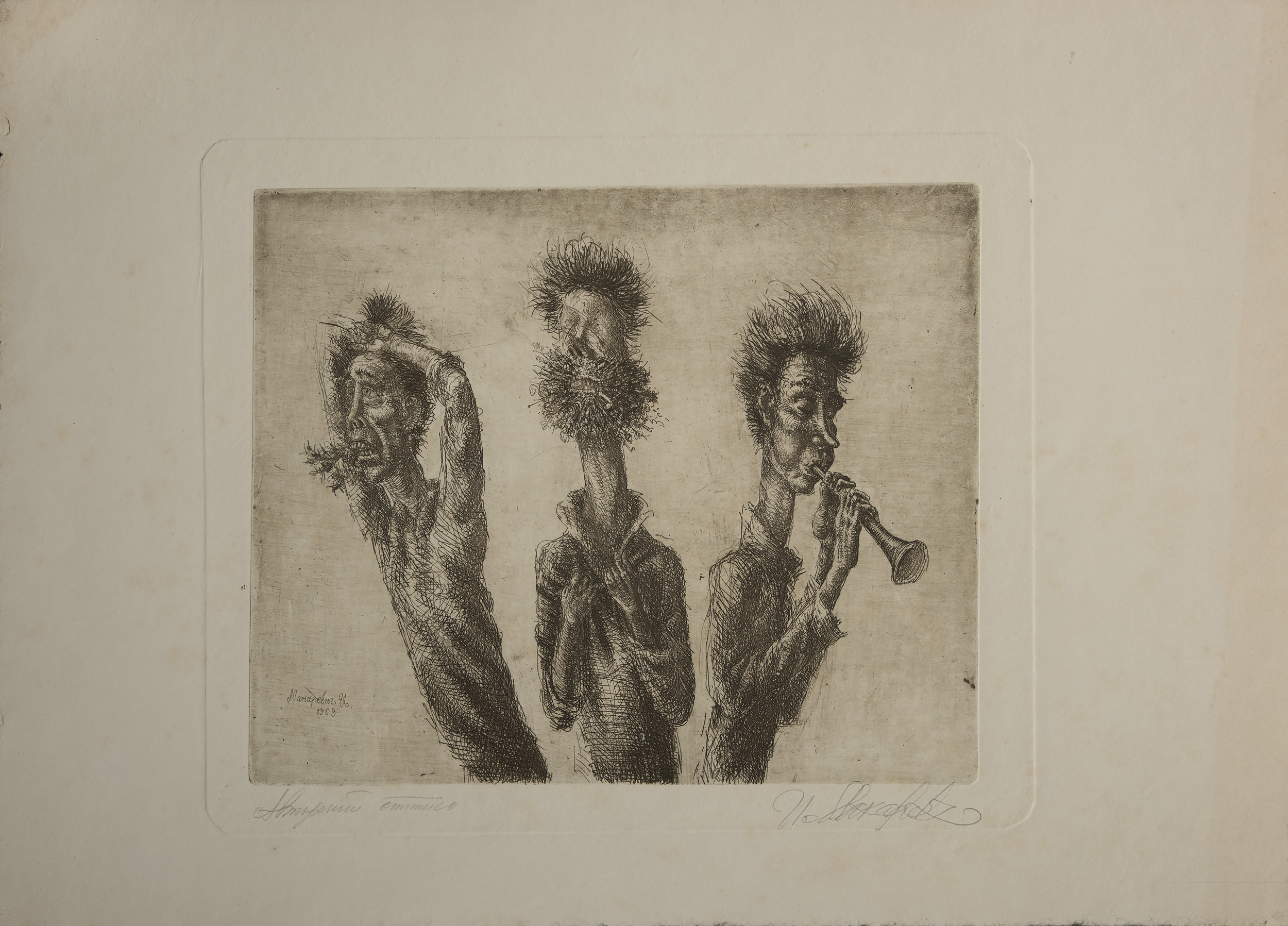
Desperation, Sadness, Hatred, 1969. Etching on paper, 19 x 23.2 cm (7 1/2 x 9 1/8 in.). Norton and Nancy Dodge Collection of Nonconformist Art from the Soviet Union. 2000.1118
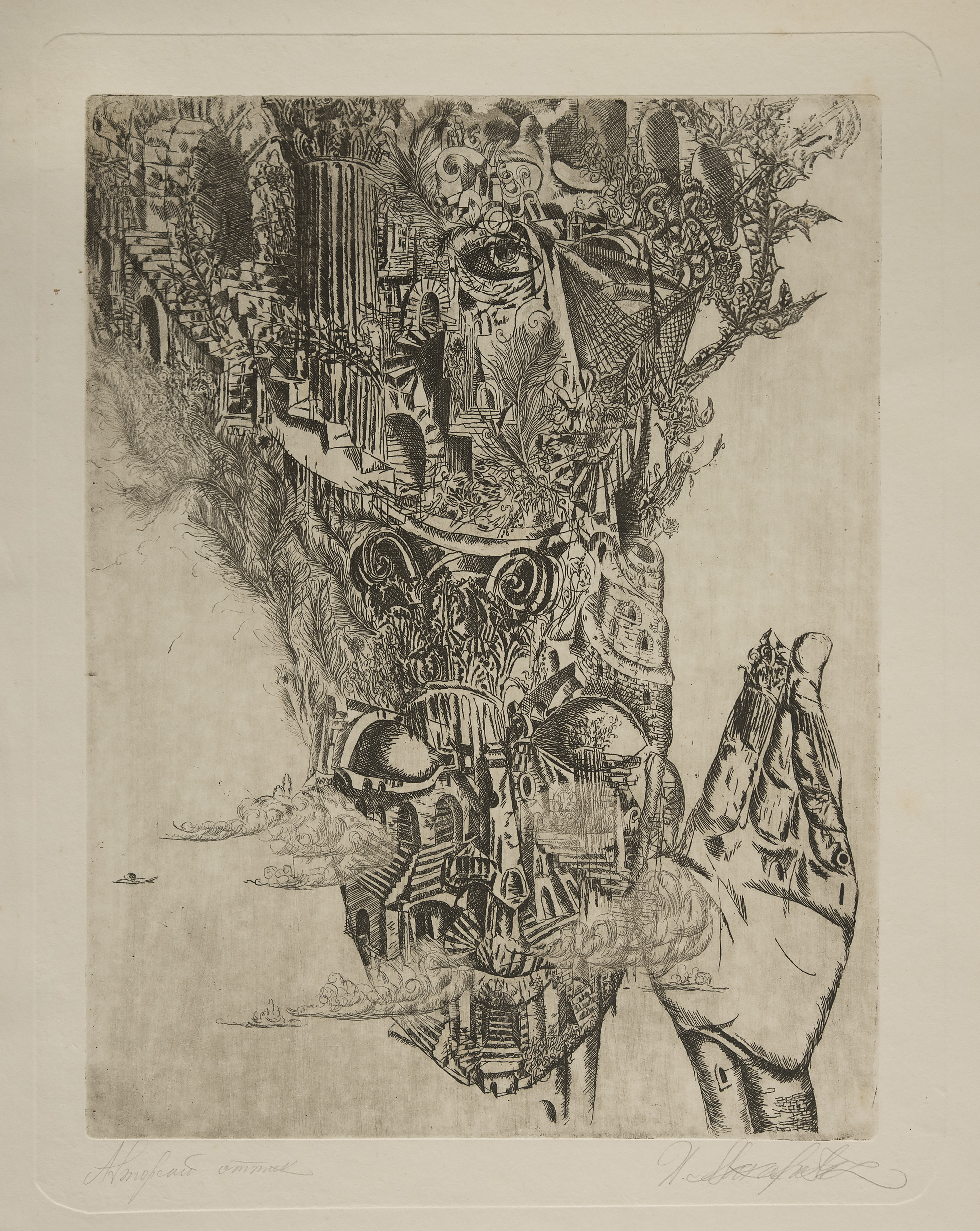
Untitled, undated. Etching on paper, 31.2 x 23.6 cm (12 5/16 x 9 5/16 in.). Norton and Nancy Dodge Collection of Nonconformist Art from the Soviet Union. 2000.1119
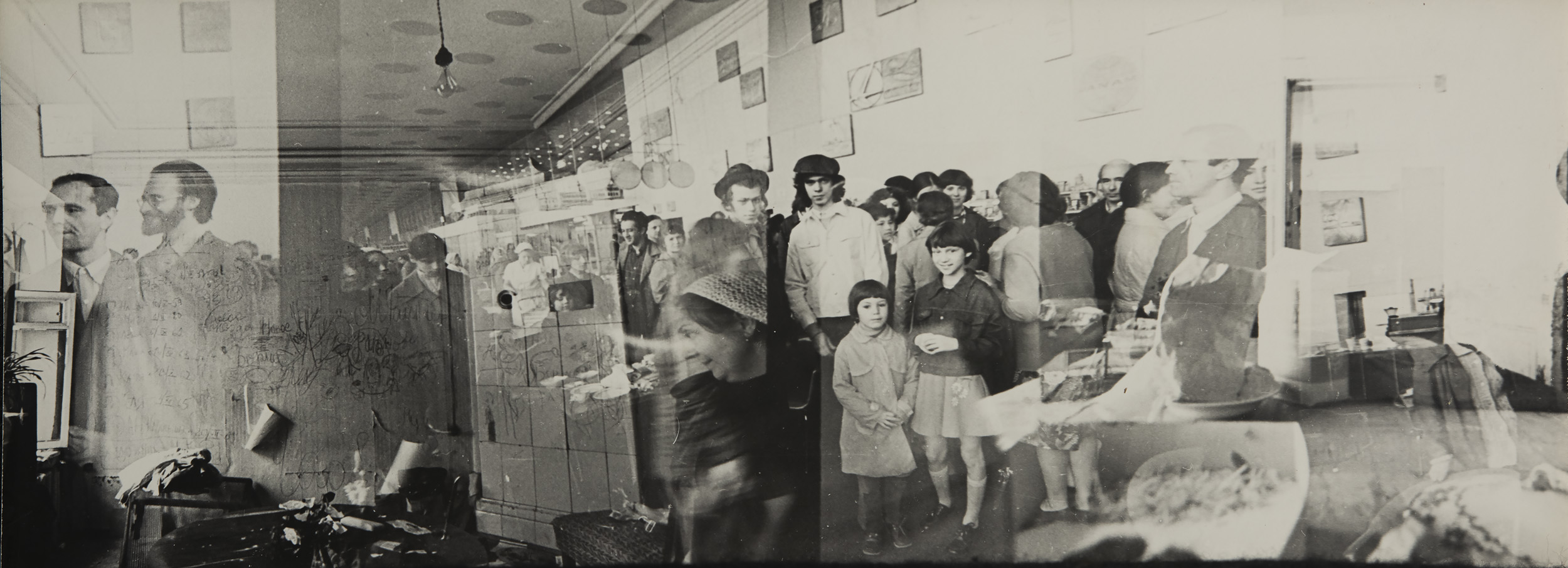
Untitled from the series Exodus, 1977. Gelatin silver print on paper, 11.7 x 30.3 cm (4 5/8 x 11 15/16 in.). Norton and Nancy Dodge Collection of Nonconformist Art from the Soviet Union. 2000.1120
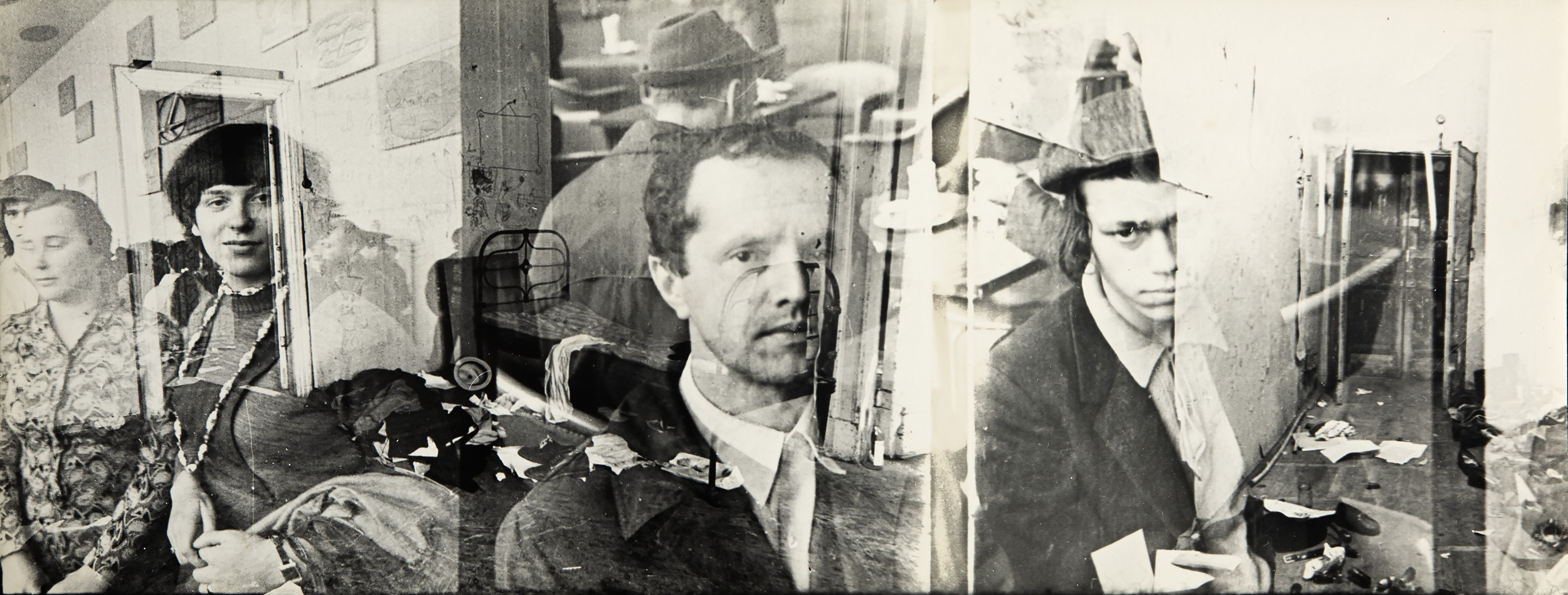
Untitled from the series Exodus, 1977. Gelatin silver print on paper. 11.8 x 30.4 cm (4 5/8 x 11 15/16 in.). Norton and Nancy Dodge Collection of Nonconformist Art from the Soviet Union. 2000.1121
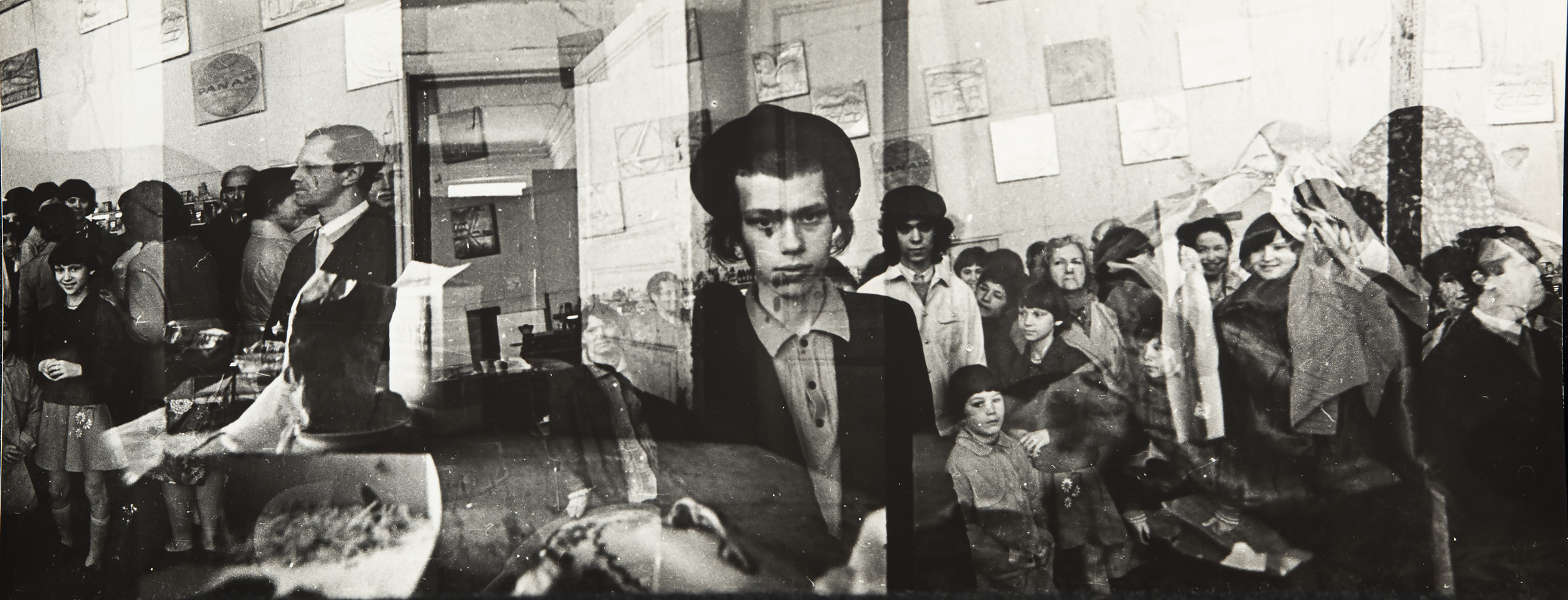
Untitled from the series Exodus, 1977. Gelatin silver print on paper, 11.8 x 29.4 cm (4 5/8 x 11 9/16 in.). Norton and Nancy Dodge Collection of Nonconformist Art from the Soviet Union. 2000.1122
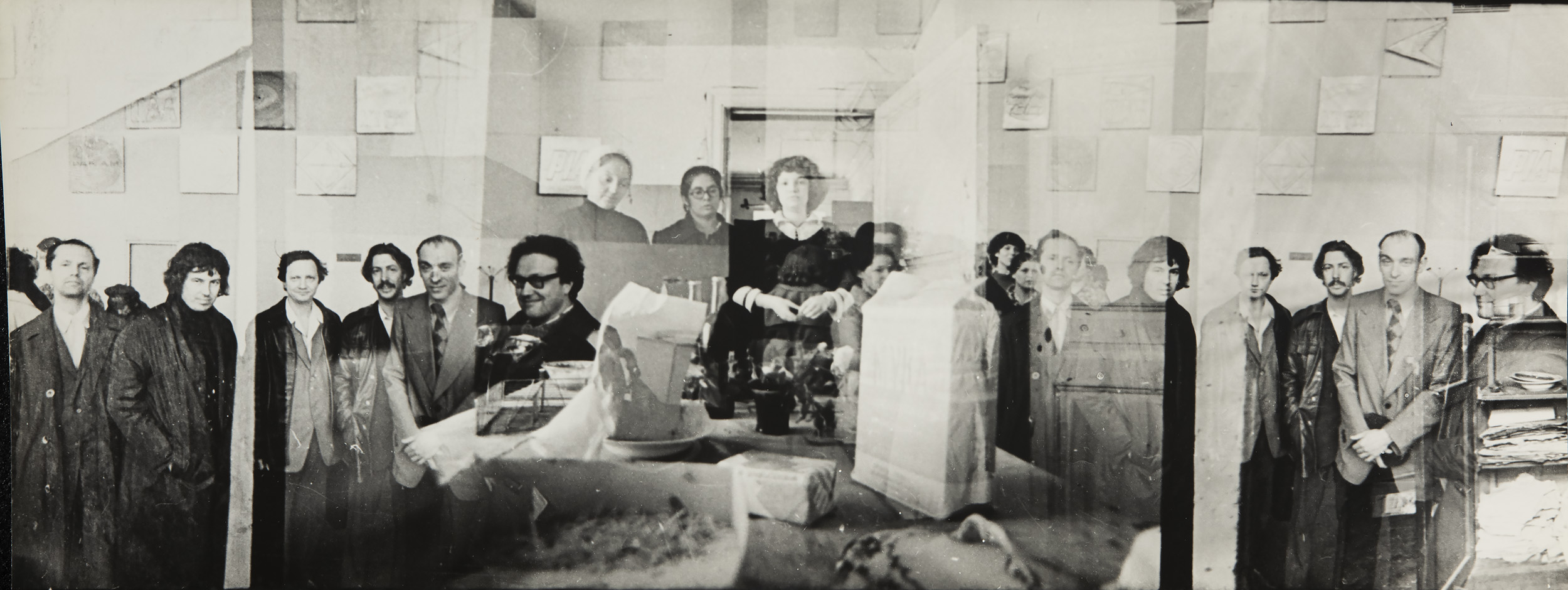
Untitled from the series Exodus, 1977. Gelatin silver print on paper, 11.4 x 29.9 cm (4 1/2 x 11 3/4 in.). Norton and Nancy Dodge Collection of Nonconformist Art from the Soviet Union. 2000.1123

Traveling Gallery of Russian Artists, 1978. Photomontage on paper mounted on paperboard, 94.5 × 90 cm (37 3/16 × 35 7/16 in.). Norton and Nancy Dodge Collection of Nonconformist Art from the Soviet Union. 1996.0700

Cross of St. Ignatius, 1979. Enameled plaster casts in wooden frame, 92.2 x 92.4 x 6.5 cm (36 5/16 x 36 3/8 x 2 9/16 in.). Norton and Nancy Dodge Collection of Nonconformist Art from the Soviet Union. 1996.0698

25 Memories of a Friend, 1978. Plastic casts in wood frame, 85.5 x 85.5 x 8 cm (33 11/16 x 33 11/16 x 3 1/8 in.). Norton and Nancy Dodge Collection of Nonconformist Art from the Soviet Union. 2000.1115

Stratigraphic Structures - Changes, 1976. Photomontage on paper, 101 × 101 cm (39 3/4 × 39 3/4 in.). Norton and Nancy Dodge Collection of Nonconformist Art from the Soviet Union. 1996.0699

Surgical Instruments, 1978-79. Oil on canvas, 131 x 315 cm (51 9/16 x 124 in.). Norton and Nancy Dodge Collection of Nonconformist Art from the Soviet Union. 1996.0701.001-003