

Georgy Kiesewalter
1955 — Moscow (Russia). Worked in Moscow (Russia) and Toronto and Guelph, ON(Canada); currently works in Moscow (Russia)
Georgy Kiesewalter is active in several spheres in the Russian art scene: on one hand, he’s an artist, having joined the Moscow nonconformist cultural milieu in his early youth, in the mid-1970s, immediately gravitating toward the more radical circle of Moscow Conceptualists and becoming one of the “young conceptualists.” On the other hand, over virtually the same period, he’s also been thoroughly documenting aspects of contemporary Russian art of particular interest to him. This dual position (as subject and object) has created some confusion in observers’ understanding of his role in the Russian art scene. If at first he was more of an artist, in recent decades he’s published a multitude of historical and archival articles and books, and his photographic work among the more detailed documentation of the period. Many of his statements and reflections have prompted controversy or even been refuted by other participants in the conceptualist process, but the consistency and tenacity with which Kiesewalter translates his and others’ artistic work into historical documents make his texts obligatory reading, at the very least, for anyone writing about art history during the 1970s and ’80s. In this sense, his own artistic statement “Art is over. Documents remain” (a text from the exhibition Новая агиография [New hagiography], 2011) offers a key to understanding his art as well as his texts. It also brings us to one of the most important questions for conceptual art: is the documentation of the making of artworks (performances, actions, exhibitions) part of the work itself, or is it more akin to record-keeping, falling within the sphere of archival work, without any pretense to artistic expression?
Kiesewalter was born in Moscow in 1955, into the family of a geologist. His aunt, Vera Kiesewalter (1899–1982), was an artist and a graduate of VKhUTEMAS, where she studied under Nadezhda Udaltsova, Aleksandr Drevin, and Robert Falk. Such an accomplished education at the most avant-garde Soviet institution of the 1920s was already viewed as a problem by the 1930s, and later proved dangerous. For most of her professional life, Vera Kiesewalter hid her formalism behind book illustration, landscapes, and still lifes. Nevertheless, she represented a culture distinct from her young nephew’s; she was a witness to and an expert on the Russian avant-garde. It’s no wonder that in his present-day Moscow apartment, her watercolors hang alongside works made by Kiesewalter’s friends, as well as pictures of his and Vera’s ancestors. The Kiesewalters were a German family who settled in Russia during the reign of Catherine the Great, and the artist’s great-grandfather was granted the rank of a hereditary noble. The family was neither rich nor poor, and after the revolution, the Kiesewalters who remained in the USSR were largely engineers. This heritage eventually became the material for his visual works and texts.
In an interview with Sasha Obukhova, Kiesewalter says that as a young man he was interested in Buddhist art and wanted to study at the Institute of Asian and African Countries, but he had insufficient standing in the Komsomol [the Communist Youth League] and so was not accepted to the institute, one of the most significant Soviet ideological institutions. [1] He subsequently received an education that was solid, if not particularly prestigious, in the English section of the philology department of Moscow State V. I. Lenin Pedagogical Institute (now Moscow State Pedagogical University). During a vacation in 1974, he met Andrei Monastyrski, and through him Irina Nakhova, Lev Rubinstein, Rimma Gerlovina, and Valeriy Gerlovin. These relationships continued in Moscow, and he found himself at the center of an artistic crowd known as the Moscow Conceptualists. Being a generation younger than the fathers/founders of conceptualism—Ilya Kabakov, Erik Bulatov, and Viktor Pivovarov—the group he belonged to became the younger branch of the movement. Like all younger generations, the young conceptualists distinguished themselves by being critical of their predecessors. For instance, they saw the Soviet pop art so crucial to the early 1970s as too closely linked to Soviet existence, while they themselves preferred a sort of romantic escapism. In March 1976, the Collective Actions (Коллективные действия, CA) group was formed. The group’s first action, Появление [Appearance], happened in Izmailovsky Park in Moscow and was carried out by Andrei Monastyrski, Georgy Kiesewalter, Nikita Alekseev, and Lev Rubinstein. The cast of artists varied in subsequent actions, but the first three names remained consistent whenever possible. After finishing university in 1977, Kiesewalter taught English for nearly three years in Yakutia, but he remained an active member of CA until 1989. In 1980, in Yakutia, in a forest near the town of Mirny, Kiesewalter held a solo action on behalf of CA: Лозунг – 1980 [Slogan — 1980]. A description of the action and some of the necessary equipment had been mailed to him from Moscow via letter and package. [2]
These conceptual poezdki za gorod (trips out of town) (as the books about CA actions were called) required actors, scripts, an audience, and documentation. The first actions were only photographed, and rather haphazardly at that. Subsequently, actions were photographed meticulously, and all relevant materials were kept—including invitations, detailed descriptions by various participants, and recorded discussions of the action after it was completed, in the case of later projects. Of course, photographic documentation occupied a role in this process that was, if not central, at least as important as the role played by text. Even though Kiesewalter himself categorically denies that his work in this regard is art [3], the entry of CA’s actions into art history is unimaginable without his (and other participants’) photographs. Meticulously compiled volumes documenting the actions, called Trips Out of Town, are anything but dry protocols with accompanying pictures. They are rhetorically composed as parts of the action, having every distinction of a conceptual artwork, which is not limited to the performance itself, but is actually an ongoing and multifaceted project carried out in ways that include the creation of documents and archives.
Kiesewalter photographed all of CA’s actions in which he participated. He also photographed his solo actions, of course. In parallel with this work, he became interested in photographing the studios of nonconformist artists of other generations (see his series Комнаты [Rooms], 1985), exhibitions, and other nonconformist events. Eventually, photography became part of his own artworks. From 1982 to 1984, he was a member of the apt art movement. From 1987 to 1996, he was part of the informal group Klub Avantgardistov [the avant-garde club]. As a participant in these groups, he made his own projects (for instance, the exhibition Музей Васи [Vasya’s museum] in the apartment gallery APTART in 1983, and the series Любишь меня, люби мой зонтик [Love me, love my umbrella] in 1984). However, the “chronicle” that slowly formed from these photographs also makes him, intentionally or not, one of the chief historians of nonconformist art in 1980s Moscow. And in his historical, archival material, the photographs from his artistic series and projects play the same role as the photographs of actions and events.
Kiesewalter’s exhibition history includes many of the important exhibitions of Moscow Conceptualists and, more broadly, of nonconformist Soviet art of the 1970s and ’80s. His solo shows are not as frequent, but they clearly show the artist’s trajectory—from a young conceptualist enchanted by the possibilities of combining textual and visual materials to an accomplished archivist and historian of nonconformist postwar art, who transposed his professional skills back into visual images. One of his most recent projects, New Hagiography, 2011, is based on the presence and absence of faces, names, and branches of a family tree; the letters in the titular text read, “Art is over. Documents remain.”
The artist himself seems to have some ironic distance from his axiom, since his four historical-documentary books, a collection of stories, and the exhibition Художник-коллекционер [The artist collector, 2023], seem to at least allow for the parallel existence of both art and documents. And Kiesewalter’s fondness for creating imaginary artists, which he shares with Ilya Kabakov, gives him away as a joker and a manipulator, which any Russian conceptualist is obliged to be. The country’s history has taught its citizens not to trust anything, even archives—even, Kiesewalter, might add, the archives you put together yourself.
Kira Dolinina
Translated from Russian by Elina Alter
Photo portrait: Self, 1980s. Courtesy of Georgy Kiesewalter
Notes:
1. Kiesewalter, Georgy. “In the Inner Circle.” Interview by Alexandra Obukhova. Garage Museum of Contemporary Art website, April 16, 2016.
2. “15. For Georgy Kiesewalter. Slogan – 1980.” Website of the group Коллективные действия, [Collective Actions].
3. Kiesewalter, “In the Inner Circle.”
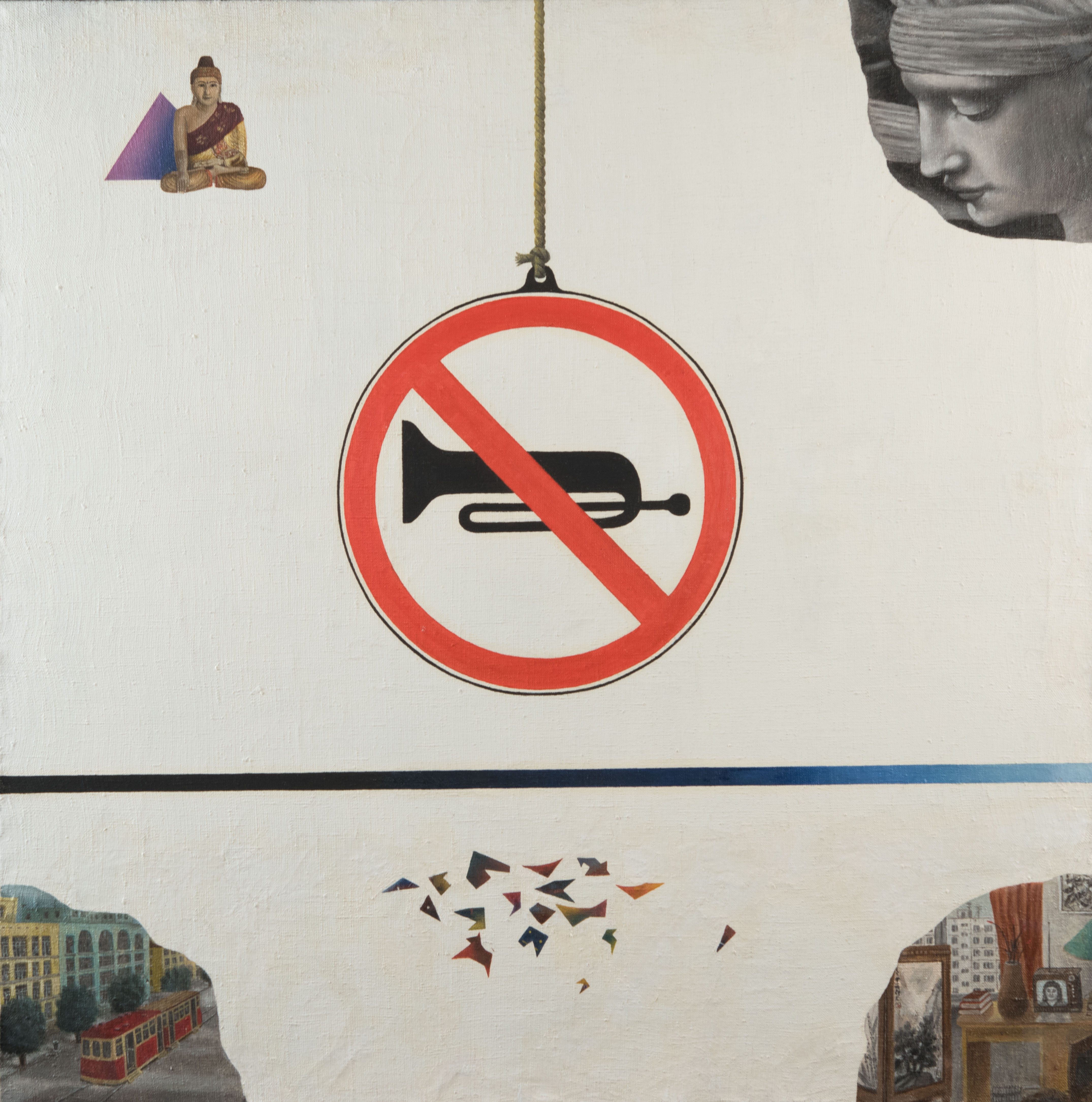
Pictures for Meditation (Dedicated to I. Kabakov), 1976. Oil on canvas, 85.1 × 85.1 × 2 cm (33 1/2 × 33 1/2 × 13/16 in.). Norton and Nancy Dodge Collection of Nonconformist Art from the Soviet Union. 2013.016.039.01

Dmitri Prigov from the series Love Me, Love My Umbrella, 1984–86. Gelatin silver print on paper, 29.7 × 23.5 cm (11 11/16 × 9 1/4 in.). Norton and Nancy Dodge Collection of Nonconformist Art from the Soviet Union. 2000.1588
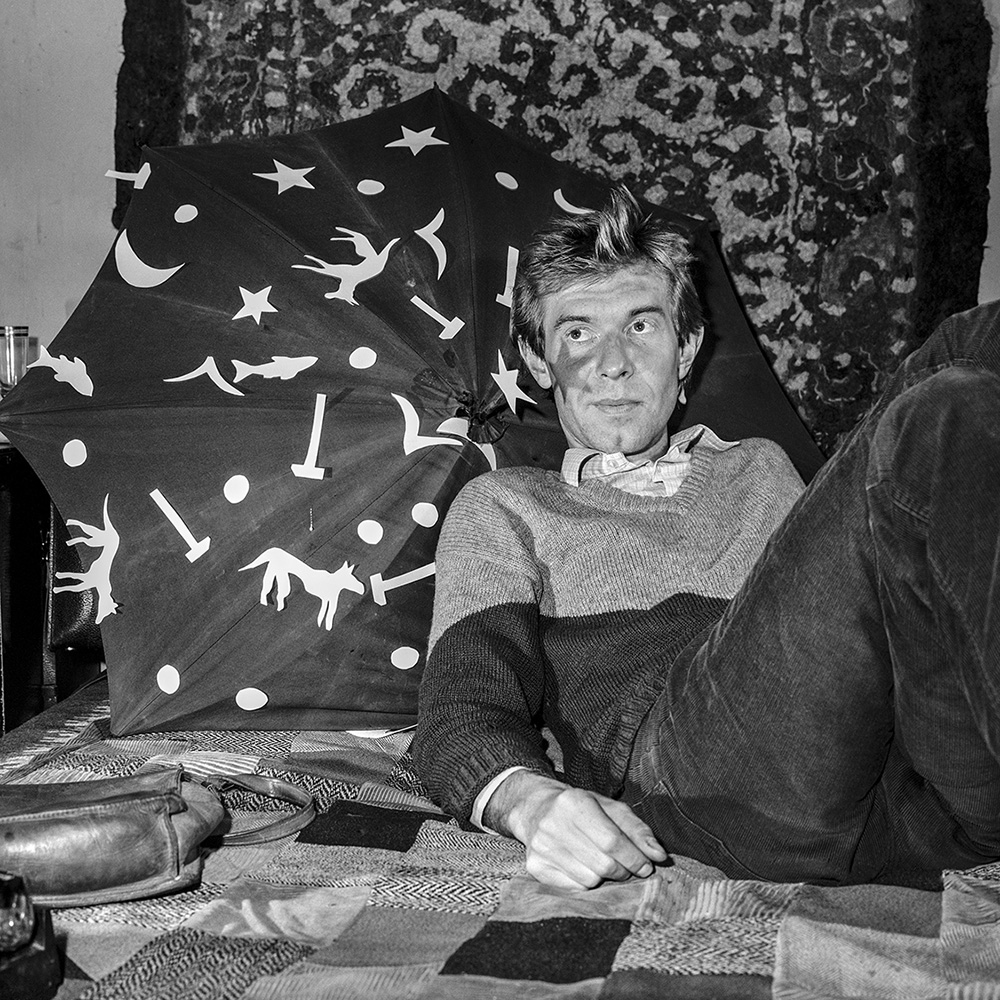
Nikita Alekseev from the series Love Me, Love My Umbrella, 1984–86. Gelatin silver print on paper, 30.3 × 23.8 cm (11 15/16 × 9 3/8 in.). Norton and Nancy Dodge Collection of Nonconformist Art from the Soviet Union. 2000.1589
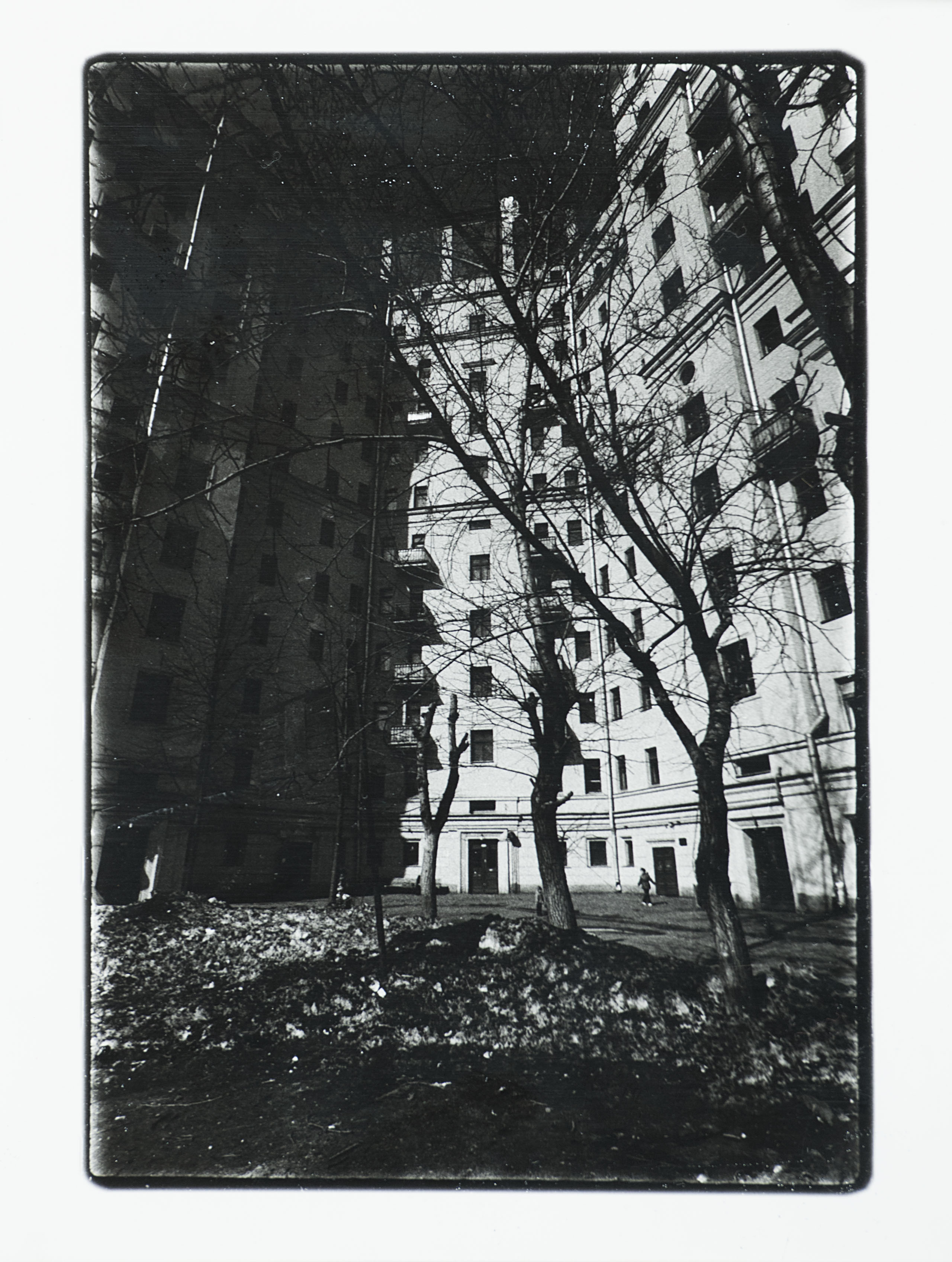
Kabakov's studio in Moscow from the album Moscow Communal Life, 1985. Gelatin silver print on paper, 23.7 × 18.2 cm (9 5/16 × 7 3/16 in.). Norton and Nancy Dodge Collection of Nonconformist Art from the Soviet Union. D20033
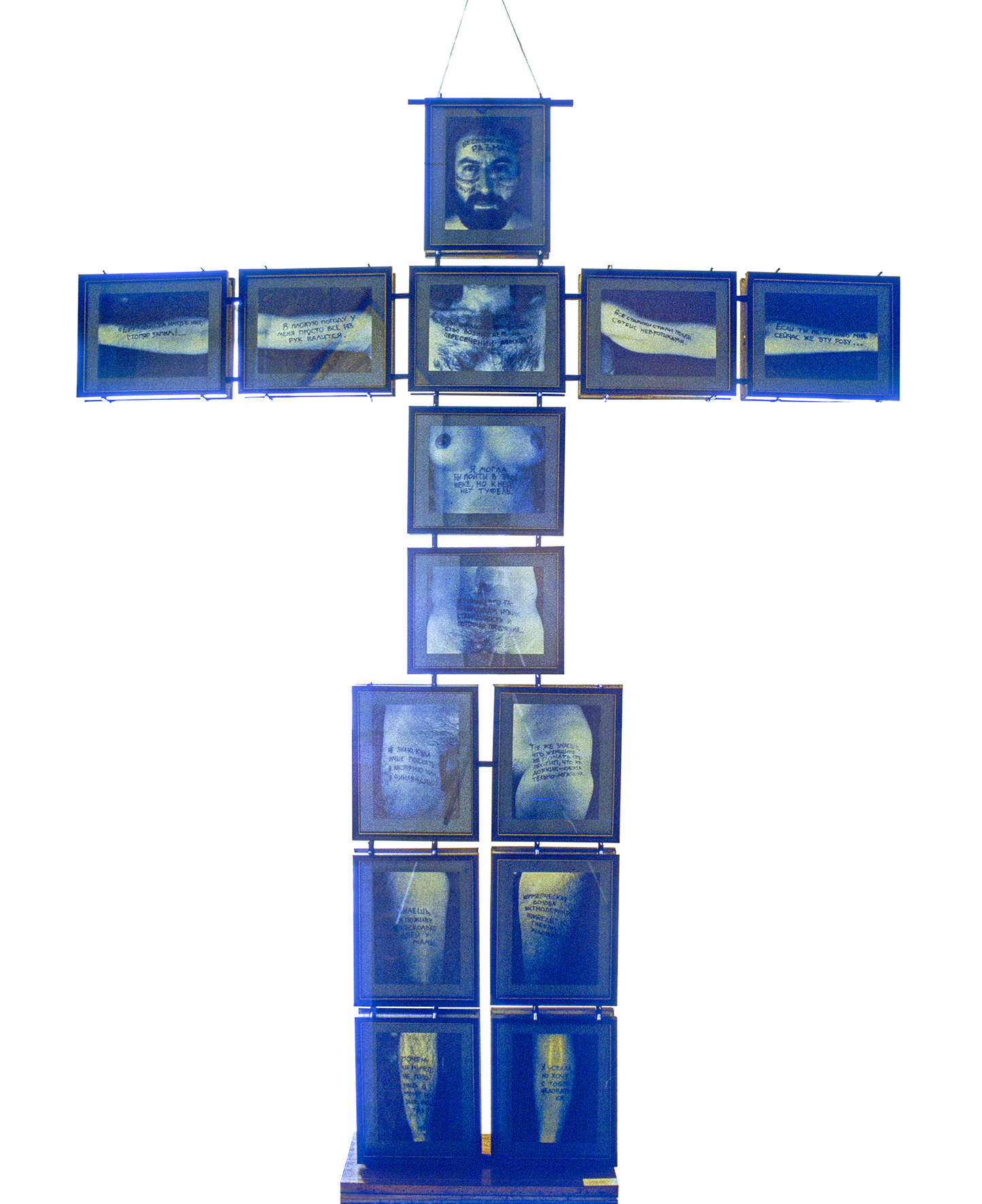
Private Conversations, 1988. Photograph on paper. Norton and Nancy Dodge Collection of Nonconformist Art from the Soviet Union. D10321.001-014
Selected Exhibitions
1976 Unofficial apartment shows, Moscow, USSR
1977 La nuova arte Sovietica: Una prospettiva non ufficiale, La Biennale di Venezia, Venice, Italy
1981 Russian New Wave, Contemporary Russian Art Center of America, New York, NY, USA
1983 Vassya Museum, APTART Gallery, Moscow, USSR (solo)
1984 AptArt in Tribeca, Contemporary Russian Art Center of America, New York, NY, USA
1985 AptArt: Moscow Vanguard in the' ’80s, Washington Project for the Arts, Washington, DC, USA
1988 I Live — I See: Moscow Artists of the 1980s, Kunstmuseum Bern, Bern, Switzerland
1990 And Where Is the National School?, F. Duran Gallery, Madrid, Spain (solo)
1990 Towards the Object, Stedelijk Museum, Amsterdam, Netherlands
1991–93 Prospects of Conceptualism, University of Hawaii Art Gallery, Honolulu, HI; Clocktower Gallery P.S.1, New York, NY; North Carolina Museum of Art, Raleigh, NC, USA
1991 MANI Museum: 40 Moskauer Künstler, Frankfurter Karmeliterkloster, Frankfurt am Main, Germany
1991 Kabakov, Kizevalter, Makarevich, Parallel 39 Gallery, Valencia, Spain (solo).
1993 Monuments: Transformation for the Future, World Financial Center, New York, NY, USA; Central House of Artists, Moscow, Russia; Kunstihoone, Tallinn, Estonia
1995–96 Flug, Entfernung, Verschwinden. Konzeptuelle Moskauer Kunst, Galerie Hlavniho Mesta Prahy, Prague, Czech Republic; Haus am Waldsee, Berlin, Germany; Stadtgalerie im Sophienhof, Kiel, Germany
1996 Russian Conceptual Art of the 1980s: the Collection of the Duke University Museum of Art, Nasher Museum of Art at Duke University, Durham, NC, USA
1998 Garages, Institute of Contemporary Art, Moscow, Russia (solo)
2005 Collaborators, State Tretyakov Gallery, Moscow, Russia (within the framework of the First Moscow Biennial)
2006 Artists Against the State: Perestroika Revisited, Ronald Feldman Gallery, New York, NY, USA
2007 Sots Art, State Tretyakov Gallery, Moscow, Russia; La Maison Rouge, Paris, France
2008 Total Enlightenment: Conceptual Art in Moscow 1960–1990, Schirn Kunsthalle, Frankfurt am Main, Germany; Fundación Juan March, Madrid, Spain
2009 Not Toys?!, State Tretyakov Gallery, Moscow, Russia (within the framework of the Third Moscow Biennial)
2010 Field of Action: Moscow Conceptual School and its Context, Ekaterina Art Foundation, Moscow, Russia
2011 New Hagiography Project, Moscow Museum of Modern Art, Moscow, Russia (solo)
2014 Rauschenberg: Collecting & Connecting, Nasher Museum of Art at Duke University, Durham, NC, USA
2015 Insider, Garage Museum of Contemporary Art, Moscow, Russia (solo)
2016 KOLLEKTSIA/КОЛЛЕКЦИЯ!, Centre Pompidou, Paris, France
2021 Other Spaces. In Artists’ Studios, Ekaterina Cultural Foundation, Moscow, Russia (solo).
2023 The Artist-Collector, Moscow Museum of Modern Art, Moscow, Russia (solo)
Selected Publications
Bignamini, laria. “From the USSR.” In Flash art 76/77, 1977: 9–19.
Cullerne Bown, Matthew. Contemporary Russian Art. Oxford: Phaidon Press, 1989.
Danilova, Alexandra and Elena Kuprina-Lyakhovich, eds. Поле Действия. Московская концептуальная школа и её контекст. 70-80-е годы ХХ века [Field of action: The Moscow Conceptualist school and its contexts, 1970s-80s of the 20th century] [exh. cat.]. Moscow: Ekaterina Cultural Foundation, 2010.
Dement, Sidney Eric. “Umbrellas, Dialectic, and Dialogue in Borislav Pekić’s ‘How to Quiet a Vampire.’” In Slavic and East European Journal 56, no. 2, 2012:153–72.
Eşanu, Octavian. Transition in Post-Soviet Art. Budapest, New York: Central European University Press, 2013.
Gulin, Igor. “История концептуализма и концепция истории” [The history of conceptualism and the concept of history]. In Kommersant Weekend 25, February 2011.
Kiss, Ilona. “Orpheusz Jakutföldön.” In Balkon 9, 2014: 26–31.
Monastyrski, A., N. Panitkov, N. Alekseev, I. Makarevich, E. Elagina, G. Kiesewalter, S. Romashko, and S. Hänsgen (The Collective Actions group). Trips out of Town. Moscow: Ad Marginem, 1998.
Rosenfeld, Alla, ed. Moscow Conceptualism in Context. New Brunswick: Zimmerli Art Museum at Rutgers University; Munich, New York: Prestel, 2011.
Stiles, Kristine. “Rauschenberg, Looking Long and Thinking Hard.” In Rauschenberg: Collecting & Connecting. Durham, NC: Nasher Museum of Art, 2014.
Tupitsyn, Margarita. Margins of Soviet art: Socialist Realism to the Present. Milano: Giancarlo Politi Editore, 1989.
Tupitsyn, Victor. “Георгий Кизельвальтер” [Georgy Kiesewalter]. In Флэш Арт (русское издание) [Flash Art (Russian Edition)] 1,1989: 143.
See also
