
Andrei Monastyrski
1949 — Pechenga, Murmansk region (Russia). Lives and works in Moscow (Russia)
One of the central figures in Moscow Conceptualism, Andrei Monastyrski has shaped its discourse and practice through a vast body of multi-genre and multimedia work. Spanning poetry, performance, interactive objects, artist’s books, installations, video art, novels, musical compositions, and extensive theoretical writings, his work has always been driven by fundamental existential questions of human experience.
Born in northern Russia to a military pilot, Monastyrski continued to spend winters there even after his family relocated to Moscow, as his father continued to work in the region. The vast, snow-covered terrain, endless starry darkness during polar nights, and occasional auroras deeply influenced his later explorations of human perception in open natural spaces. In Moscow, his family lived near Sokolniki Park, which later became a key site for his projects set in the landscape. His teenage diary combined poetic experiments, astronomical charts, a summary of Immanuel Kant’s Critique of Pure Reason (1781), along with daily notes—foreshadowing his lifelong interest in language, cognition, and phenomenology. When he was about seventeen, Monastyrski met the young poet Lev Rubinstein, and together they joined some of Moscow’s underground intellectual circles of poets, writers, and scholars. In the early 1970s, Monastyrski experimented with text, image, and sound, creating several poetry cycles as artist’s books—typewritten on paper and accompanied by minimalist hand-drawn images—including Vozobnovlenie (Restart, 1971) and Ya/MY (I/WE | Pits, 1973, ZAM, D19386.01-11). These poetic texts sought to generate cognitive states rather than convey narrative meaning, echoing the early-twentieth-century tradition of zaum poetry.
In 1974, Monastyrski enrolled at Moscow State University to study philology (graduating in 1980). That same year, he joined the State Museum of Literature, where he worked for sixteen years, advancing from staff member to associate researcher. In his free time, Monastyrski continued poetic experimentation. His new series Elementary Poetry (1975–83) extended poetic text beyond the two-dimensional page into interactive objects. One of them, Cannon (1975), was a black box with a protruding tube; when viewers looked inside, they would hear a doorbell ringing from within. This abrupt shift from visual to auditory experience disrupted sensory expectations, creating a momentary sense of emptiness, as if resetting one’s perceptual parameters. Finger, or Pointing at Oneself as an Object Outside Oneself (1977) orchestrates a situation where self-perception falls apart, oscillating between subject and object. The Spool (1981, ZAM, MANI2.02.27.01), two cards connected by a long thread, required unwinding for fifteen to twenty minutes, only to reveal identical instructions on both of them, forcing the viewer to confront repetition, exertion, and emptiness. Monastyrski’s Elementary Poetry objects, paramount to his oeuvre, were based on what he called “positive non-understanding”—a cognitive gap that resists full comprehension and invites continuous interpretation from the viewer. This gap, central to Monastyrski’s conceptual approach, is not produced by formal aesthetics but by the viewer’s bodily interaction, which triggers certain states of mind.
The conceptual framework around “positive non-understanding” reflects a broader shift in Moscow Conceptualism, which split into two branches in the early 1980s. One, led by Monastyrski and artists of his circle, was intellectually driven, rooted in discourse, language, and ambiguity. The other, centered around the sots art pioneers Komar and Melamid, the Gnezdo group, SZ, and AptArt gallery, was more audience-driven, performative, and provocative.
In 1976, Monastyrski and Lev Rubinstein conceived an unconventional poetry reading that expanded poetic text into action. Organized with Nikita Alekseev (1953–2021) and Georgii Kizevalter (b. 1955), the event Appearance became the first action of what later became the Collective Actions (KD) group. Since then, the group has staged participatory events, mostly in the Moscow countryside, focusing on phenomenological and meditative experience through meticulously orchestrated scenarios. Monastyrski, the group’s leader and only permanent member, has conceived most events, shaping their aesthetics and theoretical framework.
One of the central motifs in Collective Actions’ work is a distant human figure merging with the landscape. Monastyrski analyzed it in his text Seven Photographs (1980, ZAM, MANI1.01.E13.01-07 and MANI1.02.T06.01-07). Drawing on semiotics and philosophy of Martin Heidegger, he examined the gap between firsthand participation in KD’s actions and their later reconstruction through documentation. This tension can also be found in the collages he created for Sound Perspectives of a Trip out of Town (1982, ZAM, 2013.016.049.01), given as gifts to participants. Crafted from velvet fabric and shiny metal railroad insignia, these works embody a pronounced materiality, illustrating Monastyrski’s concept of faktography. This concept blends the early Russian avant-garde notion of faktura—the material and processual visibility of an artwork’s making—with the documentary impulse of archival activity, emphasizing the fleeting nature of experience and the inherent impossibility of fully capturing it through documentation. Monastyrski has developed this and other concepts in his extensive writings on Collective Actions, his own work, and broader questions of underground art, its relation to official culture, urban life, and international art discourse. His theoretical writings have defined the movement’s philosophical foundations, artistic methodology, and critical vocabulary.
Since 1980, with contributions from KD members, Monastyrski has compiled the group’s documentary materials into the samizdat volumes Trips Out of Town, writing prefaces and critical essays and inviting participants to contribute their own analyses. Inspired by the KD archiving enterprise, he launched the MANI (Moscow Archive of New Art) project, compiling the first folder in 1981 and participating in later ones. He also collected the MANI texts into samizdat volumes (1986–91) and edited the Dictionary of Terms of the Moscow Conceptual School (1998). These projects—emerging in a cultural landscape devoid of public exposure and independent criticism—not only nurtured social and intellectual connections within the Moscow underground but also embodied a unique practice of self-institutionalization, solidifying Moscow Conceptualism’s distinct voice within the international conceptual art scene.
Monastyrski’s art and theory intertwine in a continuous quest to understand human existence, echoing Heidegger’s Dasein, in which understanding arises not from detached analysis but from immersion in the world’s unfolding. Language, though never complete, sparks the journey further. This quest has driven Monastyrski’s seamless shifts between genres and media throughout his career, transcending boundaries between them—and between art and life itself. In 1985, Monastyrski, in collaboration with Sabine Hänsgen, created the video Conversation with the Lamp, in which reading a poetic text becomes a tool to explore the connection between language and the body. This work is considered the first work of Russian video art. In 1983–86, he wrote the novel Kashira Highway, blending a personal experience of mental distress, religious phantasmagoria, and a vivid depiction of everyday life during the Brezhnev era. Following John Cage’s musical experimentation, Monastyrski experimented with sound as material, spanning minimalist piano works like Holmy (Hills, 1985) to conceptual pieces such as Music of Consonance (1985). The influence of Zen philosophy is evident in works like Breath and Hear (1983).
In the post-Soviet period, Monastyrski continued his work by sustaining Collective Actions, collaborating with new groups like KAPITON (with Vadim Zakharov [b. 1959] and Yuri Leiderman [b. 1963]), and expanding into new media and genres. His large “installations for exhibition halls” responded to the rapidly growing exhibition opportunities in Russia and abroad following the collapse of the Soviet Union. Many of these works continued discourse around Collective Actions’ conceptual practice, such as Ring of KD (1996) and The 1970s (1998). Others challenged the Soviet past by deconstructing its visual language. In Fountain (1996–2005), for example, Monastyrski reconfigured iconic Soviet sculptures of harvest maidens, positioning them with their backs to the viewer and facing an empty center, transforming a symbol of state grandeur into an enigmatic space of absence and introspection. Many of these installations presuppose institutional production, requiring solid constructions and high-quality prints, marking a shift in Moscow Conceptualism from the handmade, underground art of the past. Today, Monastyrski continues his conceptual investigations through ongoing projects, including work on Collective Actions’ art and archive, the video series From the Window on Tsander Street (2011–present), collages with gold-colored lines (1996–present), and the photographic series Illuminations (2022–present). He has been actively exhibiting in and outside Russia, in relation to KD and independently, including four Venice Biennales, Documenta, and other major art platforms.
Monastyrski’s legacy is one of radical redefinition—art as an experience rather than an object, performance as a conduit for philosophical inquiry, and language as both material and meaning. His practice defies easy categorization. As a poet, performer, theorist, and organizer, he has consistently pushed the boundaries of conceptual art, emphasizing its experiential dimensions. Through his deep engagement with seeing, listening, and waiting, his philosophical reflections on presence and absence, and his meticulous documentation, he has shaped a uniquely Russian conceptualist tradition that continues to inform contemporary art discourse.
Olga Zaikina
Photo portrait: Andrei Monastyrski with his art objects, 2015. Photo by Natalia Aleksander. Artist’s personal archive.

Title page for the series I/We (Pits), 1973. Typewritten text and felt-tip pen on paper, 43.1 x 35.7 cm (16 15/16 x 14 1/16 in.). Norton and Nancy Dodge Collection of Nonconformist Art from the Soviet Union. D19386.01

Elementary Poetry: Spool (Motalka), 1981. Cardboard, thread, and machine-typed text on paper, 10 x 16 x 1 cm (3 15/16 x 6 5/16 x 3/8 in.). Museum purchase. MANI2.02.27.01
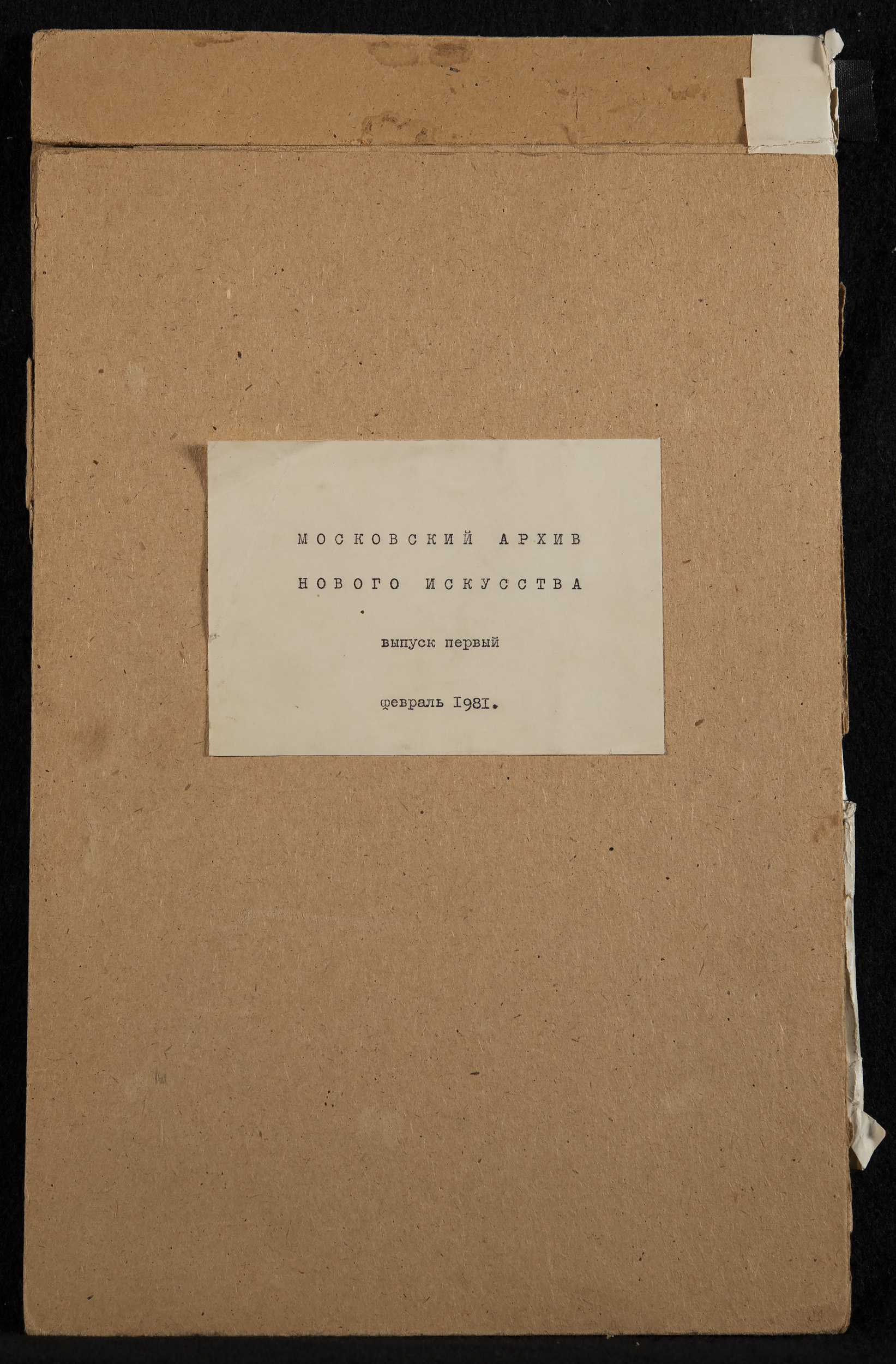
Original container for Moscow Archive of New Art, volume 1, 1981. Cardboard box with paper label. Museum purchase. MANI1.01.00a-b

Visual Display for Sound Perspectives of a Trip out of Town, 1982. Velvet covered paper, metal emblem pins, 33 x 39.5 cm (13 x 15 9/16 in.). Norton and Nancy Dodge Collection of Nonconformist Art from the Soviet Union. 2013.016.049.01

Postscript, 1983. Ink, printed text, photograph, and paper umbrella on illustration board, 27.5 x 21.5 cm (10 13/16 x 8 7/16 in.). Norton and Nancy Dodge Collection of Nonconformist Art from the Soviet Union. D11163