
Elena Elagina
1949 — Moscow (Russia) | 2022 — Moscow (Russia). Worked in Moscow (Russia)
A prominent figure of the Moscow Conceptualist school and a creator of art objects and installations, Elena Elagina was born into a family of Soviet scientists but discovered her artistic calling early on. In 1967, Elagina graduated from the Moscow Secondary Art School. From 1967 to 1972, she studied painting under Alisa Poret, a renowned artist, children’s book illustrator, and former student of Pavel Filonov. Simultaneously, from 1964 to 1976, she worked as an assistant in Ernst Neizvestny’s studio, where she encountered leading artists, writers, and academics and gained access to Western art books brought by foreign visitors—an uncommon privilege in the Soviet Union’s censored cultural landscape. Elagina’s early artistic vision was shaped by this triad of influences: the precision and paradox of Poret’s work, the monumentality and metaphysics of Neizvestny’s art, and exposure to the cutting-edge movements of Western modernism. One of Elagina’s early series, a set of seventeen etchings from this period, was recently rediscovered after being lost for decades. The series, Entia (1973), takes its name from the Latin ens, meaning “being” or “existing thing.” Steeped in philosophical and metaphysical themes, Entia employs a rich visual language that merges phantasmagoria and storytelling.
From 1972 to 1975, Elagina studied literature at the Orekhovo-Zuyevo State Pedagogical Institute. Her interest in text and image shaped the path of her artistic career. From 1969 to 1978, Elagina was employed as an illustrator at the magazine Znanie–sila (Knowledge is power), while also doing other state commissions for book illustrations and monumental art projects. Also In the 1970s, Elagina got involved with the circle of underground artists. In 1979, she became a member of the Collective Actions group (КД, or CA), which investigated philosophical and phenomenological dimensions of art through meditative and mystical performances staged in the expansive open fields outside Moscow. Together with her husband, the artist Igor Makarevich—whose photographic documentation of CA’s actions expanded and reshaped the post-event perception—Elagina played a key role in conceiving and organizing Collective Actions’ projects.
In 1987, Elagina assisted Joseph Backstein in registering KLAVA, the USSR’s first officially recognized association of unofficial artists, becoming one of its founding members. KLAVA (Club of Avant-Garde Artists), which included Vadim Zakharov (b. 1959), Sven Gundlakh (b. 1959), Dmitri Prigov (1940–2007), and other Moscow Conceptualists, gained renown for staging events in unconventional spaces, such as a municipal sauna and Butyrka prison. One of Elagina’s notable series from this period is a collection of large-scale installations united under the title Neuter Objects (1987–2020s). This series includes works such as Clean, Tar-Based, The Sublime/The Infernal, and Vascular—all of which explore the texts and textures of Soviet everyday life. By subverting its utopian aspirations through Duchampian absurdist configurations of objects intertwined with text, the series exposes contradictions within Soviet material culture. For instance, Pre-Wonderful (1990, ZAM, 2023.013.001A-H) from the series deconstructs the cliché of feminine domestic labor as a production of the “wonderful,” playing with both verbal and visual representations of the word in its fragmented state.
Elagina’s interest in text and language was also shaped by her upbringing—both of her parents were Soviet biologists whose work was often impacted by ideological discourse. This led Elagina to explore how art can interrogate and deconstruct historical narratives. A notable example is her long-term project on the Soviet biologist Olga Lepeshinskaya, a colleague of Elagina’s father. Starting with its early version, the installation At the Source of Life (1986, ZAM, D22785.001-005)—which eventually evolved into the large-scale environment The Laboratory of the Grand Undertaking (1996)—reconstructed the career of the scientist. Lepeshinskaya, a member of the USSR Academy of Medicine and a recipient of the Stalin Prize, advanced her career through Party connections and gained prominence for her theory of “living matter” as the origin of biological life—a concept later debunked as pseudoscience. Elagina’s installation combines real artifacts, such as Lepeshinskaya’s photographs and books, with fabricated elements, including fictionalized research journals and medical equipment that resembles household items. Everyday objects, like a meat grinder, mock the alchemical nature of her research, creating a phantasmagoric depiction of domestic life as a source of scientific inspiration. Elagina’s father was an advocate of Lepeshinskaya’s ideas, contributing to her book Sources of Life and writing its introduction. By examining the intersection of personal and collective history, Elagina exposed the mechanisms by which ideology shapes knowledge.
Elagina’s artistic and life partner was her husband, Igor Makarevich. Their collaboration began in the 1970s with state commissions, including large-scale monumental works for the Kremlin (Leonid Brezhnev’s office), the Olympic Village, state theaters, and sanatoriums. While each was already a prominent figure in Moscow’s underground art scene in the 1970s, their large-scale unofficial collaborative projects began in the late 1980s and have since led to more than fifty solo exhibitions worldwide. Their first major collaborative work, Closed Fish Exhibition (1990), was held at the unofficial MANI (Moscow Archive of New Art) museum, located at the dacha of fellow CA member Nikolai Panitkov. The exhibition was based on a booklet documenting a 1935 Soviet expedition in which young Moscow artists studied the fishing industry in the northern region. Using only the booklet’s textual descriptions—since it contained no images—Elagina and Makarevich attempted to reconstruct the lost artworks, resulting in enigmatic assemblages that exposed the absurdity of Soviet efforts to merge industry with art through ideological enthusiasm.
Elagina and Makarevich’s collaborative projects focused on twentieth-century utopian narratives, from the artistic visions of the Russian avant-garde to Nikolai Fedorov’s idiosyncratic theory of universal resurrection. Their multimedia environments, combining crafted and readymade materials, explored the tensions between past and future, matter and ideology, and language and imagination. Their methods aligned with those of the Moscow Conceptualists, who pushed the metaphorical language of socialist culture to its literal extreme, revealing ideological contradictions and opening space for multiple interpretations. What set Elagina and Makarevich apart was their rigorous pursuit of historical narratives, which they excavated with archaeological precision and presented through paradoxes, humor, and uncanny coincidences. In their Russian Idea project (2007), exhibited in various versions, including one at the 53rd Venice Biennale (2009), a bookshelf filled with black bread alongside a heap of soil evoked a haunting reflection on the legacies of socialist utopia—spanning nationalist mythology, Stalinist terror, and recurring cycles of famine.
In 2000, Elagina cofounded and became the chair of the Art Projects Foundation, which aimed to support contemporary art initiatives in Russia. In 2011, she cofounded the Caryatid Prize (Nizhny Novgorod), which supported female artists in Russia. Elagina received the Innovation Prize for “Creative Contribution to the Development of Contemporary Art” (2012) and the Moscow Prize for “Visual Art and Architecture” (2021), among other prestigious awards. Her works can be found in major Russian museums, Tate Modern (London), the Ludwig Museum (Cologne), and other prominent collections.
Olga Zaikina
Photo portrait: Elena Elagina, 2000s. Photo by Igor Makarevich. Artist’s personal archive

PRE (Wonderful), 1990. Wood, paint, found objects, fiberboard, 60 x 200 x 20 cm (23 5/8 x 78 3/4 x 7 7/8 in.). Museum Purchase, Avenir Foundation Endowment Fund. 2023.013.001A-H
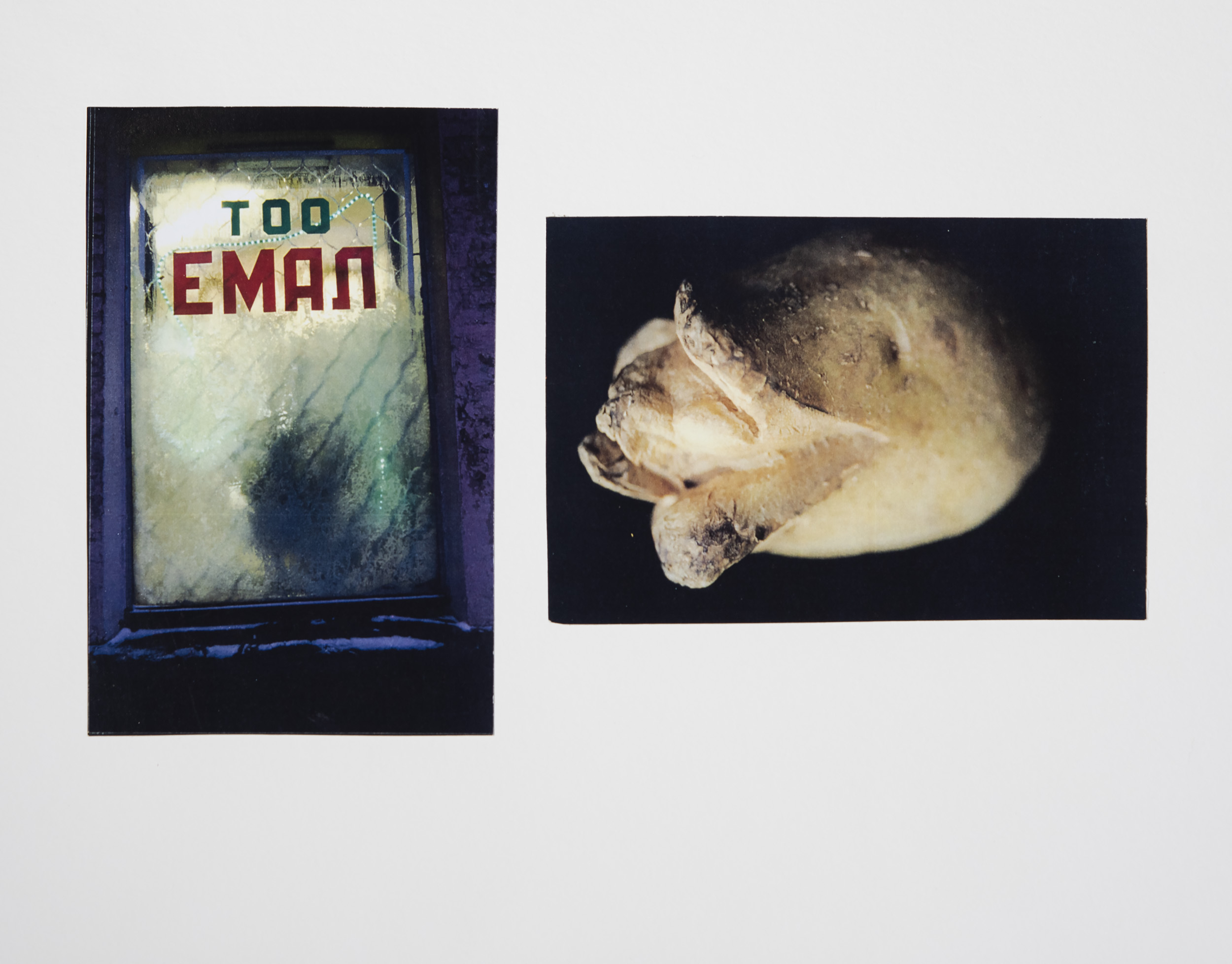
Igor Makarevich and Elena Elagina, Untitled, 1998-99. Collaged photographs on paper, 27.8 x 35.2 cm (10 15/16 x 13 7/8 in.). Norton and Nancy Dodge Collection of Nonconformist Art from the Soviet Union. 2000.1124
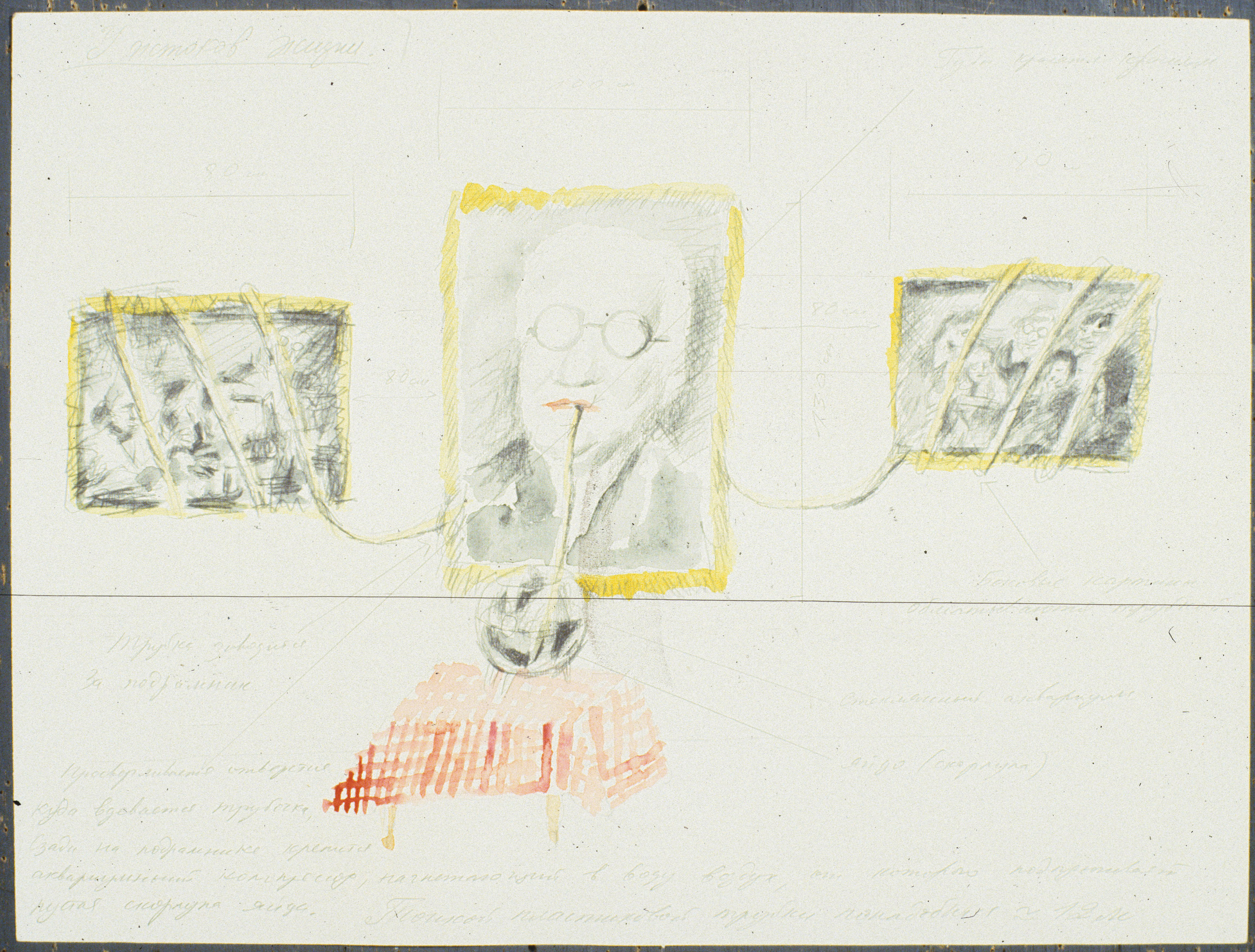
Igor Makarevich and Elena Elagina, sketch for the installation At the Source of Life, 1986. Watercolor and graphite on paper, 23.7 x 31.8 cm (9 5/16 x 12 1/2 in.). Norton and Nancy Dodge Collection of Nonconformist Art from the Soviet Union. D20029