
Alexander Grigoriev
1949 –– Leningrad (USSR). Works in Moscow (Russia)
As a child, Alexander Grigoriev attended an art club at the House of Pioneers in Smolninskoye Municipal Okrug. After leaving school, from 1966 to 1968, he worked as a modeler for the Leningrad Zonal Research and Design Institute of Standard and Experimental Design (LenZNIIEP; now the I. B. Malikov Architectural Bureau). In 1966, at the suggestion of his second cousin, who was an architect, he enrolled in the Department of Architecture at the Leningrad Engineering and Construction Institute (LISI; now the Saint Petersburg State University of Architecture and Civil Engineering).
In December 1967, Grigoriev met Lev Nussberg, the leader of the Dvizhenie (Movement) group, which comprised modernist artists, engineers, and composers. During this period, Nussberg was working on projects to decorate Leningrad for the fiftieth anniversary of the October Revolution. Through Nussberg, Grigoriev learned about kineticism, op art, and other trends in contemporary art, and helped construct the art object Цветок [Flower] (later retitled Киберсобытие [Cyberevent]) following Nussberg’s design, as well as several other objects intended for the decoration of Leningrad. Around this time, he met Francisco Infante and joined the Movement group, where he constructed his first original kinetic objects.
Under the influence of Nussberg, who did not have a university education himself and believed that studying at Soviet art institutes was a waste of time, Grigoriev left LISI in 1968 and spent the next few years as part of the Dvizhenie group, working on various projects, including the design for the Island of Flowers playground at the international pioneer camp Орлёнок [Eaglet] in the North Caucasus (1968). The playground was built like a labyrinth and included a number of exercise facilities, as well as pavilions designed in a techno-futurist style. Grigoriev created a number of objects for this project and designed the physics and chemistry pavilions. Subsequently, Nussberg came up with a catch-all, somewhat bombastic name for these kinds of projects, calling them cybernetic environments, or just киберсреды (cybersredy). At the turn of the 1970s, the members of Dvizhenie, while continuing to base their compositions on geometric principles, increasingly drifted toward a techno-organic aesthetic; hence, some of their design sketches reveal the influence of surrealism. Grigoriev’s sketches from the turn of the 1970s for cybernetic environments and fantastical cities feature the juxtaposition and blending of geometric and organic forms, and resemble the aesthetics of psychedelia in Western art and design.
In 1969, Grigoriev moved to Moscow, after receiving a residence permit through a sham marriage; soon after, he annulled this first marriage and married Tatiana Bystrova, a dancer, artist, and fellow member of the Dvizhenie group. This marriage lasted until 1976. In Moscow, Grigoriev met many leading figures of the nonconformist underground, including Mikhail Grobman (1939–2025), Vladimir Yankilevsky (1938–2018), and Eric Bulatov (1933–2025), along with many others. He helped prepare the large-scale exhibition Советскому цирку —50 лет [The Soviet Circus at 50] (Manege, 1969), creating a mock-up of the starry sky, which became part of the scenery.
Beginning in 1970, he worked at the Moscow Monumental–Decorative Art Concern, where his main responsibility was to design exhibitions. Thanks to Nussberg’s connections, the members of the Dvizhenie group were able to get work in exhibition design, and despite suspicions of political “unreliability,” they remained in demand as artists who could work in a modern style. Their period of activity coincided with the official approval of modernist aesthetics in Soviet design, and itself helped contribute to this approval.
Grigoriev helped develop and design the art-industrial exhibitions Elektronika (Moscow, 1970), Chemistry–70 (Moscow, 1970), and Elektro–72 (Moscow, 1972), among others. The payment he received for his work in exhibition design allowed him to buy two apartments in Moscow. As part of their work on group projects, individual artists were given opportunities to develop their own objects and constructions.
In 1971 and 1975, Grigoriev worked in cinema as one of the set designers for the film The Committee of 19 (1971, directed by Savva Kulish), a political thriller about Western laboratories that get exposed for developing bacteriological weapons. One of the film’s sequences showed a visit to a contemporary art exhibition with geometric objects, but it was cut during the final edit. For his second film, Mayakovsky Laughs (1975, directed by Sergey Yutkevich), based on Mayakovsky’s play The Bedbug, Grigoriev designed a TV studio/laboratory of the future in an op-art style. In the early 1970s, he took part in several performances, or “kinetic games,” organized by the Dvizhenie group, including Пришельцы в лесу [Aliens in the Forest] (1971, Chertanovo district) and Кинетические игры на море [Kinetic Games on the Seaside] (1972, Crimea). These were held outdoors, and Grigoriev participated as an actor and photographer. These performances have been preserved in staged photographs and other documentation; subsequently, the photographs underwent further processing for several publications. Judging by these photographs, one can infer that during this period, the members of the Dvizhenie group drew increasingly away from rationalistic constructions and toward fantasy, science fiction, and mysticism. In 1972, Grigoriev left the Dvizhenie group to focus on his own projects. Nussberg, who emigrated in 1976, took some of Grigoriev’s sketches with him as part of the Dvizhenie group’s archive, and repeatedly showed them at foreign exhibitions, leading to copyright disputes.
From 1973 to 2005, Grigoriev worked as a freelance graphic artist for the Znanie publishing house. As an independent artist, he created paintings and works on paper with a focus on optical illusions. For his basic units of construction, Grigoriev favored the triangle, the cone, and the pyramid, and he developed forms that ranged from planar to stereometric constructions, yielding either three-dimensional objects and structures or light-based compositions created out of electrical appliances. Around the same time, Grigoriev began creating photo collages consisting of landscape compositions, in which he included insets that functioned as portals to other dimensions. Grigoriev’s experiments differ significantly from works by other former members of the Movement group, such as Viacheslav Koleichuk and Francisco Infante, not only in their predominantly geometric motifs, but also in their general orientation towards psychedelia. Grigoriev subsequently enhanced a number of these visual effects with the help of computer technology.
In 1974, in collaboration with his longtime friend Georgi Antonov (b. 1948), the Leningrad-based actor and founder of the Динамика (Dynamics) group, Grigoriev created an object for the exhibition Student Creativity in Leningrad, and helped with preparations for a performance piece titled Igra form [Game of Forms]. For their choreographic productions, the members of the Dynamics group developed ideas from the futurist play Victory over the Sun (1913), presenting their performance as a synthesis of movement by actors, machines, and lights.
From 1975 to 1978, he worked on several action pieces that were held outdoors, including Yazycheskiy krest [Pagan Cross], Bluzhdayushchaya liniya [Wandering Line], and Zabludivshaya strela [Lost Arrow], which featured improvised magical rituals. In the late 1970s and ’80s, he became a member of the Moscow City Committee of Graphic Artists (an official trade union association created in 1975 for representatives of the Moscow underground) and took part in exhibitions hosted by the City Committee on Malaia Gruzinskaia Street. In the 1990s and 2000s, he recreated some of his lost compositions from the 1970s. From 1999 until 2019, he worked as a book designer for the Danilovsky Blagovestnik publishing house.
In the 1990s, a number of Grigoriev’s works were acquired by Vladimir Spivakov (b. 1944), at that time the director of the Moscow Virtuosos chamber ensemble; in the 2010s, other works were acquired by Roman Babichev (b. 1957), a collector and the driving force behind a retrospective exhibition of the artist’s works at the Moscow Museum of Modern Art (MMOMA) in 2023.
Kirill Svetliakov
Translated from Russian by Philip Redko
Photo portrait: Alexander Grigoriev, Portrait Through a Kinetic Object, 1967. Source: artist’s website
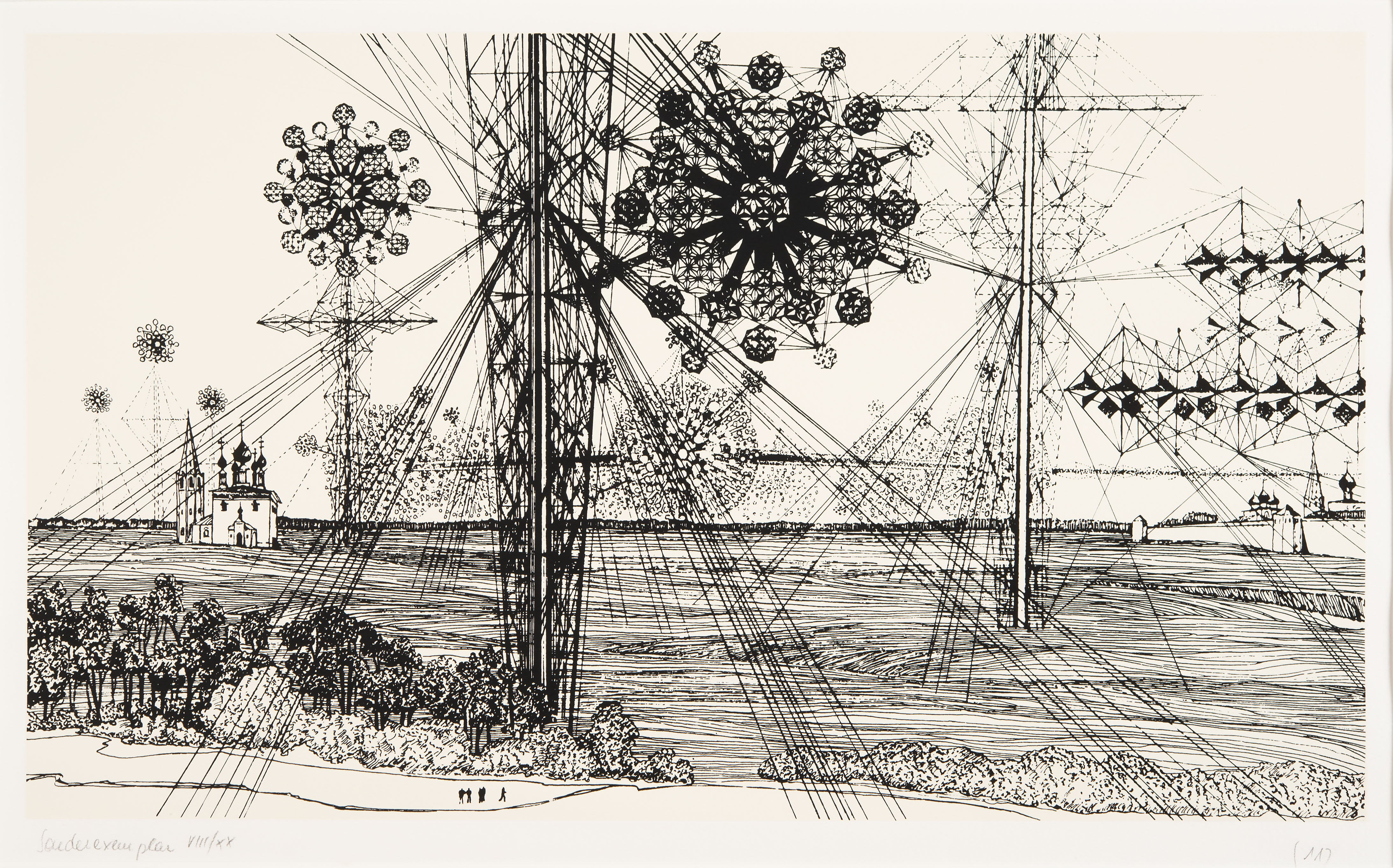
Plan of a City of the Future, 1972 from the portfolio Ten Year Development of Kinetic Art in Russia, Nuremberg: 1972-74. Screenprint on paper, 65 × 65 cm (25 9/16 × 25 9/16 in.). Norton and Nancy Dodge Collection of Nonconformist Art from the Soviet Union. 1995.0886.011