
03/12/2016 - 07/21/2016

1941 — Stepantsevo Village, Klinsky District, Moscow Region (Russia) | 2018 — Kolomna (Russia)
Architect, kinetic artist, and designer Viacheslav Koleichuk was a young genius of the Soviet Thaw of the 1960s (the period of political liberalization under Khrushchev). In his work, he brought together the principal tendencies of his time: admiration for groundbreaking science, the atom, and outer space; the joy of transforming life and the residential environment; the gradual discovery of contemporary world art; and the revival of the legacy of the Soviet avant-garde. Along with his peers, he lived through the enchantment and illusions of this period, followed by a subsequent disillusionment, but unlike many, he was not broken by these experiences but found his own way in science, invention, and fine art.
Koleichuk's Modules have become an indispensable part of any exhibition on the history of Soviet and Russian contemporary art. Straddling the borders of architecture, engineering, and sculpture, they are extraordinarily effective, often presenting the viewer with a genuine riddle: What is it that makes these remarkable constructions stay up, how could they have been planned out and calculated before computers, and who originated them and built them so brilliantly and with such exactitude? For Koleichuk himself, these were not just sculptures. As his daughter, coauthor, and historian of his work Anna Koleichuk said to me in an unpublished interview, "Each of my father’s easel works is the key to another period in his investigations." The shape springs from its own construction: the invention finds a form for itself, not the other way around.
One of the founders of Soviet kinetic art, Koleichuk was a professional architect who graduated from the Moscow Architectural Institute in 1966 with a degree in urban planning. He was also an architectural researcher, an author of books and articles, a designer and inventor, an international exhibition planner, a master of large-scale urban sculptures, a scholar and rescuer of the legacy of the Russian avant-garde, a creator of marvelous musical instruments, and a natural set designer for theater and cinema. It is difficult even to list all of his passing enthusiasms and serious interests: he did not allow either himself or his critics to rest. Over the course of his life, he never ceased to change, to learn something new, and to leave for others what he had found and experienced. Perhaps he did this to the detriment of his own career, but as a result, he did not repeat himself, did not turn, as many artists do, into an imitation of himself, and did not lose interest in the working process.
While still at the Moscow Architectural Institute, Koleichuk began to design “self-erecting” constructions, which were held up by the internal tension of beams and struts. He first presented them at a student conference in 1965. In the end, they turned out to be unsuited for actual architecture and construction work, which had been his dream. His designs were too revolutionary for mass-scale implementation, but in the form of models and concepts, they attracted the attention of not only professionals, but also journalists. Koleichuk’s projects enjoyed great success, along with other architectural fantasies of the Soviet Thaw. Moreover, unlike the latter, they acquired material form, even if only as models suitable for showing at exhibitions.
In 1966–67 he joined the group Dvizhenie (Movement, 1962–76), which had been founded by young artists involved in the new and fashionable kinetic art movement and called themselves the “kinets.” Koleichuk soon parted ways with the group and its leader, Lev Nussberg (b. 1937), but the experience of collaborative work helped him to develop his own special approach to designing, which led him not to planning out the environment around him, but to content-rich spatial urban utopias.
The group Mir, which he founded and which included only three people—himself, his wife, Marina Koleichuk, and the engineer Gennady Rykunov—undertook the creation of a thirteen-meter rotating and sound-generating kinetic composition entitled Atom, which became one of the few realized large-scale works of Soviet kinetic art. The composition was unveiled in front of the Kurchatov Institute of Atomic Energy of the Soviet Academy of Sciences in Moscow. Scientists who were associated with defense, space, and nuclear power received numerous privileges in the USSR, including being allowed to support contemporary art.
The music for the unveiling was written for and performed on the theremin, the instrument invented by the legendary scientist and inventor Lev Termen (1896–1993). In time, this “handshake across decades” would be reflected in Koleichuk’s creation of his own electronic and acoustic musical instruments: the “wirephone,” “wireharp,” “platephone,” “self-stressed bells,” and the “ovaloid metal sound synthesizer.” These instruments were used in his theatrical works and were shown in 1990 at a group exhibition with two other artists–architects–acoustic designers, German Vinogradov (1957–2022) and Boris Stuchebryukov (1950–2016), which was titled Zvukstrukt+Popfon+Bikapo.
With his energy and imagination, Koleichuk often seemed like a messenger from the future, a Soviet Buckminster Fuller. He designed radio antennae that unfolded in space, lattice construction monuments that transformed themselves as they moved above the city, and edifice-sculptures that floated in air. It was impossible to draw a line between genuine foresight, constructive experimentation with new materials, and almost provocative fantasizing, an artistic fireworks display that surprised and even frightened his admirers, especially his research supervisors.
Koleichuk's ideas made themselves noticed: he was the subject of films and television programs; and he published books and promoted science and its applications. He worked at the Central Research Institute for the Theory and History of Architecture (TsNIITIA), then at the All-Union Research Institute of Technical Aesthetics (VNIITE, 1977–94). He taught at his alma mater, the Moscow Architectural Institute. He was awarded the monetary and honorary State Prize of the Russian Federation (1999). His books included Mobile Architecture (1973), New Constructive-Architectural Structures (1978), Kineticism (1994), My ABCs (2012), Geometry of Outer Space (2012), and The Newest Structural Systems in the Formation of the Architectural Environment (2016).
Together with his architect friends, Koleichuk dreamed of breathing life into dull mass-scale construction, but his designs were more often used for unique objects that were supposed to glorify communism on the world stage: designs and installations in the Soviet pavilions at Expo-67 in Montreal, at Expo-75 in Okinawa, Japan, and at Expo-85 in Tsukuba. He walked the line between official and unofficial art, appearing to the authorities as a “useful inventor,” like Termen or Kurchatov, while to artists he remained an example of remarkable freedom of style and thought.
Indeed, what could Soviet censorship understand about the strength of materials? Systems of cable-stayed constructions, held up by their own tension, which could have supported radio towers or served as beacons for airships, were transformed by Koleichuk into sculptures that he called “masts.” One such Mast from 1972 is part of the Zimmerli Art Museum’s collection (D00360); another is in the State Tretyakov Gallery, Moscow.
Intrigued by the idea of "impossible figures,” which can be depicted but are impracticable in reality, Koleichuk produced a whole series of such objects. Using three projections as a starting point, he created a model of the "Penrose triangle," or Möbius strip, which became the basis for an almost anthropomorphic bionic sculpture. One version of such a sculpture is also held in the Zimmerli collection (D12037).
Thanks to Koleichuk’s talent and perceptiveness, the first kinetic sculptures of the avant-garde artists of the 1920s returned to life. Receiving from the collector George Costakis (1913–1990) a box with pieces that had once made up the sculpture Oval in an Oval by Alexander Rodchenko (1891–1956), he solved the puzzle and managed to reconstruct the object, which had not been seen by anyone since the time of the noted Society of Young Artists (OBMOKhU) exhibition in 1921.
Not stopping there, Koleichuk analyzed photographs from that famous exhibition and was able to reconstruct it in 2006 for a show at the Tretyakov Gallery, reproducing many full-scale works—using analogous materials—by artists working in a style similar to his own. Koleichuk brought back to history the name of the artist Karlis Johansons (Karl Ioganson, 1890–1929), whom he considered one of the founders of world kinetic art. Johansons’s works in Koleichuk’s reconstruction were included in the famous exhibition The Great Utopia: Russian and Soviet Avant-Garde, 1915–1932, shown in 1992–93 in Germany, the United States, and Russia, and they were accompanied by an article in the catalogue about Johansons and Soviet kinetic art, written by Koleichuk.
Until his last days, even when he fell seriously ill and moved in with friends at a monastery in the city of Kolomna (near the Kolomna Museum of 20th–21st Century Art, where his exhibitions were held), he did not stop working. The last work he produced during his lifetime was a replica of the famous Atom, made out of new materials for the Garage Museum of Contemporary Art in Moscow and shown at Koleichuk’s exhibit there after his death.
Alexey Tarkhanov
Translated from Russian by Ilya Bernstein
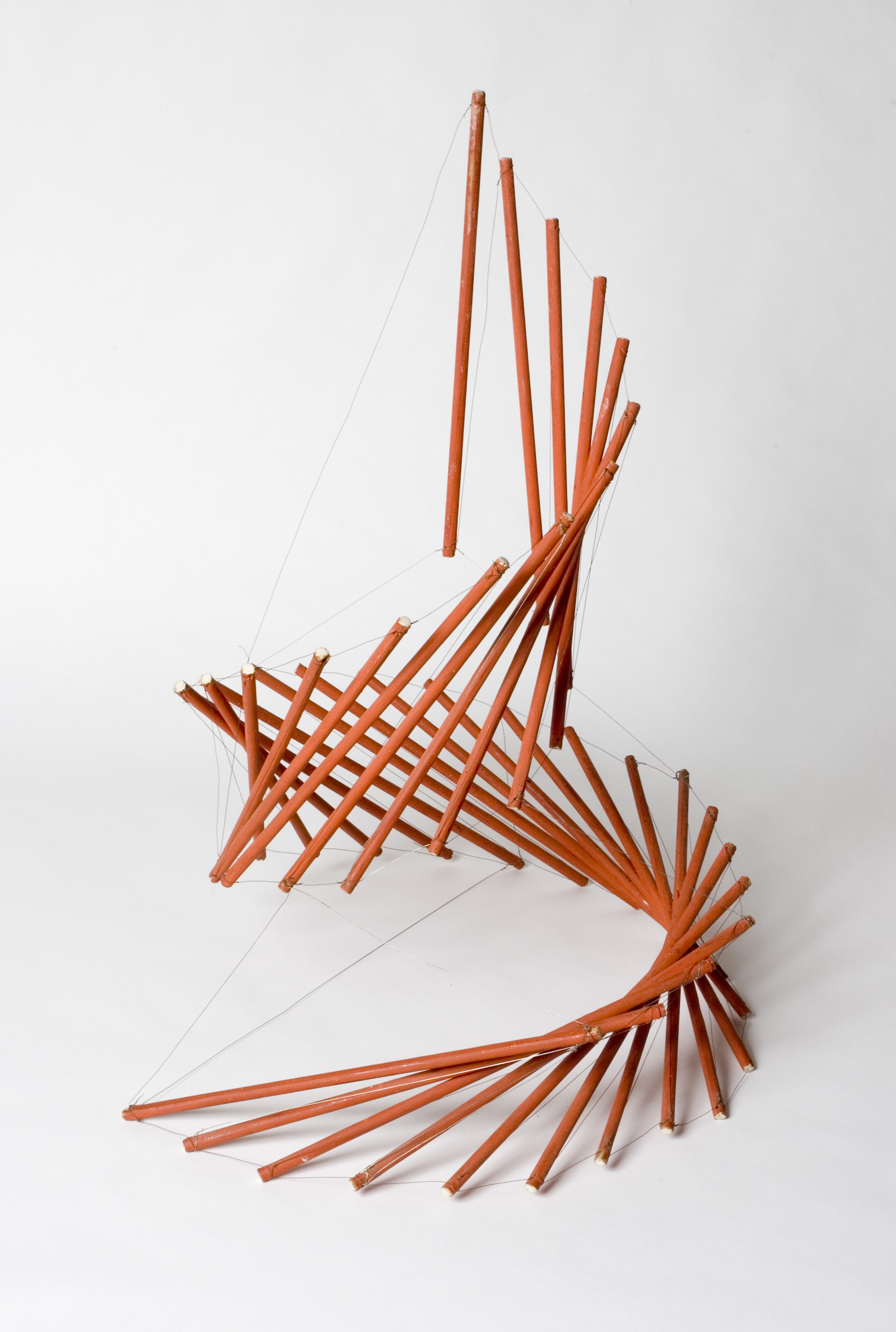
Spiral, 1966. Painted wood dowel and wire, 51.6 × 38 × 37 cm (20 5/16 × 14 15/16 × 14 9/16 in.). Norton and Nancy Dodge Collection of Nonconformist Art from the Soviet Union. D12190
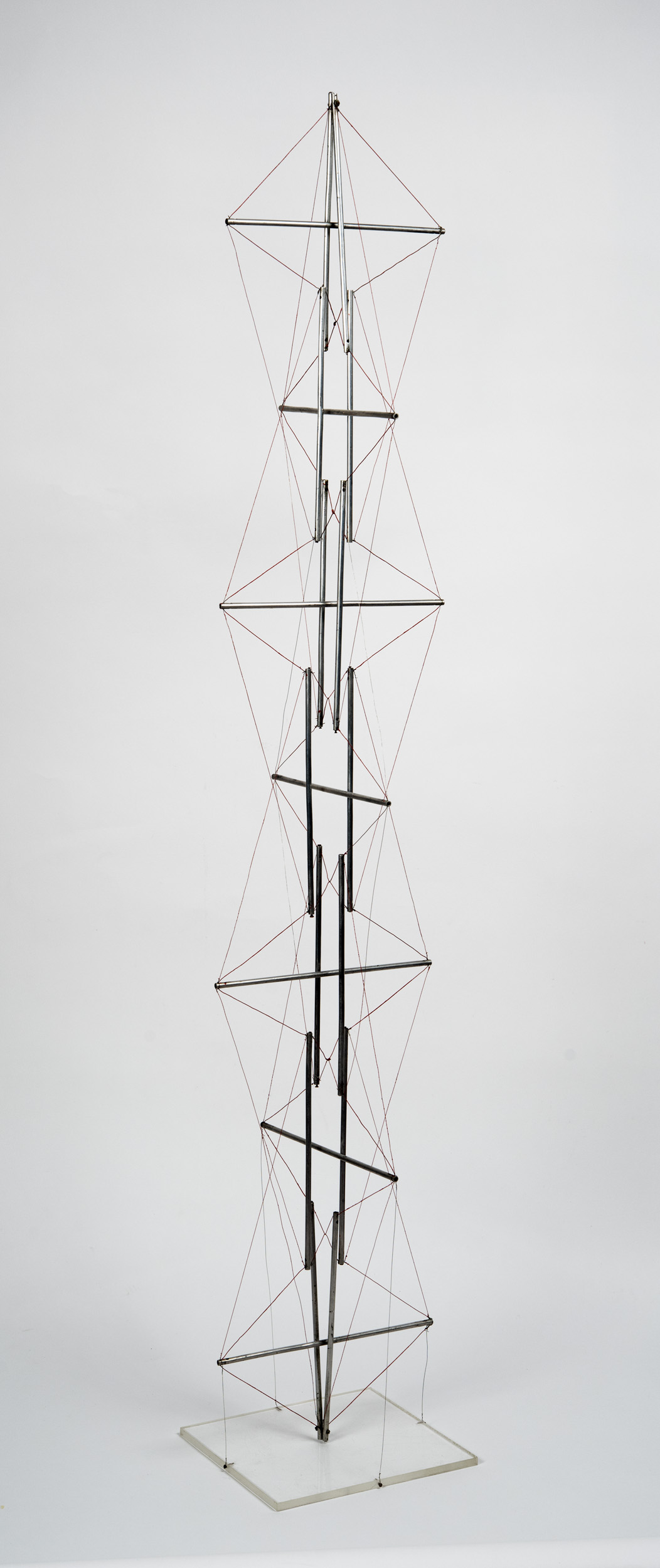
Mast, 1972. Metal and wire on acrylic plastic base, 139 × 22.5 × 23 cm (54 3/4 × 8 7/8 × 9 1/16 in.). Norton and Nancy Dodge Collection of Nonconformist Art from the Soviet Union. D00360

Self-Sustaining Tensile Structure, undated. Metal and wire on plastic base, 25.6 × 60.8 × 25.6 cm (10 1/16 × 23 15/16 × 10 1/16 in.). Norton and Nancy Dodge Collection of Nonconformist Art from the Soviet Union. D10945

Self-Sustaining Tensile Structure, c. 1970. Wood and string, 20.2 × 25 × 25 cm (7 15/16 × 9 13/16 × 9 13/16 in.). On loan from the collection of Norton and Nancy Dodge. L04326

Mobius, 1975/1985. Brass on wood base, 64.5 × 50 × 22 cm (25 3/8 × 19 11/16 × 8 11/16 in.). Norton and Nancy Dodge Collection of Nonconformist Art from the Soviet Union. D12037
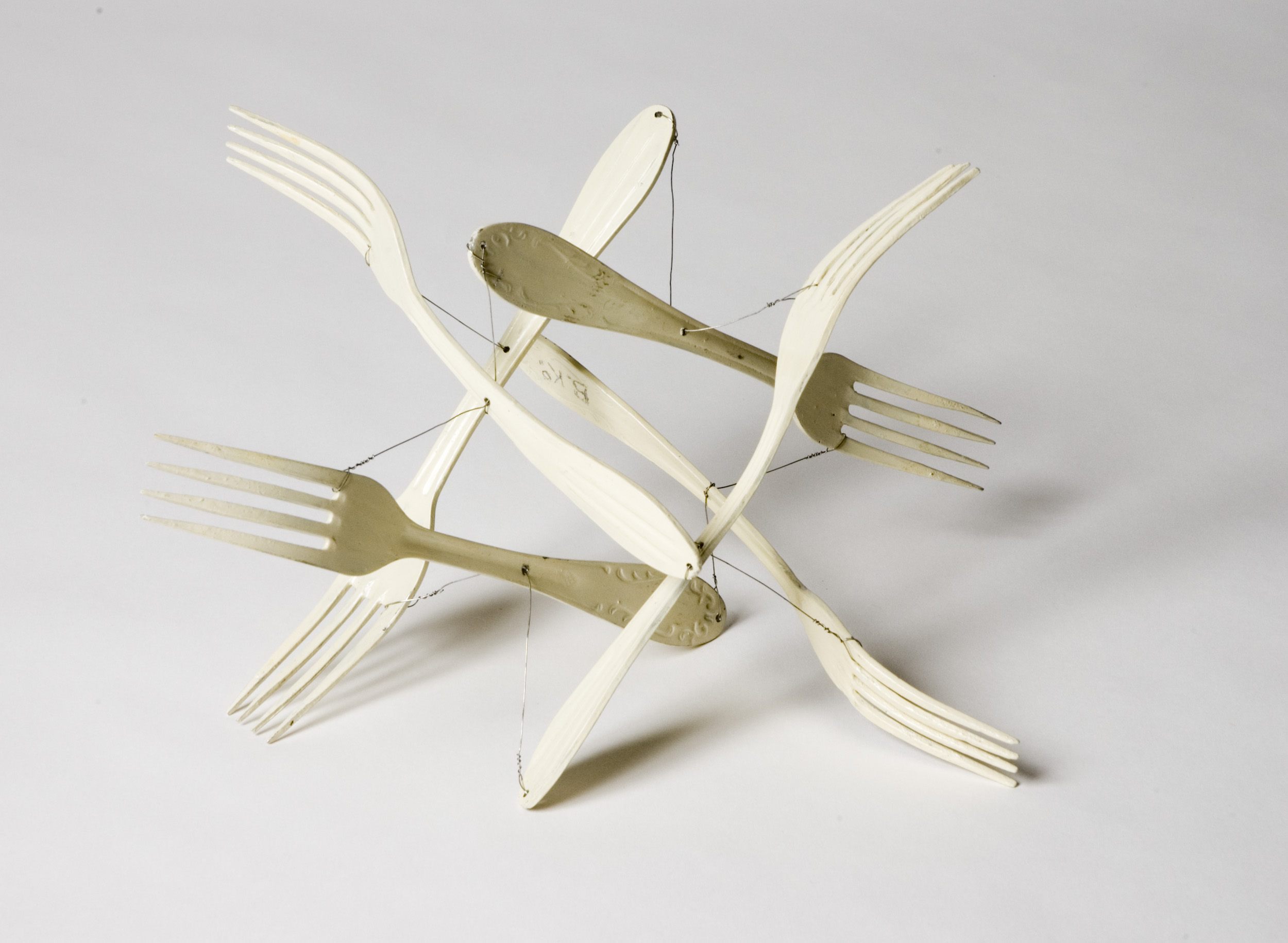
Forks, 1984. Forks and wire, 13 × 13.5 × 20.4 cm (5 1/8 × 5 5/16 × 8 1/16 in.). Norton and Nancy Dodge Collection of Nonconformist Art from the Soviet Union. D12102
Selected Exhibitions
1994 Total'naya illyuziya [Total Illusion], State Tretyakov Gallery, Moscow, Russia
2018 Viacheslav Koleichuk: Atom (1967/2018), Garage Museum of Contemporary Art, Moscow, Russia
2018 Masterskaya Viacheslava Koleichuka [Viachelsav Koleichuk’s Studio], State Center of Contemporary Art, Moscow, Russia
2020–21 Laboratoriya Budushchego: Kineticheskoye iskusstvo v Rossii [Laboratory of the Future: Kinetic Art in Russia], Central Exhibition Hall Manege, Saint Petersburg; State Tretyakov Gallery, Moscow, Russia
2021 Viacheslav Koleichuk: Zhivaya liniya – k 100-letiyu Vtoroy vesenney vystavki OBMOKHU i 80-letiyu khudozhnika [Living line: The 100th Anniversary of the Second Spring Exhibition of the OBMOKHU and the 80th Birthday of the Artist], State Tretyakov Gallery, Moscow, Russia
2024 Tak (ne) byvaet: Viacheslav Koleichuk. Ob'yekty [That Does (Not) Happen: Viacheslav Koleichuk: Objects], Nimfozorium, Tula Historical and Architectural Museum, Tula, Russia
Selected Publications
Kineticheskoye iskusstvo v Rossii. Laboratoriya budushchego: al'bom-katalog vystavki [Kinetic Art in Russia: Laboratory of the Future; Exhibition Catalogue]. Saint Petersburg and Moscow: Central Exhibition Hall Manege, 2020–21.
Koleichuk, Viacheslav. Kinetizm [Kinetic Art]. Moscow: Galart, 1994.
Koleichuk, Viacheslav. Moya azbuka [My ABC’s]. Moscow: Stroganov MGKHPA, 2012.
Koleichuk, Viacheslav. Zhivaya liniya [Living Line]. Moscow: State Tretyakov Gallery, 2023.