
Dvizhenie (Movement)
Active in Moscow in 1962–78.
The artists of the Dvizhenie (Movement) group called themselves the Russian kineticists. They sought to create their own version of kinetic art, which by the late 1950s had become an international movement that also encompassed the experiments of op art. The central idea of the Dvizhenie group was a new conception of art at the intersection of science, technology, and visuality, and their main field of experimentation was the study of new principles for constructing dynamic forms on a plane and in space. The creation of dynamic structures and objects with optical effects and illusions, and subsequently of an artificial kinetic environment, became their leading aspiration.
The Dvizhenie group stood out sharply from the Soviet artistic underground of the 1960s–70s. The works of its members—mobiles and other constructions, realistic and fantastical plans in architecture and industrial design, light installations and synthetic actions (performances, “kinetic presentations,” theatrical productions)—differed radically from the traditional easel-based forms of postwar modernism. In addition, by contrast with most informal “circles,” in which artists came together more on the basis of proximity, friendship, or literal kinship than any shared program, the Dvizhenie group was a genuine artistic association, a collective creative project. Another fundamental difference lay in the fact that their shared message hearkened back not simply to the futurists’, suprematists’, and constructivists’ plastic experiments, but to the actual utopian premise of the Russian avant-garde of the 1910s–20s. For most of the representatives of unofficial art, it was precisely the utopian thrust of the avant-garde project, its totalizing and progressivist logic, that had been compromised by the entire subsequent history of the Soviet state. The willingness of the Russian kineticists to turn once again to the utopian visions of the 1920s and to undertake the transfiguration of the world through art was a unique phenomenon within Soviet nonconformist art. It is partly paradoxical that precisely the methodical utopianism of Dvizhenie’s members—the systematic nature of their “incursion” into the territory of the everyday and their transfiguration of the living environment—brought the kinetic artists out of the underground and into the official realm. In practice, the utopian premise became successfully transformed into actual implementability of a large number of kinetic designs.
The reconstruction of the group’s history is a difficult problem for the researcher, who inevitably falls prey to the long-standing conflicts among its members. Their accounts are contradictory and often mutually exclusive. In numerous texts written between the 1990s and 2010s, the group’s artists present their versions of the association’s history and of the roles played by its various members in its overall program. Even the legitimacy of using the term group becomes questionable. The temporal distance is still too short, and what is feasible at present is only a reconstruction of the chronology of events and a brief characterization of the Russian kineticists’ association against the background of the artistic landscape of the era.
The history of the Dvizhenie group begins in 1962, when friends and like-minded associates united around the young and charismatic Lev Nussberg, a graduate of the Moscow Art School at the Surikov Art Institute (MSKhSh). According to Francisco Infante’s recollections, initially the community of artists had “neither a name nor a program,” and its participants interacted as “equals with equals.” Nussberg is inclined to conceptualize the community, emphasizing both his own role as leader and ideologist and the initial artistic unity of their collective project: “Sometime in November or December 1962, I started calling us ‘The Synthesis and Movement Collective of Young Artists,’ but of course secretly, only for internal use.” Whatever the case, the institutional form and the name—the Dvizhenie group—appeared later, at the end of 1964.
By the spring of 1963, the first version of the “collective of free artists” had come together. Initially, the association included Nussberg’s art school classmates and their friends: Vyacheslav Shcherbakov, Tatyana Kalinkina, Anatoly Krivchikov, Rimma Zanevskaya-Sapgir, Mikhail Dorokhov, Viktor Stepanov, Francisco Infante, Vladimir Galkin, Vladimir Akulinin, Gennady Neishtadt, and Yuri Lopakov. During the first years, this was not so much an association as a community of like-minded thinkers passionate about the same ideas and the same idols: Malevich, UNOVIS, Lissitzky, Klutsis, Tatlin, and Matyushin. Through “collective examinations of new works, abstruse discussions, and many pots of tea,” they developed a “plan for collective creative work.” During its first phase, this work was dedicated to geometric abstraction: according to Infante, it was specifically a shared interest in “drawn geometric nets” and the problem of symmetry (in this respect, Nussberg was influenced by the experiments of Vladimir Yankilevsky and “his heroes: Miró, Klee, and Picasso”) that brought together Nussberg, Infante, and Akulinin at the end of 1962. [1] Within geometric abstraction, vividly defined individual trajectories emerged: Nussberg created symmetric structures, geometric grids in the style of op art, or compositions that played on the dynamic opposition of horizontals, verticals, and diagonals; Zanevskaya-Sapgir achieved illusory optical effects using, for example, the doubling of the image in compositions with stars and a geometric net; and Shcherbakov followed in the footsteps of Naum Gabo, one of the forerunners of kineticism, reproducing his spatial structures in subtly elaborated graphic compositions. Infante developed ornaments “distinguished by the layered coloration of their infinitely repeating patterns,” as the kinetic artist, architect, and theorist Viacheslav Koleichuk described them. One of Infante’s main themes in the 1960s was endless movement in an “endless vertical” or a “dynamic spiral,” the creation of what might be described as a module of infinity.
The works of the community’s members from this period were shown at their first collective exhibition, the Ornamentalists’ Exhibition, which took place in March 1963 at the Creative Youth Club at the Central House of Art Workers (Lev Nussberg, Francisco Infante, Anatoly Krivchikov, Viktor Stepanov, Vyacheslav Shcherbakov, and Serafim Pavlovsky, a monumental artist of the older generation, participated). During the same year, several important encounters took place that influenced the group’s artistic evolution: the Russian kineticists met Czech art critics visiting Moscow (among them the kinetic art enthusiast Dusan Konečný, Jiri Padrta, Miroslav Lamač, and Jindřich Chalupecký) and from them found out "about current trends in contemporary art, in particular, the activities of Western European groups whose work [was] closely linked to the history of kineticism—the German Zero Group, the French GRAV, the Italian MID." [2] An enormous role was also played by Nussberg's acquaintance with Andrey Pevsner (brother of Naum Gabo and Antoine Pevsner), who lived in Moscow and maintained close ties with his brothers. Naum Gabo's projects were among the main sources of inspiration for the kineticists.
Gradually, the group’s members shifted away from easel graphic art and painting and transitioned to working on project designs, which included the creation of three-dimensional structures, objects made out of plexiglass, wood, and plasticine. The artists investigated the dynamic qualities of static forms and the nature of volumes in space. In addition, they endeavored to use mechanical movement in their constructions, learning technical and engineering skills. These new works were shown at the exhibition of architects and artists Toward a Synthesis of the Arts, which opened on December 1, 1964, at the Youth Club of Fine Art on Bolshaya Maryinskaya Street. The exhibit featured three main kineticist projects, which embodied the new conception of dynamic construction combined with light, color, and sound effects. These were Lev Nussberg’s Mars (1963), a moving construction of black threads on a metallic frame illuminated from within with a red light; Viktor Stepanov’s rotating Comma (1963); and Francisco Infante’s Soul of the Crystal (1963), described in detail by Viacheslav Koleichuk: “The composition … was characterized by the clarity of its structural organization and the purity of the materials used in its construction (transparent plexiglas illuminated by slowly changing colored light). Three similar transparent compositions, diminishing in size, made of square planes, were nested inside one another. The rhythmic layering of transparent glass created a barely detectable but noticeable concentration of light at the center of the composition.” [3] The design of the exhibit itself, consisting of complexly configured partitions, presented a stratified form that resembled the graphic designs or kinetic objects of the kinetic artists.
The scientific–experimental spirit of the kineticists’ projects perfectly matched the atmosphere of the 1960s, with their faith in scientific and technological progress, the cult of physics, and excitement about newly opened prospects of space exploration. At the 1964 exhibit, the works of the kinetic artists were presented in the same space as the futuristic urban design plans of the new-generation urban architects who were part of the Moscow Architectural Institute’s research group. This was the famous NER project (Novyy element rasseleniya, “New Element of Settlement”), which was a new conception of settlement, the conceptual project of a group of architects headed by Alexei Gutnov and Ilya Lezhava. The city of the future that they invented clearly inherited the life-constructing pathos, theory, and practice of the constructivist architects of the 1920s. In spirit, NER’s projects were a vivid architectural utopia, which, became the foundation for contemporary conceptions of urban planning. These projects resonated with the kinetic artists’ designs, not only in their utopian avant-garde premise, but also visually: NER’s “linear city” ranging from west to east resembled a geometric abstraction, and NER’s models contained fragments similar to kinetic constructions. In 1965, the Dvizhenie group created a design that was clearly inspired by this experience: the Square of Nine Muses, in which standing or soaring transparent objects, illuminated or radiating light themselves, were positioned on an enormous square.
The project-design-based character of the kineticists’ works forced viewers to perceive those works in two ways: often, they were seen less as independent compositions than as design plans for subsequent implementation. But precisely this “borderline” position gave the kineticists a freedom unthinkable for other nonconformist artists: what was possible in the applied realm was forbidden in the sphere of pure art. Furthermore, they were able to win a space for themselves within official culture, obtaining the opportunity to work on plans for the design and transformation of real spaces, which were similar in nature to their architectural projects and industrial designs (the Dvizhenie group, for example, was commissioned to design festive decorations for Leningrad’s squares and embankments for the celebration of the fiftieth anniversary of the October Revolution). Many works by the group’s artists to this day astonish the imagination by how innovative their ideas and constructive solutions were, whether individual projects, such as the kinetic object Space–Movement–Infinity (1963) by Francisco Infante and the famous Atom (1967) by Viacheslav Koleichuk, or collective works, such as the Kinetic Space “Galaxy” (1967) at the VDNKh Exhibition (Exhibition of Achievements of National Economy) or the impressively scaled Kinetic Composition with mirrors at the Elektro-72 International Exhibition in Moscow’s Sokolniki district. Infante’s object, for example, consisted of several cubes, nested inside one another and rotating independently on different planes. The construction was illuminated by mini-bulbs positioned at the vertices of the frames of the cubes. According to Koleichuk’s description, “the composition in motion created the impression of an extraterrestrial object overcoming the gravity of the earth and freely moving in space.” The same dizzying impression of overcoming gravity was produced by Atom, a gigantic transparent sphere made of hollow tubes, illuminated with color filters, that seemed to “hang” in the air.
In 1965, a pivotal exhibition in the history of the movement took place: the Exhibition and Presentation of Kinetic Art at the House of Architects in Leningrad. The exhibition space itself was transformed into a kinetic object—a unified visual environment with various lighting effects. The exhibit contained mainly complex three-dimensional moving constructions, such as Lev Nussberg’s grand Flower with dynamic light elements.
Also in 1965, Dvizhenie’s founder, Nussberg, increasingly aspiring to the role of the group’s leader and ideologist, wrote a programmatic text, Twenty-Five Notes from the Future, which formulated the author’s views on the art of the future and its role in the artistic transformation of the world. In 1966, this text, with slight changes, became the foundation of the Manifesto of the Russian Kineticists, which announced the coming “era of kineticism.” In flavor, Nussberg’s text recalls the avant-garde manifestos of the 1910s–20s, in particular, futurist manifestos and the texts of Malevich. It consists largely of ostentatious slogans and metaphors: “Today—musicians, physicists, actors … architects, psychologists, engineers, sociologists … and poets—TOMORROW, KINETICISTS”; “PEOPLE, LET’S CREATE A WORLDWIDE INSTITUTE OF KINETICISM!” The manifesto was signed by the group’s new members, but many of those who had been part of the community from the beginning refused to add their signatures. The beginning of a split became apparent.
In 1966, another high-profile exhibition of kinetic artists took place at the Culture House of the Kurchatov Institute of Atomic Energy. Its leading motif was the double helix: this was the title of a construction by Viacheslav Koleichuk and Vladislav Galkin and a collage by Viktor Stepanov. Here, too, Koleichuk for the first time presented his cable-stayed constructions Mast and Ball, created using the method of Buckminster Fuller, the renowned American architect, designer, engineer, mathematician, philosopher, and writer. The exhibition included the first kineticist performances: Infante’s Infinity of Transformations and Nussberg’s Metamorphoses. The performances’ synthetic effects, the idea of a mechanical man, and overall imagery derived directly from futurist theater. In 1971, the Czech art critic Jindřich Chalupecký recalled how the performance was constructed: “with the use of three-dimensional, light-reflecting constructions, sources of light, smells, facial expressions, poetry, and musique concrète, a dialogue took place between man and machine, in which man became mechanical so that the machine might be humanized. … Within the environment of theatricalized kinetic elements, [the artists] included two or three dozen actors and dancers who involved the audience in the action by asking them questions. This, of course, [was] a return to the futurist ‘here and now,’ to direct and energetic action.” [4]
From 1966 on, synthetic theatrical performances became yet another direction of the kineticists’ activity. They included kineticist objects, light-color stage direction, mimes, experimental music, and poetic texts. “Large kineticist Happenings” took place in Crimea, the Caucasus, outside Moscow, Suzdal, and Peterhof, and they involved meticulous preparation. “Small kineticist actions,” or kineticist games, were played out spontaneously during walks in the woods or by the sea. According to the recollections of one of Dvizhenie’s members Natalia Prokuratova, “all participants dressed up in particolored mime costumes.” “Mirror objects, costumes, scarfs” became “elements in the game.” Space was transformed using “kinetic means: sound, color, rays, motion.” Projects and scenarios for a “kineticist play environment” were worked out in a “laboratory.” But preference was always given to improvisation. It was the moment of spontaneity that was important, “the birth of the form that exists only in movement, in the instant.” [5] These play actions marked a new trajectory within the group’s work and were a departure from the legacy of constructivism and the rationality that had governed the kineticists’ experiments of the early 1960s. Motifs of the irrational and the surreal appeared in the aesthetics of kineticist performances and exhibition projects, and their use of op art illusory effects now resembled not so much scientific experiments as popular spectacles, optical entertainments. It was in part along this trajectory that the split that had emerged with the appearance of the kineticists’ manifesto now grew deeper.
The heyday of the Dvizhenie’s activities took place during the years 1963 and 1967. By the end of the 1960s, the group included over thirty people. Gradually, new members completely replaced old ones. Some members left to pursue their own creative work; others left the artistic sphere altogether. Between 1967 and 1973, the Dvizhenie group worked mainly on large commissions. The era of pure project design was now in the past. The kinetic artists decorated official exhibitions, international industrial forums, and young pioneers’ camps, and invented stage decorations for festivals and film shoots. In 1976, the Dvizhenie group broke up. Its history may be considered a vivid and unique attempt to transform the life-constructing vision of the avant-garde of the 1920s into the technological utopia of the 1960s. It is evident, however, that such an attempt could be sustained only as an essentially romantic collective project doomed to a brief existence. The individual trajectories of the artists who left the collective lay more in the realm of artistic escapism, far from the mainstream of technological and social utopias.
Ekaterina Vyazova
Translated from Russian by Ilya Bernstein
Notes:
1. Infante, Francisco. “Vinuzhdennaya assenizazia” [Compulsory fecalsludge management]. In Negativnie suzheti, collection of materials, comp. by Francisco Infante, 2nd ed. (Moscow, 2006): 5.
2. Obukhova, Sasha. “Kollektiv ‘Dvizhenie’: Echo avangarda. Protivorechivaya istoriya kineticheskogo iskusstva v SSSR” [The “Movement” collective: Echo of the avant-garde. The contradictory history of kinetic art in the USSR].
3. Koleichuk, Viacheslav. “Gruppa ‘Dvizhenie’” [The Movement group]. In Molodezhnij kalendar’ (Moscow: Politizdat, 1990): 96.
4. Obukhova, “Kollektiv ‘Dvizhenie’: Echo avangarda. Protivorechivaya istoriya kineticheskogo iskusstva v SSSR.”
5. Prokuratova, Natalia. “Teatralno-kineticheskaya plastika gruppi ‘Dvizhenie’” [The theatrical–kinetic spatial art of the Movement group] (Moscow, 2003): 1.
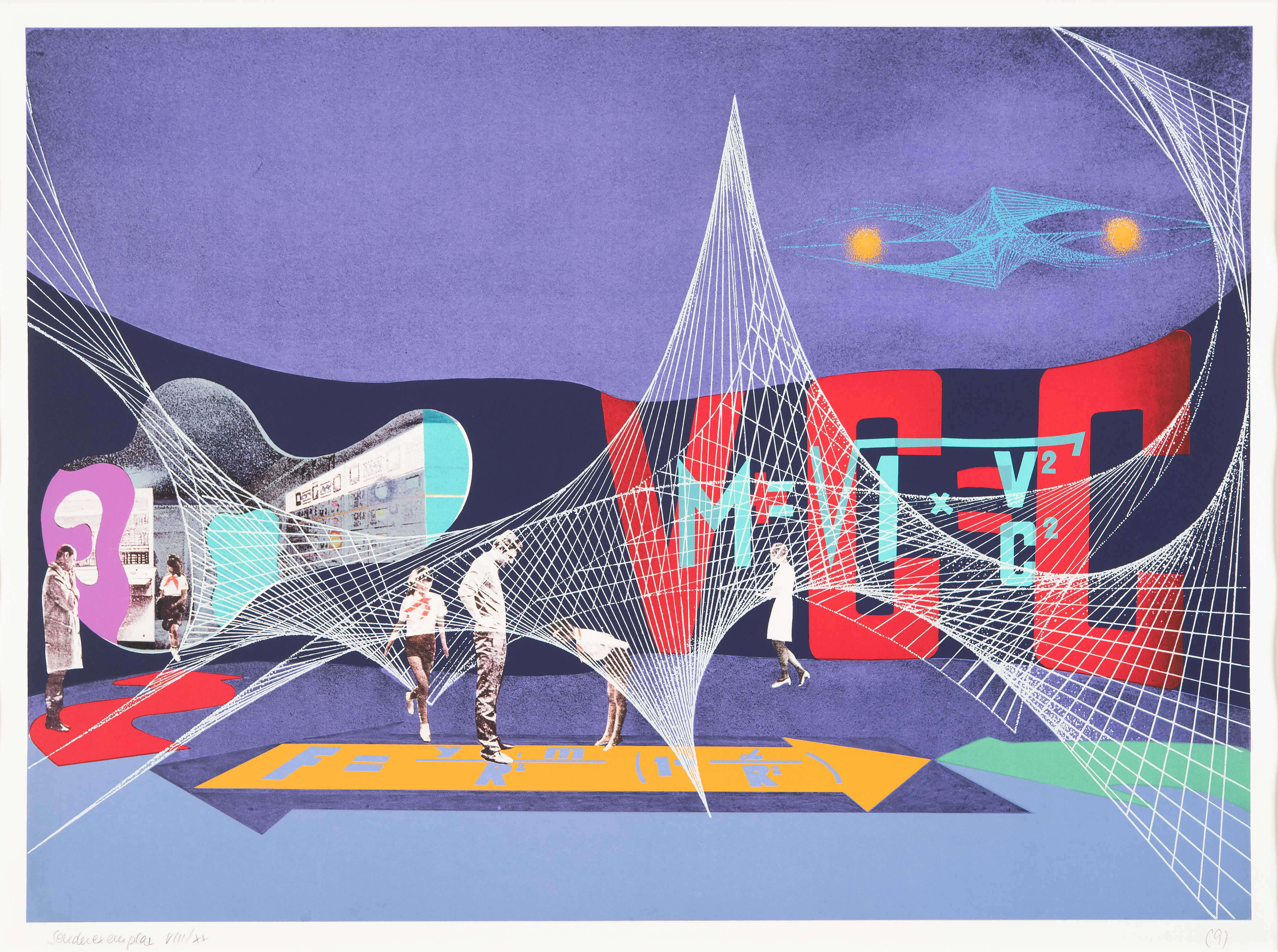
Design for a Kinetic City: Labyrinth for Children in Tuapse, Caucasus, 1968, from the portfolio Ten Year Development of Kinetic Art in Russia, Nuremberg: 1972-74. Screenprint on paper, 38.9 × 54.1 cm (15 5/16 × 21 5/16 in.) / 64.7 × 65 cm (25 1/2 × 25 9/16 in.). Norton and Nancy Dodge Collection of Nonconformist Art from the Soviet Union. 1995.0886.009
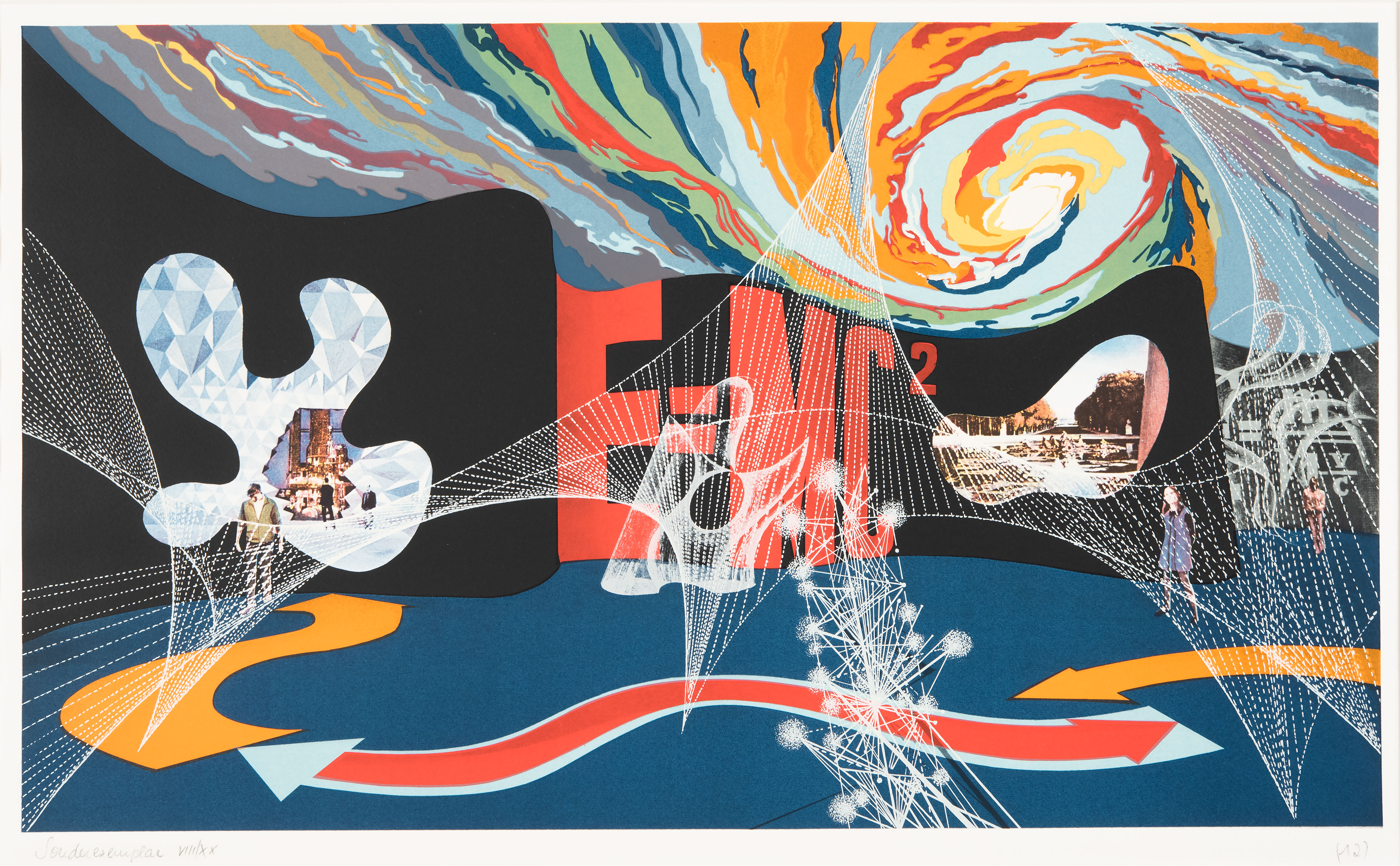
Design for an installation Ten Years of the Development of Kinetic Art in Russia, 1972, from the portfolio Ten Year Development of Kinetic Art in Russia, Nuremberg: 1972-74. Screenprint on paper, 33 × 55.6 cm (13 × 21 7/8 in.) / 65 × 65 cm (25 9/16 × 25 9/16 in.). Norton and Nancy Dodge Collection of Nonconformist Art from the Soviet Union. 1995.0886.012
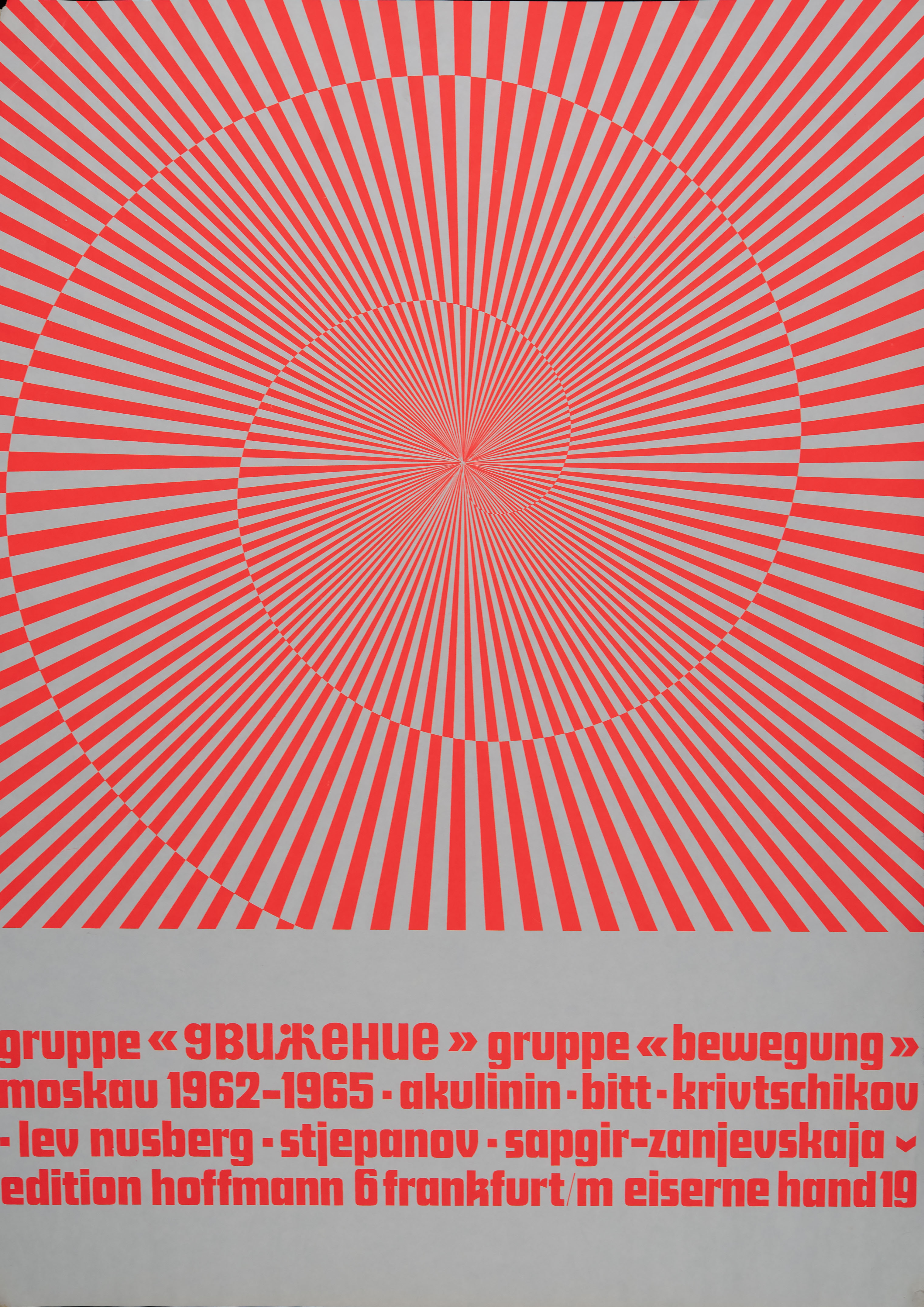
Poster for Movement Group (orange), Edition Hoffman, undated. Screenprint on paper, 84 × 59.2 cm (33 1/16 × 23 5/16 in.). Gift of James Fraser. 2003.0735
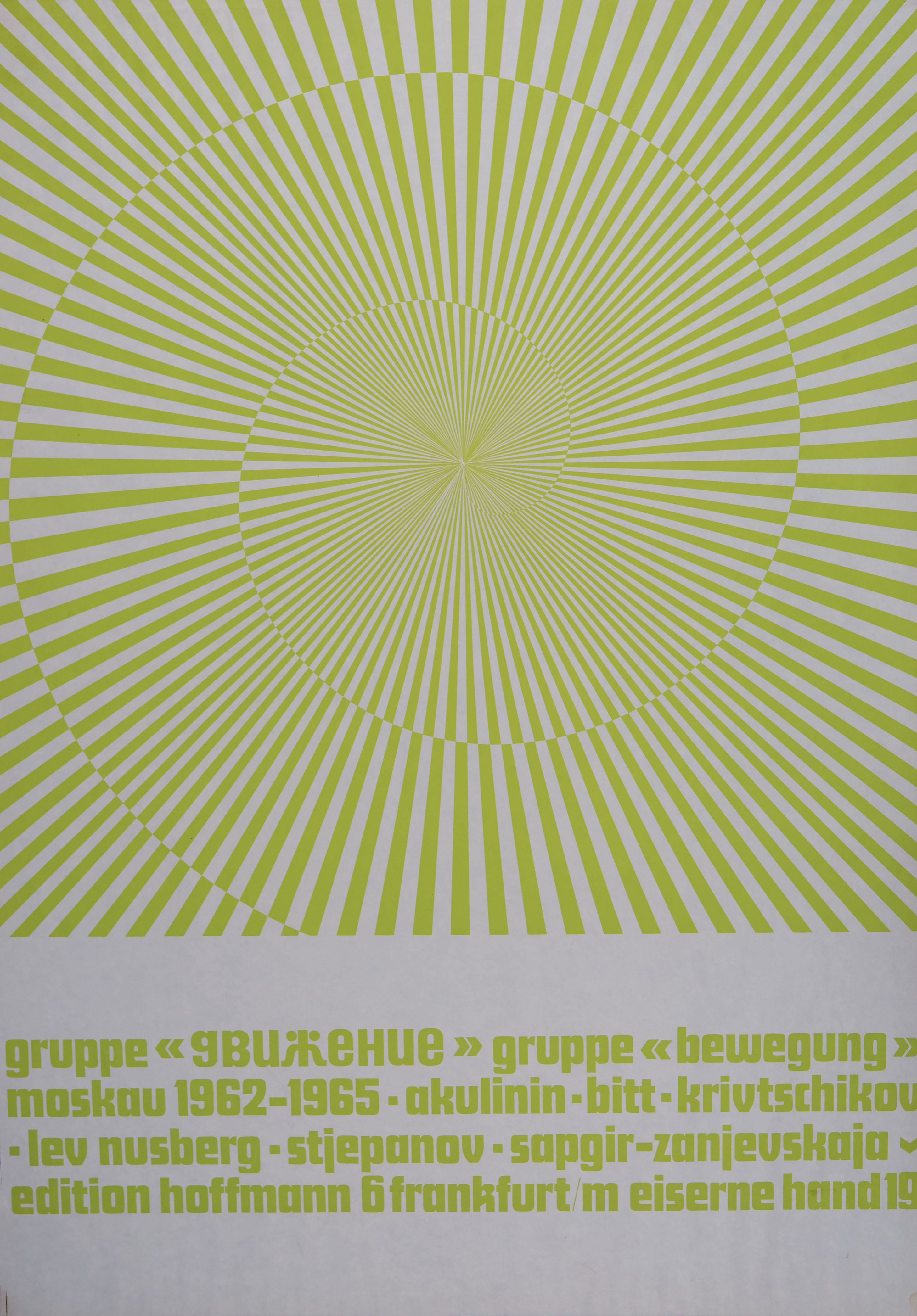
Poster for Movement Group (green), Edition Hoffman, undated. Screenprint on paper, 84 × 59.2 cm (33 1/16 × 23 5/16 in.). Gift of James Fraser. 2003.0736