
03/12/2016 - 07/21/2016

1937 — Tashkent (Uzbekistan). Worked in Moscow, Leningrad (USSR), Austria, France, Germany, USA. Lives in Orange, CT (USA)
Lev Nussberg was one of the most important Russian kineticists. In 1962, he founded the Collective of Free Artists, which united them, and largely under his influence, this community was transformed in 1964 into Dvizhenie (Movement) group, a collective kinetic art project.
To write about Nussberg is difficult: he did everything he could to obscure and mythologize his own biography. Long-standing feuds between former members of the group, which broke up in 1976, not only further complicate questions of authorship and dating, but also call into question the very genre of biographical narrative. Anyone who takes on this work runs the risk of becoming dependent on the dithyrambic or demonizing characterizations of the kineticists’ leader left by his former associates. Be that as it may, the very fact that such an aura surrounds the figure of Nussberg constitutes a vivid characterization both of a specific artistic psychotype and of the influence that he plainly exerted on those around him.
Nussberg was born in 1937 in Tashkent. His father, Woldemar, an architect, came from a family of German gardeners, the Von Nussbergs. In 1938, the elder Nussberg was arrested; in the late 1940s, Lev and his mother moved to Leningrad. There, a meeting took place that determined Nussberg's fate: he met Vasily Perov, the grandson of the famous Peredvizhniki group artist Roman Alekseyevich Perov and an employee of the Russian Museum. "Grandfather Roman" noticed the future artist’s talent and passion for drawing and helped him enter the Moscow Art School (MSKhSh), where Nussberg studied from 1951 to 1958. After going through serious academic training, however, Nussberg did an unexpected somersault, completely breaking with the academic canon. The turning point for him, as for many artists of his generation, was the famous Picasso exhibition in Moscow in 1956. “The sensitive gift of the nineteen-year-old Nussberg stumbled on an unaccustomed brokenness in Picasso. Obeying passionate urges for forbidden novelty … Nussberg began … ‘picassoing’ with all his might.” [1] Through Picasso, Nussberg first discovered abstraction and a taste for formal experiments. In 1958, he was suspended from his studies at the Moscow Art School. Gradually, he became close to artists, composers, writers, and poets of the artistic underground, such as the Lianozovo group and Mikhail Grobman. His thirst for information, on the one hand, about the Russian avant-garde of the 1910s–20s, and on the other, about contemporary art and philosophy, was enormous. According to contemporaries, Nussberg managed to assemble one of the best libraries in Moscow at that time. [2]
Eventually, Nussberg abandoned figurative representation completely and immersed himself in working with geometric abstraction. It became for him the experimental field in which he developed a new vision of the dynamic form. Later, Nussberg recalled that he “baked abstractions at night, like pies. I would take two or three geometric elements and construct my variations out of them.” [3] Like other nonconformist artists, he rediscovered the Russian avant-garde, but he invested himself above all in experimenting with three-dimensionality, following Tatlin and Rodchenko; in searching for new form and color paradigms, following Malevich and UNOVIS; or in transforming the physiology of vision itself, following Matyushin. His main inspiration came from the objects of Naum Gabo, such as the famous Standing Wave of 1920, in which the motion of a steel rod creates the illusion of a spinning three-dimensional form, as well as Gabo’s later linear constructions. In 1963, another life-changing encounter took place: Nussberg met Andrey Borisovich Pevsner, the brother of Naum Gabo and Antoine Pevsner, who was living in Moscow. From him, Nussberg received not only firsthand information about the work of the legendary brothers, but also new Western publications on contemporary art.
Evidently, Nussberg was well aware of the latest artistic trends, including kineticism, in which he had an interest. By the mid-1950s, kineticism had taken shape as an international movement. Nussberg undoubtedly knew about the Le Mouvement exhibit at the Galerie Denise René in Paris in 1955, which presented the results of various kineticist experiments and brought together kineticism and op art in the same space. The exhibition included works of artists, among others, whose influence became palpable in Nussberg’s own graphic works and objects of the 1960s. He could have been intrigued by the distinctive spatial graphics of Alexander Calder’s mobiles, by the flexible mirror strips and playful transformations of reality in the works of Julio Le Parc, and by the idea of interactivity in Jesús Rafael Soto, whose suspended constructions began to move when the viewer approached. Jean Tinguely’s playful mechanisms, and also Nicolas Schöffer’s cybernetic sculptures, directly influenced Nussberg’s Cybertheater. As the artist recalls, in 1961 he began to create his “first three-dimensional geometric and structurally symmetrical objects out of various materials, especially mirrors and light.” [4]
Around the same time, a circle of young kinetic art enthusiasts formed around Nussberg. They consisted of former classmates from the Moscow Art School and their friends. His penchant for leadership, charisma, irrepressible energy, sociability, and rare knowledge of new concepts in art made Nussberg the center of a new community of artists, who later called themselves the Russian kineticists. The nascent kinetic artists were united by an interest in geometric abstraction with the inclusion of effects drawn from op art. Nussberg’s composition Point of Departure (1961?) was built on the dynamic interaction of verticals and horizontals, in which verticality emerged out of black horizontal lines changing in width and rhythm, while a red vertical stripe, by contrast, was broken by a white horizontal line. A similar maneuver may be seen in the composition Piercing Like an Idea (1963). There, the white stripe that cuts the painting in two turns into an independent form, a spatial interval. Some of Nussberg’s compositions from this period combine the new techniques of kinetic art with allusions to the Russian avant-garde. Thus, Luminous Track of an Extraterrestrial in an Abstract Landscape (1961, ZAM, D03482) makes one recall Rozanova, Matyushin, and op art experiments in equal measure, while Composition (early 1960s), with its enormous blue-purple eye built out of the interplay of diagonals and verticals against a background of red-orange horizontals, constitutes a kind of homage to Malevich in the language of op art. At the same time, Nussberg became interested in various types of symmetry. He painted works, such as Cross (1962), in which a complex multilevel symmetrical composition is created by the layering of progressively diminishing modular black-and-white nets, or colored rhombuses that resemble kaleidoscopes with complex mosaics inside (Spring, 1962, ZAM, 1995.0886.001).
Gradually, Nussberg, like his associates in the Dvizhenie group, completely switched over to doing project design work, which consisted of creating three-dimensional constructions, objects made out of plexiglass, wood, and plasticine. In addition to experimenting with dynamic forms, he became interested in the idea of a synthesis of the arts, inspired by the general atmosphere of scientific enthusiasm, interest in cybernetics, and faith in technological progress of the 1960s. Like the futurists and the constructivists, Nussberg strove to unite artists and engineers to use not only artistic, but also technological skills, setting objects in motion, using light, color, and sound effects. His own words best characterize this aspect of his explorations, as well as the distinctive utopian thrust of his kinetic experiments: “I’d like to work with electromagnetic fields, with pulsating coagulations of plasma in space, with the motions of gases and liquids, with mirror reflections and all conceivable optical effects, with changes in temperature and with various smells and, of course, with music.” [5] One of Nussberg’s compositions of 1962–63 was in fact titled Spiral Plasma Flow, and the kineticists’ futuristic projects included plans for a construction supported by a magnetic field.
In a paradoxical manner, Nussberg managed to work in two directions at once: on the one hand, together with the artists of the Dvizhenie group, to promote the kineticist project, entirely in keeping with the experiments of contemporary art; and on the other hand, to make these explorations suitable for application in the eyes of Soviet officialdom. Thanks to this successful transformation of the technological utopia demanded by the times into contemporary design, the kineticists managed to come out of the artistic underground into the space of official culture. The artists of the group received the opportunity to show their works at exhibits and to participate in architectural and design projects to a large extent thanks to the organizational and diplomatic talents of Nussberg, who possessed both the gift of persuasion and the ability to compromise.
Several exhibitions of the kinetic artists’ work were held in the 1960s and were interesting not only for the pieces shown, but also for their innovative exhibition design. At the 1964 exhibition Toward a Synthesis of the Arts, Nussberg presented a large-scale moving construction, Mars (1963), made of black threads on a metal frame 115 centimeters in diameter, with red lighting and sound design. The Exhibition and Presentation of Kinetic Art in 1965 featured his kinetic Flower, in which tubes with light bulbs attached to their ends were presented in a fanlike arrangement: the complex motion of the fan accompanied by the interplay of flashes of light produced unpredictable spatial variations.
By his own admission, Nussberg gradually began to feel cramped “within the bounds of the structure.” He was increasingly inclined to think in terms of large-scale projects, dreaming of a “total environment of art,” a new kinetic reality. Fantastic designs with kinetic forms had already appeared in his graphic works of the early 1960s (Project for an Artificial Environment within an Architectural Interior, 1962; Project for Rotating Spirals and Cones, 1962, ZAM, D09766). From the mid-1960s, this “cyberromanticism,” as the artist himself would later call it, developed on two planes: an applied plane (design of urban spaces, exhibitions, international industrial forums, young pioneer camps, sets for festivals and film shoots) and a utopian plane (various versions of Sketches of Kinetic Space, 1967). The applied sphere became, in part, a laboratory in which grand conceits could be tried out. In this sense, the gap between the dizzying design projects, say, of the Orlyonok Young Pioneer camp and their modest practical implementation is telling. The evolution of Nussberg’s exhibition design also demonstrates the methodical development of a central idea, that of the labyrinth, which was gradually transformed into an artificial fantasy "kinetic labyrinth environment.”
The scale of Nussberg’s intentions is characterized, too, by the Kineticist Manifesto, written by him in 1966, which proclaims the advent of a new era of kineticism. In 1966–67, Nussberg, in coauthorship with the Dvizhenie group, developed plans for a “Cybertheater.” The essence of the “Cybertheater” was interaction between man and machine. The idea was to arrange fifteen to eighteen “cyber-beings”—controllable cybernetic devices—inside a complicated composite construction (from 3.5 to 4 km2). Visitors were to move along marked paths and enter into interactions with the cyber-beings and to participate “in their programmed actions and to experience various feelings: fear, pain, joy, and satisfaction derived from the experience.” The theme of the theater, the game, transformed into kineticist Happenings, became yet another strand within Nussberg’s kineticist project. His first kineticist performance, Metamorphoses, took place in 1966, and from then until the breakup of the Dvizhenie group, Nussberg was one of the organizers of synthetic theatrical actions and “kineticist games” that combined kineticist objects, light-color stage direction, pantomime, experimental music, and poetic texts.
Nussberg’s most ambitious project—the Artificial Bionic-Kinetic Environment (IKBS)—was never realized. He worked on it between 1966 and 1968 and added to it during subsequent years; an impressive body of plans, technical drawings, and textual descriptions has survived. The project included a megalopolis of the future (2030–50) designed for thirty to forty million inhabitants, as well as an enormous subterranean city forming a kind of antipode of the aboveground city, in Nussberg’s conception. An important part of the project was the “artificial bionic–kinetic environment” itself, which was formed by a circle 55–60 kilometers in diameter where technogenic zones, various types of natural landscapes, and interactive historical exhibits were inscribed in a “kinetic labyrinth.” This gigantic kinetic amusement park attraction, which according to Nussberg’s conception synthetized diverse traditions of collective “actions,” from ancient mystery cult rituals and European carnivals to Disneyland, was to be operated by a superpowerful computer. Fundamental for Nussberg was the idea of interactivity: as in the Cybertheater, visitors could choose among different routes and not simply inspect the monuments of the past, but find themselves inside various historical eras—antiquity, the Middle Ages, or even “an old Russian fairy tale.” From being mere observers, visitors became actors, thanks to the synthetic impact produced by film footage, kineticist constructions, optical effects, “cyber-beings,” texts, pantomime, music, and smells. In essence, this was a prototype of the idea of augmented reality.
Nussberg’s plastic language in these designs underwent a noticeable change, losing its connection to the rationality of constructivism. The curvilinear rhythms and contours of his kinetic forms, labyrinth, and “environments” now more resembled the designs of the architectural expressionism of the 1920s, for example, those of the famous German Glass Chain group. Some of Nussberg’s kinetic objects bring to mind the graphic works of Carl Krayl, with their crystalline forms, spheres, and polyhedra suspended from effectively kinetic cable-stayed constructions. And the fluid forms of Nussberg’s “kinetic environment” recall the organomorphic architectural images of Hermann Finsterlin, conceived under the influence of the philosophy of cosmism.
The technological repertoire of Nussberg’s kinetic utopia was inscribed within the context of his time. Thus, some architectural ideas in the Artificial Bionic-Kinetic Environment are clearly related to contemporary conceptions of kinetic architecture, for example, to the “mobile architecture” projects of the Hungarian-born French architect Yona Friedman, or to the interactive cybernetic city-spectacle of Nicolas Schöffer. Schöffer was one of the artists admired by the Russian kineticists. In 1956, he created the first cybernetic sculpture in history, which the members of the Dvizhenie group certainly knew about, and then a series of monumental Cybernetic Tower sculptures, which combine elements of movement, light, and sound. From 1969 on, he worked on plans for a cybernetic city, inventing skyscrapers in colored, rotating, light-diffusing shells, illuminated from inside and outside by powerful projectors. The life of the city, just as in Nussberg’s megalopolis, was supposed to be controlled by a powerful computer, which would regulate all mechanical processes, from lighting and ventilation to the work of transport and communal systems. And just as in Nussberg’s conception, the cybernetic city was to offer entertainment spectacles of a new type.
In 1976, Nussberg emigrated from the USSR. He lived in Austria, France, and West Germany. He participated in European exhibitions, including the Dissent Biennale in Venice in 1977. In 1980, he moved to the United States and now lives in Orange, Connecticut.
Ekaterina Vyazova
Translated from Russian by Ilya Bernstein
Notes:
1. Vorob'ev, Valentin. “Kineticheskie igry futurologa Nussberga” [Kinetic games of the futurologist Nussberg]. In Stetoskop (1999) no. 24.
2. Obukhova, Sasha. “Kollektiv ‘Dvizhenie’: Echo avangarda. Protivorechivaya istoriya kineticheskogo iskusstva v SSSR” [The “Movement” Collective: An echo of the avant-garde. The contradictory history of kinetic art in the USSR].
3. Vorob'ev, “Kineticheskie igry futurologa Nussberga.”
4. Lev Nussberg, open letter to Viacheslav Koleichuk, August 20, 1991, in Negativnie suzheti, collection of materials, comp. by Francisco Infante, 2nd ed. (Moscow, 2006): 5.
5. “Soviet Kinetic Art: The History of the Movement Group. The History of the Development of Kinetic Art in the USSR in the 1960s and 1970s,” as recorded from the words of the leader and founder of the Movement group, Lev Nussberg.

Documentary photograph of a work on paper: Project for Rotating Spirals and Cones, 1962. Positive print on paper, 21 × 28.5 cm (8 1/4 × 11 1/4 in.) / 22.8 × 29.5 cm (9 × 11 5/8 in.). Norton and Nancy Dodge Collection of Nonconformist Art from the Soviet Union. D09766
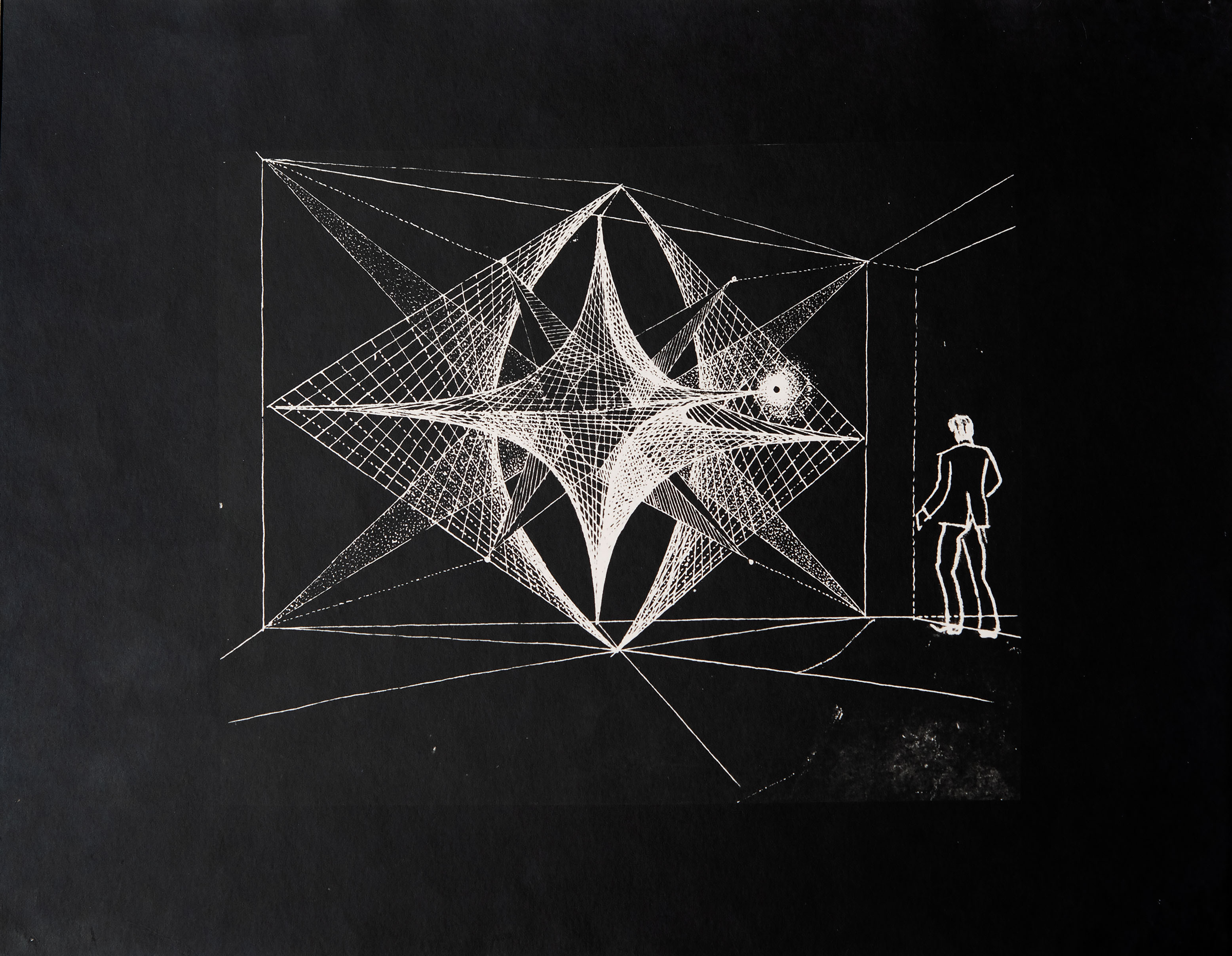
Documentary photograph of a work on paper: Project for an Artificial Environment within an Architectural Interior, 1962. Positive print on paper, 15.5 × 18.8 cm (6 1/8 × 7 3/8 in.) / 24.1 × 30 cm (9 1/2 × 11 13/16 in.). Norton and Nancy Dodge Collection of Nonconformist Art from the Soviet Union. D09765
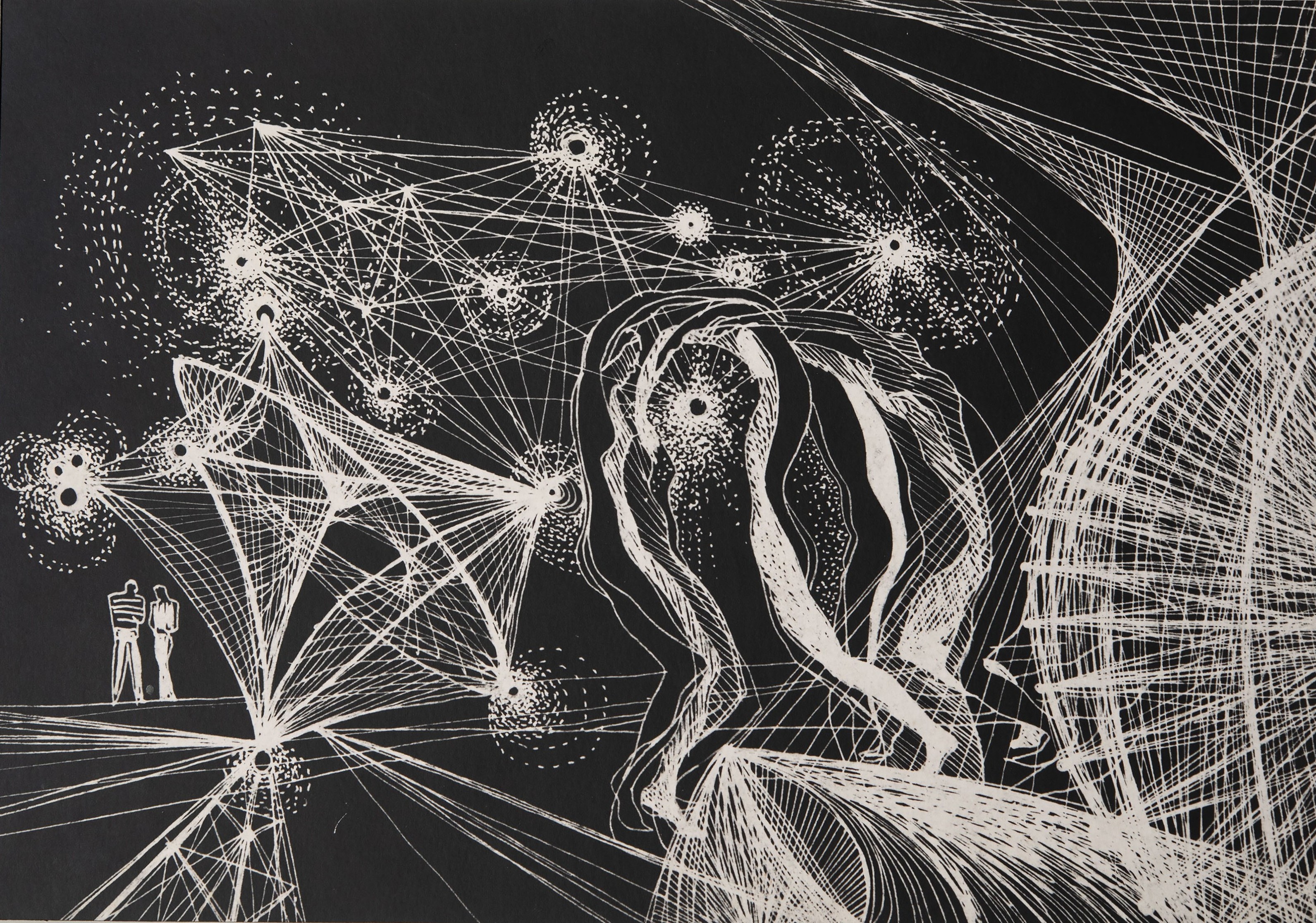
Lev Nussberg and Galina Bitt, Documentary photograph of a work on paper: Playing Zone inside of an I.B.K.S. (interactive Bionic-Kinetic Environment), 1969. Positive print on paper, 20.7 × 29.4 cm (8 1/8 × 11 9/16 in.). Norton and Nancy Dodge Collection of Nonconformist Art from the Soviet Union. D09764

Lev Nussberg and Galina Bitt, Documentary photograph of a work on paper: Playing Zone inside of an I.B.K.S. (Interactive Bionic-Kinetic Environment), 1969. Positive print on paper, 18.8 × 26.7 cm (7 3/8 × 10 1/2 in.) / 22.5 × 29.2 cm (8 7/8 × 11 1/2 in.). Norton and Nancy Dodge Collection of Nonconformist Art from the Soviet Union. D09767
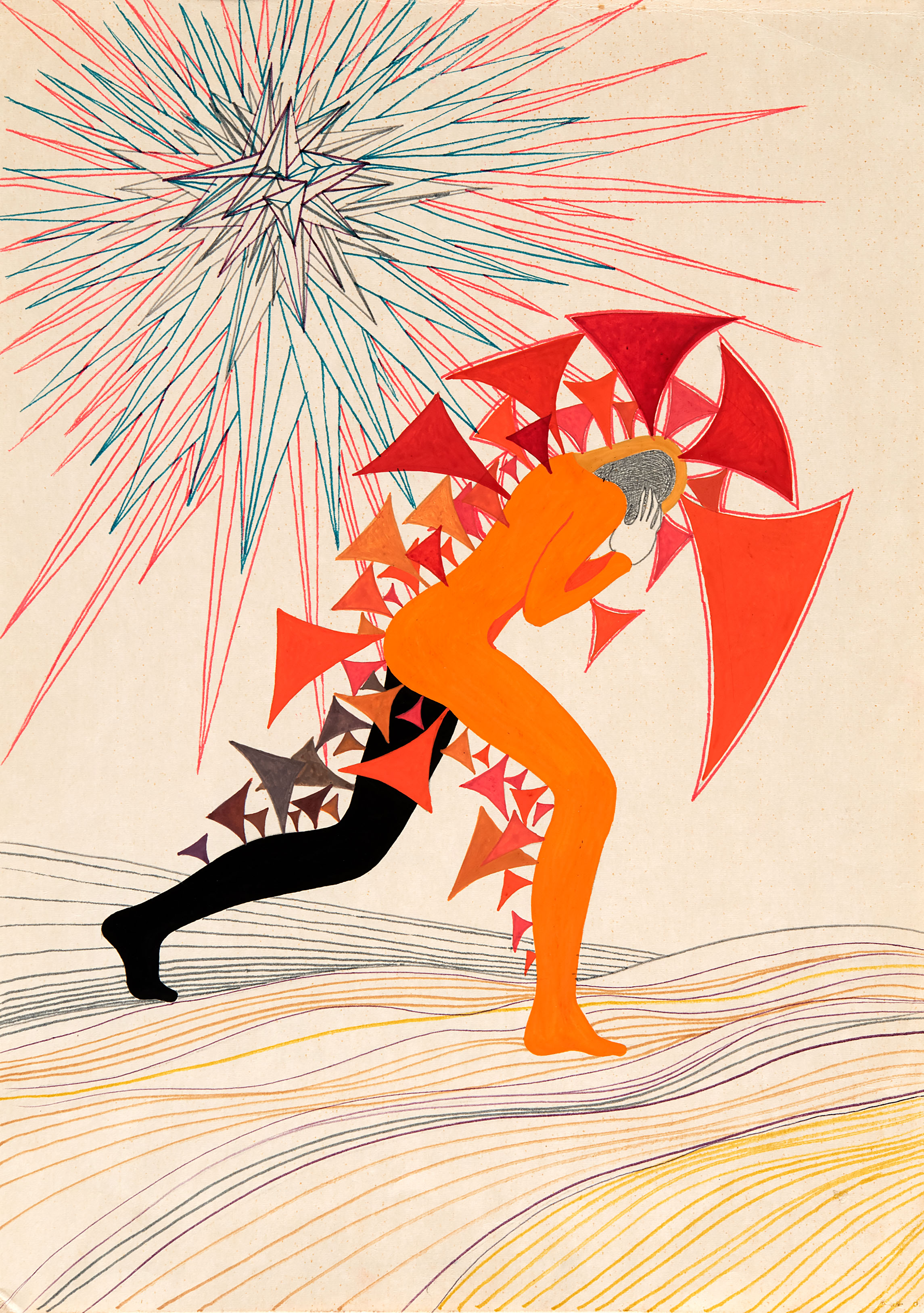
Lev Nussberg and Galina Bitt, Design of a costume for a kinetic theatrical performance, 1967. Tempera, colored markers, and graphite on paper, 43.2 × 30.6 cm (17 × 12 1/16 in.). Norton and Nancy Dodge Collection of Nonconformist Art from the Soviet Union. D01344

Lev Nussberg and Natalia Prokuratova, Altar for the Temple of the Spirit (Sketch for the creation of an altar at the Institute of Kinetics), 1969-70. Tempera and photocollage on paper, 61.8 × 86.4 cm (24 5/16 × 34 in.). Gift of Dieter and Jutta Steiner. 2003.0154

Spring, 1962, from the portfolio Ten Year Development of Kinetic Art in Russia, Nuremberg: 1972-74. Screenprint on paper, 65 × 65 cm (25 9/16 × 25 9/16 in.). Norton and Nancy Dodge Collection of Nonconformist Art from the Soviet Union. 1995.0886.001

Luminous Track of an Extraterrestrial in an Abstract Landscape, 1961. Gouache on paper, 40.6 × 72.6 cm (16 × 28 9/16 in.). Norton and Nancy Dodge Collection of Nonconformist Art from the Soviet Union. D03482
Selected Exhibitions
1963 Vistavka ornamentalistov [Exhibition of ornamentalists], Central House of Art Workers, Moscow, USSR
1964 Na puti k sintezu v iskusstve [Towards synthesis in art], Youth Club of Visual Arts, Moscow, USSR
1965 Vistavka-predstavlenie kineticheskogo iskusstva [Exhibition-presentation of kinetic art], House of Architects, Leningrad, USSR
1965 Moskevské kinetické umění [Moscow Kinetic Art], Galerie na Karlově náměstí, Prague, Czechoslavakia
1967 A kinetic performance in Leningrad, USSR
1968 Documenta 4, Kassel, Germany
1977 La nuova arte soviética: Una prospettiva non ufficiale, [New Soviet art: unofficial perspective], Biennale del Dissenso Culturale [Biennial of cultural dissent], Venice, Italy
1978 Lev Nussberg und die Gruppe Bewegung, Moskau 1962–1977, Kunstsammlung, Bochum, Germany
1981 25 Years of Soviet Unofficial Art, 1956–1981, C.A.S.E. Museum of Russian Art, Jersey City, NJ, USA
1999 Nussberg 1961–1979, Galerie Karin Fesel, Wiesbaden, Germany
2016 Dreamworlds and Catastrophes: Intersections of Art and Science in the Dodge Collection, Zimmerli Art Museum at Rutgers University, New Brunswick, NJ, USA
2017 The Other Trans-Atlantic: Kinetic and Op Art in Eastern Europe and Latin America, 1950s–1970s, Museum of Modern Art, Warsaw, Poland
2018 The Other Trans-Atlantic: Kinetic and Op Art in Eastern Europe and Latin America, 1950s–1970s, Garage Museum, Moscow, Russia
Selected Publications
Crowley, David. "The Art of Cybernetic Communism," 2011. Repr. in Utopian Reality: Reconstructing Culture in Revolutionary Russia and Beyond, ed. Christina Lodder, Maria Kokkori, and Maria Mileeva. Leiden: Brill, 2013: 219–238.
Dziewańska, Marta, Dieter Roelstraete, and Abigail Winograd, eds. The Other Trans-Atlantic: Kinetic and Op Art in Eastern Europe and Latin America. Warsaw: Museum of Modern Art in Warsaw, 2017.
Kinetizm: Gruppa «Dvizhenie», 1962–1976 [Kinetism: The “Movement” group, 1962–76]. Moskow: Znak, 2016.
Nussberg, Lev. "Cybertheater." In Leonardo 27, no. 5 (1969): 61–62.
Nussberg, Lev. Notes from an Undated Manuscript. Cited in Vyacheslav F. Koleychuk, "The Dvizheniye Group: Toward a Synthetic Kinetic Art." In Leonardo 27, no. 5 (1994): 433–36.
Ragon, Michel, Peter Spielmann, and Lev Nussberg. Lew Nussberg und die Gruppe Bewegung: Moskau 1962–1977. Texte von Bochum, 1978.
Sharp, Jane. "The Personal Visions and Public Spaces of the Movement Group (Dvizhenie)." In Cold War Modern, ed. David Crowley and Jane Pavitt. London: Victoria and Albert Museum, 2008: 237.
Vorob'ev, Valentin. “Kineticheskie igry futurologa Nussberga” [Kinetic games of the futurologist Nussberg]. In Stetoskop (1999), no. 24.