

Yuri Albert
1959 — Moscow (Russia). Worked in Moscow (Russia); currently works in Cologne (Germany)
Humor, consistency, and devotion to dialogue characterize the work of Yuri Albert, who argues convincingly that the main subject of his creative effort is art and those who make and view it. One of the most reliable, inventive, and productive artists in his generation, Albert has been making art since childhood. His proud parents sent one of his earliest pieces, a clay sculpture he’d done as a schoolboy, to Albert’s great uncle, the French-American sculptor Jacques Lipchitz, for professional appraisal. Lipchitz’s exact response may be lost to time, but the childhood sculpture returned cast in bronze, a historical footnote to Albert’s lifelong wistful nostalgia over the idea of “Real Art.” The terminology is his own, one he used in marked contrast to “Contemporary Art,” the only kind possible in our beleaguered times. Yet as Albert’s evolving oeuvre continually testifies, dogged commitment to the process of artmaking can lift the everyday toward the exalted. His sustained dedication to art as a material process grounded in communication with the viewer has scarcely wavered over his nearly sixty-year-long career.
Albert’s fateful connection to Moscow Conceptualism began with a seemingly chance visit to the studio of the artists Vitaly Komar and Alexander Melamid while he was still a teenager. The artist and educator Katya Arnold brought pupils to her husband Melamid’s workplace to help them prepare for application to college. As one of that group, Albert remembers the instant appeal of the artistic approach he found there, which favored the idea over its execution, and he found value in works that made their point without recourse to specialized vocabulary. Lessons he learned from Komar and Melamid about collaboration and the importance of creative conversation stuck with him; his exposure to their conceptual work helps explain his definition of himself as a post-conceptualist. Other early influences included Nest artists Gennadii Donskoi, Mikhail Roshal, and Victor Skersis, as well as Vadim Zakharov, whom he met when both began their studies at the Moscow State Pedagogical Institute. Although Albert left the institute before graduating, their friendship continues to this day. Albert’s first artistic collaborator was Nadezhda Stolpovskaya, also one of Arnold’s pupils, who became Albert’s wife. Stolpovskaya’s commitment to collaborative experimentation and her early translations of articles from the rare English-language art books and journals that Komar, Melamid, and others had bequeathed to the younger artists were key to Albert’s development.
Albert is fascinated with the artistic connections between works of art, which he argues are “more important than the works themselves.” [1] That sentiment underpins his now-famous performance piece Y. F. Albert Gives His Entire Share of Warmth to Others (1978), and his series Continuation of Other Artists’ Series (1979–81), which is documented in the Dodge Collection (ZAM, MANI4.01.03.01-08). The series enters into creative dialogue with Jasper Johns, Carl Andre, and Joseph Beuys as well as Stolpovskaya, Skersis, and Zakharov by borrowing and building on materials, individual works, or approaches associated with those artists. His multilayered response to works by Skersis, Chair on Clay Legs and Two Chairs (1980, MANI4.01.03.07), points both to Skersis’s appropriation of Joseph Kosuth’s conceptual work One and Three Chairs and his own reuse of it as proof of the role collaboration plays in every work of art. Albert’s Letter to V. Zakharov (1981, MANI4.01.03.03) goes even further by “outsourcing” the entire creative process to his fellow artist, while still claiming “authorship” of any work produced as part of his continuing series. In related fashion, Albert’s multiyear series I Am Not … reproduces the styles of a variety of established artists to insist that he is a different artist altogether. As in the screenprint Self-Portrait as Another Artist (1991, ZAM, 2002.0486), which references Andy Warhol, such anti-self-portraits allow Albert to take part in the global conversation about art without committing to a single method or approach.
These works stake out a position far removed from the modernist expectations for originality that characterized most unofficial late-Soviet art. In fact, where other artists might disguise or deny their reliance on artists that preceded them, Albert embraces the notion of influence in I Work Under the Influence … (1981, ZAM, D22772) and I Influence … (1981, ZAM, D22934), both of which are part of the Dodge Collection. Overt and active collaboration charactetizes Albert's compelling series of Elitist-Democratic Art, in which the artist expands his outreach to the public with works directed at blind spectators, hearing-impaired viewers, sailors, stenographers, and others. The series reflects Albert's continued focus on reducing artificial boundaries that separate artists from one another, from general audiences, and from the world at large. By explicitly addressing spectators who are usually ignored in the artmaking process, Albert is able to imaginve a works of collaborative art and jointly constructed meaning.
Relinquishing sole ownership of his art was a particularly unusual step in the newly commercialized post-Soviet arena, but his remarkably generous project Unrealized Works (2006, 2009, 2014) did just that. While alluding to the fact that unofficial artists in the Soviet “underground” were often unable to complete or exhibit their works, the project remembers an unexpected benefit of that time: those who persisted in creating art under such conditions were often extremely generous with their creative ideas. By announcing his continued willingness to enter into creative dialogue with all comers, Albert makes instant collaborators of his spectators, sharing with them the joy of mutual creation and conversation. That lesson marked Albert’s participation in collaborative artistic groups, including Cupid, Tsar of the Hill, Edelweiss, and others, which reunited him with Victor Skersis and the artists Andrei Filippov and, from 2014, Paruyr Davtyan.
Devotion to a belief in the power of collaboratively created meaning is essential to such cooperative efforts, which were marked, as always, by engagement, good humor, and continually evolving experimentation with a variety of techniques and approaches. Their highly referential projects borrowed liberally from artistic tradition but used an unusual model for group work, in which the individual artists decided on relevant issues they would investigate in lengthy group discussions but created the artworks for their joint shows independently. A show with Vadim Zakharov to mark their shared receipt of the 2023 Goslarer Kaiserring prize makes it clear that dialogue and collaborative work retain interest for the artist, who is also well known for his wide-ranging Facebook discussions covering a gamut of political, social, and artistic topics. To paraphrase Vitaly Komar’s sharp comment on the inevitability of artistic influence, Yuri Albert is always involved in coauthorship with other artists, but he understands it.
Mary A. Nicholas
Photo portrait: Yuri Albert, 2007. Photo by Nadezhda Stolpovskaya. Courtesy of Nadezhda Stolpovskaya
Notes:
1. Albert discusses this idea in more depth in a textual work from his series Autoseries II (1981), included in his 2014 retrospective show at the Moscow Museum of Modern Art.

I Have So Much To Say With My Art! from the series Elite Democratic Art (For Deaf and Mute), 1989. Acrylic paint on gelatin silver print mounted on fiberboard, 100 x 70.3 cm (39 3/8 x 27 11/16 in.). Purchased with funds donated by Norton Dodge and Nancy Dodge. 2004.0604.007

Untitled (I work under the influence...), 1981. Oil and ink on panel, 37.5 × 46.5 cm (14 3/4 × 18 5/16 in.). Norton and Nancy Dodge Collection of Nonconformist Art from the Soviet Union. D22772
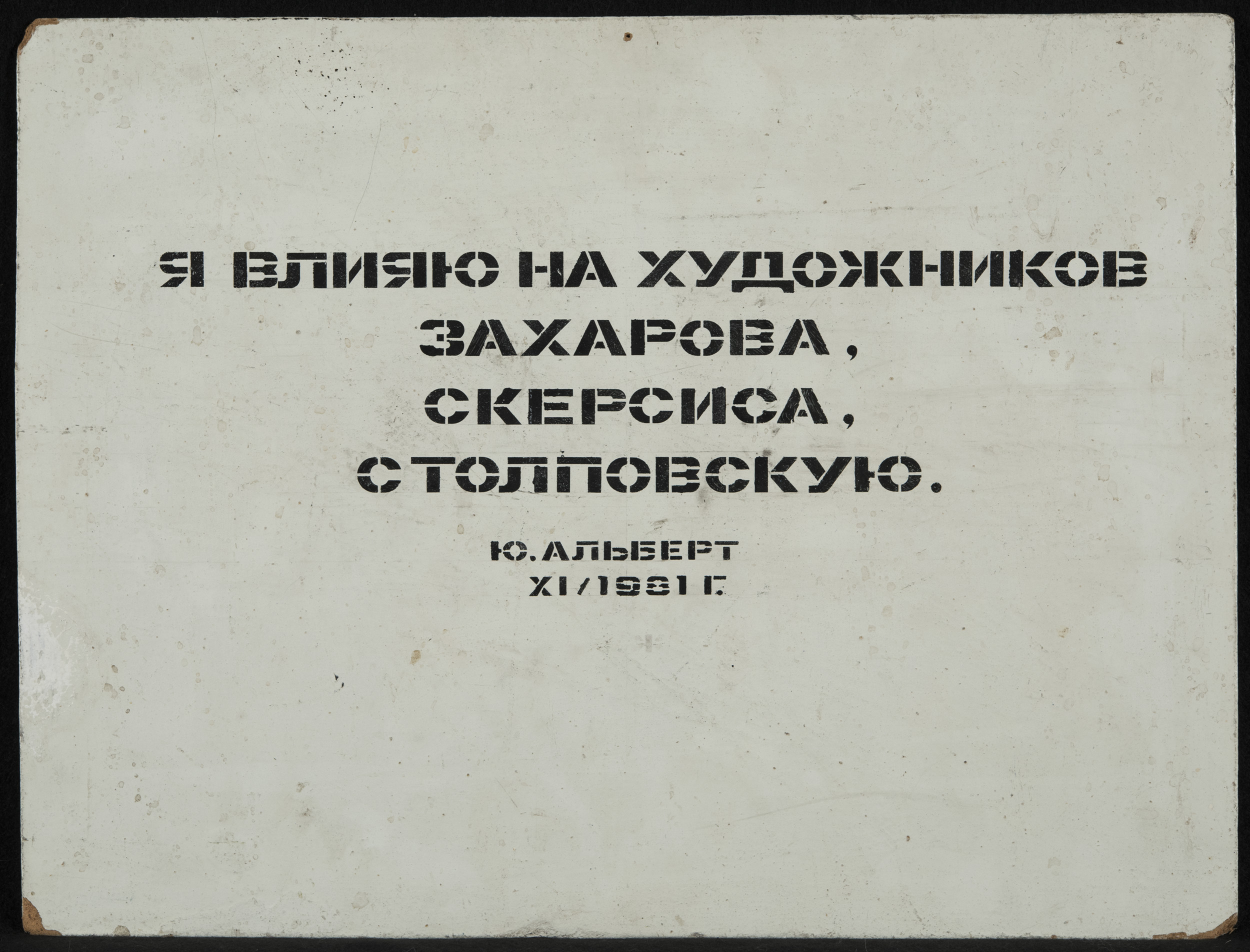
Untitled (I Influence the Art of Zakharov, Skersis, Stolpovskaya), 1981. Oil on fiberboard, 33.7 x 44.5 cm (13 1/4 x 17 1/2 in.). Norton and Nancy Dodge Collection of Nonconformist Art from the Soviet Union. D22934
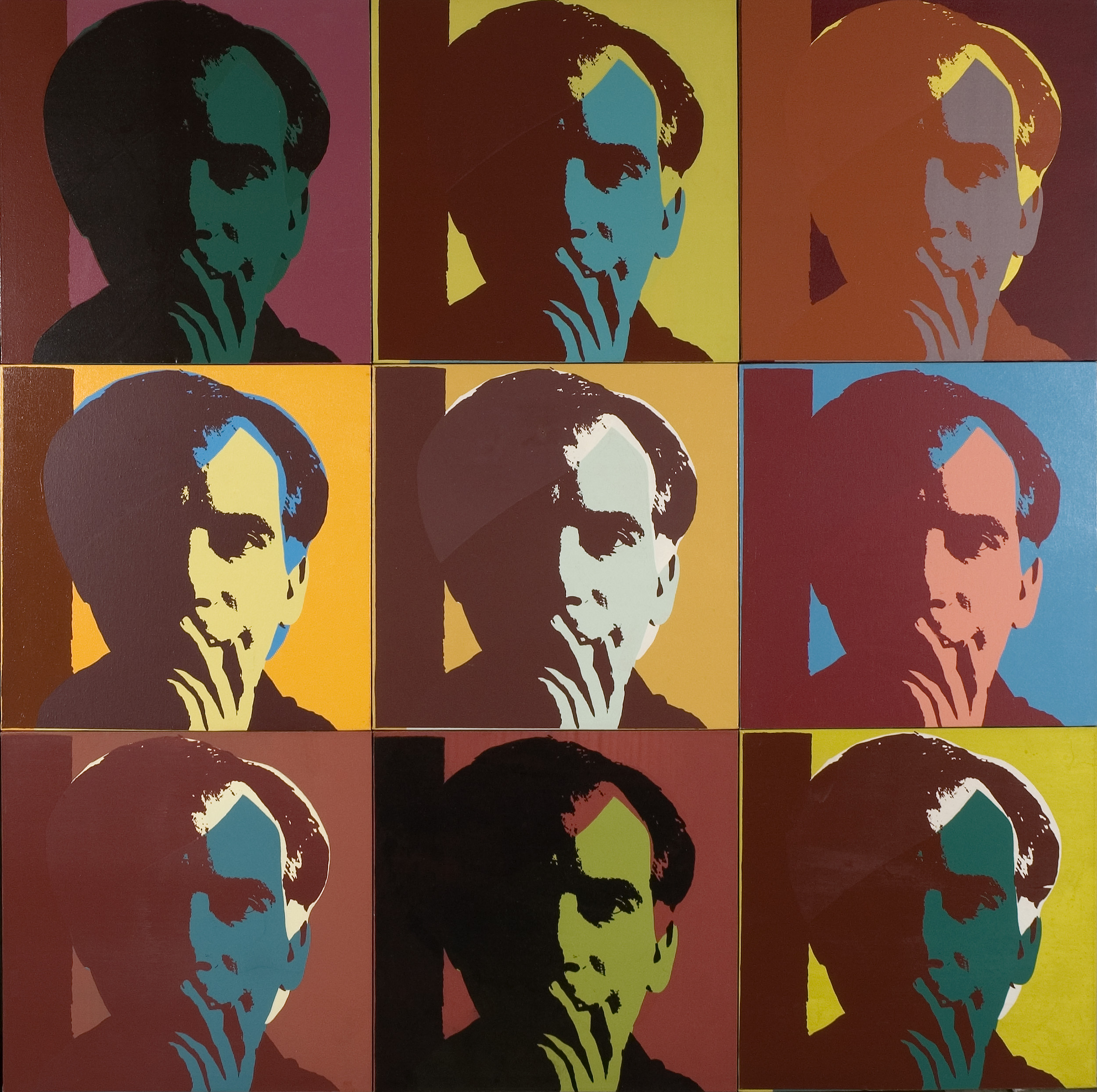
Self-Portrait Like Another Artist, 1991. Acrylic screenprint on canvas, 171.5 × 171.5 cm (67 1/2 × 67 1/2 in.). Gift of Christian K. Keesee. 2002.0486
Selected Exhibitions
1979 Group exhibition, Apartment of Yuri Albert and Nadezhda Stolpovskaya, Moscow, USSR
1982 First AptArt Exhibition, APTART Moscow, USSR
1986 Iskusstvo protiv kommertsii, ili Bittsa za iskusstvo. [Art against commerce, or fight for art], Bittsevskii Park, Moscow, USSR
1992 Mama, smotri! [Mom, look!], L-Gallery, Moscow, Russia
2009 Third Moscow Biennial of Contemporary Art, Moscow, Russia
2011 Counterpoint: Russian Contemporary Art, From Icon to Avant-Garde by Way of the Museum, Louvre, Paris, France
2013 Elitär-demodratische Kunst [Elitist-Democratic Art], Kunstmuseum Liechtenstein, Vaduz, Liechtenstein
2013–14 Chto etim khotel skazat’ khudozhnik? [What did the artist want to say with that?], Moscow Museum of Modern Art, Moscow, Russia
2017 Allegoricheskiia Abstraktsiia, [Allegorical abstraction], Multimedia Art Museum, Moscow, Russia
2023 Distortions: Moscow Conceptualists Working Today, 205 Hudson Gallery Hunter College, New York, NY, USA
Selected Publications
Albert, Yuri, and Ekaterina Degot. Chto etim khotel skazat’ khudozhnik? [What did the artist want to say with that?]. Moscow: Moscow Museum of Modern Art, 2015.
Alpatova, Irina, ed. “Drugoe iskusstvo.” Moskva, 1956–88. [“Another art.” Moscow, 1956–88]. Moscow: Galart, National Centre for Contemporary Arts, 2005.
Kiesewalter, Georgy, ed. Perelomnye vos’midesiatye v neofitsial’nom iskusstve SSSR [Thе game-changing eighties in unofficial art of the USSR]. Moscow: Novoe literaturnoe obozrenie, 2014.
Nicholas, Mary. Moscow Conceptualism, 1975–1985: Words, Deeds, Legacies. London and New York: Bloomsbury Visual Arts, 2024.
Obukhova, Sasha, and Aleksandr Izvekov. Performans v Rossii, 1910–2010. Kartografiia istorii. [Performance in Russia, 1910–2010: Cartography of history]. Moscow: Artguide Editions, 2014.
Rosenfeld, Alla, ed. Moscow Conceptualism in Context. Zimmerli Art Museum at Rutgers University. Munich: Prestel, 2011.
Sharp, Jane A, ed. Thinking Pictures: The Visual Field of Moscow Conceptualism. New Brunswick, NJ: Zimmerli Art Museum at Rutgers University, 2016.
See also