
Vadim Zakharov
1959 —Stalinabad, USSR (now Dushanbe, Tajikistan). Worked in Moscow (Russia), Cologne (Germany); currently works in Berlin (Germany)
Painter, solo performer, collaborator, collector, videographer, publicist, book designer, Moscow Conceptualist, political gadfly. . . some might accuse artist Vadim Zakharov of spreading himself too thin creatively. Yet from his earliest artworks in the late-Soviet unofficial art milieu to his latest partisan pieces from the European Union, Zakharov has been committed to continual multifaceted work in a variety of media and on multiple platforms. Asked to describe his creative path, Zakharov starts with a list that enumerates his own efforts as an artist, his activity as an archivist, and his work as a publisher. All three of those areas of his creative life are worth exploring, and they overlap and intertwine in ways that speak volumes about everything from “underground” art from the late Soviet Union to protest art of today. Zakharov’s personal experience as a Russian artist born in Dushanbe, Tajikistan, and now living in exile in Berlin, Germany, is compelling evidence of the continued relevance of nonconformist art from around the globe.
As a relatively new resident of Moscow, Zakharov enrolled in that city’s State Pedagogical Institute in 1977 to study art and design. It was there that he met the artist Yuri Albert, whose friendship and creative influence would be lasting. Zakharov’s first serious work of art—An Exchange of Information with the Sun from 1978—demonstrates the initial steps into the world of postmodern art that the artists took together. The piece actually exists in two forms. As Zakharov himself describes in an online series of conversations about art with his wife and collaborator Maria Porudominskaya, the first version of the piece included a poster-sized compilation of biographical facts about the young artist, which, like the final version of the work, was documented in a black-and-white photograph by Albert. The more memorable second version of the piece, part of the Dodge Collection, consists of just two black-and-white photographs (ZAM, D20962.01-02). In the first, the artist demonstratively affixes his thumbprint to a small mirror. The second photograph then shows him transmitting that information to the sun in a bold affirmation of Zakharov’s entry onto the larger stage of art history. The work in question was originally intended as a performance piece, to be revealed at a gathering of unofficial artists and guests organized by the Nest group of Gennadii Donskoi, Mikhail Roshal, and Victor Skersis. Zakharov’s friends, fellow artists Albert and Nadezhda Stolpovskaya, both debuted their first public works there. Zakharov describes his reluctance to perform his own work at the same event as a failure of nerve, and he seems to have had lingering doubts about the piece, since he excluded it from an important retrospective show at the State Tretyakov Gallery in Moscow in 2006. But his concerns were misplaced: Exchange of Information with the Sun identifies the artist as a force to be reckoned with and continues to resonate as Zakharov’s early insistence on his right to create art.
A work from 1982, Hand Inscriptions: I Have Acquired Enemies (ZAM, D12098.01-05), functions similarly to situate Zakharov in relation to the community of unofficial artists working in Moscow at the time. As a younger member of that milieu, Zakharov calls out established members of the Moscow “underground,” accusing each of creative shortcomings that in his view were stunting their own artistic development and paralyzing artistic progress as a whole. Zakharov’s deliberately provocative statements are literally “embodied,” since he has pasted the accusations—directed at Eduard Steinberg, Boris Orlov, Erik Bulatov, Vladimir Yankilevsky, and Ilya Kabakov—on his own palm. His unsmiling indictments challenge those artists with underhandedness, insincerity, and pretentiousness. A performed “turning of the other cheek” in the final photograph serves tellingly not as a gesture of forgiveness, but rather as documentation of Zakharov’s creative war on the older generation, who will now see him as the enemy.
The work, like several other pieces from 1983 in which Zakharov appears in an eye patch, was aimed at disrupting the unofficial art milieu, which to his mind was as sclerotic and paralyzed as the geriatric Soviet system it opposed. Eye Patch imaginatively placed the young artist within the global community he would later inhabit in fact: the self-fulfilling text of Eye Patch insisted that “art is not indifferent to the year of my birth, the names of my friends, and the number of years I have worn this patch.” This rehearsal of the role of official representative of Russian art attempted to insert Zakharov’s works into a global dialogue about art that transcends the constricted local context of late-Soviet unofficial art. He was able to rise above those boundaries once it became possible for artists to travel outside of the Soviet Union. After he was invited to participate in an art show in still-divided Germany in 1988, Zakharov moved there permanently with his family in 1990.
In addition to solo work as a conceptual and performance artist, Zakharov participated in a wider variety of creative collaborations, building on early partnerships with Igor Lutz, Nadezhda Stolpovskaya, and Victor Skersis (SZ) to include projects with Sergei Anufriev, Ivan Chuikov, Yuri Leiderman, Sabine Hänsgen, Andrei Monastyrski, and others. He also devoted considerable energy in the post-Soviet era to publishing and curatorial activities to archive, preserve, and promote his own work and that of his colleagues from the unofficial art milieu. The Russian-language journal Pastor he published in Germany was “a completely conceptual idea,” an experimental attempt to “resurrect the context of Moscow conceptualism on a different territory.” [1] Zakharov has spoken at length about the many adjustments unofficial artists needed to make when entering the highly stratified art market in the West and has criticized himself and others for sometimes devoting too little attention to the way “underground” artworks were presented and received, noting that the position of experimental artists on a marginalized periphery made some artists curiously reluctant to commit to a single style or final artistic decision. There are advantages to that stance, however, as Zakharov’s own organizational efforts suggest. Zakharov has received numerous awards for his artwork, including the Innovation Prize (2006), the Kandinsky Prize (2009), and the Goslarer Kaiserring (awarded jointly with Yuri Albert in 2023). Yet his most enduring honor is more likely the result of a lengthy artistic experiment he has conducted by turning his own home into the modular communal art space Free Home. That spirit of community continues to reward the artist and his colleagues today.
Mary A. Nicholas
Photo portrait: courtesy of the artist, 2025
Notes:
1. Zakharov’s comments come from an unpublished interview I conducted with the artist in Berlin on February 24, 2020. As Zakharov noted in an interview in 2015, adopting a different identity, as he did with the journal Pastor, published from 1992 to 2001, can provide a sense of “independence of action and thought.”
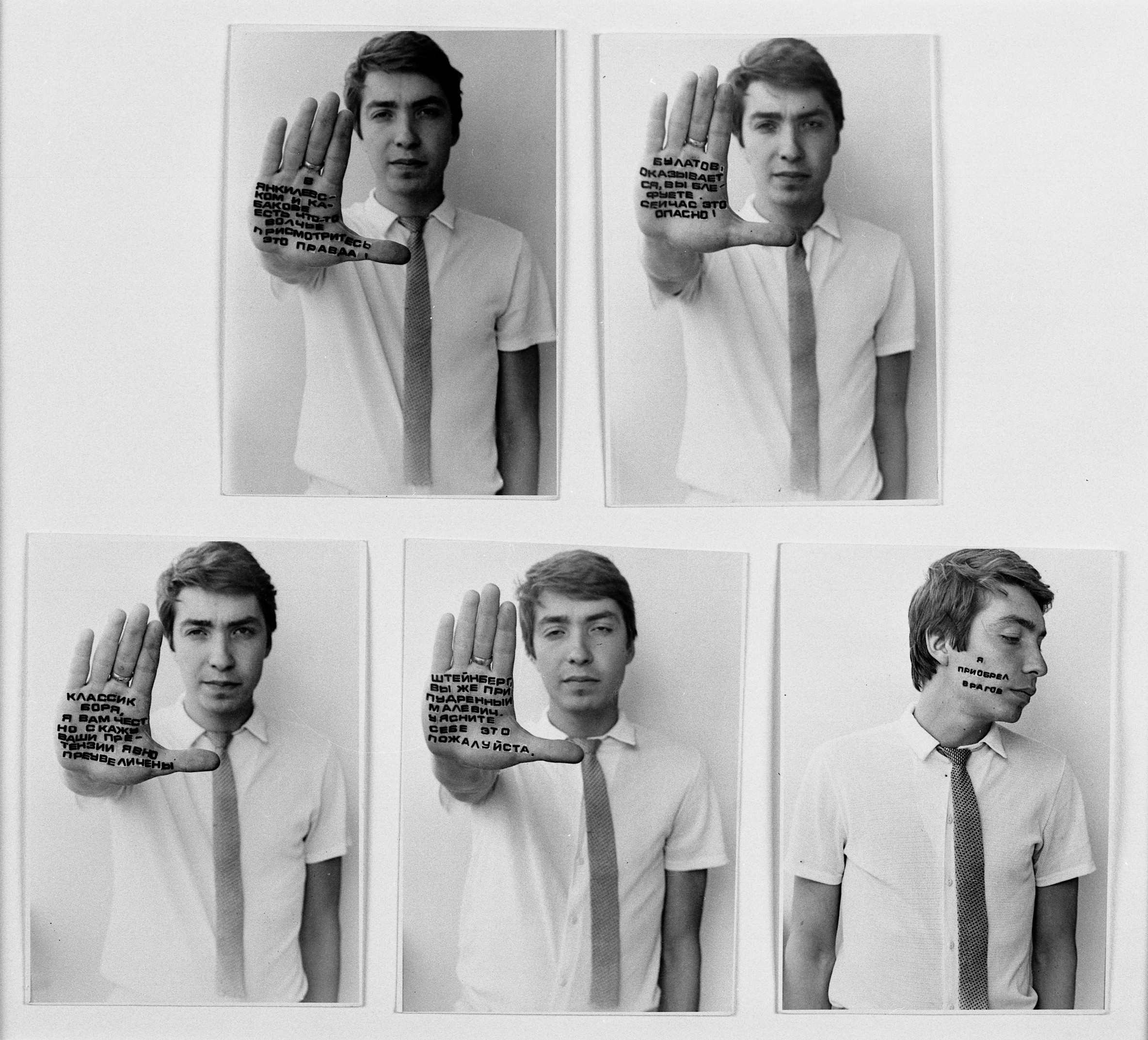
I Have Acquired Enemies, 1982. Gelatin silver print with ink and handwriting on paper, 16.5 × 12 cm (6 1/2 × 4 3/4 in.). Norton and Nancy Dodge Collection of Nonconformist Art from the Soviet Union. D12098.01-05

V.A. Zakharov Conducts the Information Exchange with the Sun, 1978. Gelatin silver print on paper, 12.7 × 18.6 cm (5 × 7 5/16 in.). Norton and Nancy Dodge Collection of Nonconformist Art from the Soviet Union. D20962.01
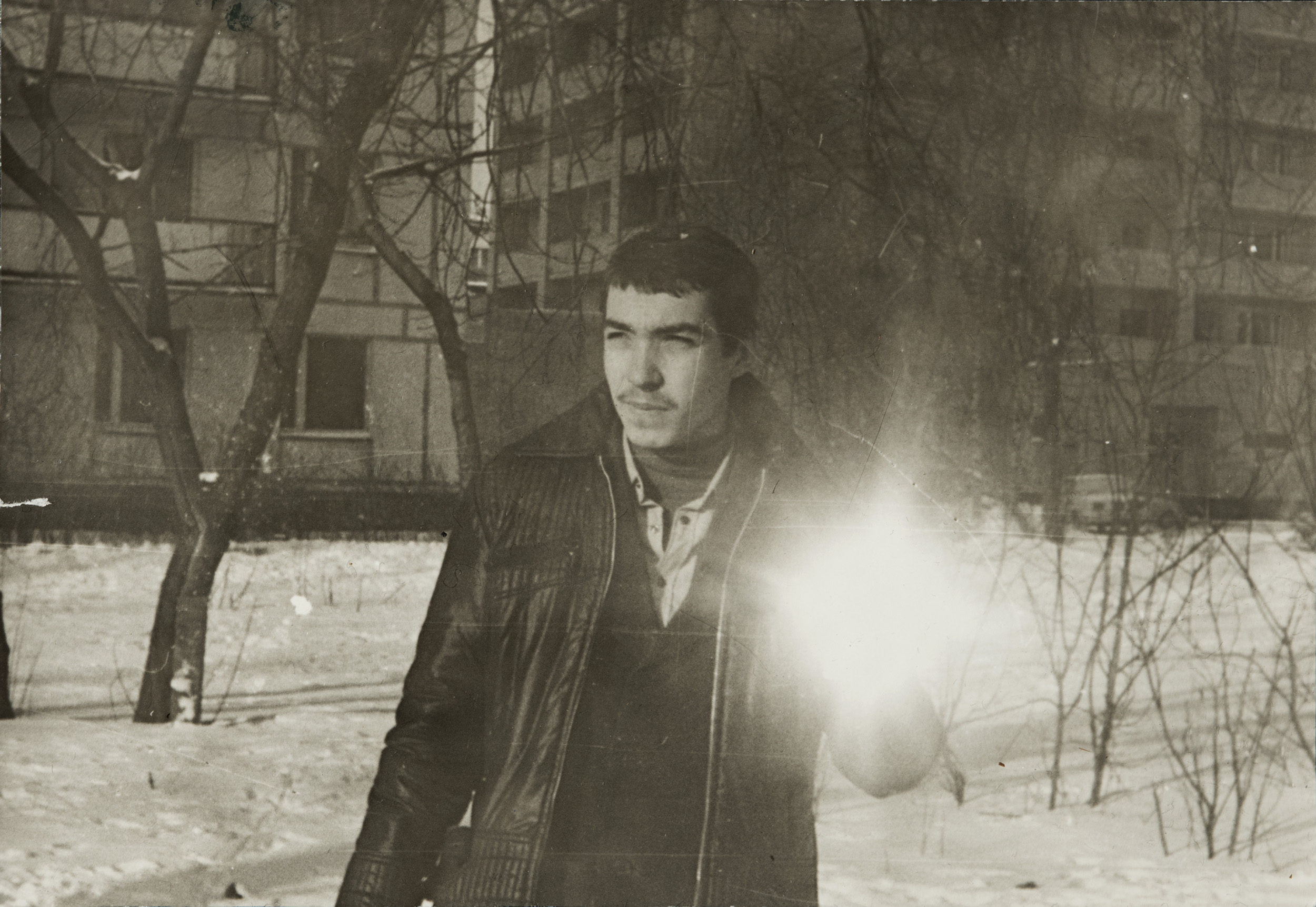
V.A. Zakharov Conducts the Information Exchange with the Sun, 1978. Gelatin silver print on paper, 12.7 × 18.4 cm (5 × 7 1/4 in.). Norton and Nancy Dodge Collection of Nonconformist Art from the Soviet Union. D20962.02