
SZ (СЗ)
1980–84, 1990, Moscow
Victor Skersis, 1956 – Moscow, Russia. Worked in Moscow (Russia); currently works in Bethlehem, Pennsylvania (USA)
Vadim Zakharov, 1959 – Stalinabad, USSR (now Dushanbe, Tajikistan). Worked in Moscow (Russia) and Cologne (Germany); currently works in Berlin (Germany)
Self-described “coauthors” since 1980, Victor Skersis and Vadim Zakharov are the creative minds behind the collaborative art practice SZ. The two had been friends since 1978, when they met through mutual acquaintances, the artists Yuri Albert (b. 1959) and Nadezhda Stolpovskaya (b. 1959), and their influential partnership built on collaborative experiences that both had honed since the beginning of their respective artistic careers. Skersis saw creative partnership as a foundational principle of contemporary art, having studied and worked with Vitaly Komar (b. 1943) and Alexander Melamid (b. 1945), who provided an enduring example of the vitality of joint creative endeavor. Skersis’s work in the Nest, the three-man group that brought him into close professional contact with Gennadii Donskoi (b. 1954) and Mikhail Roshal (1956–2007) between 1974 and 1979, cemented his belief that collaboration was the most productive model for innovative artmaking. Zakharov, too, had experience working in collaboration with others; an early partnership with Igor Lutz (b. 1959), which partially coincided with Zakharov’s studies at the Moscow State Pedagogical Institute, included play with sots art motifs and creative reuse of the civil defense training that was mandatory for male students at the time. Their shared experience of work in partnership helped make SZ a significant catalyst for invention in the unofficial art milieu throughout the early 1980s. Important developments in unofficial art in that period, including both the Moscow Archive of New Art (Moskovskii arkhiv novogo iskusstva, or MANI) and the open access art gallery AptArt, are nearly unthinkable without the contribution of SZ. Concepts the artists developed in tandem at the time continue to resonate with artists decades later.
Beginning in the summer of 1980, SZ began a period of artistic experimentation intended to expand both the creative vocabulary available to artists in the Moscow underground and the set of art practitioners in that milieu. One of the most interesting and compelling ideas was SZ’s notion of unconstructed artistic “activity” (deiatel’nost’), which recast the individual artwork as a process with indeterminate boundaries in time and space. Pushing beyond the idea of the artistic “happening,” a concept Skersis had explored as part of the Nest, Skersis and Zakharov understood “activity” as artwork that was actively engaged with the surrounding environment and independent actors within it. This distinctive approach provided underpinning for most SZ works, including two series from 1980 that are documented in the Dodge Collection. Filling the Voids (1980, ZAM, D20964.01–03) imagined engaging everyday city dwellers in the free and unconstrained exchange of views on art and life. Casting the endeavor as part of a bid to “produce various types of information; develop polysemantic products; and search for new channels for the circulation and receipt of information,” the artists distributed an Bulletin SZ, installed “bird-feeder mailboxes,” and announced the creation of a special “nook and cranny for information of any sort.” [1] As representatives of their newly “trademarked” artistic company SZ, the artists opened the realm of unofficial art in Moscow to previously ignored stimuli, including willful absurdity, the introduction of commercial elements, artistic appropriation, misdirection, and distortion, as well as the use of readymades. Their works are infused with whimsy, humor, and faux derring-do, and they brashly reimagine the urban landscape as a site for unrestricted art performance.
The SZ work Logical Organisation of Urination of Dogs (1980, ZAM, D20972.01–05) attempted similarly to recast the Moscow city map as a kind of creative art space open to all comers. While employing pseudoscientific vocabulary to describe their quasi-logical monitoring activities, the artists staked out territory in defense of unrestricted imagination widely accessible to all. That is the message of their 1980 Inscriptions series, also translated as Tags, included in the Dodge Collection (D25448, D10028, MANI1.01.E18.11). Here, too, the artists treated the late-Soviet urban landscape as an open canvas on which they stenciled open-ended statements for individual contemplation. The varied, randomly placed, and ambiguous texts provided willing readers with a moment all too rare in late-Soviet life: the chance to interpret public texts on their own.
Skersis and Zakharov brought that same spirit to their work collecting materials for MANI, the important self-directed collection of late-Soviet unofficial art of the 1980s. Their egalitarian approach to gathering materials for MANI highlighted their focus on open access and collaboration. SZ saw MANI less as a snapshot of an art movement frozen in time and more as a dynamic, living document that was open to continual reinterpretation and change. That innovative attitude marked their own contributions to the counter-archive, and it also explains works by fictitious artists that the duo created for their 1982 Phantoms series (ZAM, MANI4.01.04.00–04) and included in the archive. Like other work in the series documented in the Dodge Collection, the banner All Men Are Scum! (MANI4.02.27.00–02) tries to imagine and highlight voices otherwise missing in the Moscow artistic underground. This consistent emphasis on inclusivity, conversation, and unconstrained collaboration defined SZ’s activity throughout the artists’ time together, and it was essential in shaping and developing the important APTART movement in the early 1980s as well.
SZ played a significant role in the series of collaboratively organized exhibitions that made up APTART between 1982 and 1984. APTART was intended to expand the reach of the unofficial art milieu in Moscow, opening the endeavor to much wider audiences interested in active participation in the creation of art rather than contemplation of traditional art objects. SZ’s approach to shared creation was democratic in intent, focusing, as artist Anatoly Zhigalov (b. 1941) noted at the time, on “communicative” works of art that could “exist and develop even without the authors.” [2] Both Skersis and Zakharov worked at Soviet publishing houses during this period, and those jobs gave them access to resources that otherwise would have been out of reach. That explains the large-format photographs they included in the very first APTART group exhibit. The nearly nude, black-and-white self-portraits were confiscated by the KGB during a raid on the apartment gallery soon after the show opened. Despite such setbacks, APTART and SZ persevered in their activities for several more years, bringing insouciant dedication to the independent pursuit of art. The final SZ exhibit—Brothers Karamazov, organized in 1990 after both artists had left the Soviet Union—was itself a work of art. The continually evolving show presented visitors with a new set of works to contemplate every week. The revolving scenes there featured paintings, mixed media, and installations in a complex evocation of personal history, artistic inquiry, and shared fates still compelling today.
Photo portrait: Vadim Zakharov and Victor Skersis, 1990. Photo by Bruno Mancia. Courtesy of Franziska Bodmer and Bruno Mancia, FBM studio
Notes
1. Description of the project is part of the Bulletin SZ, reproduced in Skersis and Zakharov, Gruppa SZ: Sovmestnye raboty, 1980–1984, 1988, 1990 (Moscow: ArtKhronika, E. K. ArtBureau, Art Projects Foundation, 2004), 49.
2. Zhigalov’s comments are from a questionnaire he filled out at Zakharov’s request, part of an organized effort by the artist to facilitate broader exchange of views in and about the unofficial art community.
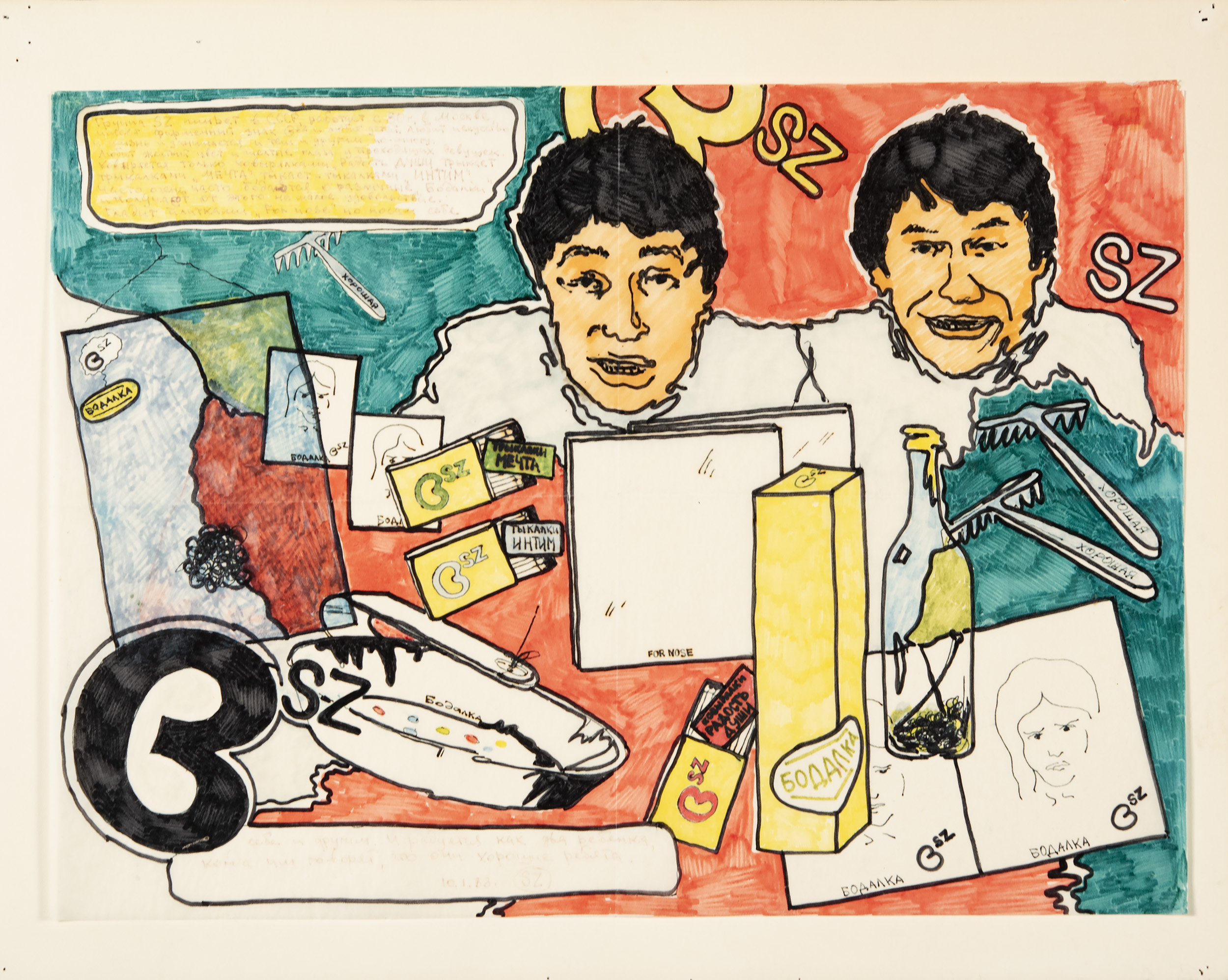
SZ Advertisement Poster (diptych, right panel) from the series SZ Production, 1982. Ink on glassine, 30 × 41.6 cm (11 13/16 × 16 3/8 in.). Norton and Nancy Dodge Collection of Nonconformist Art from the Soviet Union. D10020.02
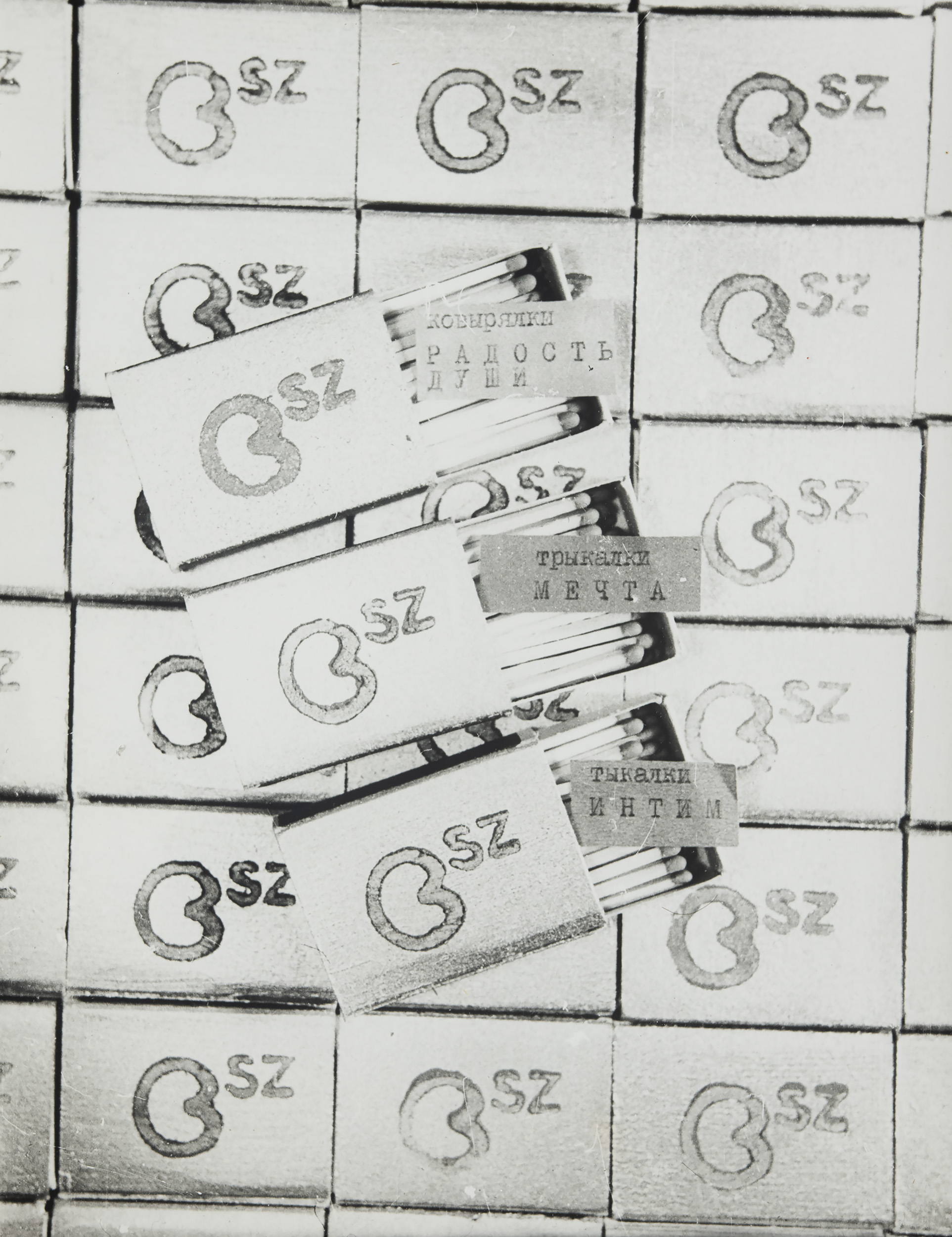
Digger, Snapper, Stabber from the series SZ Production, 1980. Photograph on paper, 23.8 × 18.2 cm (9 3/8 × 7 3/16 in.). Norton and Nancy Dodge Collection of Nonconformist Art from the Soviet Union. D21038

Tags, 1980. Photograph with typed letter on paper, 34.5 × 48 cm (13 9/16 × 18 7/8 in.). Norton and Nancy Dodge Collection of Nonconformist Art from the Soviet Union. D10028

SZ Activities. Package with a Double Bottom for Collecting Information. From the series Filling the Voids, 1980. Photograph on paper, 18.1 × 11.8 cm (7 1/8 × 4 5/8 in.). Norton and Nancy Dodge Collection of Nonconformist Art from the Soviet Union. D20964.01

SZ Activities. Package with a Double Bottom for Collecting Information. From the series Filling the Voids, 1980. Photograph on paper, 112.9 × 18 cm (44 7/16 × 7 1/16 in.). Norton and Nancy Dodge Collection of Nonconformist Art from the Soviet Union. D20964.02

SZ Activities. Package with a Double Bottom for Collecting Information. From the series Filling the Voids, 1980. Photograph on paper, 112.9 × 18 cm (44 7/16 × 7 1/16 in.). Norton and Nancy Dodge Collection of Nonconformist Art from the Soviet Union. D20964.03