
Vladimir Yankilevsky
1938 — Moscow (USSR) | 2016 — Paris (France). Worked in Moscow (Russia), New York, NY (USA), Cologne (Germany), and Paris (France)
Vladimir Yankilevsky was one of the most important figures in Moscow nonconformist art of the 1960s to 1980s. Some art critics classify him as a follower of surrealism, especially in his early works, but the artist denied such strict definition. Other scholars have regarded his work as “metaphysical conceptualism.” [1] Yankilevsky’s activity is much broader than the framework of any particular art movement. His remarkable body of work encompassed complex triptychs and pentaptychs, relief sculptures, paintings, and a great variety of works on paper in mixed media (e.g., 1962, ZAM, D05911;1967, ZAM, D07765;1972, ZAM, D00220). Among the underlying themes in his oeuvre are the resolution of opposites, the conflict between individuals and technology, and the quest for balance between what the artist identified as masculine and feminine principles (e.g., 1967–68, ZAM, D04940.01-03). As the artist also noted, the concept of anthropomorphism was very important to him, and his abstract images always carry some figurative elements. [2]
Yankilevsky received his first art lessons from his father, the artist Boris Yankilevsky (1907–1987), who in the early 1930s studied under the well-known Russian graphic artist Vladimir Favorsky (1886–1964). In 1941, Vladimir was evacuated to the village of Kozlovka on the Volga River, where his mother worked at an airplane factory. After the end of WWII, in 1945–46, Yankilevsky’s father continued his military service as part of the Soviet forces in Germany, and the family joined him there.
From 1950 to 1956, Yankilevsky studied at the Moscow Secondary Art School, and after his graduation, he began working as an illustrator for the Goslitizdat publishing house. His visit to a Pablo Picasso exhibition at the Pushkin Museum of Fine Arts in Moscow in 1956 had a great impact on the artist’s creative development. In 1957, he enrolled in the graphic arts department of the Moscow Institute of Graphic Arts and Printing Industries, where he was introduced to abstract expressionism by his teacher, experimental artist Eli Beliutin (1925–2012).
In 1961, fascinated with baroque music, Yankilevsky created the series Peizazh sil [Landscape of Forces] (ART4.RU, Moscow) under the influence of J. S. Bach’s cello suites. In the early 1960s, he began producing mixed-media triptychs incorporating reliefs. In these works, the artist sought to express the tensions that, according to him, always exist between two binary opposites: the unstable, dynamic masculine, and the stable feminine. The masculine and feminine principles complement each other, he believed, and are present in every individual, male or female.
In the early 1960s, Yankilevsky created his first important pieces, including Dialog [Dialogue] (1961, State Tretyakov Gallery, Moscow) and Triptikh No. 1:Klassicheskii [Triptych No.1: Classical] (Ludwig Museum, Budapest). He developed his conception of the triptych further in such works as Triptikh No.2: Dva nachala [Triptych No.2: Two Principles] (1962, ZAM, D05911) and the pentaptych Atomnaia stantsiia [Atomic Station] (1962, Museum Ludwig, Cologne). According to the artist, his triptychs and pentaptychs reflect a complex concept of the universe that is based on three main principles—natural, civilizational, and existential—as well as their interrelationship.
Yankilevsky was a part of the circle of independent Moscow artists that included Eduard Steinberg, Yuri Sobolev, Ülo Sooster, and Ilya Kabakov. After graduating from the Institute of Graphic Arts and Printing Industries in 1962, Yankilevsky participated later that year in the exhibition of Beliutin’s students in Moscow. That exhibition later became known as the Taganskaya Exhibition, or Taganka. Soon after Taganka, several of Yankilevsky’s large works, including his 1962 six-meter pentaptych Atomnaia stantsiia [Atomic Station], were transported to the Manege exhibition hall, where a show dedicated to the thirtieth anniversary of the Moscow Artists’ Union was held. When the country’s top political leadership, headed by Soviet premier Nikita Khrushchev, visited the exhibition, he subjected works of many artists, including Yankilevsky, to sharp criticism.
The artist’s 1965 solo exhibition at the Biophysics Institute of the USSR Academy of Science fared no better and was closed down on the evening of its opening. Two other exhibitions of his works in the Soviet Union (at the Dubna Science Center and at the Protvino Science Center) were banned, and in 1971, he was denied membership in the Artists’ Union. Nevertheless, his works began receiving recognition outside of the Soviet Union: In 1966, his first solo exhibition abroad took place at the Capek Brothers Gallery in Prague, and the following year, the Prague National Gallery acquired several of his works.
In 1972 Yankilevsky produced a series of etchings titled Anatomiia chuvstv [Anatomy of Feelings], which serves as an artistic inquiry into the complexities of human emotion and lived experience(1971, ZAM, D01037). The series functions as an analytical exploration of an individual’s internal psychological landscape and their subsequent reactions to the prevailing social environment. By dissecting the intersection between private sentiment and external societal pressures, Yankilevsky provides a nuanced visual commentary on the tension between the self and the collective.
Further reflections on the impact of the social milieu on the individual’s life inspired the artist to create a large cycle of etchings and drawings titled Mutanty [Mutants], with subtopics Sodom i Gomora [Sodom and Gomorrah], Gorod-Maski [City of Masks], and Funktsii i grafiki [Functions and Graphics]. Yankilevsky observed that, through this series, he sought to render visible the profound psychic mutations and existential deformations that the human psyche undergoes as a consequence of its external social environment (1972, ZAM, D00220; 1978, ZAM, 1995.0296.001-002). [4]
During this period, Yankilevsky also began producing what he called “existential boxes.” According to the artist, a person often finds himself trapped in such invisible psychic enclosures, shaped by two forces: society’s pressure to conform and the individual’s resistance to this societal pressure [5]. One of Yankilevsky’s key works exemplifying this concept was the installation Dver’. Posviashchaetsia roditeliam moikh roditelei [The Door; Dedicated to the parents of my parents] (1972, Maillol Museum, Dina Vierny Foundation, Paris). As Yankilevsky noted, he believed that each person carries within themselves the past as memory, the present as actuality, and the future as a dream, and his triptychs often include a “window” as a look into the past or into the future. [6]
Some of Yankilevsky’s pentaptychs include mannequins dressed in ordinary Soviet street clothes, as exemplified by Pentaptikh No.2: Adam i Eva [Pentaptych No.2: Adam and Eve] (1980, ZAM, D05912.01-05) and Triptikh No. 14: Avtoportret (Pamiati moego otsa) [Triptych No. 14: Self-Portrait (in Memory of a Father); 1987, State Russian Museum, Saint Petersburg]. Pentaptych No.2: Adam and Eve, one of Yankilevsky’s commentaries on the alienation of the individual in contemporary life, appropriates the altarpiece form and a biblical title. The two half-figure mannequins represent the “everyman” and “everywoman” standing behind doors of communal apartments, complete with old mailboxes and bells found by the artist among the ruins of demolished houses.
In 1973, Yankilevsky took part in the exhibition Avant-garde russe Moscou 73 at the Dina Vierny Gallery in Paris, from which the Centre Georges Pompidou acquired one of his drawings. In 1974, he became acquainted with Norton Dodge, who became a major patron, but until 1975, the artist was deprived of any opportunity to exhibit his works in official Soviet exhibition halls. In 1980, he was finally granted admission to the Artists’ Union, which was followed by a spate of exhibitions, including showings in Moscow, Germany, France, the United States, and Italy. In 1988, Yankilevsky visited the United States for the first time to attend the openings of his retrospective exhibitions in New York and San Francisco. In 1990, he moved to New York, and in 1992 to Paris.
Alla Rosenfeld
Photo portrait: Vladimir Yankilevsky in front of the two panels from his Pentaptych No. 2 Adam and Eve (1980) at his studio on Rusakovskaya St. in Moscow. George Kiesewalter, 1981.
Notes:
1. See Janet Kennedy, “From the Real to the Surreal,” in New Art from the Soviet Union: The Known and the Unknown, ed. Norton Dodge and Alison Hilton (Washington, DC: Cremona Foundation, 1977): 37–38; Vsegda drugoe iskusstvo: Istoriia sovremennogo iskusstva Rossii. Sobranie Viktora Bondarenko [Always “other” art: History of contemporary art in Russia. Collection of Victor Bondarenko] (Moscow: World Art Museum, 2010): 77; Ekaterina Andreeva, Ugol nesootvetstviia. Shkoly nonkonformizma. Moskva-Leningrad, 1946–1991 [Angle of nonconformity. Schools of nonconformism. Moscow-Leningrad, 1946–1991] (Moscow: Iskusstvo-XXI vek, 2012): 70. Also see Alek D. Epshtein, “Vladimir Yankilevsky i istoki rossiiskogo kontseptualizma” [Vladimir Yankilevsky and the origins of Russian conceptualism], Neprikosnovennyi zapas, no. 106 (2/2016): 242.
2. Epshtein, “Vladimir Yankilevsky,” 236.
3. Ibid., 240.
4.Schlott, Wolfgang. Vladimir Jankilevskij (Yankilevsky) Radierungen Anatomie der Gefühle, Stadt—Masken, Mutanten (Sodom und Gomorra). [Etchings. Anatomy of Feelings. City-Masks, Mutants (Sodom and Gomorrah)]. Bremen: Temmen, 1999: 22.
5. Schlott, Vladimir Jankilevskij.
6. “Iz besedy Edit András s Vladimirom Yankilevskim” [From the interview of Edit András with Vladimir Yankilevsky], New York, May 1992, in Vladimir Yankilevsky: Anatomy of Feelings. London: Aktis Gallery, 2010: 57-82.
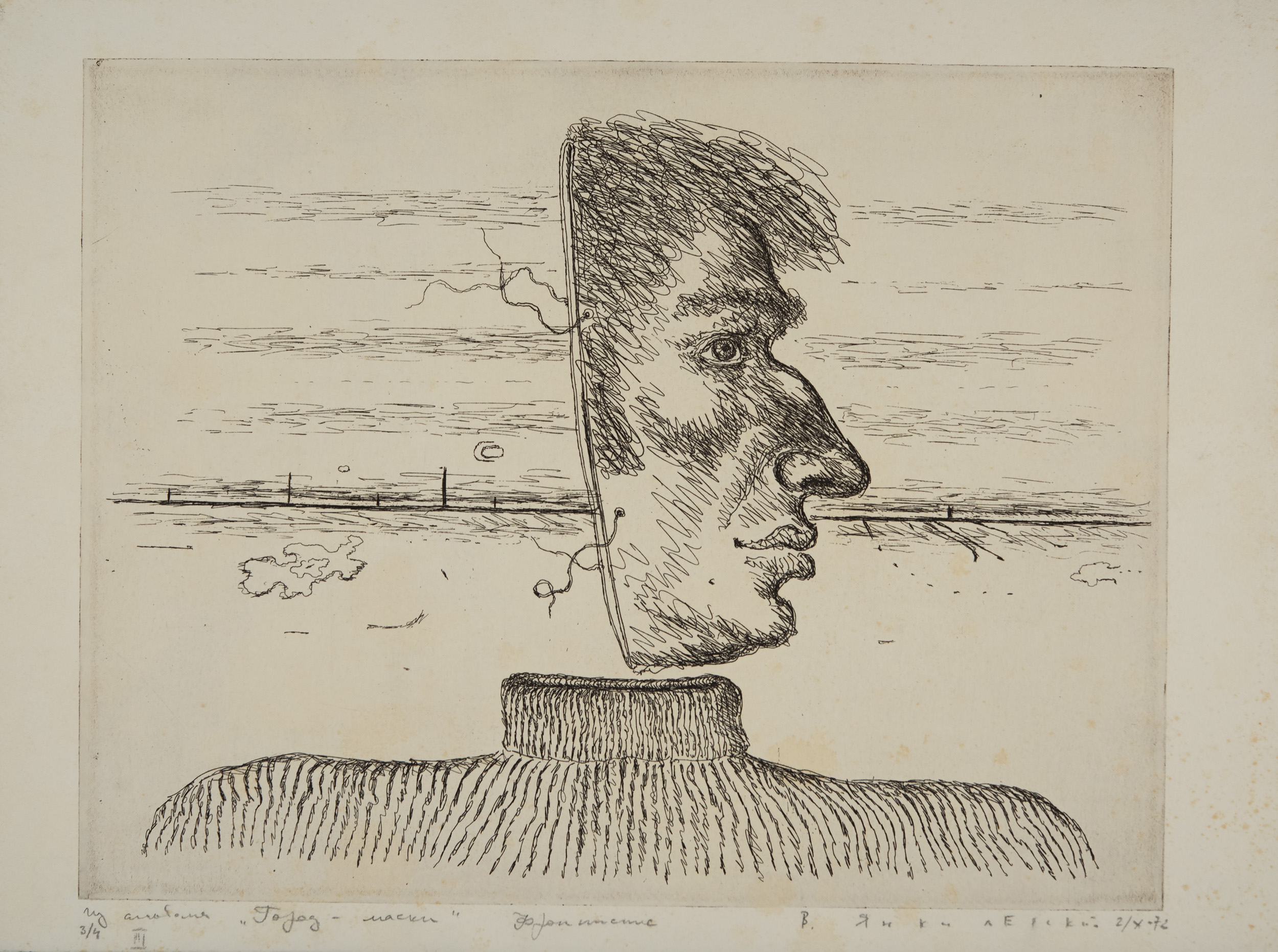
Frontispiece from the album of etchings City – Masks, 1972. Etching on paper, 24.6 x 32 cm (9 11/16 x 12 5/8 in.). Norton and Nancy Dodge Collection of Nonconformist Art from the Soviet Union. D00220
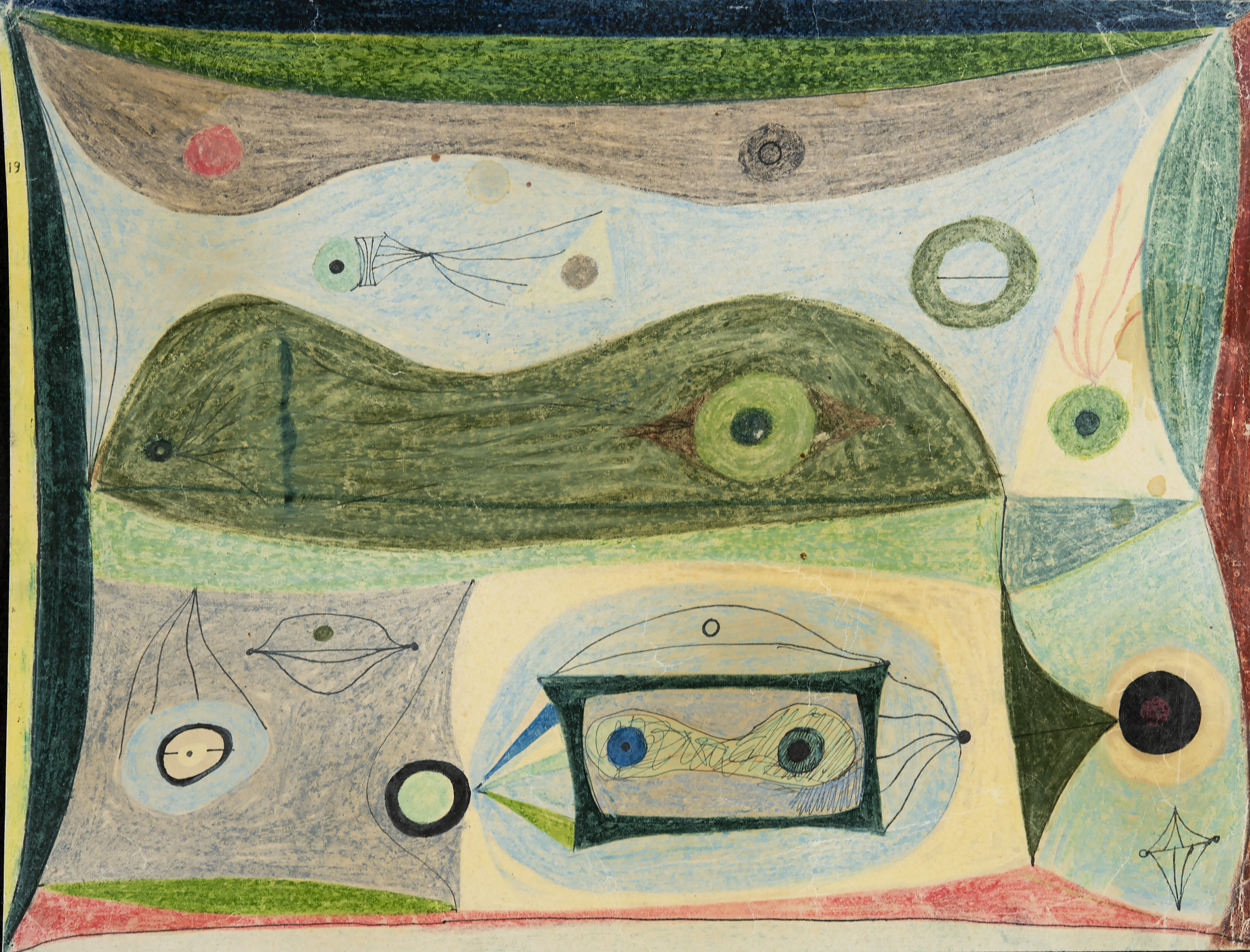
No. 5 from the series Theme and Improvisation, 1961. Crayon and ink on paper, 27.4 × 35.8 cm (10 13/16 × 14 1/8 in.). Norton and Nancy Dodge Collection of Nonconformist Art from the Soviet Union. D06897
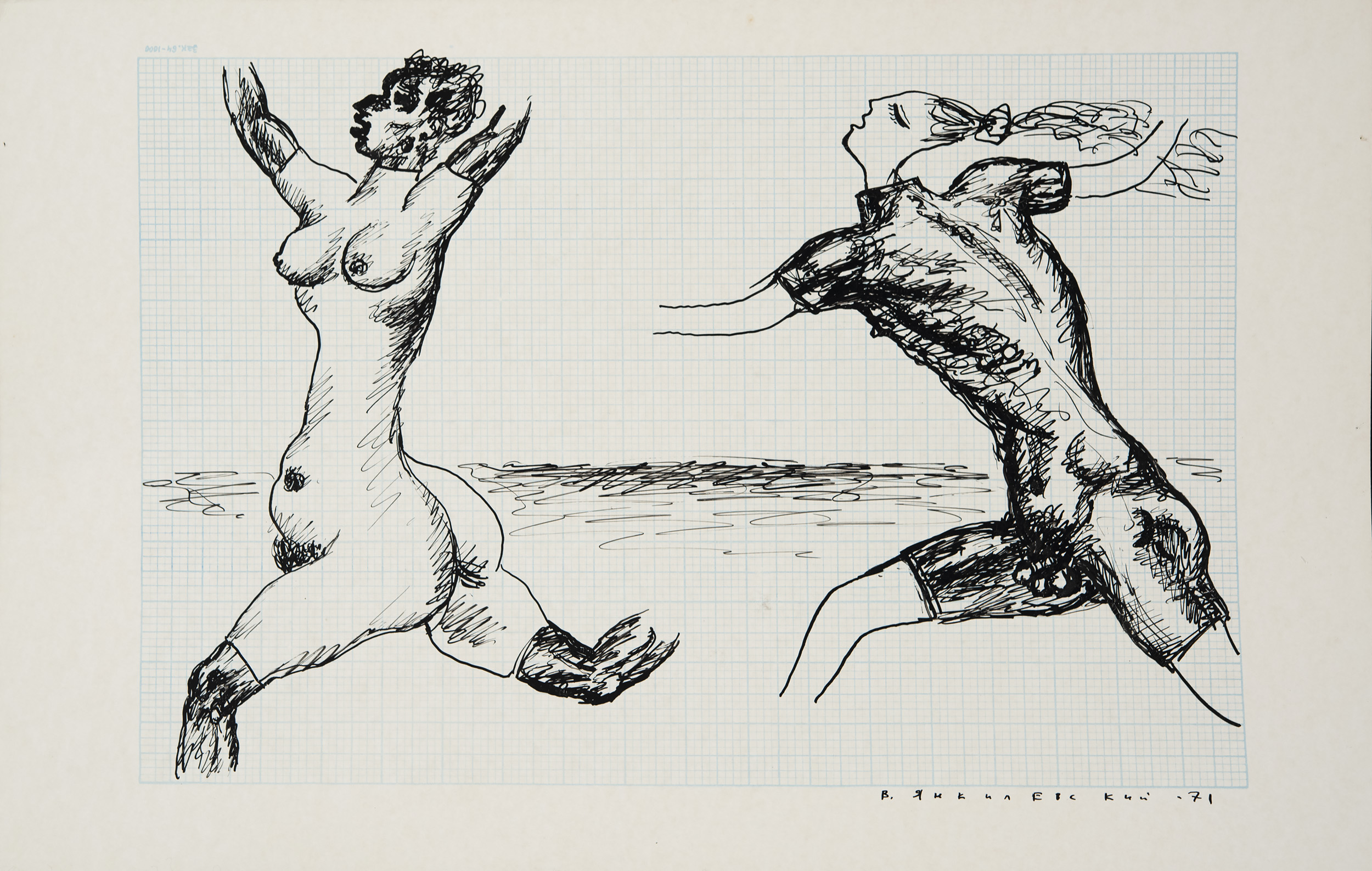
Pursuit, III, from the cycle Anatomy of Feelings, 1971. Ink on checkered paper, 26.1 x 40.5 cm (10 1/4 x 15 15/16 in.). Norton and Nancy Dodge Collection of Nonconformist Art from the Soviet Union. D01037

Nomenclature, from the album of etchings Mutants (Sodom and Gomorrah), 1978. Etching on paper, 29.3 × 34.8 cm (11 9/16 × 13 11/16 in.). Gift of Jack and Ruth Wexler. 1995.0296.001-002

Triptych no. 7: Song of Songs, 1967. Oil on fiberboard, wood, overall: 117 x 422 x 30 cm (117 x 93 x 30;117 x 230 x 20;117 x 99 x 30). Norton and Nancy Dodge Collection of Nonconformist Art from the Soviet Union. D04940.01-03

Pentaptych no. 2: Adam and Eve, 1980. Mixed media on fiberboard, 195 x 1126 x 29 cm (76 3/4 x 443 5/16 x 11 7/16 in.). Norton and Nancy Dodge Collection of Nonconformist Art from the Soviet Union. D05912.01-05