
Yuri Sobolev
1928 — Moscow (Russia) | 2002 — Pushkin (Russia). Worked in Moscow (Russia), Pushkin (Russia), and Zurich (Switzerland)
Yuri Sobolev graduated from the Moscow Polygraphic Institute in 1953 and spent the early part of his career practicing art criticism. (He shortened his hyphenated surname, Nolev-Sobolev, and went by Yuri Sobolev as a book designer and graphic artist.) As the author of reviews on book design, he collaborated with the magazines Tvorchestvo, Poligraficheskoe proizvodstvo, and the annual publication Iskusstvo knigi [The Art of the book] (1950s–’60s). In 1960, Sobolev became the head artist of the publishing house Znanie, which specialized in nonfiction. Soviet nonfiction books were subject to less censorship than other kinds of literature (such as belletristic, sociopolitical, or educational), where restrictions were quite rigid. As head artist, Sobolev introduced contemporary trends to the design department. He favored a collaborative approach to working on books, limiting his own role to that of artistic director and moderator, essentially performing the duties of a publishing-house art director before the profession emerged in the Soviet Union.
Along with Sobolev, a new generation of illustrators joined the publishing house: Boris Lavrov, Ruben Varshamov, Nikolai Popov, and Yuri Vashchenko, as well as several young artists who would become stars of the Russian contemporary art world: Ilya Kabakov (1933–2023), Ernst Neizvestny (1925–2016), Ülo Sooster (1924–1970), Viktor Pivovarov (b. 1937), Vladimir Yankilevsky (1938–2016), and Anatoly Brusilovsky (b.1932). Their designs for books and brochures became more image-driven; many of the illustrations were done in the style of surrealism, op art, or abstraction. In 1962, a group of artists led by Sobolev produced a collection titled Наука и человечество [Science and humanity], dedicated to achievements in modern science. On the masthead, Sobolev is listed as the “script author” of the collection, whose innovative design was based on a nonlinear montage of text and images. Yuri Gerchuk, a scholar and theorist of book design, wrote that in order to “visually embody the image of modern science, the book used an expressive language of associative montage, bringing together a variety of frequently contrastive images.” [1] A distinctive feature of Sobolev’s work is his inclusion of numerous visual dialogues between classical art and images from the modern world. Only two issues were published in this format (1962, 1963), after which the team of artists was barred from the project, in part because of the participation of Sobolev, Neizvestny, Sooster, and Yankilevsky in the exhibition 30 лет МОСХ [30 years of the Moscow Artists’ Union] at the Manege in 1962, after which Nikita Khrushchev cracked down on modernism and the artistic intelligentsia realized that free creativity would never be officially recognized in the USSR. After the exhibition, Sobolev left his position as head artist of the Znanie publishing house, though he stayed on as an illustrator until 1964.
Sobolev was one of the first designers in the Soviet Union to develop a modular-grid design for a magazine (Декоративное искусство СССР [Decorative art of the USSR], 1965, together with M. Zhukov and Y. Kurbatov). However, despite this promising start, he left Decorative Art of the USSR in order to return to nonfiction publishing. As the head artist of the magazine Znanie-sila [Knowledge is power] (1967–80), Sobolev recruited a new generation of artists: Valeriy Gerlovin (b. 1945), Vagrich Bakhchanyan (1938–2009), Elena Elagina (1949–2002), Alexei Ryumin, and the architect Vyacheslav Glazychev (1940–2012). Sobolev introduced a modular grid for the layout and emphasized photography and photo collage in the design.
As a guest designer, Sobolev worked for the publishing houses Detgiz, Molodaya Gvardiia, Iskusstvo, and Mir. He designed issues of the historical and biographical almanac Prometei [Prometheus] (1966–74), together with B. Zhutovsky and E. Neizvestny, as well as the books Young Poets from Arab Countries (1965); Bernard Shaw, by E. Hughes (1966); Botkin, by E. Nilov (1966); Reporting from No Man's Land: Stories About Information, by E. Sedov (1966), together with Zhutovsky; Lyrical Etudes, by E. Mezhelaitis (1969), together with Zhutovsky and Neizvestny); Chozenia, by V. Korotkevich (1969); Circus, by E. Kuznetsov (1971); The Intelligent Eye, by R. L. Gregory (1972); and more.
Sobolev’s worldview was greatly influenced by his friendship with Ülo Sooster; for several years in the late 1950s, the two artists rented a studio together. They designed books together (Glass River, by B. Dizhur, 1958; The Inexhaustible One, 1964), and filled the gaps in their art education: “now we were Cubists, now Dadaists, now Surrealists.” [2] Their friends’ avant-garde experiments included a staged performance (documented in photographs), which took place in Sooster’s studio on Sretensky Boulevard in Moscow (1968). Sobolev and Sooster led an informal art club at the Artisticheskoye [Artistic] Cafe in Moscow (1958), a gathering place for representatives of Moscow’s bohemian subculture. Sobolev’s room, which became known as “Zero’s Ark” (Нолев, a pun on Ноев [Noah’s]), was also a popular meeting place for artists in the early 1960s.
Together with Sooster, Sobolev was the production designer for the animated film Glass Harmonica (by director Andrei Khrzhanovsky, Soyuzmultfilm, 1968). The film was banned and the original copy destroyed (it was restored in the late 1980s by the director). Sobolev made his second animated film with Khrzhanovsky in 1972 (the second production designer was A. Arkadyev), and he worked as a production designer at the Mosfilm film studio (1976–80). Together with the director G. V. Aleksandrov, he worked on the restoration of Sergei Eisenstein’s unfinished film ¡Que viva México! (1932, released in 1979).
Sobolev’s graphic works of the ’60s are distinguished by a variety of techniques, themes, and images. The turn to “mythologisms” is a characteristic feature of the art of the ’60s. Isolation from the “open” development of contemporary art consigned the artists of the second avant-garde to an existence within the hermetically sealed space of “cultural metaphysics,” within which each artist developed his or her own set of images and symbols. (I. Kabakov) [3] A recurring motif in the artist’s work throughout the 1960s and early 1970s is the archetypal image of a woman that combines elements of nature—a tree, a bird, and a fish. This image—for example in Untitled (Woman-Bird) (1971, Radvila Palace Museum of Art, Lithuanian National Museum of Art)—takes on various connotations, ranging from the mythological siren to the surrealist “mermaid girl,” inspired by the works of René Magritte. Among the works from this period are several prints in the Norton and Nancy Dodge Collection of Nonconformist Art from the Soviet Union: Странник [The Wanderer] (1964, D12103, drypoint), Tree with Wings (1971, D12093, drypoint), and Святой Себастьян [St. Sebastian] (1965, D12104, etching).
His works from the 1970s reflect the spiritual questing common to artists of that period; there’s a turn to Buddhism, an interest in holistic philosophy, and a new-age aesthetic. An element of structural design appears in his graphic works: the pencil grid. The grid becomes the “zero layer” of his work, over which further images are superimposed. His most famous series from this period, Космос для собственного употребления [Cosmos for Personal Use] (1974–75, 46 sheets) consists of five parts: Земля [Earth], Вода [Water], Огонь [Fire], Воздух [Air], and Эфир [Ether]. The work incorporates quotations from Buddhist and Hindu iconography, vintage photographs, and images of mass culture. The collage technique and a preference for citation over improvisation made their first appearances in this series and remained part of Sobolev’s graphic style until the 1990s.
In 1974, as part of the working group of the All-Union Institute of Technical Aesthetics, Sobolev helped prepare a multiscreen slide film for the congress of the ICSID (International Council of Societies of Industrial Design in the Present—World Design Organization), which was held in Moscow in 1975. The visual concept of the multiscreen was to be an elaboration of Sobolev’s “montage principle”: images of art were incorporated into the flow of everyday goods. However, the multiscreen was banned, since the concept of the film did not correspond to the idea of the design forum. Sobolev continued to make slide films; together with Yuri Reshetnikov, he worked on a multiscreen slide show Письма войны [Wartime Letters] (1982) for the City Museum of Dneprodzerzhinsk (today Kamianske, Ukraine) . Between1974 and 1996, he made more than ten slide films, including one dedicated to the work of Ülo Sooster (1979, All-Russian Theater Society), Ты услышишь эту музыку однажды [You will hear this music someday] (1986, Tbilisi-86 Jazz Music Festival), ODMO (1988; the exhibition Ich lebe — Ich sehe [I live, I see], Kunstmuseum Bern), and others.
From 1980 to 1996, Sobolev collaborated with the puppet theater director Mikhail Khusid; in their work together, they sought to create a synthetic environment by including contemporary art genres in their shows (performance, installation, slide film, multimedia). Together with Khusid, he worked in puppet theaters across the Southern Urals; their productions include Почта [Mail], for the Theater of Man, Object and Puppet in Tyumen, 1981; Что было после спасения [What Happened After Salvation], for the Labyrinth Theater in Chelyabinsk, 1987–88; and Я, Фауст [I, Faust] 1988–89, also in Chelyabinsk.
From 1988 to 1992, he lived and worked in Switzerland and Russia. He spent the last years of his life in Pushkin (Tsarskoye Selo), where in 1990, together with M. A. Khusid and J. Sobrekas, he founded the Interstudio International Workshop of Synthesis and Animation. The workshop had three areas of focus: it functioned as a theater and a school of contemporary art, and it organized the international puppet theater festival “KUKART,” with Sobolev serving as the art director of musical and visual programs (1993–2001). Sobolev also served as the production designer and cowriter of Дон Жуан [Don Juan] (1992) and Бобо мертва. Прости мне, Вавилон [Bobo is dead. Forgive me, Babylon] (1996), directed by M. Khusid—both for the Interstudio theater workshop. As an instructor at the Saint Petersburg State Academy of Theatrical Art, he taught a course on “the artist of paratheatrical forms” (Tsarskoye Selo branch, 1991–96).
Anna Romanova
Translated from Russian by Philip Redko
Notes:
1. Gerchuk, Yuri. “Юрий Соболев — режиссер современной книги” [Yuri Sobolev – stage director of vontemporary book], in о.с.т.р.о.в.а Юрия Соболева [Yuri Sobolev's islands], edited by Nelli Podgorskaya, Anna Soboleva, and Galina Metelichenko. Moscow: Moscow Museum of Modern Art, 2014,:117.
2. Другое искусство. Москва 1956 –76. К хронике художественной жизни [Other Art. Moscow 1956–76. Towards a Chronicle of Artistic Life]. Volume 1. Moscow: Art Gallery “Moscow Collection”, 1991: 24.
3. Kabakov, Ilya. 60 — 70-е... Записки о неофициальной жизни в Москве [60s–70s. Notes on Unofficial Life in Moscow]. Moscow: Novoe Literaturnoe Obozrenie, 2008: 48.
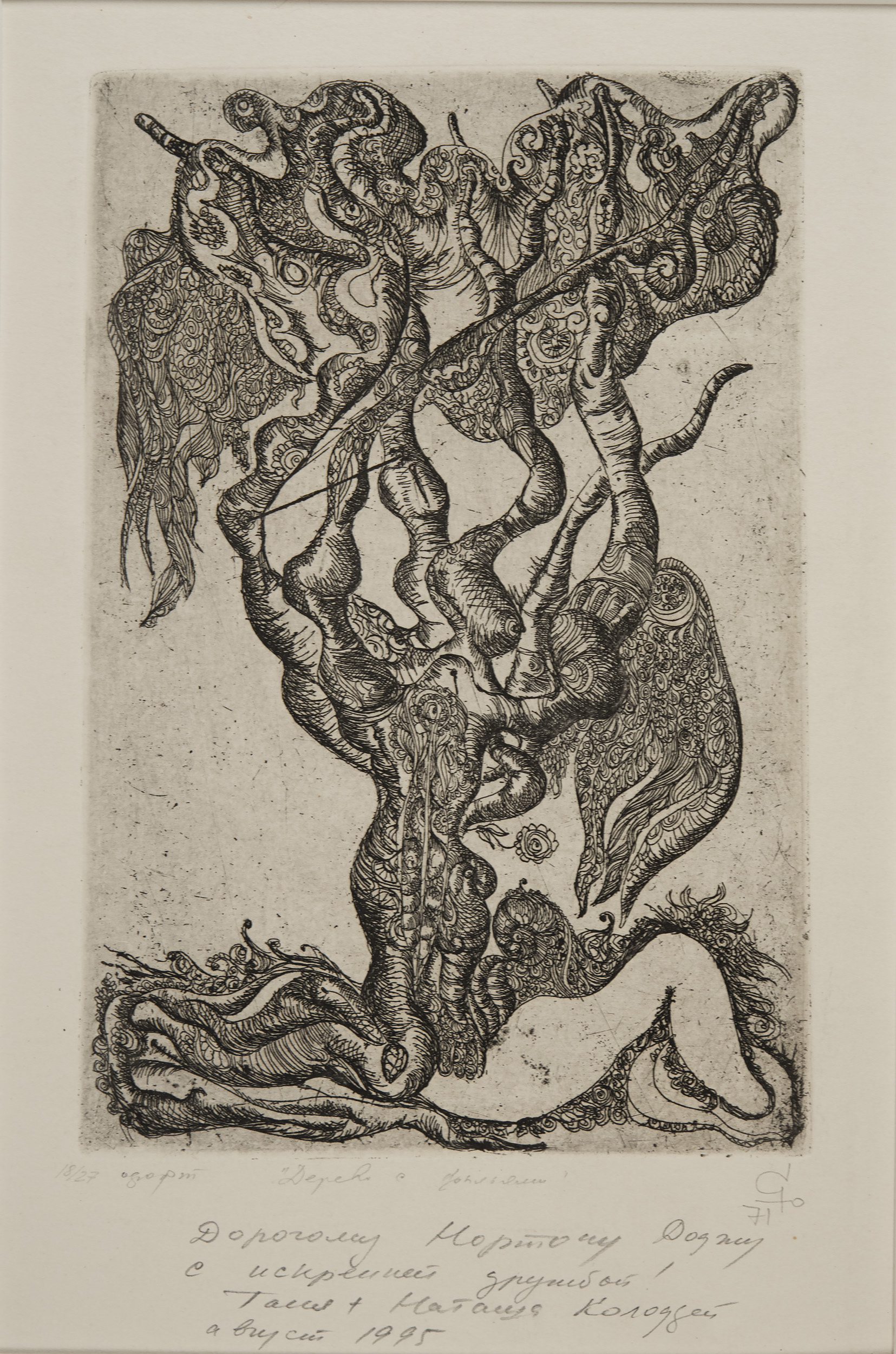
Tree with Wings, 1971. Etching on paper, 21.2 x 14.2 cm (8 3/8 x 5 9/16 in.). Norton and Nancy Dodge Collection of Nonconformist Art from the Soviet Union. D12093
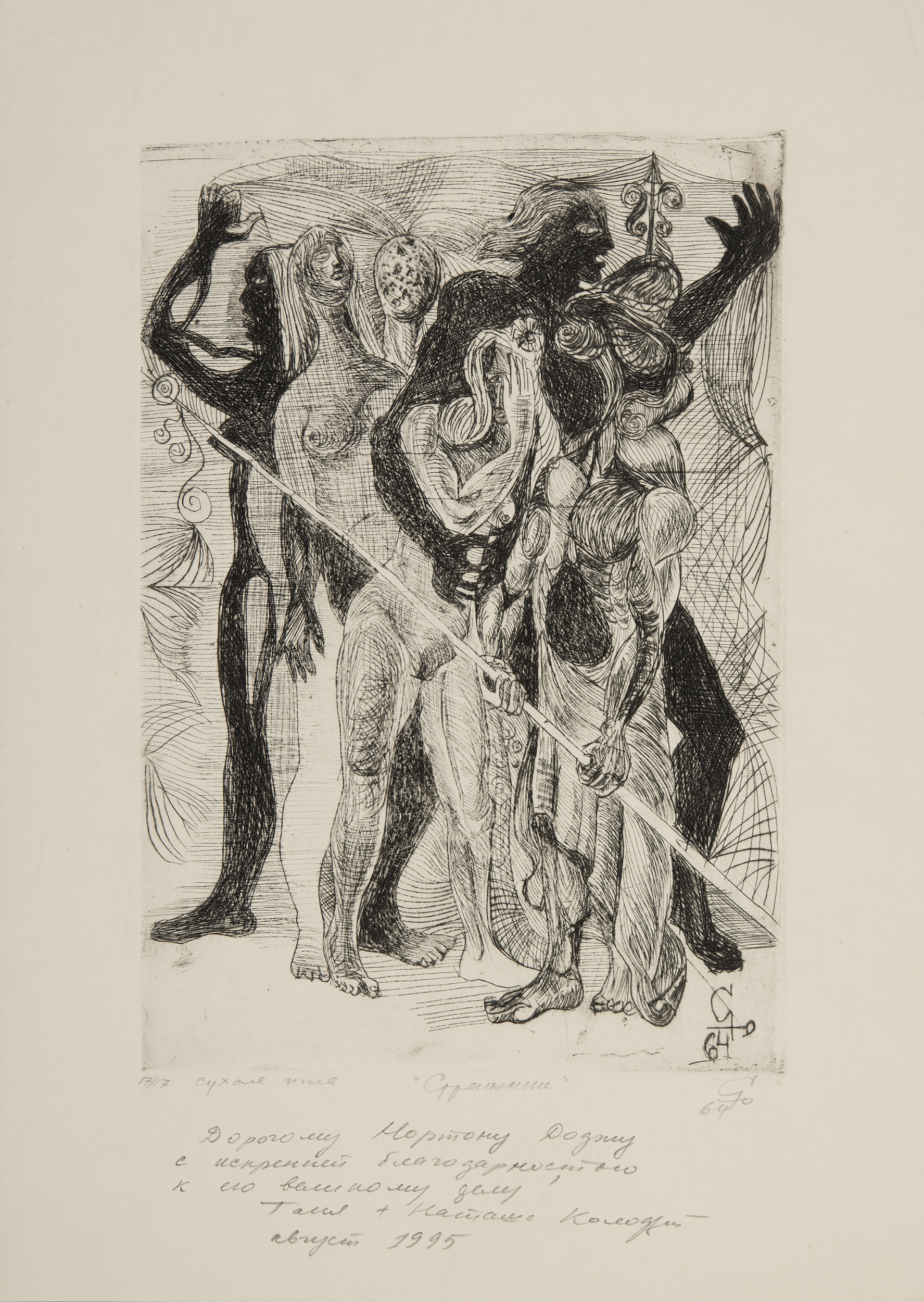
The Wanderer, 1964. Etching on paper, 24.9 x 17 cm (9 13/16 x 6 11/16 in.). Norton and Nancy Dodge Collection of Nonconformist Art from the Soviet Union. D12103
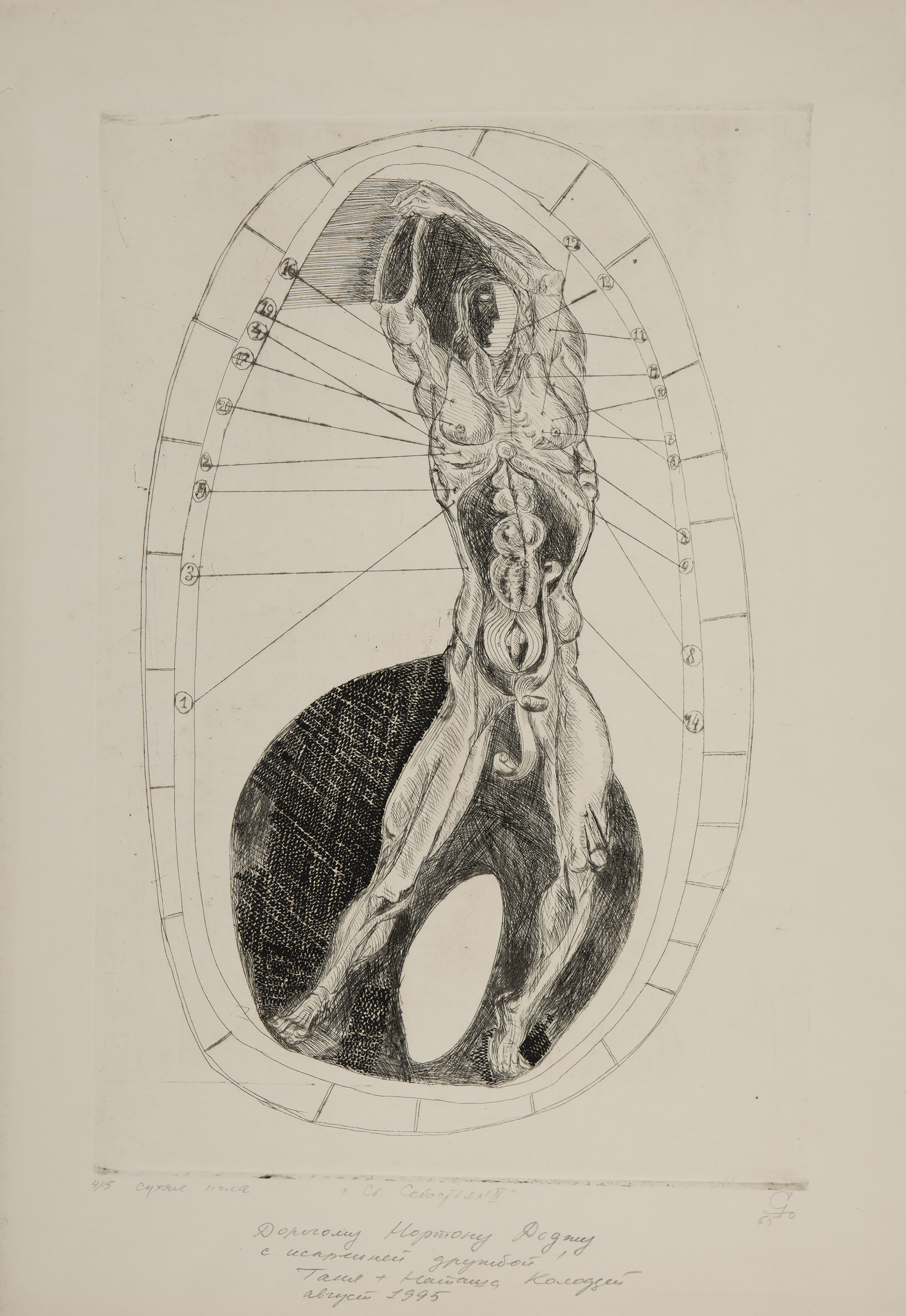
St. Sebastian, 1965. Etching on paper, 39 x 25.8 cm (15 3/8 x 10 3/16 in.). Norton and Nancy Dodge Collection of Nonconformist Art from the Soviet Union. D12104