
Ülo Sooster
1924 — Ühtri, Hiiumaa island (Estonia) | 1970 — Moscow (Russia). Worked in Tartu (Estonia), Karaganda (Kazakhstan), and Moscow (Russia)
Ülo Sooster was born in 1924 in the village of Ühtri on the island of Hiiumaa, in the western part of the Republic of Estonia. He received his art education from 1944 to 1949 at the renowned Pallas Higher Art School in Tartu (now Pallas University of Applied Sciences). By the time of his studies, Estonia was already occupied by the Soviet Union and art education was increasingly dominated by socialist realism. The school was renamed Tartu State Art Institute in 1944, and the teaching staff was gradually replaced with hard-line Stalinists. Nevertheless, because of its Paris-style studio system, Sooster managed to study with notable modernists such as Ado Vabbe and Elmar Kits shortly before they were fired for propagating Western-style formalism at the school.
At the Tartu State Art Institute, Sooster met the talented art students Valve Janov, Silvia Jõgever, Kaja Kärner, Lüüdia Vallimäe-Mark, Lembit Saarts, and Heldur Viires, who later formed the underground modernist-oriented group the Tartu Circle. After graduating in 1949, Sooster was arrested together with several of his fellow students and sentenced to twenty-five years in the Karaganda labor camp. In the Gulag system, political prisoners—including members of the creative intelligentsia—were indiscriminately mixed with criminal prisoners, and making art was strictly forbidden and punishable. During the early prison years, Sooster created only tiny pencil drawings of his prison mates and camp views scribbled on small scraps of paper. However, it was in these small-scale labor camp drawings that Sooster arrived at surrealism.
In 1954 Sooster was appointed to the position of artist at the Dolinka labor camp, finally gaining access to oil paints. In the next few years, he painted some fifty self-portraits that convey the tribulations and the psychological states of the young artist in the Gulag environment. After the death of Stalin, Nikita Khrushchev was appointed general secretary of the Soviet Union and in 1956 began his de-Stalinization policy, under which political prisoners were rehabilitated, and Sooster’s sentence was reduced to seven years. After his release in 1956, Sooster married Lidia Serh (later Sooster), an artist at the neighboring women’s camp whom he had met a few years earlier through work duties. After failed attempts to settle in Estonia, the couple finally moved to Lidia’s hometown, Moscow, in 1957. It was here that Sooster started to develop his signature style, which integrated his French-influenced modernist art education, intense study of the work of Picasso and European modernism, close reading of Sigmund Freud, leitmotifs from Estonian nature, and newly found relief painting technique.
The three leitmotifs in Sooster’s work— the juniper, the fish, and the egg— have all been associated with his birthplace on the island of Hiiumaa. The fish connected Sooster to his fellow students in the Tartu Circle: Employed as a surrealist motif with anthropomorphic features, fish could be used to caricature Soviet leaders, and their patterned scales could hide forbidden abstract experiments. Junipers became one of the most analytical motifs in Sooster’s works, and he used them to develop his serial method of creation, which his close friend the Moscow Conceptualist artist Ilya Kabakov has analyzed in his monograph about Sooster. [1] The egg, as a mysterious object and ideal sculptural shape, united Sooster with European surrealists. According to Elnara Taidre, Sooster’s three leitmotifs form the foundation of his artistic mythology, the unique aesthetic-philosophical system that the artist created. [2]
The formal genealogy of Sooster’s junipers can easily be traced, from the motif’s first appearance in the artist’s drawings and paintings in the 1940s; to its development during the severe style of the late 1950s; to its use in the middle of the 1960s as a means of creating optical effects; to the textured, semi-abstract experiments of his late metaphysical paintings. In the beginning of the 1960s, Sooster started developing a modular composition system in a number of his pictures in which he created different sequences of junipers using horizontal, vertical, and small circular modules. Drawing was the creative laboratory where he tested and developed ideas for paintings; a pencil drawing showing the same juniper modules in four different placements (Tartu Art Museum) documents the development of the modular composition system. Sooster first introduced the system in his paintings Mustad kadakad [Black Junipers] (1961, Tartu Art Museum) and later employed it in his seminal works Värvilised kadakad [Colorful Junipers] (1963, private collection and 1966, private collection) and Valged kadakad [White Junipers] (1967–70, Tartu Art Museum).
The egg, a motif that had captivated Salvador Dalí, René Magritte, Max Ernst, and Man Ray, connected Sooster with the European surrealist movement. For Sooster, the egg was an archetype that allowed him to ponder universal questions such as life and death, as well as the smallest particles of physics and biology and the Big Bang. According to the art historian Eha Komissarov, Sooster's egg motif is characterized by endless ambiguity and a tendency to point to ever-new associations. [3] He used it to explore his interest in science, depicting microscopic images of cells and referring to scientific illustrations of the atom’s nucleus. During the 1960s Sooster developed imagery of a giant egg placed in a panoramic landscape, which he used in several of his most iconic compositions, such as Punane muna [Red Egg] (1964, private collection) and Valge muna [White Egg] (1968–70, Tartu Art Museum). Among the last unfinished paintings that were found in his studio were two modular egg compositions, Neljaks jaotatud muna rohelisel foonil [Egg Divided into Four on a Green Background] (1969–70, Art Museum of Estonia) and Neljaks jaotatud muna sinisel foonil [Egg Divided into Four on a Blue Background] (1969–70, Art Museum of Estonia), revealing the thinking of late Sooster.
In one of his most transgressive works, Huuled [The Lips] (1964, Art Museum of Estonia), Sooster created an ambiguous motif that suggested both the lips and the vagina, and whose eroticism deviated from the traditional male gaze, bordering on the abject. [4] His deconstruction of female bodies soon developed into what Ilya Kabakov has called a “living lump”: a surrealist-organic abstraction that sometimes bears references to the monstrous. [1] In Moscow unofficial art circles, Sooster quickly became a legendary figure, whose closest friends were Ilya Kabakov, Sooster’s studio neighbor on Sretensky Boulevard, and Yuri Sobolev, artistic director of the publishing house Znanie-Sila. Sooster also regularly visited his artist friends in Tartu and became a bridge between the nonofficial art circles of Moscow and Tallinn. Sooster’s participation in the notorious Manege Affair in 1962 ended the artist's opportunities to show his works in the Soviet Union. Nikita Khrushchev, on visiting the exhibition 30 Years of the Moscow Artists' Union at the Moscow Manege—which included two of Sooster’s seminal paintings, Silm munas [The Eye in the Egg] (1962, Tartu Art Museum) and Suured kadakad [Big Junipers] (1962, Tartu Art Museum)—became infuriated with Sooster and his artist friends and threatened to send them to the Gulag. This event is seen by art historians as one of the dates marking the end of the Thaw in Moscow.
Not belonging to the Soviet Union of Artists, Sooster earned his livelihood from illustrating science and fiction books, working mainly for the Moscow publishing house Znanie-Sila. The first solo exhibition of his works was held at the Tartu Art Museum in 1971, after the artist’s premature death in his Moscow studio the year before. In 2001 the Art Museum of Estonia organized a retrospective of Sooster’s oeuvre, which the artist’s family had gradually returned to Estonia. Sooster’s works can be found in the collections of the Tartu Art Museum and the Art Museum of Estonia in Tallinn, as well as the Tretyakov Gallery in Moscow, Zimmerli Art Museum, and Prague National Gallery.
Liisa Kaljula
Photo portrait: Ülo Sooster in Ilya Kabakov´s studio about 1965. Photo by Jaan Klõšeiko. Art Museum of Estonia. EKM j 55018:4 FK 308:4
Notes
1. Kabakov, Ilya. On Ülo Sooster’s Paintings. (Tallinn: Kunst, 1996).
2. Taidre, Elnara, Cosmology of Sooster’s Artistic Mythology (Tallinn: Art Museum of Estonia, 2024), 55.
3. Eha Komissarov, “Surrealistlik Sooster,” in Ülo Sooster 1927–1970: Mälestusnäitus (Talinn: Eesti Kunstimuuseum, 2001), 24.
4. Liisa Kaljula, “Sooster: Abject,” in Ülo Sooster (Talinn: Art Museum of Estonia, 2024), 223.
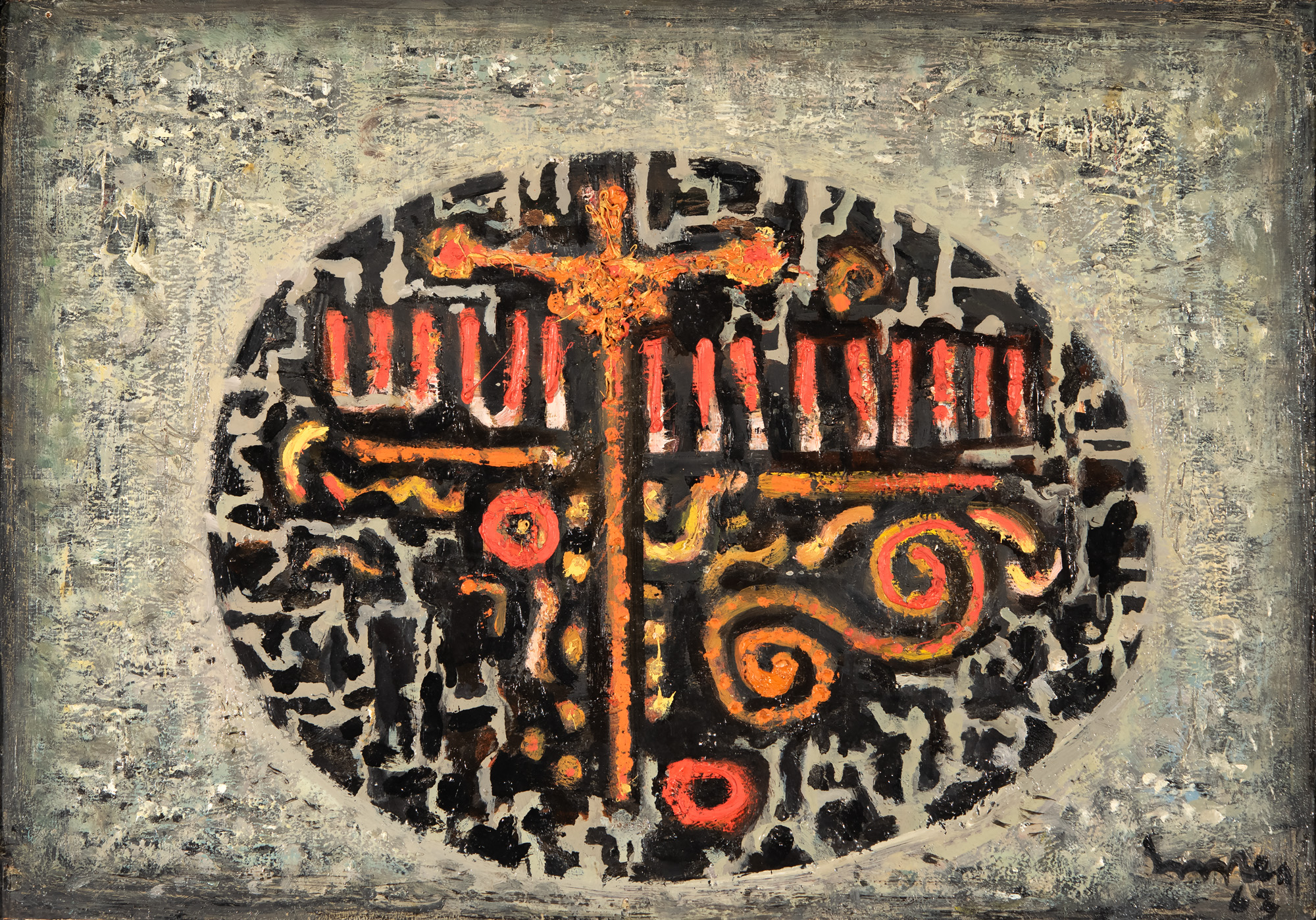
(Untitled), 1963. Oil on illustration board, 34.4 × 49.7 cm (13 9/16 × 19 9/16 in.). Norton and Nancy Dodge Collection of Nonconformist Art from the Soviet Union. D02716

(Untitled), undated. Watercolor and monotype on paper, 20.5 × 29.5 cm (8 1/16 × 11 5/8 in.). Norton and Nancy Dodge Collection of Nonconformist Art from the Soviet Union. D07243
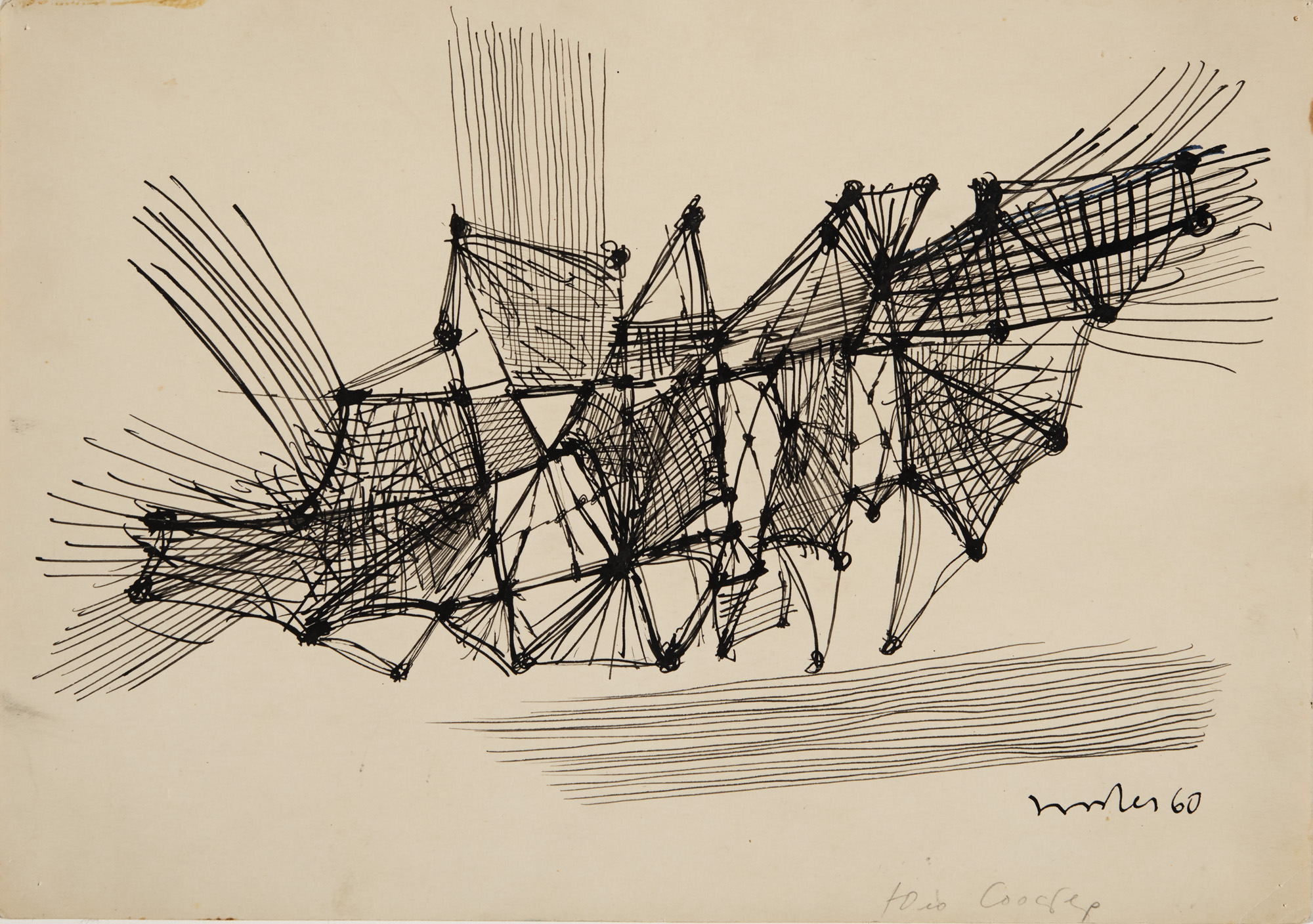
Untitled, undated. Ink on paper, 19 × 27 cm (7 1/2 × 10 5/8 in.). Norton and Nancy Dodge Collection of Nonconformist Art from the Soviet Union. D16699

Untitled (Female), 1964. Ink on paper, 19 x 27.2 cm (7 1/2 x 10 11/16 in.). Norton and Nancy Dodge Collection of Nonconformist Art from the Soviet Union. D17093
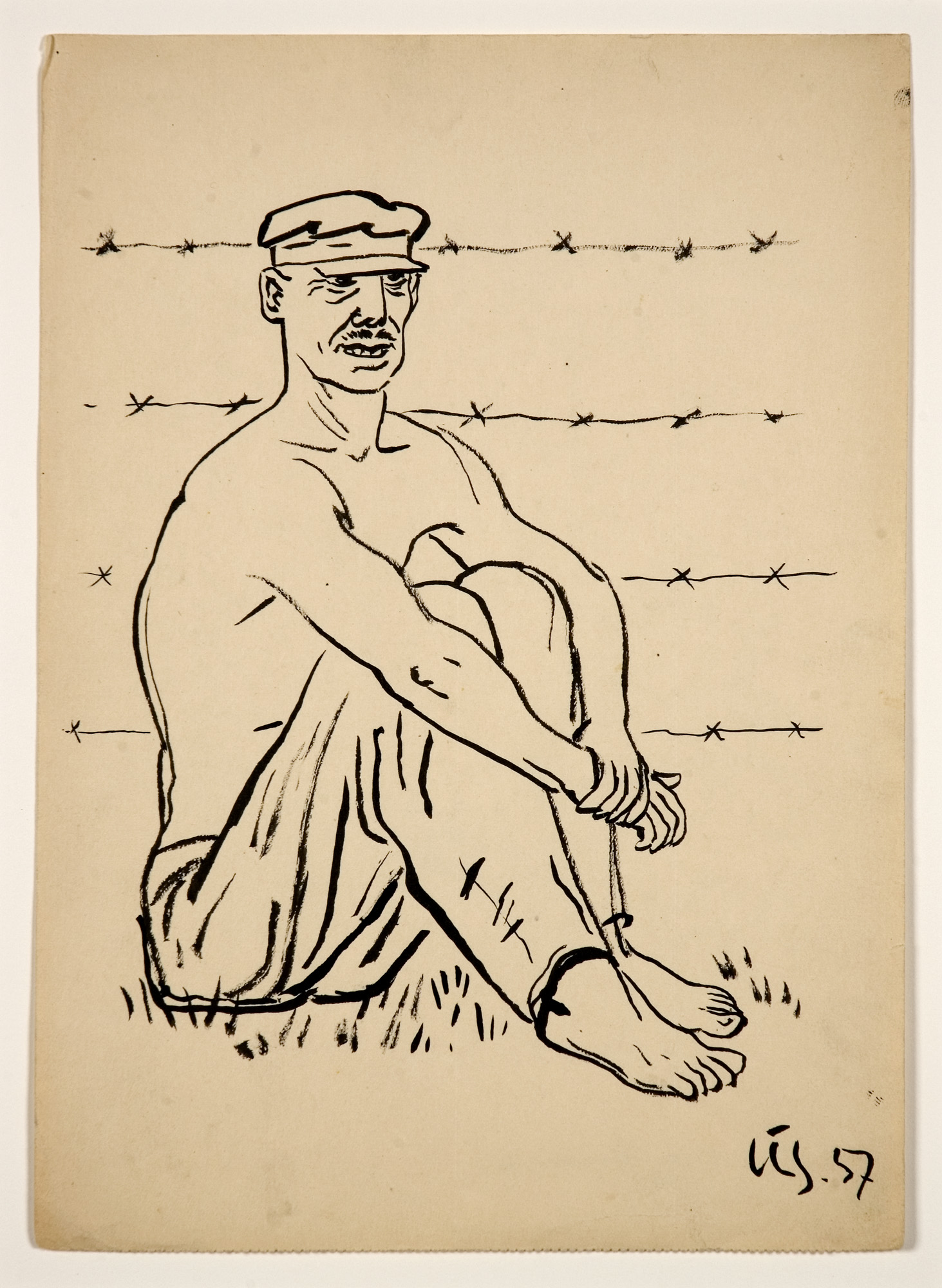
Prisoner, 1957. Ink on paper, 28.3 × 20.2 cm (11 1/8 × 7 15/16 in.). Norton and Nancy Dodge Collection of Nonconformist Art from the Soviet Union. D17092

(Untitled), 1961. Ink on paper, 27.2 × 19.1 cm (10 11/16 × 7 1/2 in.). Norton and Nancy Dodge Collection of Nonconformist Art from the Soviet Union. D08417