
Nikolai Filatov
1951 — Lviv (Ukraine). Lived and worked in Russia since 1982, dividing his time between Moscow and Pereslavl-Zalessky, Yaroslavl region (Russia)
As a painter, a graphic artist, a creator of art objects and installations, and a representative of the underground of the 1980s, Nikolai Filatov developed the original idea of the “permanence of the revolution,” referring to the artistic traditions of the Russian avant-garde (in particular, cubo-futurism). He also contributed to the development of hyperrealism and neo-expressionism. In addition, he was a pioneer of the artistic practice known as squatting in the USSR.
Filatov was born on July 10, 1951, in Lviv, to a family of a musician and teacher at the Lviv State Conservatory (now the Mykola Lysenko Lviv National Music Academy). He graduated from the Lviv Institute of Decorative and Applied Arts (now the Lviv National Academy of Arts) in 1977. From the late 1970s onward, Filatov visited Moscow regularly, joining the ranks of the so-called unofficial artists. His first solo exhibition was an underground show at 28 Malaia Gruzinskaia Street in Moscow in 1978, where he presented artworks influenced by hyperrealism.
From 1980 to 1981, Filatov studied at the Moscow Higher School of Art and Industry. In 1984 he became a member of the Moscow branch of the Union of Soviet Artists.
At this time, Filatov continued to work in a hyperrealist style, and in 1980, together with Kyiv’s Serhii Bazylev (b. 1952) and Sergei Geta (b. 1951), and Moscow’s Aleksei Tegin (b. 1951) and Sergei Sherstiuk (1951–1998), he created the Group of Six. [1] Although the artists had experimented with photorealistic painting before this, hyperrealism really took shape as a movement in the USSR after the exhibition American Painting of the Second Half of the Nineteenth and Twentieth Centuries (1980), which was held at the Pushkin State Museum of Fine Arts, and which featured works by Chuck Close (1940–2021), Richard Estes (b. 1932), and Ralph Goings (1928–2016). As his colleagues later recalled, Filatov’s interest in hyperrealism in the 1970s in Lviv resulted in his painting with an airbrush in imitation of the poor quality of an image on a television screen.
In the spring of 1985, Filatov, along with the Russian artists Andrei Roiter (b. 1960) and German Vinogradov (1957–2022), created the first Moscow squat, called Детский сад [Kindergarten in Russian], where underground artists could meet, exhibit, and store their work. This former kindergarten in Khokhlovskii Lane was in an old two-story building that had been mothballed pending renovation. The building was taken over by art workshops, installation spaces, and temporary exhibitions. The artists’ experiments were aimed at mastering new artistic trends, in particular postmodern New Wave painting. It was here that Filatov began to create monumental paintings in the neoexpressionist style.
The works of the three artists Filatov, Roiter, and Vinogradov had no stylistic overlap; however, they were united by their openness to experimentation and in their understanding of squatting as an unprecedented new and open way to live. In addition to these three artists (the fourth was the sculptor Aleksei Ivanov), the Kindergarten was visited by representatives of various artistic movements: Muscovite conceptualists, the older generation of the underground, artists from the Saint Petersburg circle of Timur Novikov (1958–2002), Odesan conceptualists, Kyivan hyperrealists, and artists from Lviv, as well as musicians and filmmakers. Western gallerists and collectors also visited the squat, which lasted less than a year and a half, until November 1986.
Filatov, who was present when the ideology of the Kindergarten was being formed, defended the principle of freedom, which permitted interaction between any artistic form and idea. This conscious refusal to seek a specific position in art or to belong to the intellectual mainstream is also inherent in Filatov’s own art. His works of this period, which combined neoexpressionist tendencies and elements of cubism, symbolized, for the artist, a generalized image of the history of Russian avant-garde ideas, which also included such utopian thinking as Russian cosmism and communism. For example, his Futurist with Red (1985, ZAM, 1994.0376) borrows from the language of cubism with its ascetic use of color and geometrized forms, but the title itself and the somewhat arbitrary nature of the geometrization indicate the author’s ironic detachment.
In 1987 Filatov joined the squat in Furmanny Lane. Here, he continued to work in a neoexpressionist manner, creating fast and wild images. He chose cubo-futurism as his starting point, joining a postmodern irony with the pathos of the Russian avant-garde of the 1910s and 1920s. Without referencing specific artists, Filatov instead created more stereotypically cubist paintings, using stock characters and bright colors, and building on the dynamic balance between different contrasting areas of the painting. He used expressive brushstrokes and borrowed the cubist principle of constructing images in a simplified and geometric way. His works were simultaneously reminiscent of the early works of Kazimir Malevich (1879–1935) or David Burliuk (1882–1967) (more illogical than cubist). Through his use of irony and historical skepticism, Filatov turned the avant-garde aspiration for a bright future into an “arrow pointing nowhere.” [2] For example, his works Трактор [Tractor] (1988, ZAM, D02153) and Марс [Mars] (1988, ZAM, D02154) consist of triangles and squares created by expressive brushstrokes. Behind the apparent chaos of colors and lines, multifaceted structures are seen disintegrating, forcing us to reflect on the conflict between form and idea that is inherent in the avant-garde.
In 1987, in Moscow, Filatov took part in the first exhibition of the Avant-Garde Club and held his first public solo exhibition. [3] In the years following, he continued to work in the style of neo-expressionism, creating monumental paintings based on cubo-futurism and irrationality.
In the 2000s, Filatov continued his dialogue with the avant-garde not only in painting but also using other media, such as his Спіралі [Spirals] project (2006). This consisted of a large number of spirals, all modified slightly differently, with different scales, colors, materials, and varying textures. Starting with the familiar, common, and banal, which is transformed by the mass media from high art to design and kitsch, the artist created art objects that were ironic and open to interpretation, thus covering a wide range of meanings, from a model of a galaxy or a historical development to an aromatic insecticide.
Половецькі пляски [The Polovtsian Dances] project (2020) was a milestone in Filatov’s career. Continuing to develop his dialogue with the avant-garde, Filatov immersed himself in its origins, which he interpreted as being unspoiled by civilization, nonacademic in form, and the embodiment of the spirit of freedom, carnival, and nature. Irony, a distance from high culture, and a deliberate negligence of performance are fundamentally at the heart of this project, which acts as a polemic in particular with the composer Alexander Borodin and his Polovtsian Dances from the opera Prince Igor (1890). Filatov moved away from using contrasting, saturated primary colors (which was typical of his previous works) to a more restrained and complex play of tones, using pastel colors. The dancing figures are presented in various historical and artistic interpretations, from cubist, expressionist, and abstract ones, characterized by emotional brushstrokes, to the use of more plastic outlines for the human form, softening the avant-garde geometricism characteristic of Filatov’s recognizable individual style. His references to the origins of contemporary art of the twentieth century can be seen as a stance against the dominance of the market or those tendencies dictating the fashion for constantly changing trends in contemporary art.
In the 1980s and 2000s, Mykola Filatov often visited Lviv and maintained ties with Ukrainian artists (Andrii Sahaidakovs’kyi, Yurii Sokolov, and Andrii Boiarov, among others). In 2019 his works were presented at the exhibition Сквот: Фурманний провулок [Squat: Furmanny Lane] in Kyiv, curated by the gallery owner Yevhen Karas.
Oksana Barshynova
Translated from Ukrainian by Nathan Jeffers
Notes:
1. The group also included Lviv resident Igor Kopystiansky, who has since renounced his affiliation with the group.
2. “Ракурс 14: Фурманный переулок” [Rakurs 14: Furmannyi pereulok, Angle 14: Furmannyi Lane], Dialogue of Arts, no. 3 (2012).
3. The Avant-Garde Club (KLAVA) was the first registered association of unofficial artists in the USSR, founded in 1987 in Moscow. Its headquarters was the exhibition hall of the Proletarsky District, and its members included Joseph Backshtein (1945–2024; executive director and curator), Boris Matrosov (b. 1965) (chairman), Nikita Alekseev (1953–2021), Sergei Anufriev (b. 1964), Sven Gundlakh (b. 1959), Elena Elagina (1949–2002), Georgy Kiesewalter (b. 1955), Igor Makarevich (b. 1943), Andrei Monastyrski (b. 1949), Irina Nakhova (b. 1955), Dmitri Prigov (1940–2007), Lev Rubinshtein (1947–2024), and Andrei Filippov (1959–2022). KLAVA was famous for its exhibition-actions that were held in places unusual for contemporary art. Among the most famous projects was the exhibition Baths (men’s section of the Sandunovskie baths, 1988) and the exhibition held in the Butyrka Prison (1992), curated by Joseph Bakshtein.
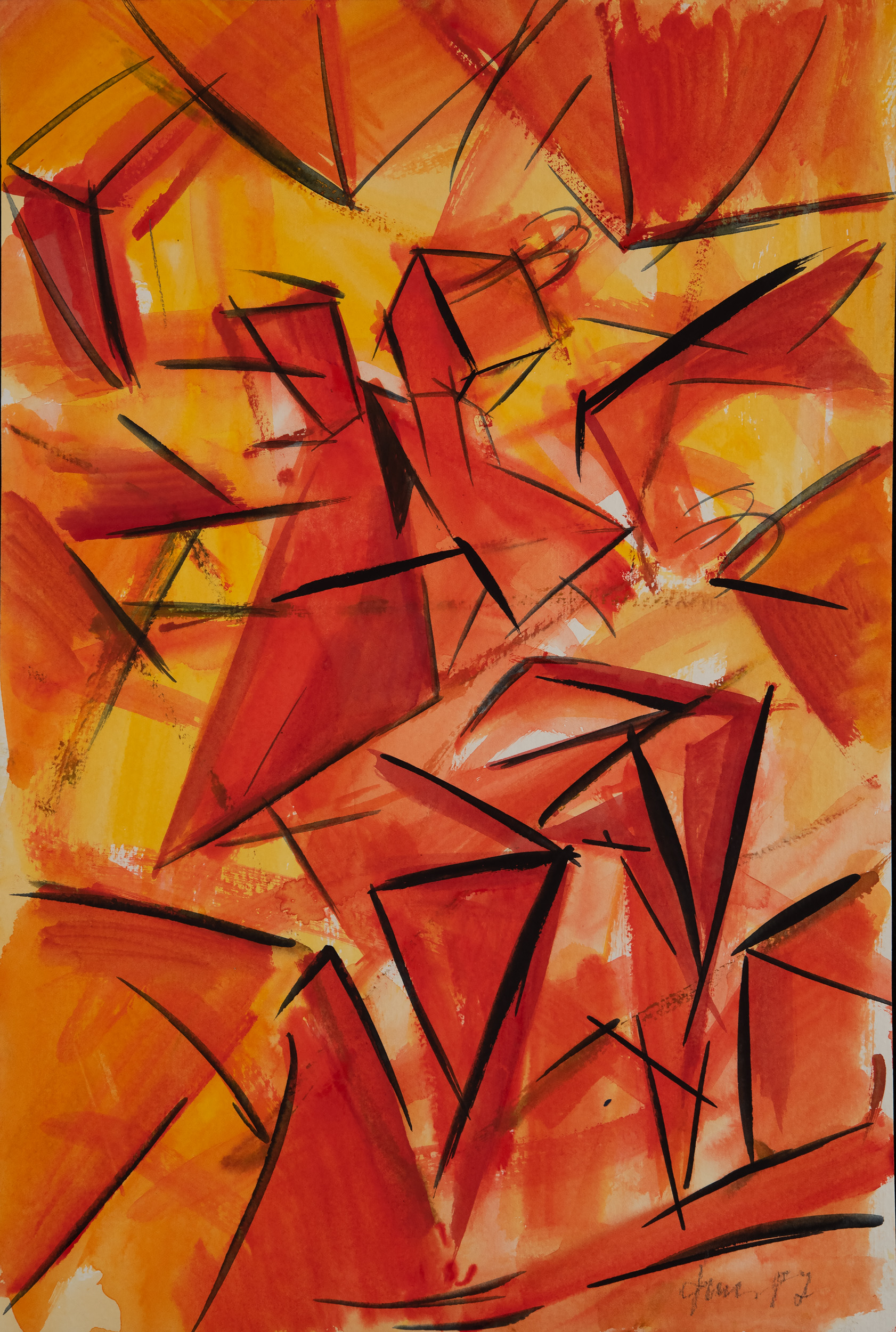
Under the Sun, 1987. Watercolor on paper, 44.6 × 30.4 cm (17 9/16 × 11 15/16 in.). Gift of Vlad Meisher. 1994.0399
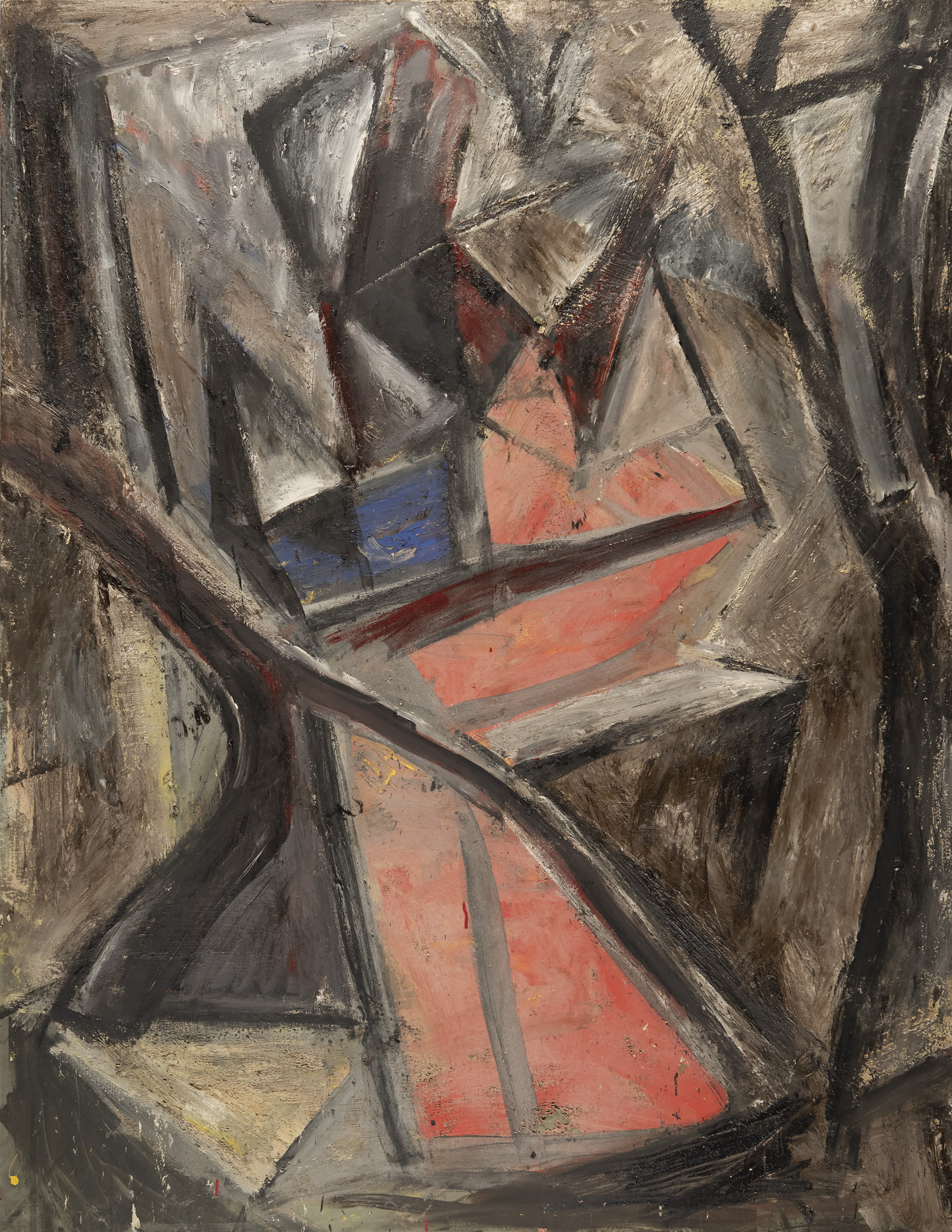
Red Crystal, 1985–86. Oil on canvas, 176.5 × 138.5 cm (69 1/2 × 54 1/2 in.). Gift of Robert E. Falcone. 1995.1018

Wooden Idol, 1984. Oil on canvas, 147.6 x 112.2 cm (58 1/8 x 44 3/16 in.). Gift of Joseph G. Masarich. 1993.0744