

Sergei Geta (Heta)
1951 — Kyiv (Ukraine). Worked in Kyiv (Ukraine) and Moscow (Russia)
Sergei Geta is a Ukrainian and Russian artist, book illustrator, printmaker, fine artist of works on paper, painter, and representative of hyperrealism in Soviet and post-Soviet art.
Geta graduated from the graphic arts department of the Kyiv State Art Institute (now National Academy of Fine Arts and Architecture) in 1976, where he studied under Vasyl Kasiian and Vasyl Chebanyk. His diploma work consisted of illustrations for Karl Marx and Friedrich Engels's Manifesto of the Communist Party, in which he drew on the traditions of domestic graphic arts of the 1920s. Geta is considered one of the first artists to pioneer the illustration of sociopolitical literature. While studying at the institute, he became interested in contemporary artistic practices.
In 1974, he began working together with fellow student Dmytro Nahurnyi (1946–2019), a Kyiv artist who worked in mural painting, graphic illustration, and painting and a 1975 graduate from the Kharkiv Industrial Design Institute (now Kharkiv State Academy of Design and Arts). The pair created the performance entitled Communication (English in the original), for which a core theme was seeking understanding between people. The performance consisted of a conversation between the two artists standing in two telephone booths next to one another. In the same year, the pair also contributed to the exhibition Вернісаж [Opening ceremony] at the Polish Consulate in Kyiv, where they presented object-paintings made from everyday items, as well as one of the first conceptual slide films in Ukraine, consisting of self-portraits of the artists taken from different angles, reflecting their interest in slides as a popular medium and in the aesthetic of contemporary photographic imagery.
From 1975, Geta began exhibiting his works at exhibitions. He collaborated with the Ukrainian magazines Дніпро [Dnipro] and Вітчизна [Homeland]. He produced illustrations for books: I. Takuboku's poetry collection Жменя піску [A handful of sand] (1975), Y. Shcherbak's books Маленька футбольна команда [The little soccer team] (1979) and O. Teslenko's book Дозвольте народитися [Let me be born] (1979) and poetry collection Перемога [Victory] (1980).
He received a scholarship from the USSR Union of Artists (1979–81) and was a member of the international creative group Intercosmos (Senezh House of Creativity, 1979). He was a member of the Union of Artists (1979–88) and is a member of the Union of Artists of Russia. Geta was awarded a diploma at the 1979 First Triennial of Drawing in Nuremberg, Germany, and second prize at the 1982 Second Triennial of Drawing in Wroclaw, Poland.
The evolution of Geta's work is marked by a transition from an interest in the artistic possibilities of graphic techniques (silkscreen printing, etching) to a more direct style of drawing using a lead pencil, ultimately the medium used to create his most famous works. His work also began to feature increasingly specific imagery and an attention to the modern world and its denizens. His earlier works are indicative of this arc, such as in the series of silkscreen prints Пори року [Seasons] (1975), which features a decorative use of color with an attempt to convey the mood and state of nature. Портрет фотографа А. Бардецького [Portrait of Photographer A. Bardetskyi] from the same year (a young man in dark glasses next to the shiny lenses of an early 20th-century camera), displays the emergence of the main techniques Geta would go on to use in his later hyperrealist works of the early 1980s. These works would be defined by the metaphorical nature of the work’s subject, an unexpectedness and sharpness of vision, image detail, and figurative ambiguity.
The series of etchings Демократія військової хунти [Democracy of the Military Junta] (1974–1979), Таємничий космос [The Mysterious Cosmos] (1978), Сучасники [Contemporaries] (1978), Світ звинувачує [The World Accuses] (1979), В наш час [In Our Time] (late 1970s), and Фрагменти новітньої історії [Fragments of Recent History] (1982) combine formal techniques with a sharp, journalistic quality and metaphorical imagery. The pieces further incorporate symbolic elements (such as keys, stairs, and road signs) and graphic details (dotted lines, arrows, and geometric shapes).
In Moscow, Geta was a member of the Група шестьох [Group of Six] (1980–1985). The group was composed of Aleksei Tegin, Sergei Sherstiuk (1951–1998), Serhiy Baziliev, Mykola Filatov, Igor Kopystianskyi, and Geta himself, all of whom were broadly oriented toward the principles of hyperrealism. However, despite their common artistic and aesthetic tendencies, the group did not have a distinct ideological position; they did not oppose official Soviet art, but rather built their own niche within it. Their work was marked by an interest in private and everyday life, a desire to create a different kind of art that was contemporary and fashionable. The group sought a professional, technical execution combined with a subject matter that was more free and unconventional than typical Soviet art of the time. While painting themselves and their surroundings, these artists reflected their era and their own youthful, bohemian environment. Outwardly, they were separated from their surrounding reality, yet they were nevertheless native to it.
In the late Soviet art of the 1970s and 1980s, hyperrealism (or photorealism as it was called in the USSR) became the first legal movement against the backdrop of official socialist realism. It brought new themes to Soviet art: loneliness, the search for understanding, human dissatisfaction, and the impact of the industrial environment on people. It distinguished itself from Western hyperrealism with the presence of narrative and compositional diversity. Despite the obvious connection with Western art, the works of domestic hyperrealists were actively exhibited at official exhibitions and interpreted by Soviet critics, in particular the well-known Russian art critic Alexander Kamensky, as the “modern stage of realism,” which was understood as the main and acceptable direction of art in the USSR at that time.
Hyperrealism was popular among artists in Estonia (Ando Keskküla, Andres Tolts, Miljard Kilk, Ilmar Kruusamäe, Rein Tammik, Enn Tegova, Heiti Polli), Latvia (Miervaldis Polis), and Russia (Alexander Volkov, Alexander Petrov, Evgeny Amaspiur). Geta himself, along with the painters Sergey Baziliev and Sergei Sherstiuk, feature among the movement’s Ukrainian representatives. Unlike their colleagues who depicted industrial landscapes, Ukrainian artists focused on scenes from the private lives of their immediate surroundings, offering an unexpected view of everyday life.
In the Group of Six, wherein the majority of the artists worked in painting, Geta's graphic works in lead pencil were distinguished by their artistic originality. Geta’s photographically accurate and detailed series Портрети сучасників [Portraits of Contemporaries] (1980s) included works such as Морозиво [Ice Cream], ВДНГ [VDNH, Expocenter of Ukraine], Telephone (1981, ZAM, D03737), Maksym, Художник Володя Брайнін [The Artist Volodia Brainin], and Друзі [Friends]. These works combined an intellectual playfulness and concreteness with conventionally figurative depictions. This created a particular ambiguity in the artworks’ content and, with it, certain social criticisms. This can be most clearly seen in the works Expocenter of Ukraine and Ice Cream, which feature details of pompous, Stalinist architecture from the named exposition complex as a background for the democratic images of “young people from the street.”
In the late 1990s, Geta switched to painting on canvas, depicting landscapes, the movement of water, and fragments of flora in the same photographically accurate manner on large panels. He called these works “ecological realism.” He was fascinated by ancient Chinese philosophy during this period and began work on the series Дао трави [Dao of Grass] and the cycle Дао води [Dao of Water], on which he is still working.
Artworks by this artist are held by the State Tretyakov Gallery (Moscow, Russia), the New Museum - Nuremberg State Museum of Art and Design (Nuremberg, Germany), the National Museum in Wrocław (Wroclaw, Poland), the National Art Museum of Ukraine (Kyiv, Ukraine), Museum Ludwig (Cologne, Germany), and Alpha Cubic Gallery (Tokyo, Japan).
Halyna Skliarenko
Translated from Ukrainian by Nathan Jeffers
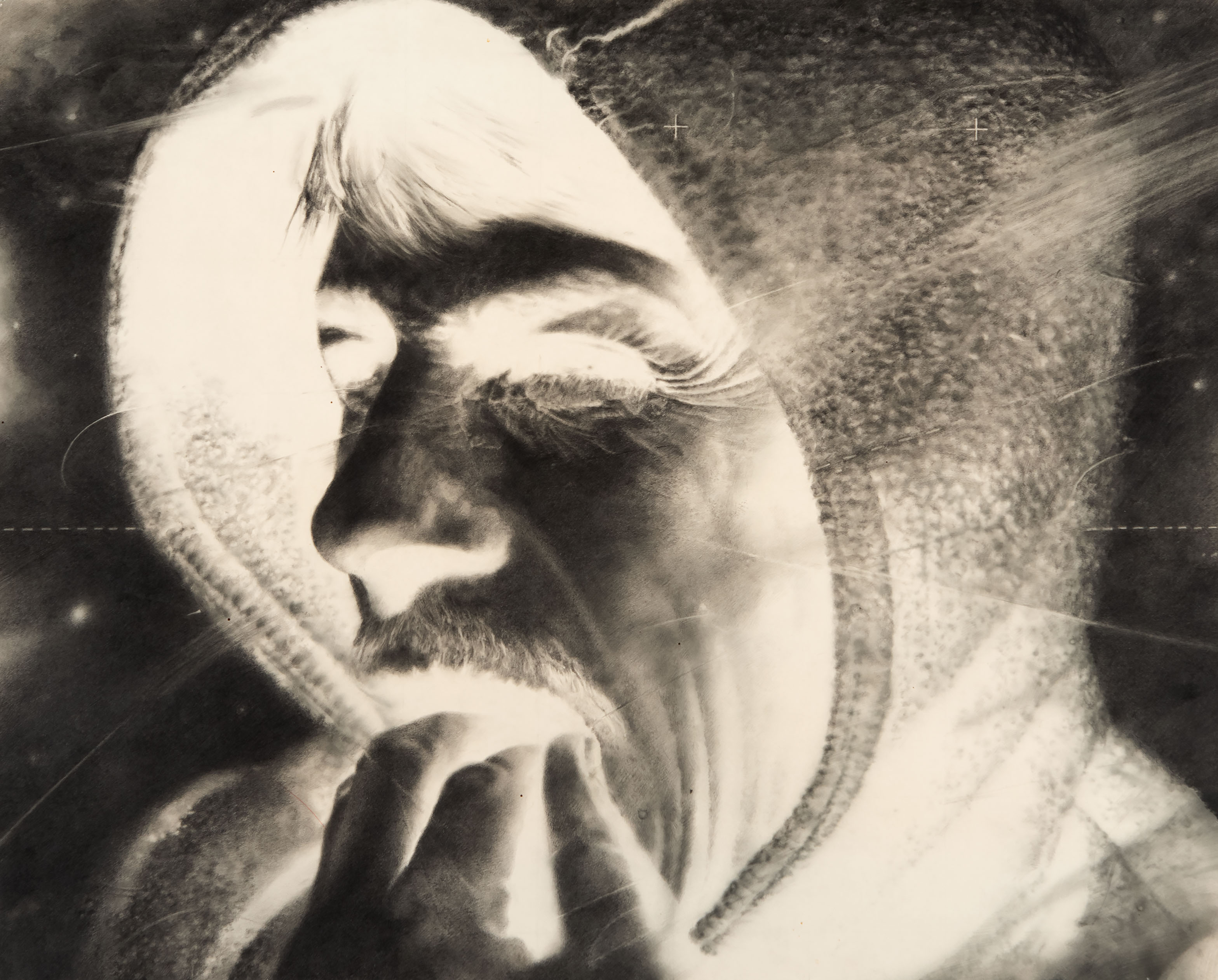
Self Portrait minus 30, 1984. Graphite on paper, 60.7 x 74.9 cm (23 7/8 x 29 1/2 in.). Norton and Nancy Dodge Collection of Nonconformist Art from the Soviet Union. D07121

Talk from the series Generation (Portraits of Contemporaries), 1981. Graphite on paper, 61.5 x 70.2 cm (24 3/16 x 27 5/8 in.). Norton and Nancy Dodge Collection of Nonconformist Art from the Soviet Union. D03737
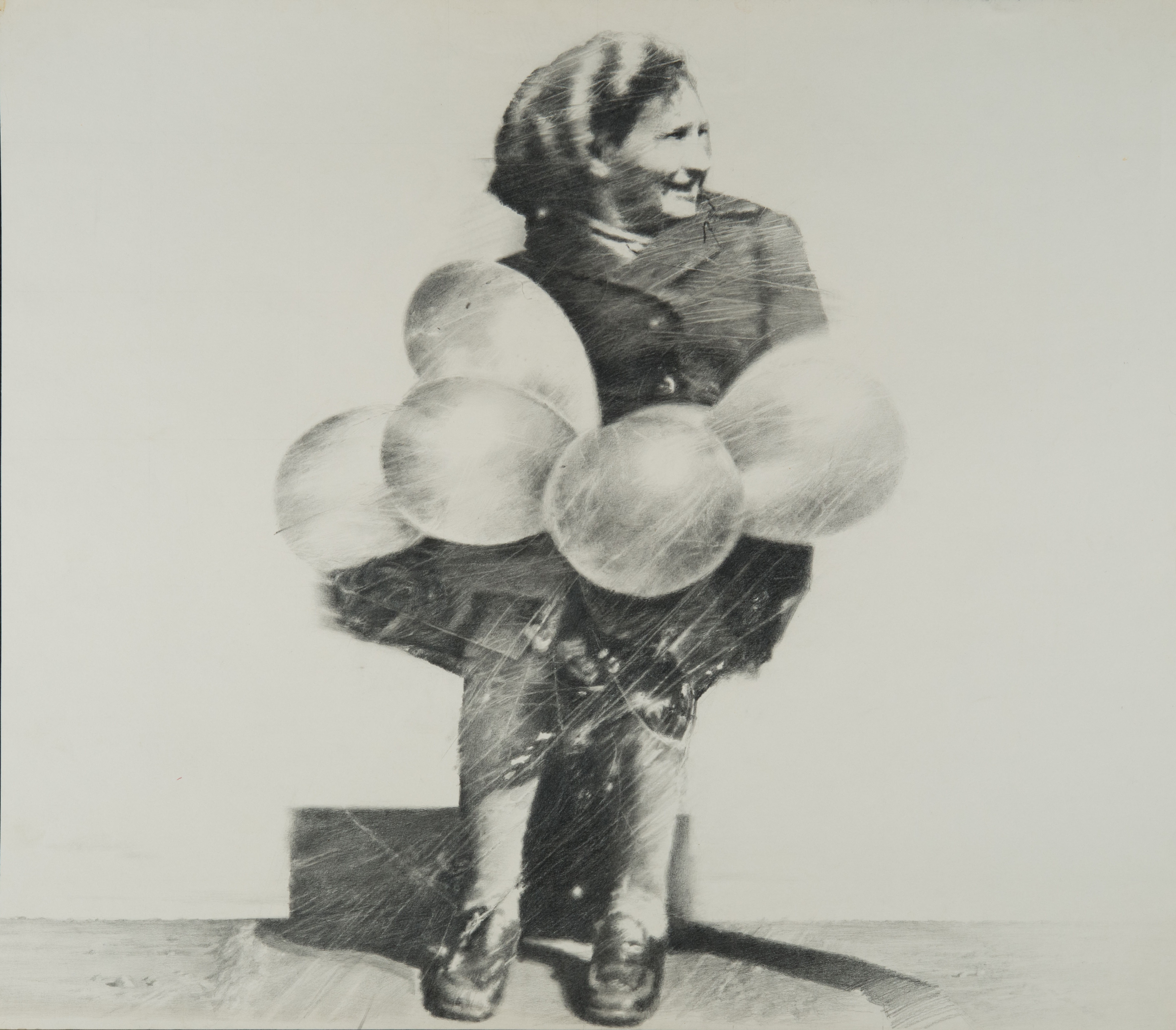
The Walk, 1983. Graphite on paper, 61.7 x 70.4 cm (24 5/16 x 27 11/16 in.). Norton and Nancy Dodge Collection of Nonconformist Art from the Soviet Union. D03122
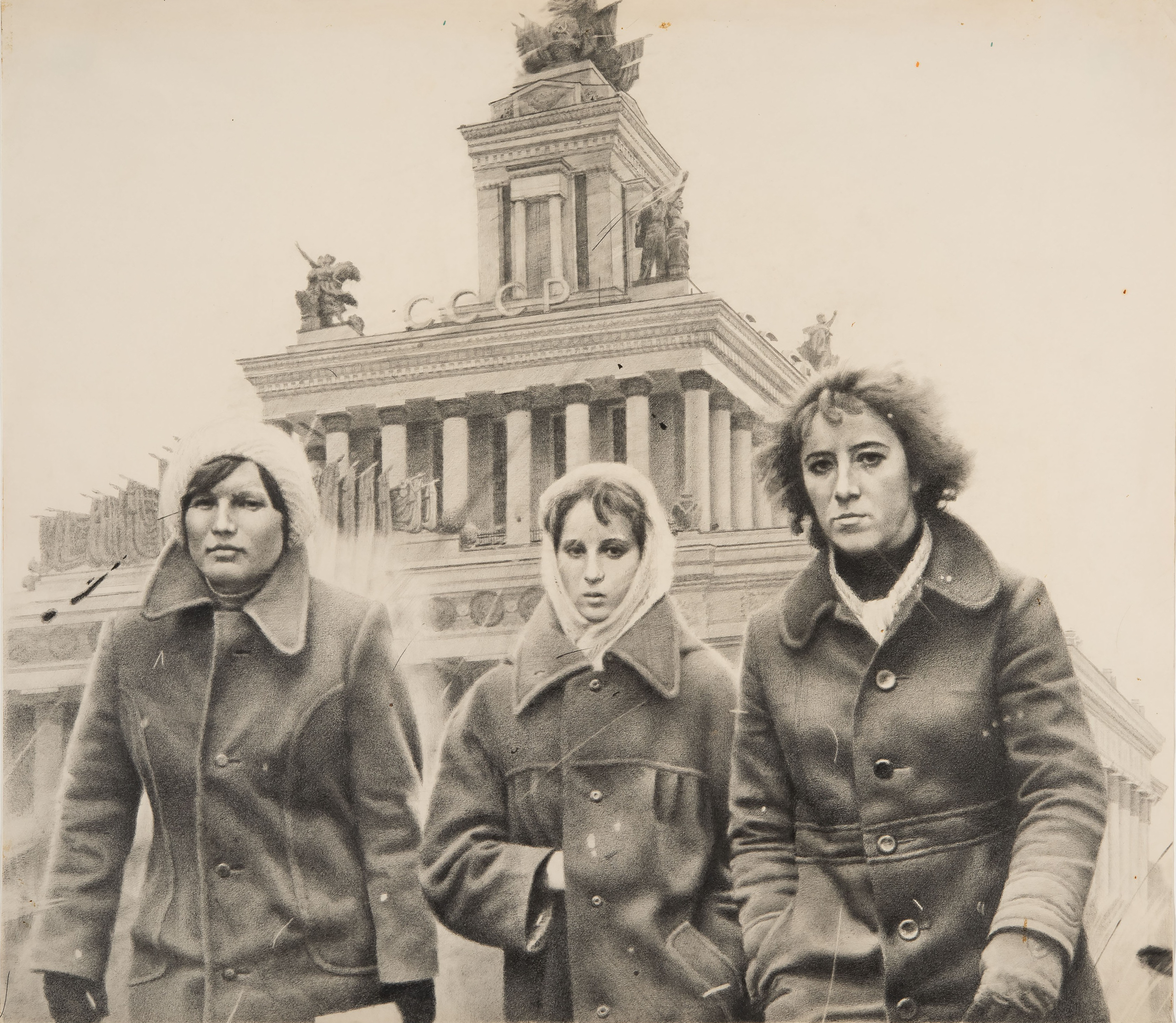
Faith, Hope, Love, 1982. Graphite on paper, 61.5 × 70.3 cm (24 3/16 × 27 11/16 in.). Norton and Nancy Dodge Collection of Nonconformist Art from the Soviet Union. D16450
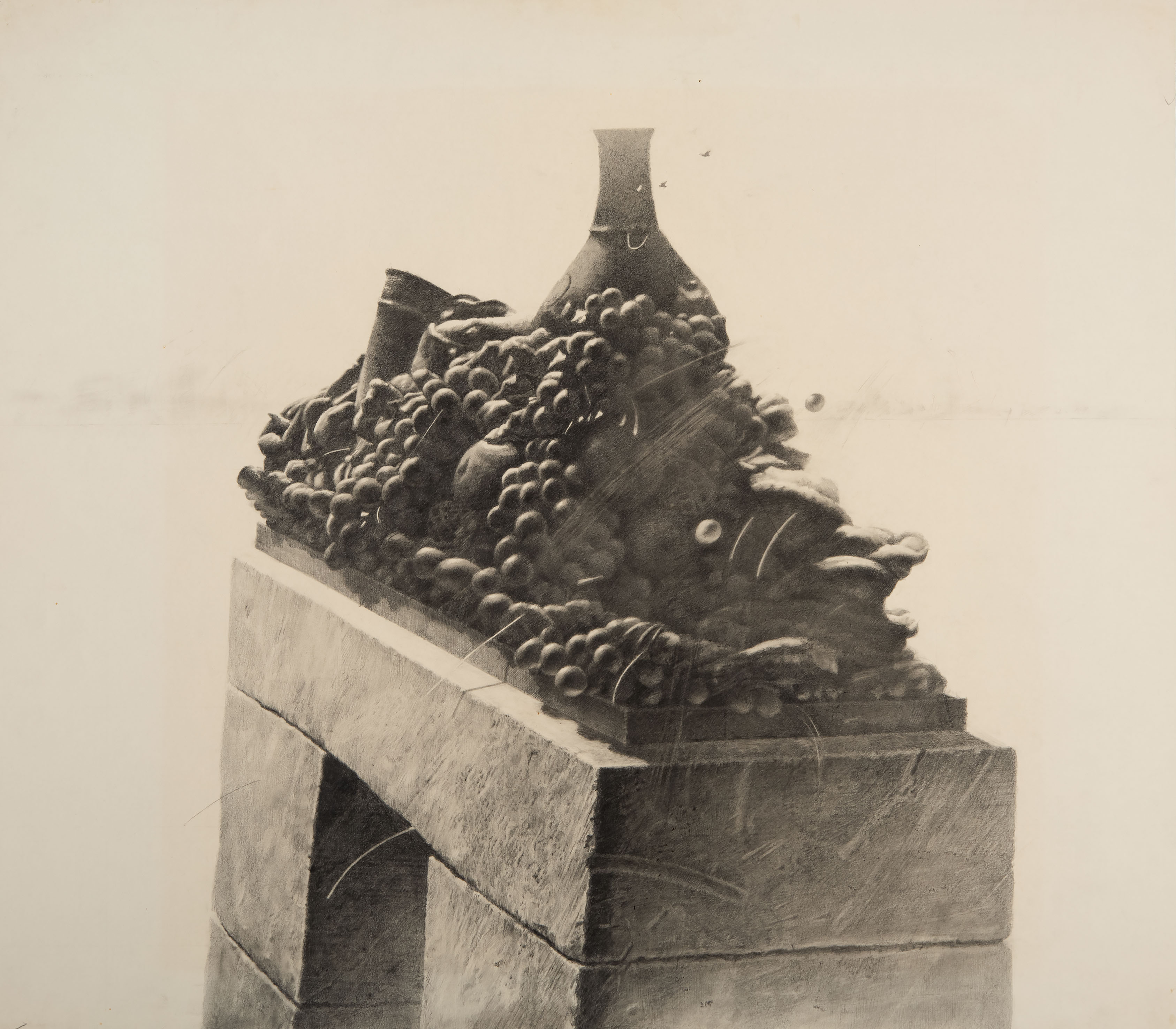
Still Life No.2 or Holiday, 1982. Graphite on paper, 61.5 × 69.9 cm (24 3/16 × 27 1/2 in.). Norton and Nancy Dodge Collection of Nonconformist Art from the Soviet Union. D07491
Selected Exhibitions
1980 All-Union Exhibition of Works by Young Artists, Tashkent-80, Tashkent, Uzbekistan
1982 Три Суперреалисти [Three Superrealists] (Tegin, Geta, Sherstiuk), Pushchino, Moscow region, USSR
1982 The All-Union Exhibition Молодость страны Советов [The youth of the country of Soviets], Moscow, USSR
1983 Документ и реализм [Document and realism], Exhibition of Moscow Hyperrealists, Moscow, USSR
1983 За мир та социализм [For peace and socialism], Exhibition of works by young artists from the USSR and the GDR, Moscow, USSR
1983 All-Union Exhibition of Portraits by Young Artists, Наш современник [Our Contemporary], Moscow, USSR
1984 Central House of Artists, Moscow, USSR (solo)
1986 Akademgorodok, Novosibirsk, USSR (solo)
1993 Central House of Artists, Moscow, Russia (solo)
1994 Dialogues of Perception, Kobra Gallery, New York, NY, USA
1997 Мир чувственных вещей в картинках [The world of sensual things in paintings], Pushkin State Museum of Fine Arts, Moscow, Russia
2007 Гиперреализм и окрестности [Hyperrealism and its surroundings], Galileo Cultural and Exhibition Center, Moscow, Russia
2015 Гиперреализм. Когда реальность становится иллюзией [Hyperrealism. When reality becomes illusion], State Tretyakov Gallery, Moscow, Russia
2018 Blacklead, Winzavod Center for Contemporary Art, Moscow, Russia (solo)
2024 International exhibition Реализмы 2024 [Realisms 2024], ART Korobka Art Center, Moscow, Russia
Selected Publications
Bazyliev, S. “Pro chas, pro druziv, pro hiper” [On time, friends, and hyper]. In Fine ART 4 (2008): 12–15.
Havrylova, K. “Filosofiia zhyttia u tvorchosti Serhiia Hety” [The philosophy of life in Sergei Geta’s creative practice]. In Fine ART 4 (2008): 15–18.
Kamenskii, A. “Dokumentalnyi romantizm” [Documentary romanticism]. In Tvorchestvo [Creation] 10 (1982).
Kozlova, O. T. Fotorealizm. Moscow: Galart, 1994.
Kurdiukova, D. “Igra v realizm” [A game in realism]. In Iskusstvo [Art] 2–3 (2010): 90–94.
Mamonov, B. “Moskovskii giperrealizm kak sluchai chastnoi zhizni” [Moscow hyperrealism as a feature of one’s personal life]. In Khudozhestvennyi zhurnal [Moscow Art Magazine] 45 (2002).
Perfilev, V. “Vystavka Proizvedenii M. Pereiaslavtsa, A Rukavishnikova, S. Gety” [Exhibition of works by M. Pereiaslavets, A Rukavishnikov, S. Geta]. In Iskusstvo [Art] 7 (1985): 33–37.
Polomoshnykh, T. “S inykh pozitsii” [From other positions]. In Tvorchestvo [Creation] 2 (1991).
Skliarenko, Halyna. “Hiperrealizm v konteksti ukrainekoho mystetstva druhoi polovyny XX stolittia” [Hyperrealism in the context of Ukrainian art in the second half of the 20th century]. In Suchasne mystetstvo. Zbirnyk statei [Contemporary art. Collected articles] 9 (2013): 165–183.
Skliarenko, Halyna. “‘Liudy z Pivdnia: Kyivska versiia hiperrealizmu” [People from the South: The Kyivan version of hyperrealism]. In Obrazotvorche mystetstvo [Fine Arts] 1 (2013): 44–47.
Smirnov, T. I. Fotorealizm v Rossii. Smotret i videt [Photorealism in Russia: watch and see]. Moscow: BuksMart, 2019.
See also