
Galina Bitt (Zayats)
1946 –– Moscow (Russia). Worked in Moscow and Leningrad; currently works in Moscow (Russia)
Galina Bitt graduated from the Moscow Textile Institute in 1964 and soon became a member of Dvizhenie (Movement), an unofficial art collective led by Lev Nussberg that specialized in kineticism and cybertheater. Dvizhenie was most active during the late 1960s and early 1970s; early on, its members created works on canvas and paper and in sculpture, all in a kineticist style that drew inspiration from the Russian modernist avant-garde as well as the contemporaneous global kinetic art tradition. Following a schism in the collective (during which several members left to found their own groups), the group’s focus shifted to performance art, which was site-specific and made use of elaborate lighting, costumes, choreography, music, and multimedia art objects. Bitt is known both for her visual artworks, especially her works on paper and silkscreen, and for her participation in Dvizhenie’s large-scale performance pieces, including the kinetic games of the early 1970s, which were staged at picturesque sites across the USSR. As well as performing in these games, Bitt contributed kinetic props of her own devising, as well as designs for costumes and sketches for mise-en-scène.
Alongside and in combination with their performances, the artists associated with Dvizhenie worked in a diverse array of media; these include mobiles, self-tensioning constructions, transforming sculptures, optical paintings, collage, photography, sound and light installations, and interactive objects. The group was able to produce artworks across a wide variety of disciplines because their ranks included not just trained artists but also actors, musicians, physicists, engineers, electricians, and psychologists––most of whom joined up after the group’s early crisis. Dvizhenie also produced a manifesto (Manifesto of Russian Kineticists, 1966), among the first since the plethora of manifestos associated with early-twentieth-century avant-garde movements.
Bitt’s early kineticist works were included in a group exhibition at the Architects’ House in Leningrad (May 20–June 6, 1965); at this point, Dvizhenie still enjoyed semiofficial status and could exhibit in public spaces. Subsequently, several members of Dvizhenie, including Bitt, traveled to Leningrad in order to contribute festive decorations for the city on the occasion of the fiftieth anniversary of the Revolution. They were invited at the suggestion of V. Petrov, a Leningrad-based artist who had been impressed by their exhibition at the Architects’ House and by Nussberg’s proposal for decorating the University Embankment. Most of the artists, including Bitt, returned to Moscow in 1967, after the project’s first stage was complete and its implementation began. With support from Western artists, Dvizhenie organized several exhibitions in Europe, including in Prague in 1965 and in Munich in 1966; the group also participated in several international exhibitions of kinetic art. Bitt contributed works to all of these exhibitions. In 1969, following their production of a children’s-play-cum-environmental-project titled Island of Flowers, Dvizhenie was officially banned by the authorities. The group disbanded after Nussberg emigrated in 1976.
Bitt’s early works (made during the 1960s) are characterized by explorations of light, movement, and spatial construction, which function in concert to create the illusion of mutable space. Her work from the 1970s and 1980s reflects her growing interest in the intersection of art and science; many of these pieces involve mechanical and electrical components. Bitt’s kinetic installations of the period are notable for their minimalist aesthetic and focus on visual perception. During this period, Bitt expanded her range of materials, incorporating mirrors and other reflective surfaces to create multilayered visual experiences that hint at dimensions of existence beyond our own. A number of these objects were used as props in the kinetic games. As Natalia Prokuratova, another member of Dvizhenie, recalled: “The participants of the Kinetic Games sought to integrate creative activity with the forces of the natural environment. The space of action was outlined approximately and easily changed, as preference was given to improvisation! The context of the aesthetic space was created through kinetic means: sound, color, rays, movement—the birth of a form that exists only in motion, in the moment.” [1]
Bitt’s works on paper feature geometric forms in dynamic arrangements, sometimes in vivid color, other times in monochrome. These compositions frequently employ symmetry and concentric shapes. Her output also includes sketches for proposed kinetic objects, abstract in form and with moving parts, and she created structurally ingenious costumes for performances. Other works on paper feature landscape-like compositions: kinetic figures (again geometric, symmetrical, colorful) in dynamic arrangements within a spatial field containing features that resemble kineticist riffs on the natural world—mountains made of mathematical curves or rays, bodies of water implied by two-dimensional fluid shapes.
Much of her work, and the output of Dvizhenie as a group, draws on the legacy of the Russian avant-garde, in particular suprematism: like the modernist works of Naum Gabo or Aleksandr Rodchenko, Bitt’s pieces are synthetic, working across media and genres, and immerse the viewer in a multisensory experience, rather than a purely visual one. Bitt’s works on paper, including several held by the Dodge Collection, sometimes resemble El Lissitzky’s Prouns, in their depiction of hybrid mathematical-organic objects, halfway between creatures and purely geometric features. Bitt called these figures “bion-kinetic creatures,” or “bionkins.” She also applied the term “bion-kinetic” to her landscapes. Unlike Lissitzky, however, Bitt did not de-emphasize the evocations of the natural world, even in her most geometrically abstract compositions. The level of abstraction varies in her work: I.B.K.S. (Interactive Bion-Kinetic Environment) (1977) [D01341], in the Dodge Collection, depicts natural features that are recognizably a seashore, a body of water with a wavy surface, and hills and sky in the distance (alongside more abstract elements that have no obvious analogue to the natural world). Meanwhile, a highly abstract composition, also in the Dodge Collection, bears the title Green Mountain Spirit (1971–72) [1995.0886.010].
In 1977, Bitt participated in the Dissident Biennale in Venice, which was dedicated to the theme of dissent and proved popular among European intellectual circles. Today her works are exhibited at the New Tretyakov Gallery in Moscow as well as the Museum of the Avant-Garde. In 2017, two of her works were sold at Sotheby’s in London. An exhibition dedicated to the development of kinetic art in Russia, featuring Bitt’s works, was held at the Saint Petersburg Manege in the spring of 2020.
Ainsley Morse
Notes:
1. Kineticism in Russia: Kinetic Art, The “Dvizhenie” Collective, 1962–1976: album. 2nd ed. Moscow: Znak, 2016: 244.
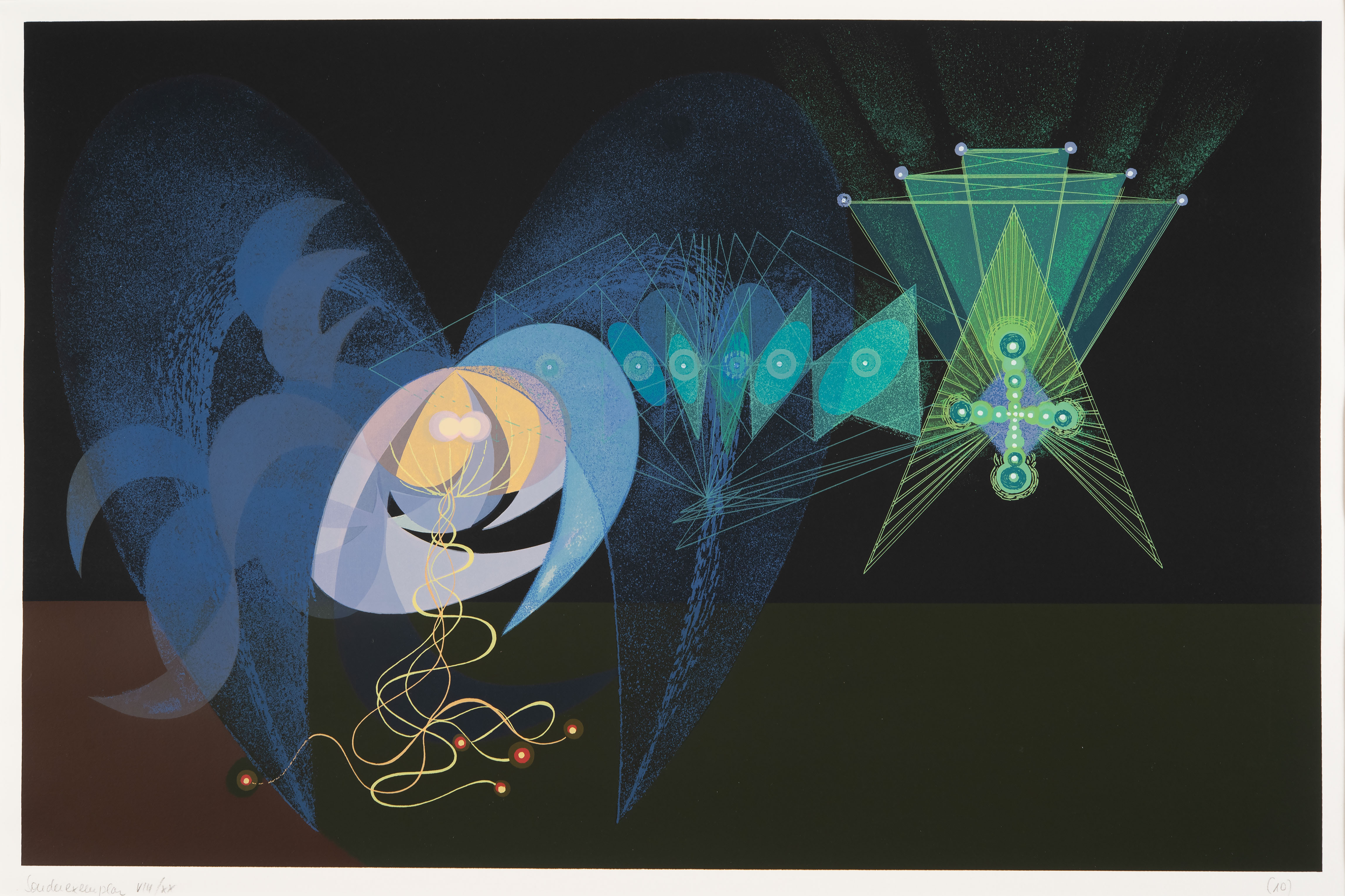
Green Mountain Spirit, 1971-72 from the portfolio Ten Year Development of Kinetic Art in Russia, Nuremberg: 1972-74. Screenprint on paper, 65 × 65 cm (25 9/16 × 25 9/16 in.). Norton and Nancy Dodge Collection of Nonconformist Art from the Soviet Union. 1995.0886.010
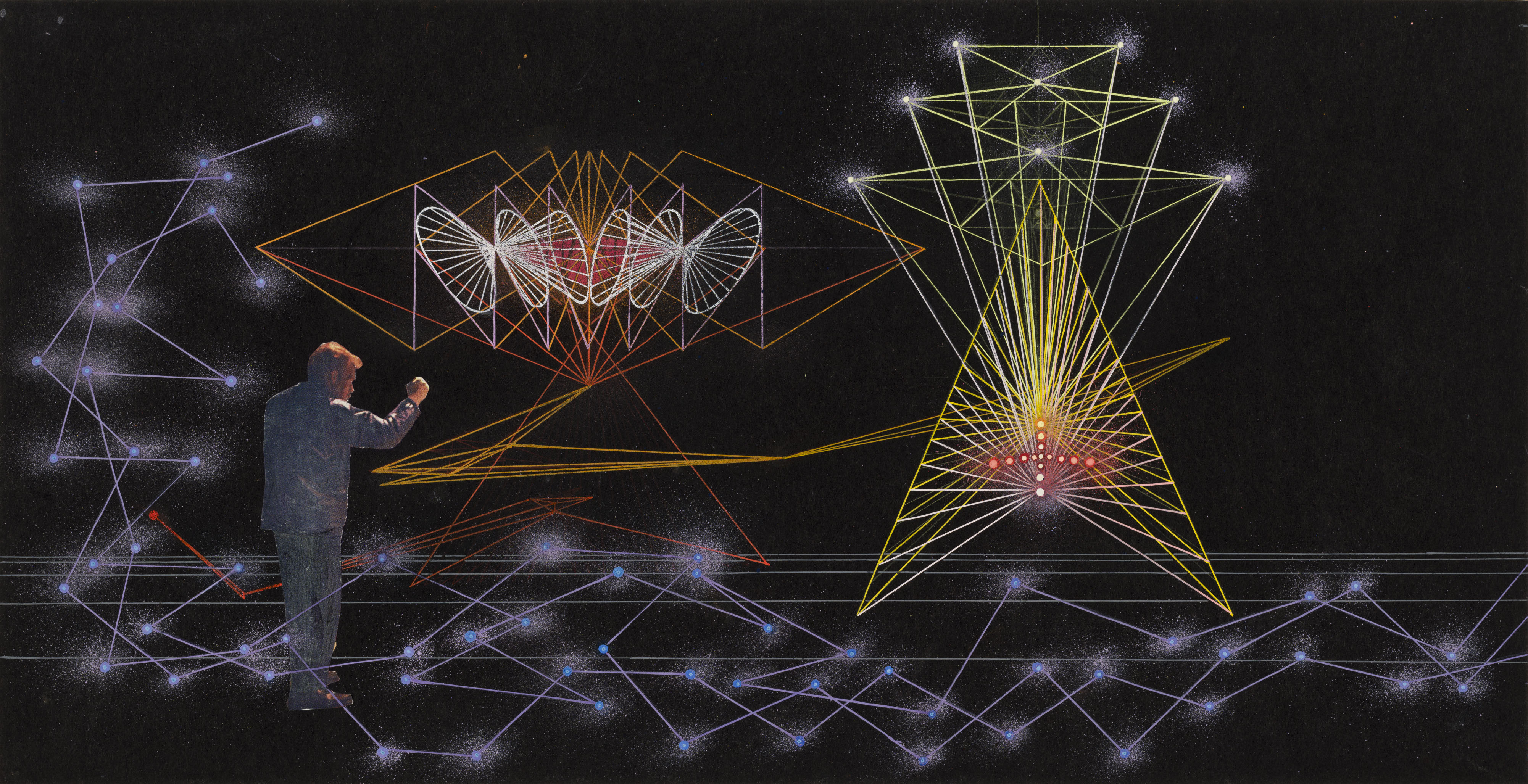
A Bion-Kinetic Creature (Bionkin), 1965. Tempera and photocollage on paper, 28.9 x 56.4 cm (11 3/8 x 22 3/16 in.). Purchased with funds donated by Norton Dodge and Nancy Dodge. 2003.0156

I.B.K.S. (Interactive Bion-Kinetic Environment), 1977. Gouache on paper, 32.2 x 44.1 cm (12 11/16 x 17 3/8 in.). Norton and Nancy Dodge Collection of Nonconformist Art from the Soviet Union. D01341
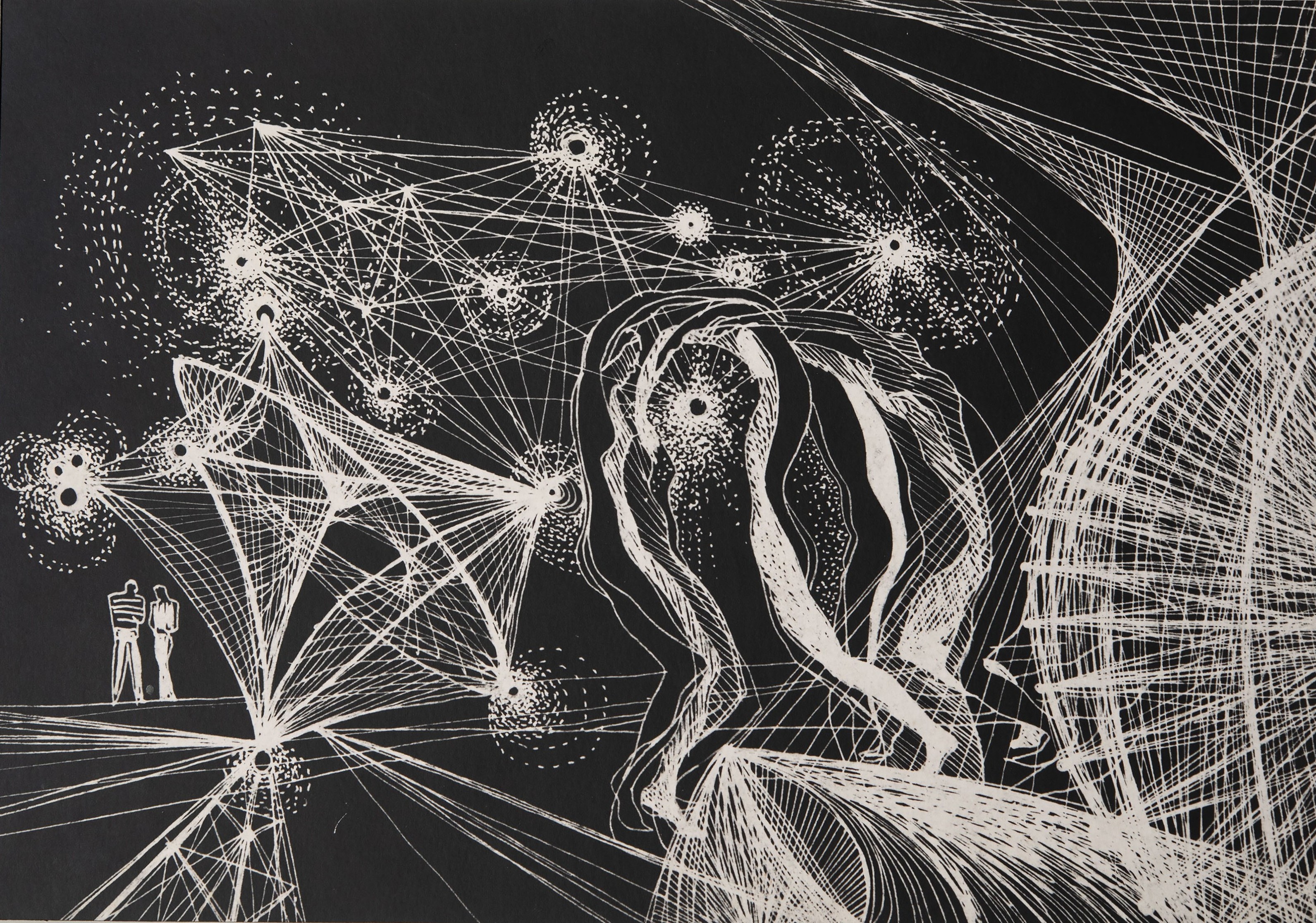
Galina Bitt and Lev Nussberg, Documentary photograph of a work on paper: Playing Zone inside of an I.B.K.S. (interactive Bionic-Kinetic Environment), 1969. Positive print on paper, 20.7 × 29.4 cm (8 1/8 × 11 9/16 in.). Norton and Nancy Dodge Collection of Nonconformist Art from the Soviet Union. D09764

Galina Bitt and Lev Nussberg, Documentary photograph of a work on paper: Playing Zone inside of an I.B.K.S. (interactive Bionic-Kinetic Environment), 1969. Positive print on paper, 18.8 × 26.7 cm (7 3/8 × 10 1/2 in.) / 22.5 × 29.2 cm (8 7/8 × 11 1/2 in.). Norton and Nancy Dodge Collection of Nonconformist Art from the Soviet Union. D09767
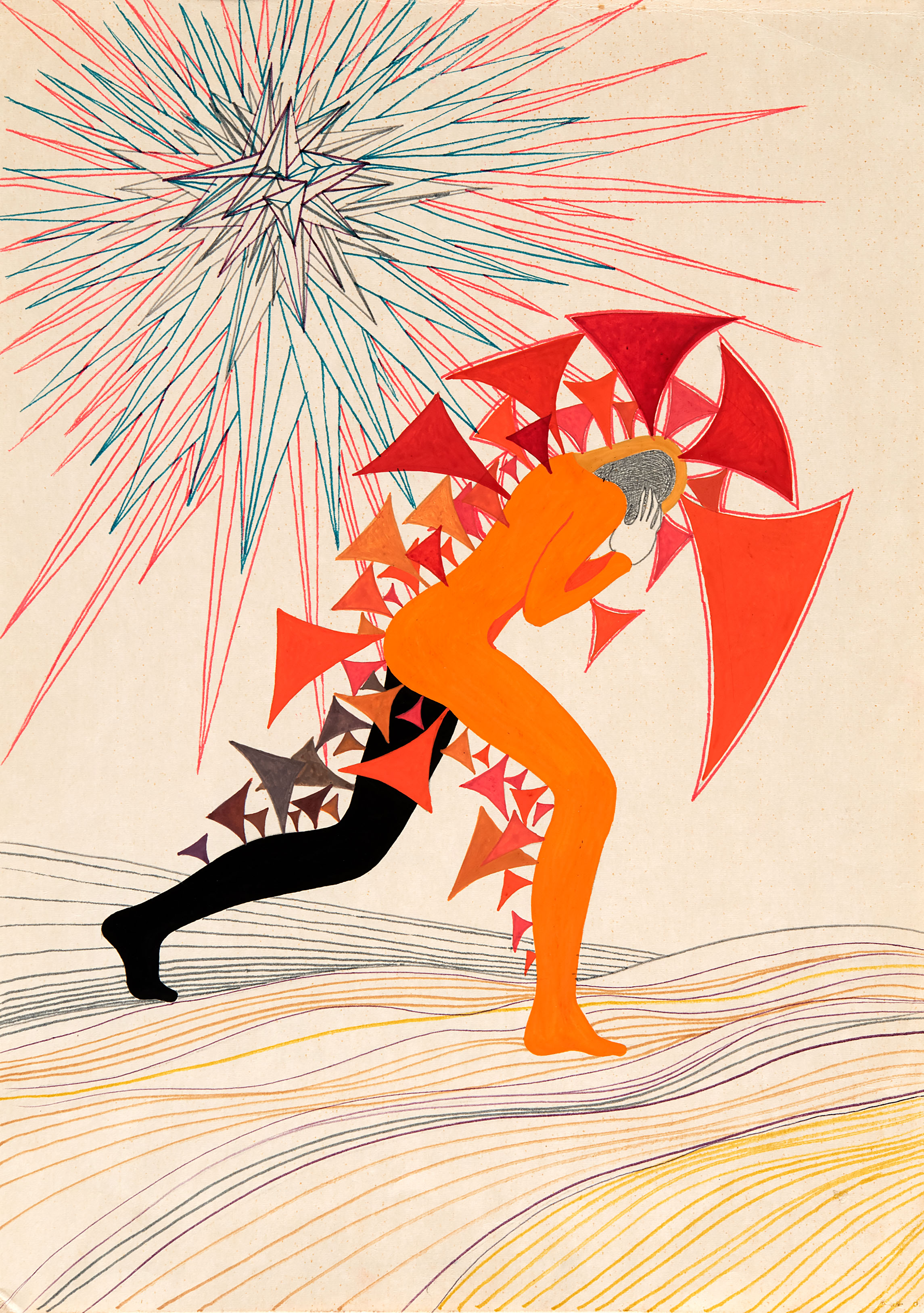
Galina Bitt and Lev Nussberg, Design of a costume for a kinetic theatrical performance, 1967. Tempera, colored markers, and graphite on paper, 43.2 × 30.6 cm (17 × 12 1/16 in.). Norton and Nancy Dodge Collection of Nonconformist Art from the Soviet Union. D01344