
Belarusian Nonconformist Art in the 1980s

Tatsiana Zhurauliova
As elsewhere in the USSR, the 1980s in Belarus were a period of transition and progressive ideological democratization that reflected the logic of perestroika initiated by Mikhail Gorbachev’s government in 1985. In the cultural sphere, the decade saw the active development of neo-avant-garde and nonconformist artistic trends, as well as unofficial cultural spaces and networks. In her comprehensive presentation of this milieu, curator and author Tania Arcimovič notes the difficulty of defining it with monolithic terms such as “unofficial,” “nonconformist,” or even the commonly used at the time “неформальное/нефармальнае” [informal], [1] given the variety of ways in which individual artists engaged with, participated in, or challenged the official art establishment. [2] Many of the artists whose work can be characterized as nonconformist studied—and sometimes later taught—at one of the state art institutions such as the Minsk Art College (now the Aleksei Glebov Minsk State Art College) and the Belarusian State Theater and Art Institute (now the Belarusian State Academy of Arts). Many also belonged to the Artists’ Union at some point during their careers, as it was the principal gatekeeper for exhibition access and studio allocation under the Soviet system. At the same time, however, these artists also cultivated and participated in independent networks of artistic exchange and collaboration that fostered invention and experimentation, pushing against the institutional, stylistic, and ideological rigidity of the official art-world establishment.
Art Groups and Associations
Throughout the 1980s, artists based in the Belarus capital, Minsk, and other major cities (such as Vitebsk and Polatsk) came together to form a variety of often interconnected and overlapping art associations, writing group manifestos and organizing collective exhibitions. As noted by art historian and curator Volha Arkhipava, the emergence of numerous independent art associations in the 1980s was motivated by several factors: they functioned as a means of protest against the monopoly of the official art establishment; by operating according to the recognizable Soviet logic of a society or an organization, they offered artists a form of institutional protection—the so-called krysha [roof, cover]—that enabled them to mount exhibitions and projects that would have been impossible to realize individually; and they allowed for a collective artistic statement, thus lending it additional weight and democratic dimension. [3] The membership across these organizations was highly fluid: many artists exhibited with different groups simultaneously or participated in a given project only once. In this sense, these groups were not fixed formations, but rather shifting fields of association, determined by shared interests and intent.
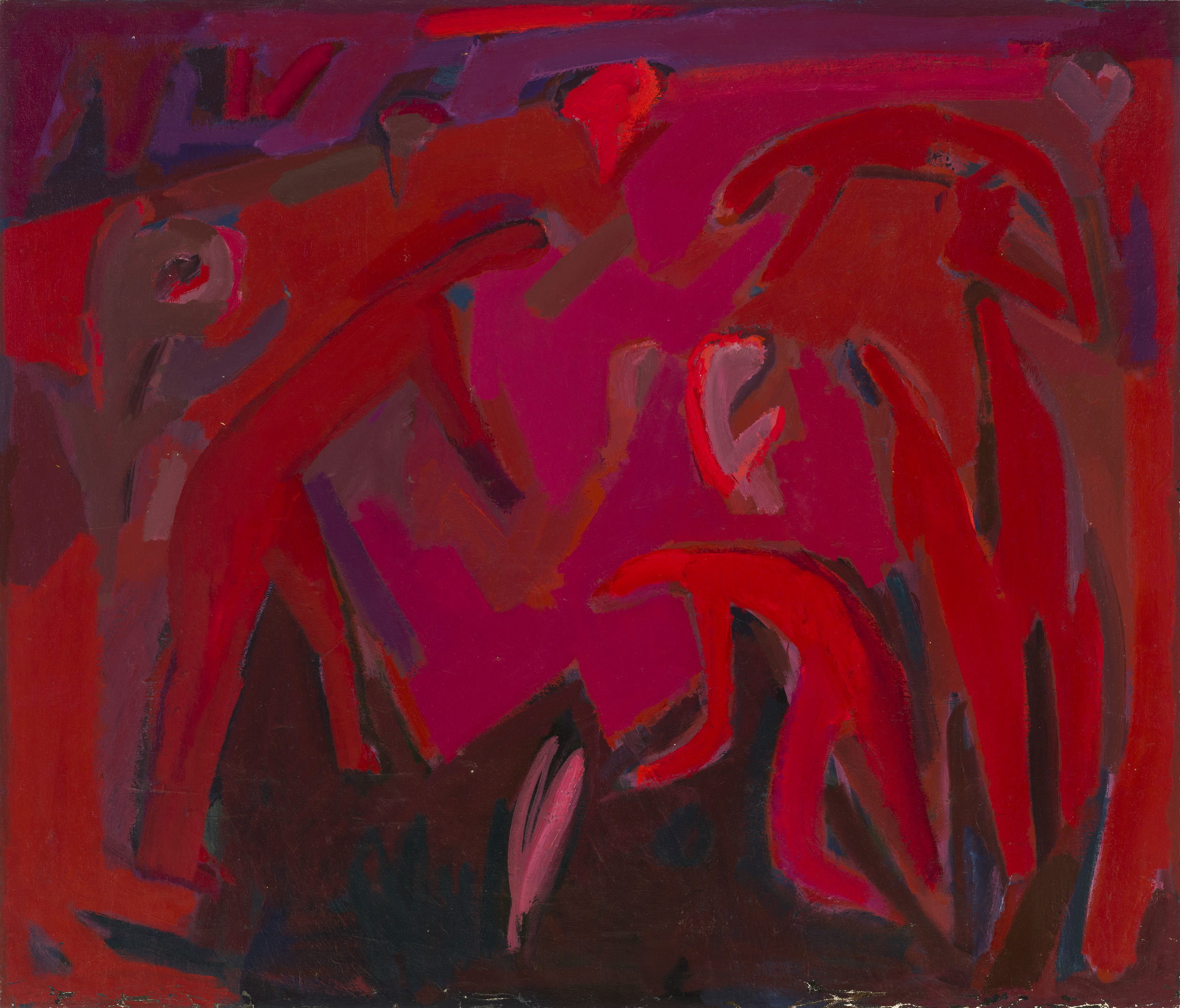
The group Nemiga-17 (Няміга-17) is one of several independent associations that emerged simultaneously from and in opposition to the official art establishment. The name of the group refers to the address of Sergey Kiryuschenko’s studio on Nemiga Street, assigned to him when he joined the Artists’ Union in 1983. The group, which also included artists Nikolay Buschik, Anatoly Kuznetsov, Algerd Malishevsky, Oleg Matievich, Tamara Sokolova, and Leonid Khobotov, rejected the principles of socialist realism in favor of the search for a renewed visual language that emphasized stylistic individuality and expressive use of color and form. Kiryuschenko’s works in the Zimmerli collection (Shepherd, 1982, ZAM, D21238 and Picking Flowers, 1983, ZAM, D21239) reflect the group’s ethos in their bold use of saturated color and dynamic, gestural application of paint, while their tendency toward abstraction situates them on the margins of the officially permitted aesthetic of the time. In 1986, works by the group’s artists were rejected from an exhibition at the Palace of Arts (Палац мастацтва), the official exhibition space of the Belarusian Artists’ Union; this led them to mount an exhibition in Kiryuschenko’s studio. However, the exhibition’s widespread success among the artistic and intellectual communities of Minsk led to its presentation at the Palace of Arts the following year. [4] This simultaneously solidified the group’s importance in the Belarusian art world and signaled the gradual process of democratization of public art spaces. Over its existence until 2003, the Nemiga-17 group held more than ten major exhibitions, including exhibitions at the National Museum of Belarus in 1993 and at the Tretyakov Gallery in Moscow in 2002.
The year 1987 was a particularly important moment in the development of the Belarusian nonconformist art world, marked by the launch of numerous new artistic collectives and exhibition initiatives, reflecting the changing political and ideological climate of perestroika. Among several art associations that emerged in Minsk in that year are Halina (Галіна) and Forma (Форма). Reflecting the porosity and interconnectedness of the avant-garde scene of the time, by the end of the year, several artists from Halina joined Forma, together establishing the Association of Creative Intellectuals Forma (Абʼяднанне творчай інтэлігенцыі ‘Форма’). According to the group’s letter demanding an official status recognition, the association was open “to individuals engaged in the visual and other arts who work in a non-traditional manner” and saw its goals as “to broaden the cultural landscape” and “to renew and democratize art.” [5] In 1987, the group organized several important exhibitions that featured works by artists from across different groups and associations. This included Перспектыва [Perspective] (Exhibition Hall of the Belarusian Scientific Research Institute of Technical Information, Minsk, 1987) and На Калектарнай [On Kollektornaya Street] (Minsk, 1987).
Walera Martynchik is credited with the idea for the name Forma, which represented a response to “the longstanding battle between dogmatic and the so-called ‘formalist’ art” [6] and highlighted the group’s focus on what Martynchik characterized as “problems of art, not of immediate politics.” [7] Martynchik’s works in the Zimmerli collection (Holiday in the Provinces, 1985, ZAM, D08652 and Zone of Consolation, 1987, ZAM, D08651) are representative of his style from the period: the nonhierarchical compositions are bursting with myriad abstract geometric and organic shapes, while their surfaces vibrate with tension between the flatness of the modernist grid and the illusionistic three-dimensionality of architectural drawing.
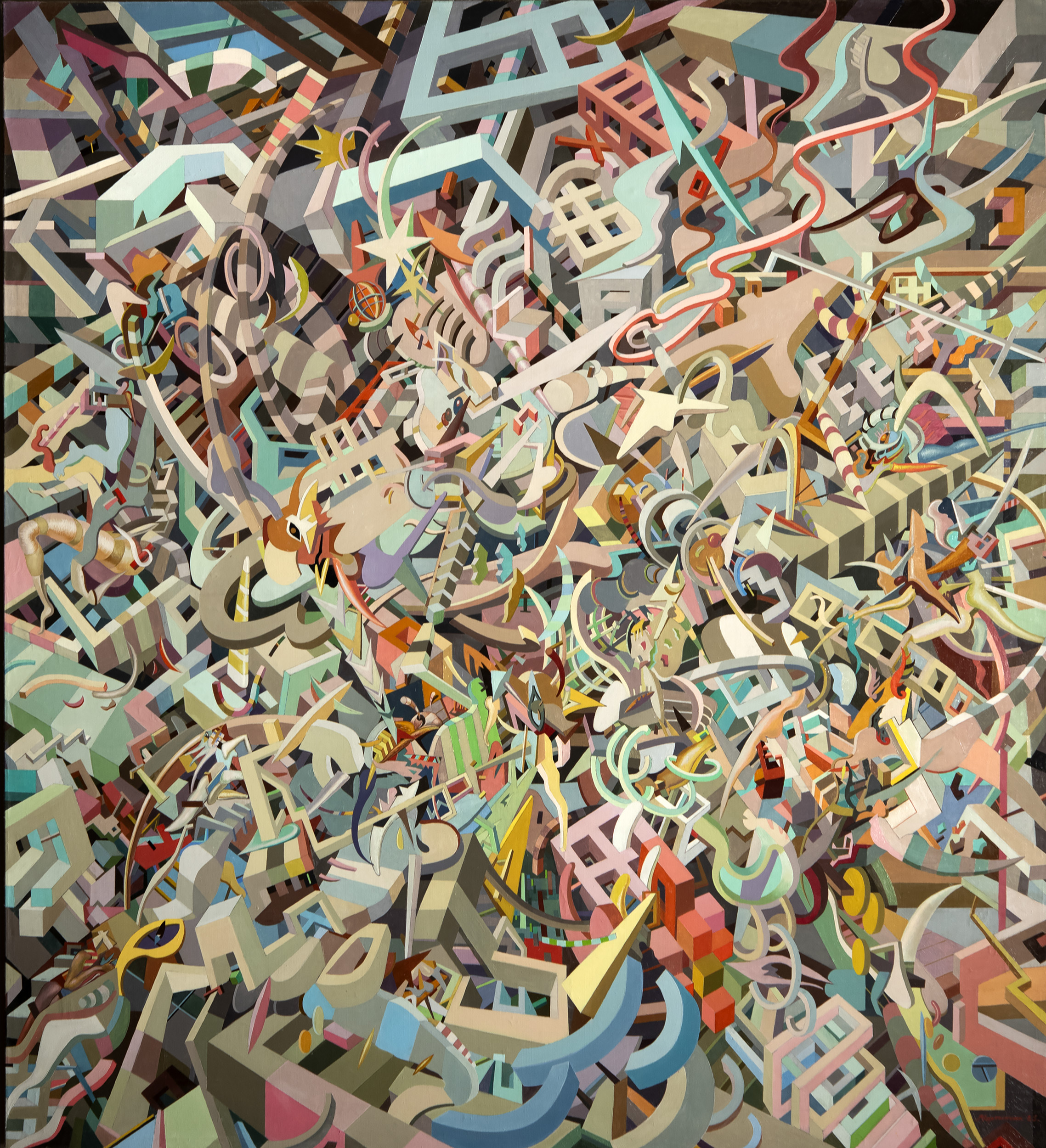
It would be appropriate to say that Martynchik’s works bear distant echoes of Kazimir Malevich’s and El Lissitzky’s suprematist compositions. In fact, the legacy of Vitebsk avant-garde and UNOVIS [8] looms large over Belarusian nonconformist art of the 1980s. It is most directly represented by the Kvadrat association (Квадрат), founded in Vitebsk on March 16, 1987. Conceived as an alternative to the official art establishment, the group simultaneously parodied the language of the Soviet bureaucracy and hearkened back to the brief collective utopia of the Soviet avant-garde of the 1910s and early ’20s. Kvadrat had all the attributes of the Art Party: a chairperson (Alexandr Maley), an executive secretary (Nikolai Dundin), a records secretary (Tatyana Rudenko), a charter, and an insignia—a black square on a gold background—that was worn on the members’ chests. [9] The minutes of the first meeting of the association defined its goal as “the fight against routine, conservatism, stagnation, careerism, practicism, dogmatism, and prostitution in the visual arts.” [10] In 1987, in addition to several group exhibitions in Vitebsk, Kvadrat participated, together with the artists from Forma and Halina, in the exhibition of informal (неформальных) art groups under the patronage of the Artists’ Union that took place at the Palace of the Arts in Minsk. [11] In 1988 and 1989, the group organized and co-organized a series of events dedicated to the 110th anniversary of Malevich in Vitebsk and Minsk. This included the exhibition Эксперимент [Experiment], presented in 1988 in the exhibition hall of the Vitebsk Artists’ Union and in 1989 in Minsk in the Palace of Arts. In conjunction with the exhibition, the Minsk-based Pluralis group (Плюралис/Плюраліз) performed Уваскрашэнне Казіміра [Resurrection of Kazimir], which became an important milestone in the history of performance art in Belarus.
Among Kvadrat’s original members was Alexandr Solovyov, by that time a well-established artist, who served as a set designer (1965–77) and the chief artist (1977–95) of the Yakub Kolas National Academic Drama Theater in Vitebsk and as the chairman of the Vitebsk branch of the Artists’ Union (1973–77). Throughout his career, Solovyov balanced his official work with his more personal practice that embraced abstraction, drawing inspiration from historical modernist movements and the Vitebsk Art School in particular. His paintings at the Zimmerli (Before Eternity, 1969, ZAM, D18038 and Untitled, n.d., ZAM, D16486) are representative of his approach to abstraction with their dynamic, gestural fields of vibrant colors.

Other artistic groups that emerged during this period included: BLO (БЛО)—founded by Artur Kilnov, the group included Vitaly Chernobrisov—Komi-Kon (Коми-Кон/Комі-Кон), 4-63, and Belarusian Climate (Беларускі клімат).
Even a cursory overview of Belarusian nonconformist art from the 1980s would be incomplete without mentioning the so-called Minsk School of Photography, which encompasses the groups Panorama (Панорама/Панарама), Province (Провинция/Правінцыя), and META (МЕТА). [12] These groups emerged from the photography workshops of Valery Lobko, who taught at the Minsk Photo Club. The Province group was formed by Lobko’s students Sergei Kozhemiakin, Victor Kalenik, Alexander Uglianitsa, and Vladimir Shakhlevich. Uglianitsa, along with photographers Victor Kalenik and Aliaksiej Trufanay, established META. In 1988, the groups presented their work together in an important exhibition, Пачатак [Beginning], held at the Minsk House of Cinema (now the Red Cathedral). In addition to their experimental photographic practice, many of these artists also documented the nonconformist art world. In particular, Uglianitsa’s photographic archive represents an invaluable record of the key events of this period. [13]


Preserving the Memory and the Archive of the 1980s
The archive of the 1980s nonconformist art movement in Belarus exists largely in fragments: in artists’ homes, in private collections, and in individual memories that are growing harder to recover and harder to access, because many figures of the movement have died and others have been forced into exile by the current authoritarian regime.
In the absence of governmental support—and more often than not, despite active governmental persecution—the work of Volha Archipava, Tania Arcimovič, Artur Klinau, Sergey Kiryuschenko, Aleksei Borisionok, Alexey Lunev, Lena Prents, Andrei Dureika, and many other Belarusian, Ukrainian, and Polish artists, curators, and art historians has been dedicated to collecting and preserving this heritage.
In 2002, Klinau founded pARTisan magazine—an almanac of contemporary Belarusian art and culture that ran until 2020, providing one of the very few independent platforms for the analysis of nonconformist art. In 2009, in conjunction with the magazine, Klinau established the pARTisan Collection—a series of richly illustrated volumes dedicated to individual artists, art movements, or artistic tendencies in Belarus, for example, the volumes Minsk. Nonconformism of the 1980s and New Wave: Belarusian Photography of the 1990s, and volumes dedicated to the work of artists Igor Savchenko and Sergey Kiryuschenko.
In 2012, Archipava launched the project “Belarusian Avant-Garde,” which evolved over time into a more comprehensive online resource called BMP—Belaruski Mastatski Poligon (Belarusian Art Polygon)—conceived as an encyclopedia of independent, informal, and official artistic associations in Belarus. The project ceased in 2017 due to financial constraints, but its archive was partially transferred to KALEKTAR: Research Platform on Belarusian Contemporary Art. Cofounded by Shabohin with Kiryushchenko and Borisionok in 2015, the platform is, to date, the most comprehensive collection of materials related to both contemporary and historic Belarusian art. In the same year, the KALEKTAR team launched the research project ZBOR (the Belarusian word збор, meaning “collection”) with the goal of assembling research materials on forty works by Belarusian artists that were created between 1980 and 2014, with the selection made by the project’s advisory board.
This progress on developing a comprehensive history and archive of nonconformist art in Belarus has been halted by the country’s political situation since 2020. The ongoing repression that followed the mass protest movement against the fraudulent 2020 presidential elections, as well as the Belarusian state’s support of Russia’s war against Ukraine, has dramatically accelerated the dispersal of the expertise necessary to preserve and study this heritage. A wave of purges of cultural professionals from state institutions—described by Archipava as “cleansings of the Belarusian intelligentsia”—has forced many of the scholars and curators best equipped to work with these materials into exile.
The Zimmerli Art Museum’s collection of nonconformist art represents one of the most significant international repositories of this material. It includes work by artists central to the history of Belarusian culture in the 1980s. In conditions where the primary custodians of this history have been dispersed, silenced, or lost, and where national collections in Belarus itself failed to collect and preserve primary artistic materials, the Zimmerli’s initiative to create a comprehensive resource on Eastern European nonconformist art and artists is invaluable in preserving endangered heritage and making it available to a broader international audience.
Accordion Content
-
1. Note on language: some of the original texts referenced in this text are in Belarusian language, while others are in Russian; whenever possible, the quote is provided in the original language in notes. The linguistic positions of the nonconformist art circles varied at the time, with some artists and groups primarily using Belarusian, while others used both Russian and Belarusian, depending on the context.
2. Arcimovič, Tania. “‘Freedom Cannot Be Personal,’ or, Art as a Restrictions Antithesis.” In Minsk. Nonconformism of the 1980s, Kalektsyya pARTyzana [pARTisan Collection]. Minsk: Galiiafy, 2015: 15–17.
3. Shabohin, Sergey. “Volha Arkhipava: ‘Kul’tura i istoriya Belarusi prekrasny istochnik vdokhnoveniya i budushchikh perspektiv’” [Volha Archipava: “The culture and history of Belarus is a wonderful source of inspiration and future prospects”]. Interview, KALEKTAR, June 27, 2023. Arkhipava has been conducting a long-term research project on Belarusian art associations in the 1920s and 1980s. This work led to the creation in 2012 of the online portal “Belarusian avant-garde” (later renamed BMP—Belaruski Mastatski Paligon), envisioned as an encyclopedia of independent, informal, as well as official art groups in Belarus. Due to financial difficulties, the site ceased operations in 2017 and its resources have been partially transferred to the online platform KALEKTAR.
4. Kuzmich, Anna. “Perestroika v izobrazitel’nom iskusstve Belarusi” [Perestroika in the visual arts of Belarus]. In Art Kurator, 2016, archived on KALEKTAR, February 22, 2022.
5. The original quote in Russian: “по уставу могут входить лица, занимающиеся изобразительным и иным искусством, работающие в нетрадиционной манере. Цели и задачи Ассоциации в расширении культурной ситуации. В обновлении и демократизации искусства.” Association of Creative Intelligentsia “Forma,” “Pis’mo Assotsiatsii tvorcheskoy intelligentsii ‘Forma’ k vlastyam s trebovaniyem registratsii ob»edineniya” [Letter of the Association of Creative Intelligentsia Forma to the authorities demanding registration of the association], 1987, personal archive of Andrej Pliasanaǔ (Andrei Plesanov), archived on KALEKTAR, June 9, 2023.
6. Exhibition booklet, 1989, quoted in “Forma: Z ysapaminay Valera Martynchyka” [Forma: From the recollections of Walera Martynchik], in Minsk: Nonconformism of the 1980s, pARTisan collection. Minsk: Galiiafy, 2015: 173.
7. “праблемы мастацтва, а не імгненнай палітыкі.” “Forma: Z ysapaminay Valera Martynchyka,” 174. For Martynchik, this emphasis differentiated the group from the contemporary artistic underground in Moscow.
8. UNOVIS, an artistic group, founded and led by Kazimir Malevich at the Vitebsk Art School 1919; abbrev. of Utverditeli Novovo Iskusstva [Champions of New Art].
9. Maley, Alexandr. Vitebsky “Kvadrat”: khudozhestvennoe issledovanie nonkonformistskogo dvizheniya khudozhnikov v Vitebske i Minske (1987–2000 gg.) [Vitebsk “Kvadrat”: An artistic study of the nonconformist art movement in Vitebsk and Minsk (1987–2000)]. Minsk: Ekonompress, 2015: 40.
10. “борьба (против) с рутиной, косностью, застоем, карьеризмом, практицизмом, догматизмом и проституцией в изобразительном искусстве.” “Minutes no. 1, meeting of the Vitebsk artists’ group, March 16, 1987.” In Maley, Vitebsky “Kvadrat”: 235–36.
11. Maley, Vitebsky “Kvadrat”: 60.
12. Reut, Іna. Novaya khvalya: Belaruskaya fatagrafіya 1990–kh [New Wave: Belarusian photography of the 1990s]. Kalektsyya pARTyzana [pARTisan Collection]. Minsk: Vydavets I. P. Logvіnaў, 2013.
13. Uglianitsa’s photographs represent the core of photographic documentation reproduced in Minsk. Nonconformism of the 1980s.