
Walera Martynchik
1948 — Minsk (Belarus). Lives and works in London (England)
Walera Martynchik, born in post–World War II Minsk, BSSR (now Belarus), took his earliest art training at an art studio in Hrodna, where he studied from 1954 to 1964. In 1964 he enrolled in the Minsk Art College (now Aleksei Glebov Minsk State Art College) but did not graduate because the works he began creating for student exhibitions were marked as unacceptable. He entered the Belarusian State Theatre and Art Institute (now the Belarusian State Academy of Arts) in 1967, majoring in monumental decorative art. Again, he lost his scholarship due to presenting stylistically unacceptable works, and despite a nine-month hospitalization due to stress, he managed to graduate from the institute in 1972, defending his diploma, which presented the sketch Return for the Veterans’ House (supervised by the renowned Belarusian monumental artist Gavriil Vashchenko [1928–2014]). Thanks to this, he was able to start a career as a monumental artist in a state art company. Earning a living as an official monumental artist, he began to seriously develop his own style as an unofficial or underground artist.
His artistic style took shape in the late 1960s and 1970s, in the aftermath of the Khrushchev Thaw—a time when the brief openness of the previous decade had given way to renewed ideological control, compelling young artists like him to develop independent visual languages outside the official Soviet art system. During the same decades, young artists gradually started to discover the Vitebsk avant-garde, learning through scattered publications, occasional academic references, and informal discussions that the provincial Belarusian city of Vitebsk in the 1920s was a place where a revolution in visual art had taken place, where the artists Marc Chagall (1887–1985), Kazimir Malevich (1879–1935), El Lissitzky (1890–1941), and other significant artists had worked. The traditions of avant-garde culture inspired the young artist Martynchik, and he delved into the avant-garde underground.
After graduating from the Art Institute in 1972, he developed his personal style, grounded in the legacy of the avant-garde, the emerging aesthetics of computer art, and a philosophy of complexity—an interest in interrelated systems, feedback, and dynamic order within visual form. [1] He called his first major compositions Zones. Titles such as this captured the themes and atmosphere of Martynchik’s paintings from the period, which evoke the feeling of confinement, control, and surveillance characteristic of labor and prison camps (in Russian, зона) and life in the Soviet system. Yet these works offered the artist the only space of freedom during the two decades when unofficial art in Belarus was excluded from public exhibitions and isolated from the international cultural scene. Since 1972, he participated in the underground unofficial art scenes of Minsk, Leningrad, and Moscow. In the 1970s Martynchik had the opportunity to visit the studios of Moscow underground artists—Oleg Tselkov (1934–2021), Vladimir Yankilevsky (1938–2016), and Oscar Rabin (1928–2018)—whose work had a profoundly stimulating influence on his art. These figures, now well known internationally, shaped his understanding of artistic independence and expressive freedom.
In 1987, amid a surge of interest in nonconformist art, artists in Minsk began to unite in collectives and groups, leading to the establishment of the Association of Creative Intelligentsia “Forma” (Аб’яднанне творчай інтэлігенцыі «Форма»), which became one of the central initiatives of the Belarusian unofficial art scene of the late 1980s. The name was proposed by Martynchik himself. By creating such a group, his goal was to demonstrate that independent cultural movements existed not only in Moscow but also in other cities and places, deeply entrenched in the underground. The main and first members of the collective included Viktor Petrov, Vladimir Bobrov, Genadz Khatskevich ([1952–2014] who, at the time of Forma’s creation, was in a prison psychiatric ward), Vladimir Lappoт(b. 1963), and Sergey Lapsha (b. 1954). Later, members from the Galina (Галiна) group, then led by Alexander Taranovich, joined Forma, along with two more artists: Dmitry Ermilov and Andrey Belov. Later, artist-performer Viktor Petrov, the informal leader of Forma, invited artists Alexander Zabavchik and Valentin Nudnov to join the group. Until its dissolution in 1989, the group organized a number of important exhibitions, including The Artist’s Workshop (Майстэрня мастака, Republican House of Arts Workers, Minsk, 1987), Perspective (Перспектыва, Exhibition Hall of the Belarusian Scientific Research Institute of Technical Information, Minsk, 1987), and the scandalous exhibition On Kollektornaya Street (На Калектарнай, Minsk, 1987). The latter caused controversy for its overtly experimental format, site-specific installation, and open defiance of official exhibition norms—it was held in a residential courtyard rather than an approved state venue and included works addressing personal and spiritual freedom, which Soviet critics deemed “formalist” and “antisocial.”
In 1989 Martynchik emigrated to Warsaw, and later moved to Paris, where all the artist’s works were acquired by the renowned French gallerist and collector Harry Basmadzhyan. Since 1990 the artist has been living in London, producing a rich and diverse body of work, while also teaching drawing and painting. His practice encompasses large-scale surreal and metaphysical paintings, portrait commissions, and conceptual compositions that merge figuration with abstract spatial structures. He has exhibited regularly in London and abroad, and his paintings are held in private and museum collections in the UK, Belarus, and the US.
He has continued to develop his recognizable style. While in the 1960s and ’70s he focused on conducting experiments with ink and charcoal on paper and oil on canvas and on formal exploration—testing the boundaries between abstraction and figuration, depth and flatness, gesture and structure—in the past four decades, his style has evolved toward creating complex lattice structures and juxtapositions that interweave representations of animate and inanimate objects. For Martynchik, these complex, repetitive structures function as self-contained “capsules of metaphysical reality”—autonomous visual universes where the physical density of form and the rhythm of repetition evoke the endless motion of time and consciousness. This approach is already evident in his early works, such as the watercolor Losing Gravity (1975) and the ink drawing Danse Macabre Choreography (1977), and becomes fully developed in his later works, where multiple duplicated objects form a chaotic ornament, with each element intricately detailed and layered over other objects: The Cosmic Event After Van Gogh Cut off His Ear (1984–87), Angels and Cannibals I (1978), Conspiracy of Silence (1984), Holiday in the Provinces (1985, ZAM, D08652), Comfort Zone (1987, ZAM, D08651), In Search of Gravity (2000), and Last Supper Reconstruction (2010).
Martynchik himself points out that his development was greatly influenced by the fifty-volume Great Soviet Encyclopedia, which he studied in his childhood. This allowed him to draw inspiration from the entire history of human thought, from Euclidean atomistic theories to modern complexity philosophy. Above all, he was most drawn to the infinite multidimensionalities and multiverses proposed by computers (or even the idea of computers themselves). There is an explosion of various forms, elements, and details in the collective mass, creating a dynamic tension that is nevertheless resolved through the balance of color and composition. At first glance, his works may appear decorative and eclectic, but upon closer examination, they reveal a structural complexity and coherence that reflect the principles of chaos theory and geometric-visual order. Starting from the 2000s, he began creating polyptychs in which his total ornamentality begins to “disintegrate,” where recognizable figures of characters and objects become more dominant than his geometric mosaics. He also started creating portraits and icons depicting famous composers and scientists whose silhouettes are composed of small elements from his visual universe, deliberately repeating the imagery of Giuseppe Arcimboldo (1526–1593). Many of his recent works are deliberately kitschy, referring to the wildness of transavantgarde explorations. Today Martynchik increasingly creates series of sculptures from ceramics and metal, and in the Anatomy of Light series (since 2018)—as well as light sculptural installations—in the form of human body parts.
KALEKTAR platform
Photo portrait from the artist’s website.
1. The philosophy of complexity refers to the interdisciplinary systems thinking that emerged in the 1960s, grounded in cybernetics (Norbert Wiener), general systems theory (Ludwig von Bertalanffy), and the thermodynamics of open systems (Ilya Prigogine). These ideas framed the universe and human creativity as dynamic, self-organizing processes rather than fixed mechanisms.
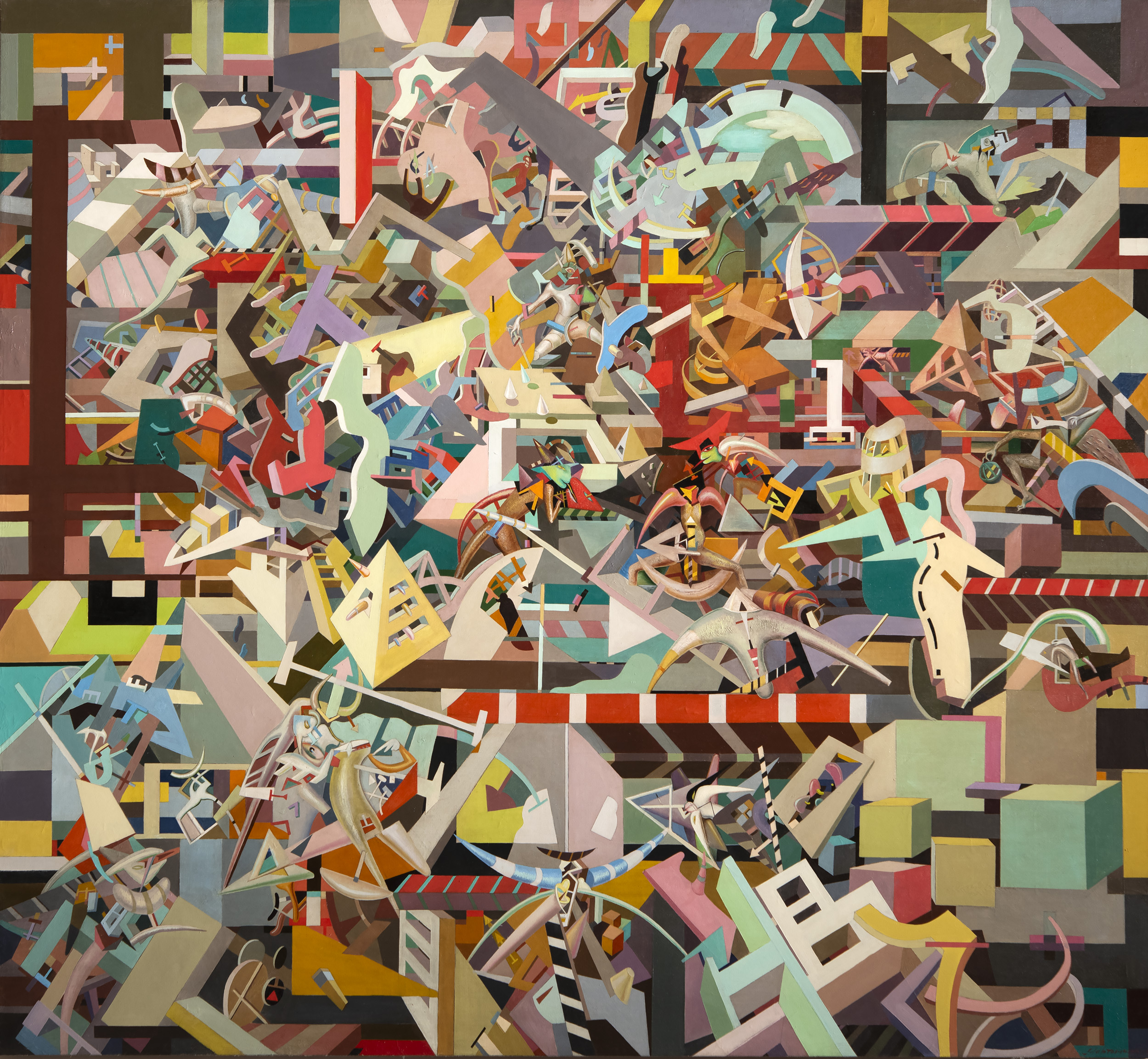
Consolation Zone, 1987. Oil on canvas, 197.6 × 218 cm (77 13/16 × 85 13/16 in.). Norton and Nancy Dodge Collection of Nonconformist Art from the Soviet Union. D08651
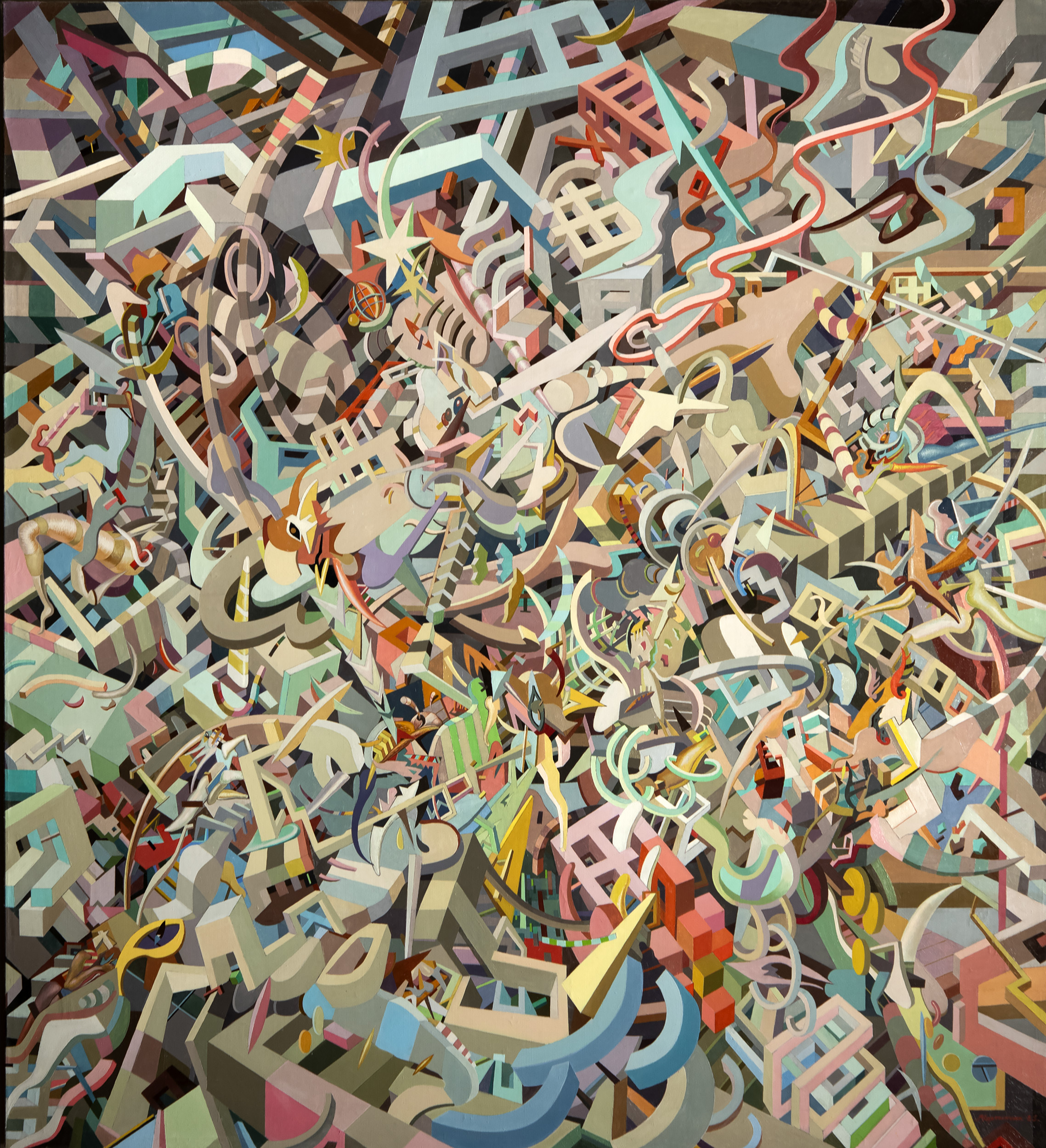
Holiday in the Provinces, 1985. Oil on canvas, 218 × 198 cm (85 13/16 × 77 15/16 in.). Norton and Nancy Dodge Collection of Nonconformist Art from the Soviet Union. D08652