

Ziiakhan Shaigeldinov (Shai-Ziia)
1948 — Issyk, Almaty Oblast (Kazakhstan) | 2000 — Almaty (Kazakhstan). Worked in Almaty (Kazakhstan)
Ziiakhan Shaigeldinov, better known in late-twentieth-century Almaty art circles as Shai-Ziia, is an iconic figure of perestroika-era Kazakhstan, which was poor, hungry, dirty, and, at the same time, feverishly alive. As the owner of a video camera—an extreme rarity in those days—he could get into any institution, community, and even private group of friends by casually explaining that he was a video journalist from WTW, New York. Nobody asked for credentials. The giant camera was proof enough; back then, people respected the official television channels, which was all that existed at the time. He would open his alleged reports with the words “Dear American television viewers,” and then he would film whatever he saw. He was most interested in the new art galleries that recently emerged in the wake of the rise of capitalism. Paradoxically, although it was a time of great poverty, the galleries were extremely active. As a result, he ended up with a huge archive of footage capturing Almaty’s art world at the end of the twentieth century.
Shai-Ziia graduated from a prestigious downtown high school in Almaty, which stood next to a monument to Felix Dzerzhinsky. Rumor had it that his father was a colonel in the KGB, although, with Ziiakhan’s propensity for making things up, he would sometimes claim that he was raised by foster parents. He liked photography. After serving in the Soviet army, he worked at the Almaty documentary film studio. As he described it, “Beginning in 1984, I was always able to get myself work. I am a videographer and object artist. I have organized and held close to ten art shows, including a two-month-long event called Pop Art, in a gallery co-organized by me and Vladimir Ganzha. I am currently an independent broadcast journalist, shooting stories for many different television production companies.” [1]
It’s hard to say which parts of his life were fact and which were fiction. He would often refer to himself as a psychologist, an ecologist, a builder, or an anarchist—but, regardless of whatever else he claimed to be, he definitely thought of himself as an artist. Proof of this are two of the art exhibitions on his résumé, both called Zhiger, which were held in 1980 and 1982 by the youth association of the Artists’ Union of Kazakhstan. These demonstrate that he had attempted to be a part of the official art world of that period, the only art world that existed at the time.
The unofficial art scene came into being a bit later, during the Gorbachev years, inaugurated in Kazakhstan with the foundation of the Zelenyi treugol’nik [Green triangle] and Nochnoi tramvai [Night trolley] art collectives. Naturally, Shai-Ziia not only took part in their activities, but also attempted to start his own new movements: the Partiia pofigistov [Who Cares party], Tsentr tvorcheskoi reabilitatsii [Center for artistic rehabilitation], and Art-kommuna [Art commune], the latter two proposing the literal construction of buildings for the purpose of holding exhibitions and serving as meeting spaces for avant-garde arts including Shai-Ziia himself. There is a video of him at a Nochnoi tramvai opening from that period: in a wide-brim hat, Shai-Ziia is on the street, talking to passersby through a telephone handset hooked up to a loudspeaker, which gathers a crowd. He invites them in to see the exhibition “of the top avant-garde artists,” who are not yet valued, “but will soon be understood by everyone,” and if the people don’t like it, then they can leave. [2] The camera documents the faces of the people watching the performance, frequently focusing on the police officer lingering nearby, who had not yet received orders about what to do. Eventually, both Shai-Ziia and the camera turn their full attention to the officer, blatantly attempting to provoke him. Finally, the cop comes to his senses and, along with his colleagues who have arrived at the scene, attempts to disperse the crowd. Naturally, the people begin to object, and thus, the happening’s purpose is fulfilled: out of their distaste for the police, the potential viewers finally come into the exhibition space to see the show.
Unfortunately, not all of Shai-Ziia’s performances were captured on film. For instance, there is no documentation of Shai-Ziia in a khaki overall covered in little May Day flags, which he often wore around town. When the Memorial Society organized a show called Stalin vchera, segodnia, zavtra [Stalin yesterday, today, and tomorrow] in 1990, Shai-Ziia showed up with an accordion. People may have considered him a madman, but he looked absolutely natural in the many newly opened art spaces he haunted.
The pieces he showed at the Ular and Voyadzher galleries, the Directorates of Art Exhibitions, and at the geology museum—the latter being the first show of the Green Triangle collective—were by and large collages, assemblages, and found objects. Even his fellow artists were occasionally shocked by his use of materials, which was daring for the time—a complete rejection of the classical oil paint and canvas. Today, Shai-Ziia’s choice of media can be interpreted as a protest and provocation against the Soviet rules dictating that art supplies could only be sold to those who had artists’ union memberships.
Then there is also the most simple explanation for Shai-Ziia’s choice, bandied against him by officially recognized artists: that the man simply did not know how to draw. But he wasn’t interested in depiction and illusoriness as tools for making sense of the world. What he cared about was the concept of freedom, playing with textures and clichés, creating opportunities to debunk official ideologies, all of which may have also been in compensation for childhood complexes.
Thus, he covered an official portrait of Lenin with collaged paper for the work Untitled, in the late 1980s, leaving only a small space through which the leader of the revolution could be recognized. He covered a portrait of Karl Marx, Untitled, at the end of the 1980s. The version in the Zimmerli collection is called Karl Marx in a Spider Web (c. 1987, ZAM, D17344); in it, he covered an image of Marx in barrettes, assembling them so they resemble a swarm of cockroaches running away from each other. His metaphors are direct—even slogan-like—but they still have the power to be impressive in their simplicity and childlike joy. For example, the sculpture Sovetskaia kul’tura [Soviet Culture] (1989), which consists of the fretboard from a guitar, a Zhostovo painted tray, and a Soviet wooden toilet lid. The use of everyday objects as supports to create compositions that present philosophical generalizations conveys Shai-Ziia’s message through repetition. Other works following this model include the abstract Biomodule (1995–96), which is made entirely out of clothespins, Chasy [Clock] (mid-1990s), and the Zimmerli’s The Door of Time (Dver’ vremeni, 1988, ZAM, 2000.0730), which is a real wooden door, covered in watch faces like barnacles stuck to a ship. The metaphor is very transparent but, at the same time, multivalent. This is why Shai-Ziia kept returning to the powerful symbolism of the clock face.
Shai-Ziia’s most successful piece, the video documentary AntiButya (1994), is also about the flux and mutability of one’s personal perspective and time itself. For all of his hatred of communist ideology, he did not consider the development of capitalism to be a panacea that was going to cure what ailed Kazakh society—it wasn’t for nothing that he called himself an anarchist as well as a psychologist. Butya (Bulat Abilov) was one of the first nouveau-riche businessmen in Kazakhstan to organize a charitable benefit for children of limited means. The event ended by distributing gifts to those who showed special invitations to the event. How Shai-Ziia got in remains a mystery; it was most likely thanks to his camera and inextinguishable curiosity. But the much bigger mystery is how he managed, from the very beginning of the event, to identify and begin to follow a boy who was there on his own, having accidentally stumbled into the event without an invitation. Shai-Ziia captured the entire range of emotions this orphaned boy experienced—his shyness, uncertainty, hope, joy, and anxious expectation of receiving a gift, then his fearful confession of not having an invitation, sense of guilt, and disillusionment after being kicked out of the banquet hall. The video’s soundtrack, the Animals’ “House of the Rising Sun,” turns the everyday story into a scene filled with tragedy and disappointment. And into a real social drama. This video was never shown in Shai-Ziia’s beloved Almaty galleries, and was only screened after his tragic death in 2001, at the first large-scale group show of Central Asian artists, called No Mad’s Land, held in Berlin.
As the important Kazakhstani cultural critic Alim Sabitov has explained, “Ziiakhan Shaigeldinov, a pioneer of Kazakh video art who showed his work under the pseudonym Shai-Ziia, created a sui generis video chronicle of the Almaty art world. Over the course of many years beginning in the early ’90s, he captured every important event: openings, actions, performances. Over time, he transitioned from purely documentary work to experimenting with form. His strategies for increasing the visual expressiveness of the images included the introduction of camera movement and changes in focal distance; he practically did not explore the artistic potential of montage. The early passing of this talented artist interrupted his long-running experiment.” [3]
Valeria Ibraeva
Translated from Russian by Bela Shayevich
Photo portrait courtesy of Asemgul Krylova
Notes:
1. Sultanbaeva, Zitta, and Asya Nurieva. Art atmosfera Alma-Aty [The art atmosphere of Almaty]. Almaty: Astana Motors, 2015: 96.
2. Shai-Ziia. “Vernissage” video recording. In video archive by Shai-Ziia. Tselinny Center of Contemporary Culture [archived].
3. Sabitov, Alim. “Pionery kazakhstanskogo videoarta” [Pioneers of Kazakh video art], in Khudozhestvennaya zhizn Kazakhstana [Art life of Kazakhstan]. Almaty: Izdanie Centra sovremennogo iskusstva Sorosa-Almaty, 2001: 38–39.

Karl Marx in a Spider's Web, c. 1987. Oil with barrettes on canvas, 84.9 x 64.9 cm (33 7/16 x 25 9/16 in.). Purchased with funds donated by Norton Dodge and Nancy Dodge. 2000.0738
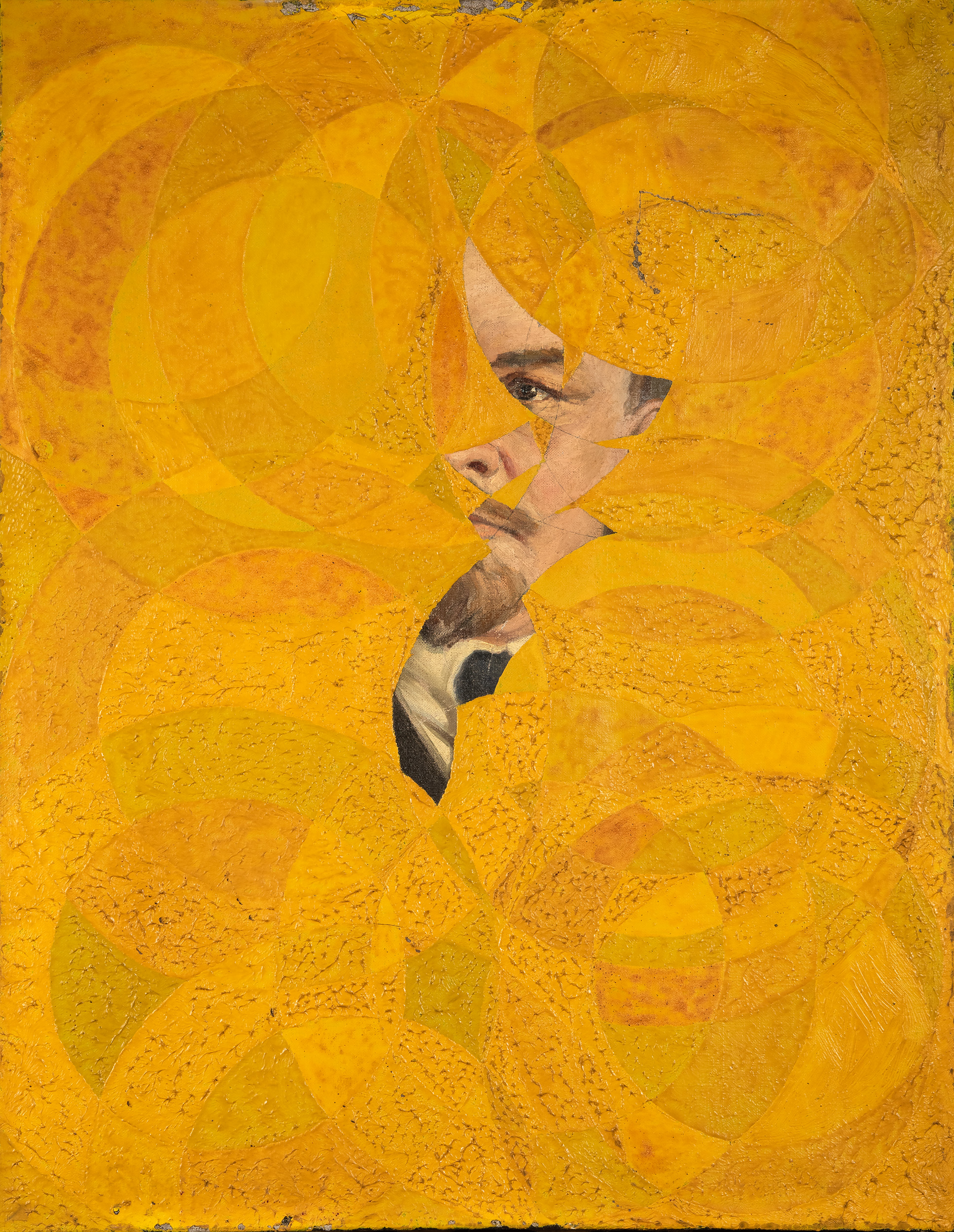
No. 10, c. 1987. Oil on canvas, 85.6 x 65.6 cm (33 11/16 x 25 13/16 in.). Purchased with funds donated by Norton Dodge and Nancy Dodge. 2000.0733
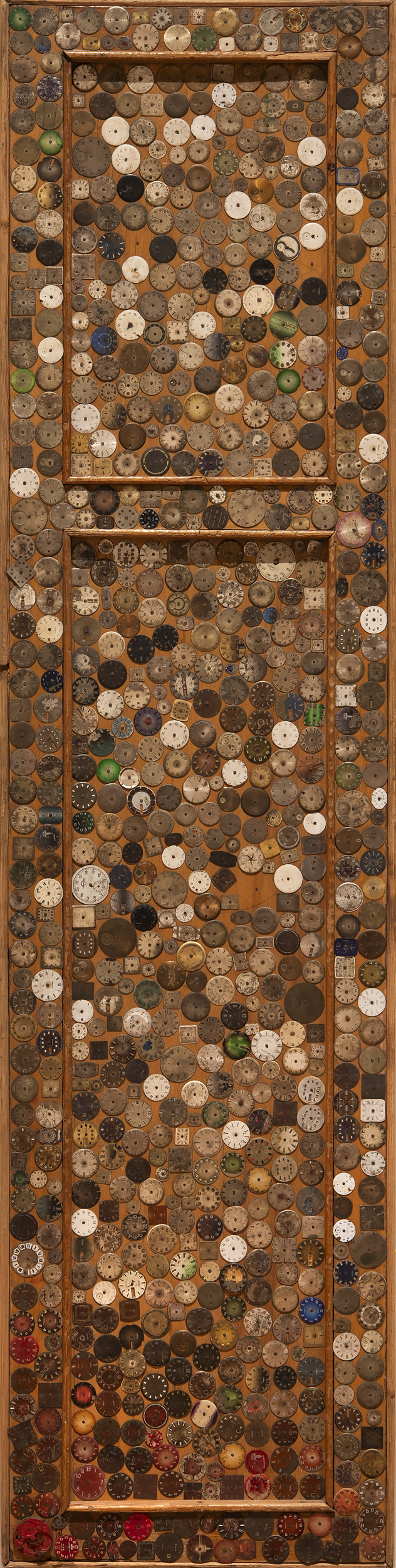
Door of Time, 1988. Watch faces on wooden door, 165 x 42 cm (64 15/16 x 16 9/16 in.). Purchased with funds donated by Norton Dodge and Nancy Dodge. 2000.0730
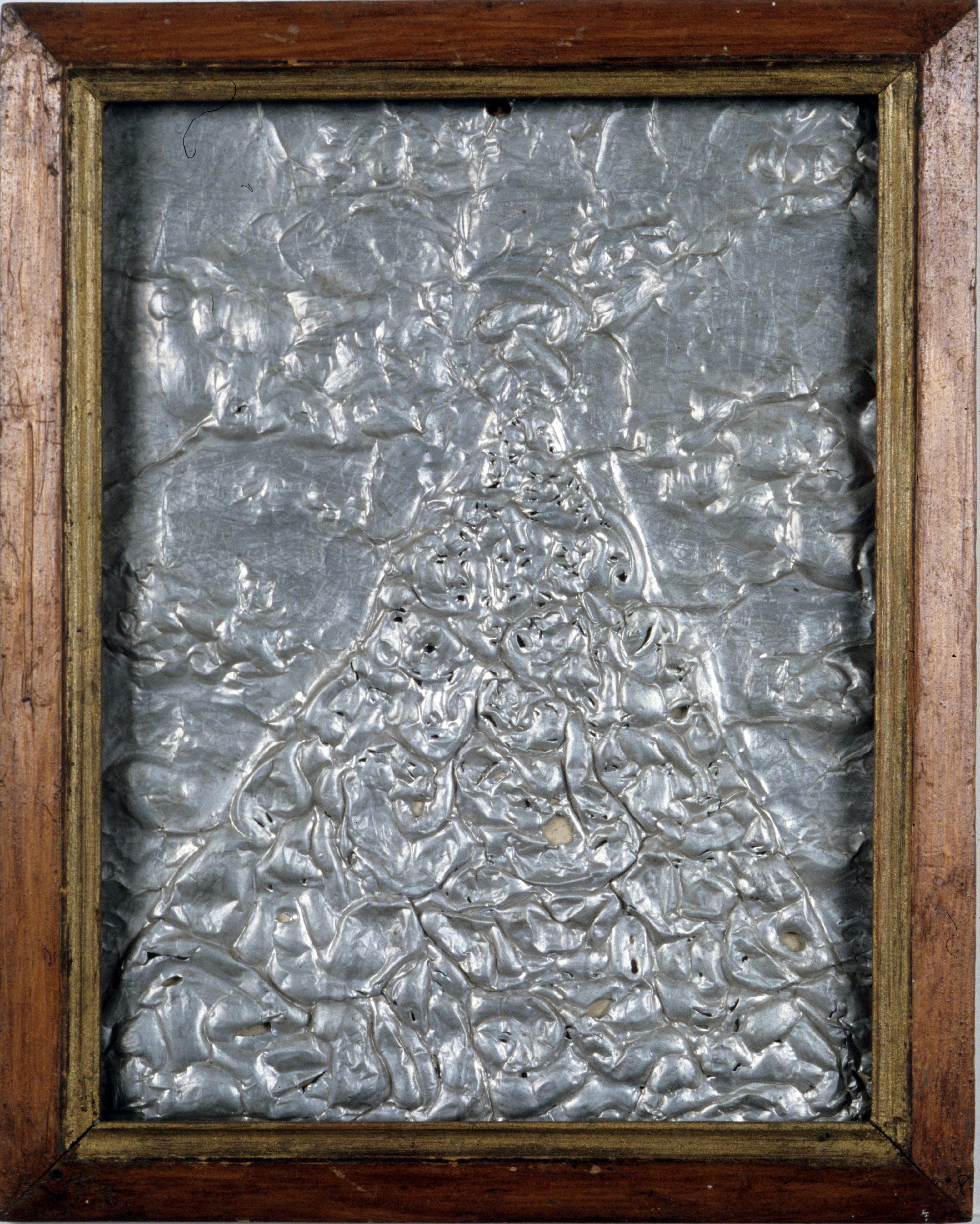
Hammer and Sickle, c. 1987. Aluminum repoussé and paperboard on wood panel, 85 x 94.5 cm (33 7/16 x 37 3/16 in.). Purchased with funds donated by Norton Dodge and Nancy Dodge. 2000.0732
Selected Exhibitions
1980 and 1982 Жигер [Zhiger] exhibition of young artists of Kazakhstan, exhibition hall of the Artists’ Union of Kazakhstan, Almaty, Kazakhstan
1989 Зеленый треугольник [Green Triangle], Museum of Geology of the Republic of Kazakhstan, Almaty, Kazakhstan
1990 Stalin vchera, segodnia, zavtra [Сталин вчера, сегодня, завтра, Stalin yesterday, today, tomorrow], exhibition hall of the Directorate of Art Exhibitions, Almaty, Kazakhstan
1991 Живопись души [Painting of the spirit], Cathedral exhibition hall, Almaty, Kazakhstan
1995 Парад галерей [A parade of galleries], Kasteev State Museum of Art, Almaty, Kazakhstan
1996 Про-витамин [Pro vitamin], Ular Gallery, Almaty, Kazakhstan
1996 Алматинское тупое искусство [Almaty’s dumb art], Voyager Gallery, Almaty, Kazakhstan
1998 Выставка сюрреалистов [Exhibition of surrealism], Ular Gallery, Almaty, Kazakhstan
1998 Опт-арт [Opt art], exhibition hall of the Directorate of Art Exhibitions, Almaty, Kazakhstan
2000 Пионеры и комсомольцы казахстанского видеоарта [Pioneers and Komsomol members of Kazakh video art], video program at the Soros Center for Contemporary Art’s second annual exhibition, Almaty, Kazakhstan
2001 New Acquisitions from Central Asia, Zimmerli Art Museum, New Brunswick, NJ, USA
2001 No mad’s land, Zeitgenössische Kunst aus Zentralasien, House der Kulturen der Welt, Berlin, Germany
2002 TransForma, Center for Contemporary Art, Geneva, Switzerland
Selected Publications
Hager, Martin, et al. Abseits der Seidenstrasse. Kunst und Kultur aus Zentralasien [Off the Silk Road: Art and culture from Central Asia]. Berlin: Haus der Kulturen der Welt, 2001.
Ibraeva, Valeria. “Kazakhstan Contemporary Art Moves Ahead.”In Asian Art News 13 (2003): 46–53.
Ibraeva, Valeria. Искусство Казахстана. Постсоветский период. [Iskusstvo Kazakhstana. Postsovetsky period, Art of Kazakhstan. Post-Soviet period]. Almaty: Tonkaya gran’ Press, 2014.
Khudozhestvennaya zhizn Kazakhstana [Art life of Kazakhstan]. Almaty: SCCA-Almaty, 2001.
Sultanbaeva, Zitta, and Asya Nurieva. Art Atmosfera Alma-Aty [The art atmosphere of Almaty]. Almaty: Astana Motors, 2015.
See also