
The Body Implied: The Vanishing Figure in Soviet Art
The Body Implied presents works of art made between 1970 and the present that feature partially obscured or hidden figures or instances where the human form is implied but not visible. In concealing the body, the artists in this exhibition explore a key tension: the body in relation to the state and the self. Although there was government censorship of art and literature in the Soviet Union, the works in this exhibition emerged from a period of greater artistic freedom thanks to Gorbachev’s glasnost (openness) and perestroika (restructuring) reforms. The artists used this newfound freedom to critique the Soviet regime and respond to political and artistic repression, which was often marked by violence.
Including works from the Norton and Nancy Dodge Collection and the Claude and Nina Gruen Collection, The Body Implied incorporates installation, drawing, photography, sculpture, and video by twenty-two artists from Armenia, Estonia, Georgia, Kazakhstan, Russia, and Ukraine. Examples of contemporary work recontextualize the permanent collection by demonstrating how these concerns continue to shape artistic expression in the present.
Organized by Stephanie Dvareckas, Dodge Fellow at the Zimmerli Art Museum and PhD candidate in the Department of Art History at Rutgers University, in consultation with Jane A. Sharp, PhD, Research Curator for Soviet Nonconformist Art, and Julia Tulovsky, PhD, Curator of Russian and Soviet Nonconformist Art.
Generous support was provided by Art Bridges Foundation’s Access for All Program.
The exhibition and brochure are made possible by the leadership support of the Avenir Foundation Endowment Fund, with additional support from the Dodge Charitable Trust–Nancy Ruyle Dodge, Trustee.

Shai-Ziya (Ziyakhan Shaigeldinov), No. 10, c. 1987. Oil on canvas, 85.6 x 65.6 cm (33 11/16 x 25 13/16 in.). Purchased with funds donated by Norton Dodge and Nancy Dodge. 2000.0733

Andrey Chezhin, Kharmsiad-2, 1995. Toned gelatin silver photograph. Norton and Nancy Dodge Collection of Nonconformist Art from the Soviet Union. D16624-D16626.

Gluklya (Natalia Pershina-Yakimanskaya), Diary for Grandmother, 2000. Overcoat with ink, 108.7 × 90 × 5 cm (42 13/16 × 35 7/16 × 1 15/16 in.). The Claude and Nina Gruen Collection of Contemporary Russian Art. 2023.023.002.
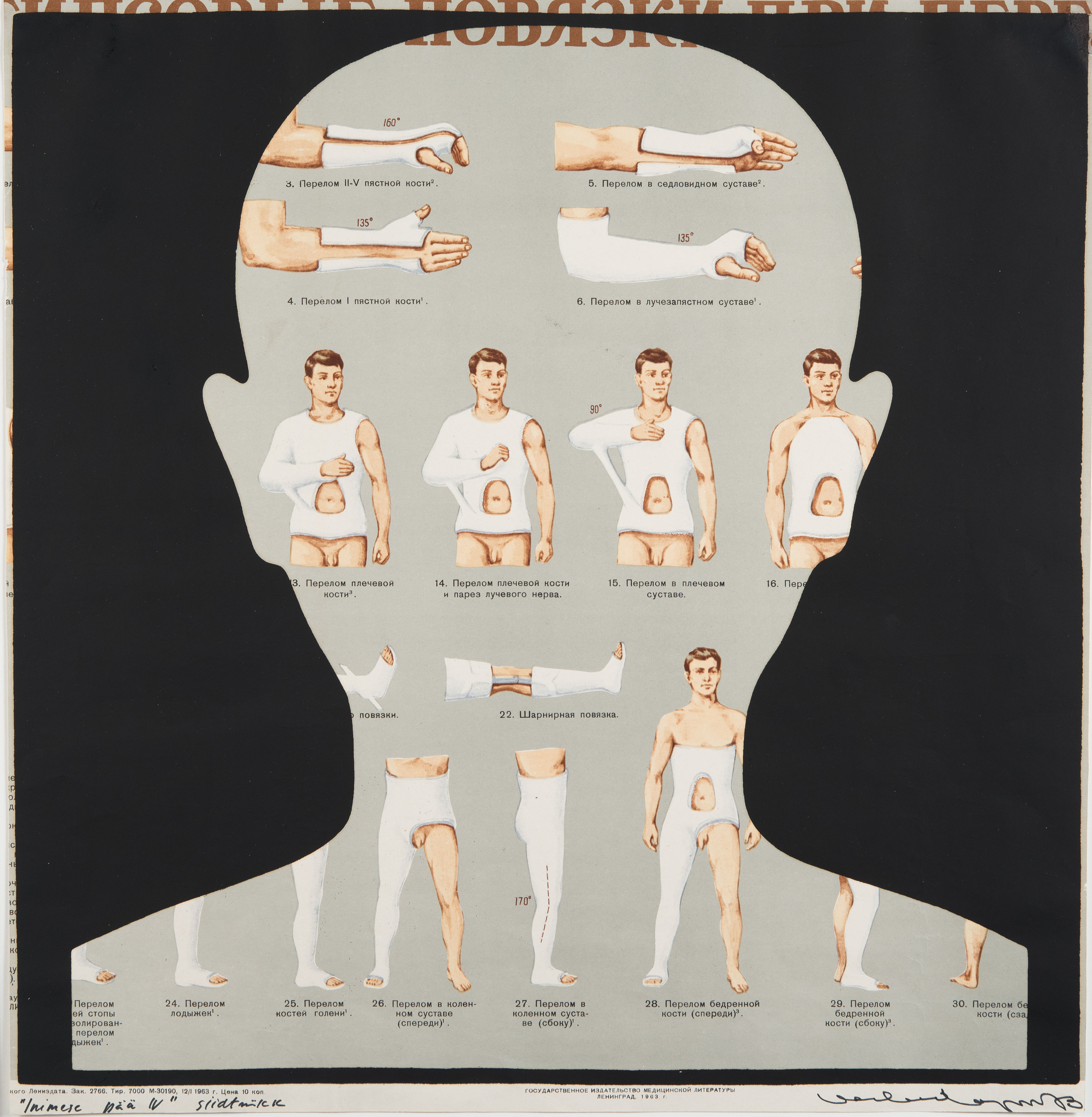
Leonhard Lapin, Man’s Head IV, from the series Siidtrükk, 1973. Screenprint on top of a photomechanical print, 52.3 × 50.4 cm (20 9/16 × 19 13/16 in.). Norton and Nancy Dodge Collection of Nonconformist Art from the Soviet Union. D15218

Igor Makarevich, Cross of St. Ignatius, 1979. Enameled plaster casts in wooden frame, 92.2 x 92.4 x 6.5 cm (36 5/16 x 36 3/8 x 2 9/16 in.). Norton and Nancy Dodge Collection of Nonconformist Art from the Soviet Union. 1996.0698

Igor Makarevich, Surgical Instruments, 1978–79. Oil on canvas, 131 x 315 cm (51 9/16 x 124 in.). Norton and Nancy Dodge Collection of Nonconformist Art from the Soviet Union. 1996.0701.001-003

Volodymyr Naumets and Sergei Anufriev, Thirty-two works from the series Up. Photodocumentation of the performance, 1982. Gelatin silver photographs, 24 × 29.8 cm (9 7/16 × 11 3/4 in.). Norton and Nancy Dodge Collection of Nonconformist Art from the Soviet Union. D10031.25
Accordion Content
-
Zimmerli’s Latest Exhibition of Soviet Art Explores What Is Not Seen
New Brunswick, NJ—The human figure has been a central theme throughout art history. In the new exhibition The Body Implied: The Vanishing Figure in Soviet Art at the Zimmerli Art Museum at Rutgers—New Brunswick, the absence of a fully visible human form conveys a key tension from the Soviet era: the body in relation to the state and the self.
“Visitors have a unique opportunity to explore contemporary issues through the diverse perspectives of artists from multiple countries, several of whom created their art under Soviet rule,” said Stephanie Dvareckas, the Zimmerli’s Dodge Fellow and a Ph.D. candidate in art history at Rutgers, who organized the exhibition. “The exhibition raises questions about bodily autonomy, protest, and state violence—recalling consent, abortion rights, and the elevation of marginalized voices.”
Featuring more than 100 objects—painting, drawing, assemblage, video, sculpture, photography—The Body Implied presents works of art made between 1970 and the present, by 22 artists from Armenia, Estonia, Georgia, Russia, Kazakhstan, Lithuania, and Ukraine. Imagery features partially obscured or hidden figures, as well as instances where the human form is implied, but not visible. The exhibition brings together diverse contexts and, through atypical pairings, allows for new comparisons.
The exhibition is divided into five sections. “Physical Traces” refers to materials left behind by the body. “Fragments” alludes to the obstructed and obscured body as a kind of disfigurement. “Medical Traces” demonstrates the body implied through medical devices and imagery. “Domestic” representations suggest spaces designed for bodies that aren’t there, with vacant spaces and household objects acting as proxies for the body. “Textual” works insinuate physical action or thought, but words stand as remnants of the human form, affirming their entanglement with the body.
Three works on view by Igor Makarevich are related to each other: Stratigraphic Structures (1976), Cross of St. Ignatius (1979), and 25 Memories of a Friend (1978). Each was created by an action—a sort of performance—in which the artist made plaster casts of his own face, with expressions of varying degrees of stillness and distress. Each group is displayed in a grid, suggesting what he has called a “repressive space.” In his work, Makarevich responds to the repressive conditions of the Soviet Union and the feeling of erasure.
GLUKLYA recreated clothing worn in protests on the streets of St. Petersburg, Russia, that were exhibited in the 2015 Venice Biennale curated by Okwui Enwezor. The video May 1 documents multiple years of protests and accompanies Clothes for the Demonstration Against the False Election of Vladimir Putin. This installation includes shirts and vests—hung on towering poles propped against the wall—embroidered with images and such rallies as “Pensions must be with dignity,” “Bring back free education!!!,” and “Stop This Infamy.” These demands that seem to re-emerge with each new generation, across the globe, reveal the precarity of people against the state.
“This exhibition has allowed for important collaboration within and outside our permanent collection,” said Julia Tulovsky, Ph.D., Curator of Russian and Soviet Nonconformist Art, who consulted on the exhibition. “While most works are drawn from our vast Norton and Nancy Dodge Collection of Nonconformist Art from the Soviet Union, Stephanie also uncovered these themes in our Claude and Nina Gruen Collection of Contemporary Russian Art, which includes art from the later 1990s and early 2000s. In addition, we had the exciting opportunity to partner with the artist GLUKLYA and Galerie Blue Square.”
The Body Implied: The Vanishing Figure in Soviet Art is on view at the Zimmerli through September 15, 2024. The exhibition is organized by Stephanie Dvareckas, Dodge Fellow at the Zimmerli Art Museum and Ph.D. candidate in the Department of Art History at Rutgers University, in consultation with Jane A. Sharp, Ph.D., Research Curator for Soviet Nonconformist Art, and Julia Tulovsky, Ph.D., Curator of Russian and Soviet Nonconformist Art.