
Igor Palmin
1933 — Stalingrad (USSR; now Volgograd, Russia) | 2025 — Moscow (Russia). Worked in Voronezh, Moscow, Leningrad/Saint Petersburg, and other Russian cities
Igor Palmin was a master both of the photographic portrait and of Russian architecture photography. Many people are familiar with his photographs of such artists as Dmitrii Krasnopevtsev (1925–1995), Vladimir Veisberg (1924–1985), Evgenii Kropivnitsky (1893–1979), Oskar Rabin (1928–2018), or Vladimir Nemukhin (1925–2016), even if they are not familiar with the photographer. He established the visual canon for our engagement with Art Nouveau and constructivism and with the architecture of Fyodor Shekhtel, Konstantin Melnikov, Ivan Leonidov, and Aleksandr Vesnin.
But his legacy is not limited to these two large domains. Palmin created a vast visual archive of artistic and exhibition life of the 1960s through 1980s. He produced a poignant photographic series on the tragic history of the Chechen-Ingush Republic and its monuments. He created exquisite landscape and cityscape images, as well as meticulous and lively photographs of everyday life.
Igor Palmin was born into a family of actors, but he did not inherit that predisposition. He chose geology as his profession, yet he always remembered his childhood visual impressions from the theater: The constructivist set designs of the prewar Voronezh Theater, where his parents worked, reverberate throughout his images of Leonidov’s and Melnikov’s buildings. The theatrical mise-en-scènes that he observed from the audience as a boy found their continuation in his portraits of artists. And House with the Elephants on the Volga River, the Art Nouveau dacha of Konstantin Golovkin, which Palmin saw from a ship while he was evacuating during World War II, became the focus of his photograph for the book on Russian Art Nouveau architecture. He used to refer to such coincidences as “clues from fate.”
Palmin became passionately enthusiastic about photography while in his first year at the geology department at Voronezh University. One of his first images, in which the future photographer’s style is already discernible, belongs to this period (Class Shirker, Voronezh, 1953). [1] A boy from the postwar decade gazes at the viewer, eager and calm. The gaze of the photographer—attentive and kind—is reflected back. This sense of mutual trust will be apparent fifteen years later in his portraits of his artist friends.
After university, Palmin worked as a geologist for a few years but then drastically changed his life. He enrolled at the Cinematography Department at the Gerasimov Institute of Cinematography (VGIK) and was then been based in Moscow since 1962. At first, he worked at the Laboratory for Scientific and Applied Photography and Cinematography at the Soviet Academy of Sciences, and then as a cinematographer and film editor of scientific programs on television. In 1966 he met Ernst Neizvestny (1925–2016), and two years later, his colleague Valeriy Stigneev (1937–2021) introduced him to the circle of unofficial artists. In the next twenty years Palmin created a unique photographic archive of artistic life: hundreds of images of faces, artist studios, exhibitions, performances, and social interactions.
One of the first images from this period is the famous portrait of Oskar Rabin (Oskar Rabin. Cherkizovo Apartment). [2] As Palmin himself wrote, he “immediately understood Oskar as a unity of person, art, and environment.” [3] Rabin’s infamous stubbornness and taciturnity manifest themselves in the half smile, the turn of the head, and the artist’s posture, as he leans against an empty canvas. The lines of another member of the Lianozovo Group, Igor Kholin (1920–1999), could serve as a poetic parallel to this portrait:
Face like an icon. Round shoulders.
Stubborn like a mule.
Mind like a razor.
A conversation with him—like a battle. [4]
An electric light bulb creates a semblance of a halo atop Rabin’s head and at the same time illuminates an empty table with ashtrays and paint stains, calling to mind the uneasy light of the uprooted world in Rabin’s paintings. In the portrait of Vladimir Veisberg, a master of self-termed “invisible painting” characterized by subtle gradations of white (1972, ZAM, D09156), there is a different kind of light—clear, bright, woven from pearly particles of light, like the “white on white” nature of Veisberg’s works.
Palmin’s formula for depicting his protagonists lies in compositional and associative rhymes. For the portrait of Vladimir Yankilevsky (1938–2016) (Vladimir Yankilevsky), [5] he found his solution in a compositional parallel “between the orderliness on the table and the proportion and structure of his paintings, in his penchant for long horizontals” [6]—while Viktor Pivovarov (b. 1937), by the desk, under the light of a desk lamp (Viktor Pivovarov, 1977), [7] resembles a fairy-tale stargazer—and immediately one remembers his illustrations for children’s books.
Palmin always stressed that he made portraits of “his people”—loved ones and close friends—and in this, his images have a lot in common with the old genre of keepsake photography. Palmin’s typical shot is usually a full-face portrait. He practically never experimented with points of view or used a wide-angle lens. He did not take hundreds of shots, just a few—precise and subtle.
Palmin actively participated in artistic life and was a frequent and welcome guest in the studios and apartments of his friends. His photographs of artist studios and apartments so precisely reflect the character and artistic world of their inhabitants that it is not hard to guess who lived and worked in these spaces.
Palmin sees the Kropivnitskys’ house and its surroundings in Lianozovo as populated with fairy-tale beings and plants, similar to those that can be found in the paintings by Evgenii Kropivnitsky, Olga Potapova (1892–1971), and Valentina Kropivnitskaia (1924–2008) (ZAM, D09125). The Krasnopevtsev apartment (ZAM, D09135) seems like an ancient cave of wonders (some of which were the subjects of his still lifes) that have been collected and arranged by the master according to strict laws of his own understanding of absolute harmony.
This period of close contact with the artists lasted for about twenty years. In the mid-1980s, it stopped—many of the artists left the Soviet Union, some of them passed away, and the community fell apart.
By 1971, Palmin had left his work on television and dedicated himself entirely to photography. He freelanced at various publishing houses—Iskusstvo [Art], Sovetskii khudozhnik [Soviet artist], and Sovetskii pisatel [Soviet writer]—and magazines— Dekorativnoe iskusstvo [Decorative arts], Tvorchestvo [Creativity], Sovetskaia arkhitektura [Soviet architecture] as well as Western publishing houses. In 1980 architecture became his main artistic focus.
Palmin created an extensive series of photographs of Russian constructivist, Art Nouveau, and neoclassical architecture. The monograph Russian Art Nouveau, by Elena Borisova and Grigory Sternin, with Palmin’s photographs, first published in France in 1987 and then in Russia in 1990, was a resounding success. The book introduced Russian Art Nouveau architecture to the general public. Palmin’s way of looking at architecture differed from that of those who came before him (F. Shekhtel. Riabushinsky’s Palace. Main Staircase). [8] He describes his method like this: “In St. Petersburg I began to find and pay attention to things that other artists did not notice: stained glass in the stairwells, the staircases . . . To capture these images, I chose the approach not of architecture photography, but a ‘cinematic’ one, what you would call montage: as if I am pulling one frame after another. I ‘felt’ this house, rather than ‘approached’ it.” [9] He returned many times to works by his favorite architects—Shekhtel and Melnikov—throughout the years, creating “photographic monographs” of these masters. [10]
With architecture, as with people, Palmin built personal relationships, treating his subjects carefully and respectfully. He did not take any unnecessary shots; he waited for the right light. He shot them frontally, avoided harsh points of view, looked attentively, closely examined the form: Each of his shots is a result of a deeply personal experience. For him, a building is a living organism, where traces of its past life are added to its original form: cracks, changes in surface texture, plants, and other types of architecture that surround it, and finally, signs of human activity, the unavoidable everyday life infused into the architecture.
A typical example of such a photo shoot is the “visual poem” about Konstantin Melnikov’s house and the architect’s life, which Palmin worked on throughout the 1980s and 1990s. [11] At that time the architect’s son still lived in the house, but Palmin perceived this not as a hindrance but as an advantage. He photographed an intimate portrait of the house, rather than a formal one. He “believed in this house, believed that it is what it had to be” (Melnikov’s House: Light in the Living Room, 1980s; Melnikov’s House: In the Studio, 1980s [12]) [13]
In the era of bold photographic experiments, new digital possibilities, and unexpected perspectives, Palmin stayed out of the competition, not altering his approach. He did not like to refer to his photographs either as “architecture” or “fine art” photography, and for a long time refused even to recognize their artistic value, reducing their purpose to that of a purely documentary record. In this attitude there is something of an ascetic modesty of Russian icon painters. This is not entirely accidental and is rather directly related to matters that he liked to contemplate—light, time, and memory.
Anna Gershovich
Translated from Russian by Anastasia Skoybedo
Photo portrait: Igor Palmin, 1975. Self-portrait. In: Igor Palmin. Past Perfect, 2011: 16.
Notes:
1. Faina Balakhovskaia, Alexandra Kharitonova, Irina Lebedeva, and Sasha Obukhova, eds., Igor Palmin: Past Perfect (Moscow: Art Volkhonka, Fond Kultury “Ekaterina,” 2011).
2. Igor Palmin: Past Perfect, 97.
3. Igor Palmin: Past Perfect, 96.
4. Igor Kholin, Izbrannoe. Stikhi i Poemy [Selected works, poems] (Moscow: Novoe Literaturnoe Obozrenie, 1999), 22.
5. Igor Palmin: Past Perfect, 317.
6. Igor Palmin: Past Perfect, 316.
7. Igor Palmin: Past Perfect, 336.
8. Elena Borisova and Grigory Sternin, Art Nouveau Russe (Paris: Editions du Regard, 1987).
9. Igor Palmin, “Arkhitektura kak tema [Architecture as a theme],” In Igor Palmin, and Anatoly Strigalyov, Arkhitekturnye pamiatniki: Igor Palmin — arkhitekturnaia fotografia: Vpered v proshloe, nazad v budushchee [Architectural monuments: Igor Palmin—architectural photography: Forward to the past, back to the future], exh. cat., State Russian Museum (Moscow: State Museum of Architecture, 1993), 3.
10. Igor Palmin, “Chestnaia arkhitektura [Honest architecture],” in Arkhitekturnye pamiatniki, 4.
11. Palmin, “Chestnaia arkhitektura,” 5.
12. Exhibition Muse of Architect Melnikov, LiveJournal entry featuring photographs by Igor Palmin.
13. Igor Palmin, interview. Radio Blago, May 25, 2014.
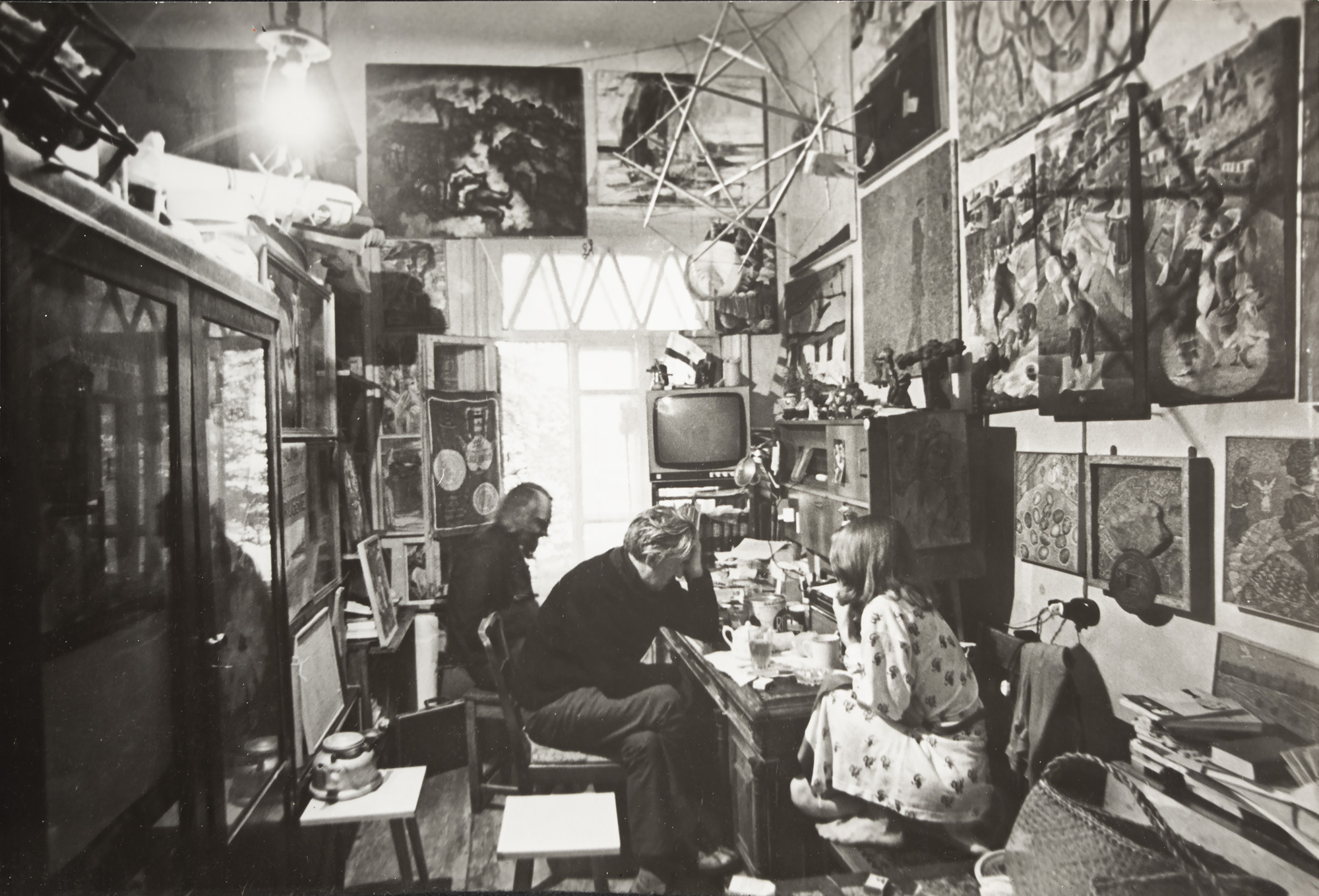
At the Collector's, Talochkin and Nemukhin, undated. Gelatin silver print, 39 × 56.5 cm (15 3/8 × 22 1/4 in.). Norton and Nancy Dodge Collection of Nonconformist Art from the Soviet Union. D09126
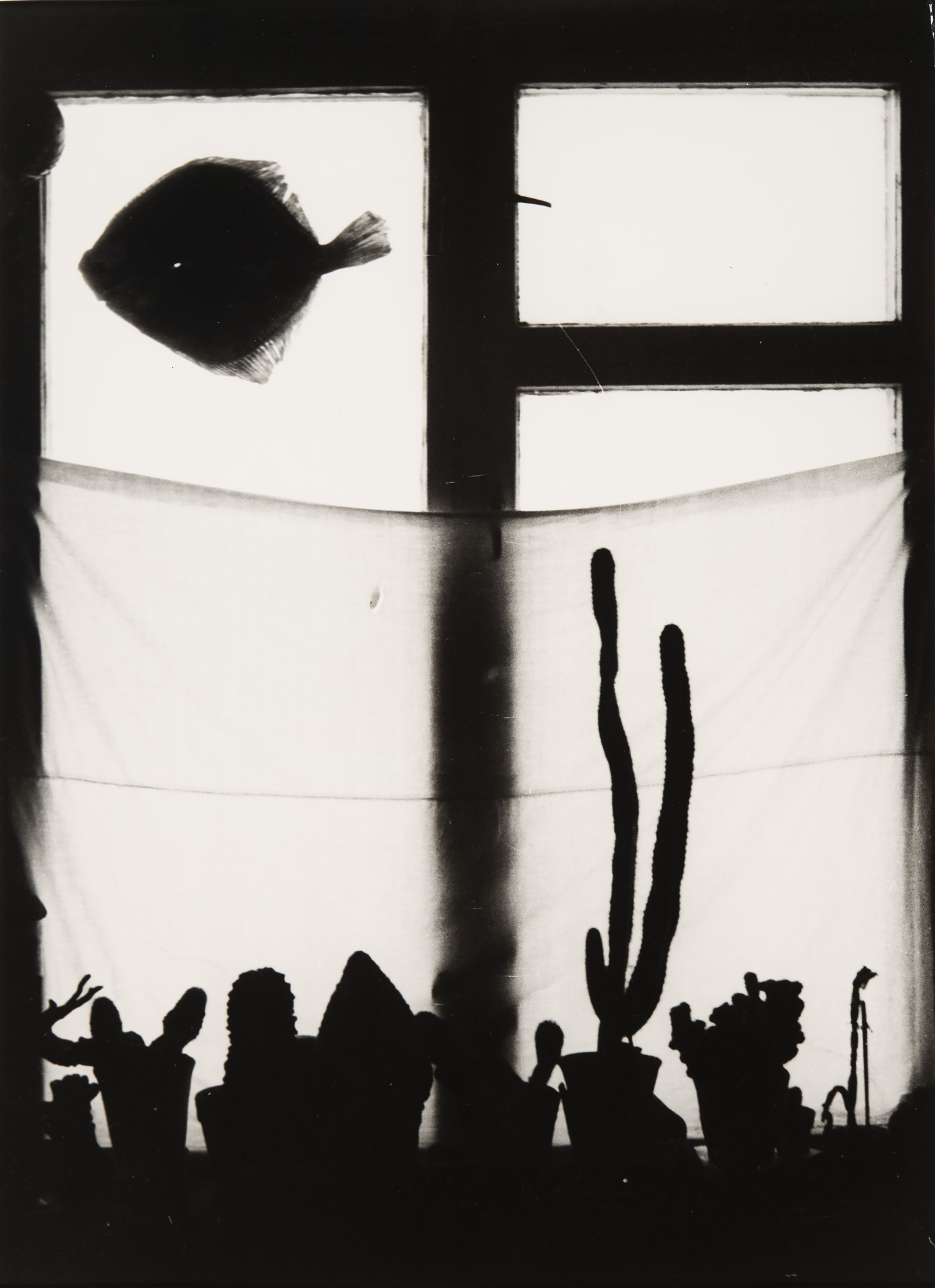
Window of Dmitrii Krasnopevtsev, 1970s. Gelatin silver print on paper, 53.2 x 39 cm (20 15/16 x 15 3/8 in.). Norton and Nancy Dodge Collection of Nonconformist Art from the Soviet Union. D09135
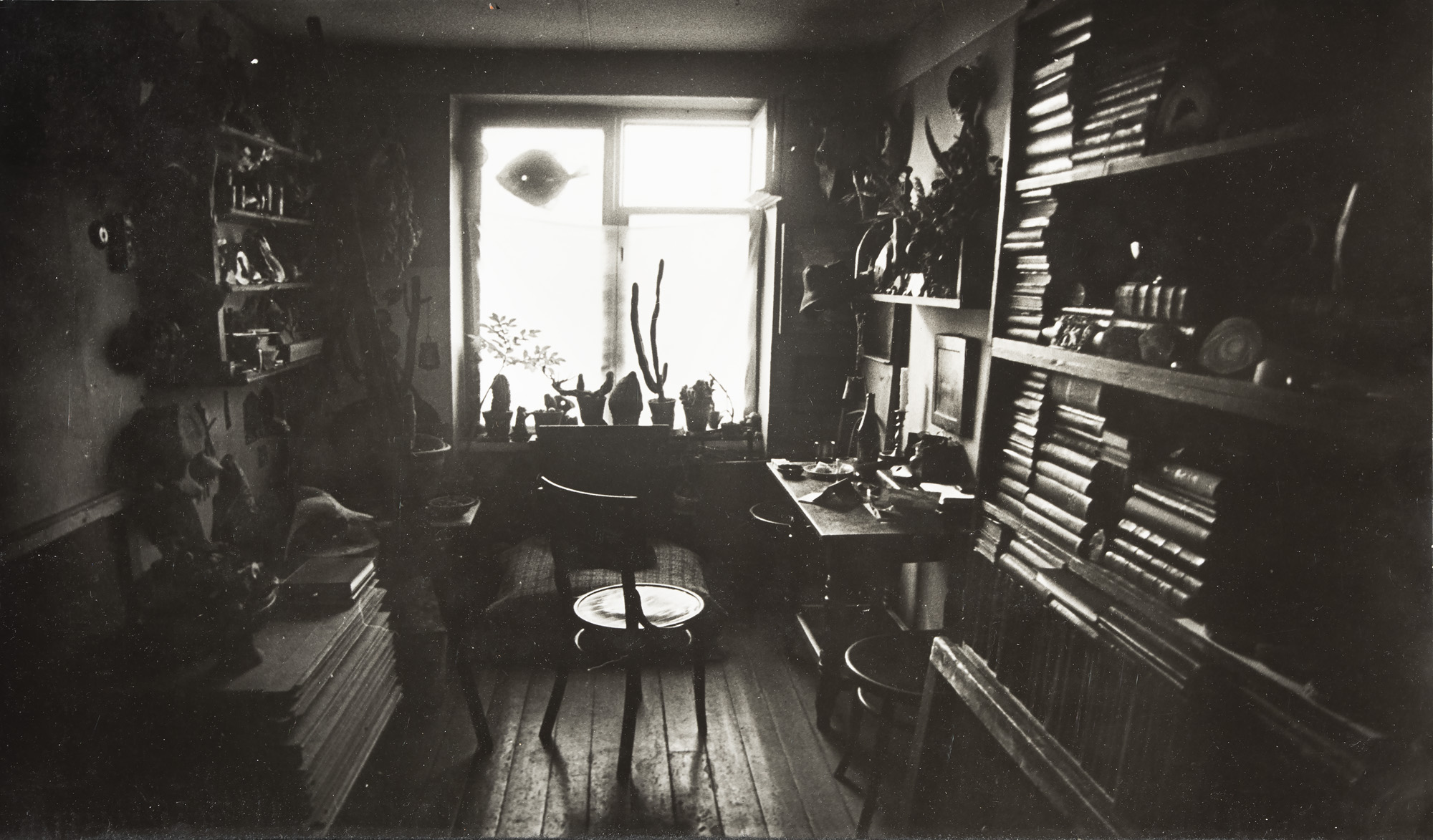
Studio of Krasnopevtsev, undated. Photograph, 38 × 58 cm (14 15/16 × 22 13/16 in.). Norton and Nancy Dodge Collection of Nonconformist Art from the Soviet Union. D09136
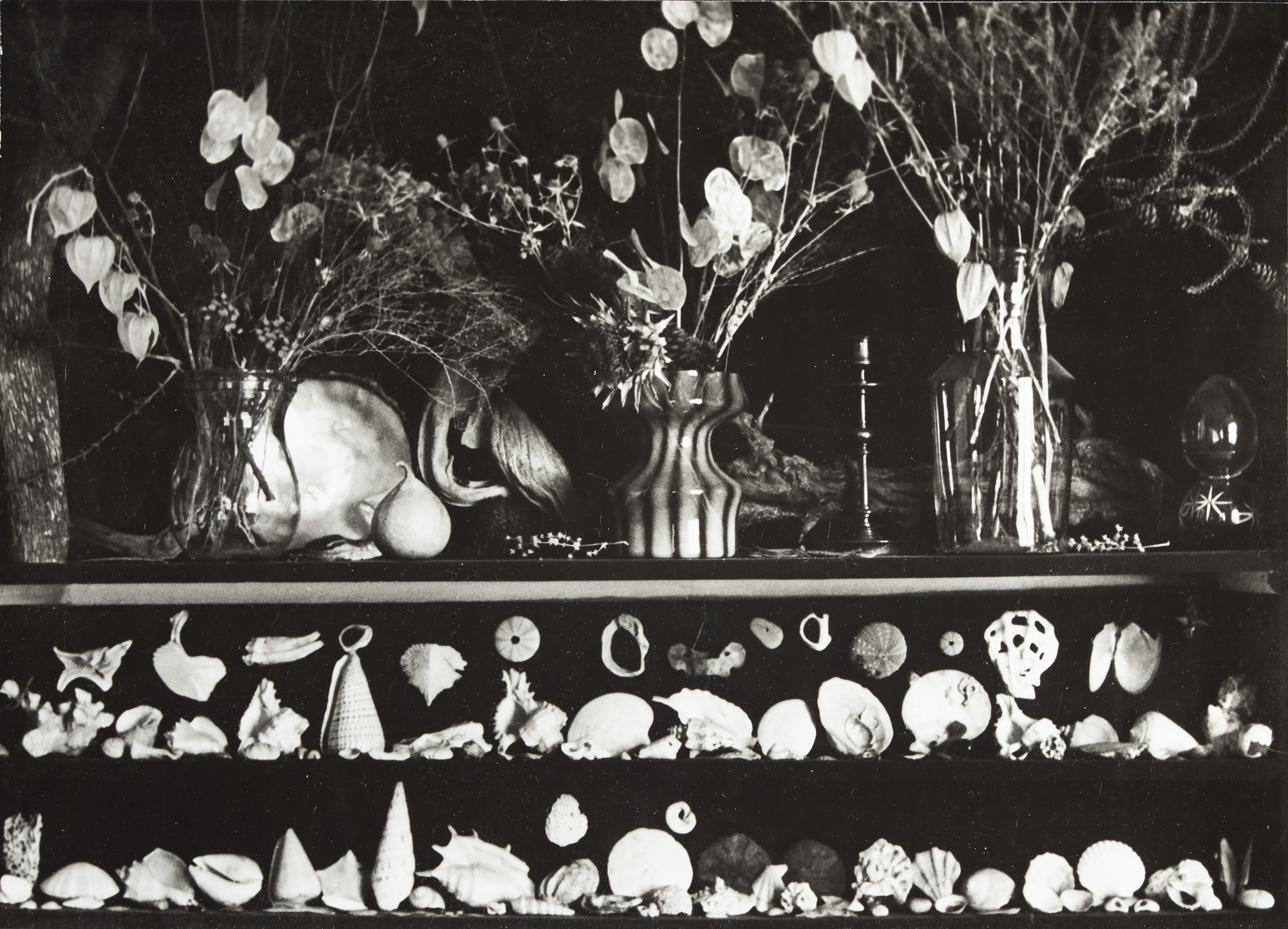
In the Studio of O. Kandaurov, undated. Photograph, 36 × 49 cm (14 3/16 × 19 5/16 in.). Norton and Nancy Dodge Collection of Nonconformist Art from the Soviet Union. D09138
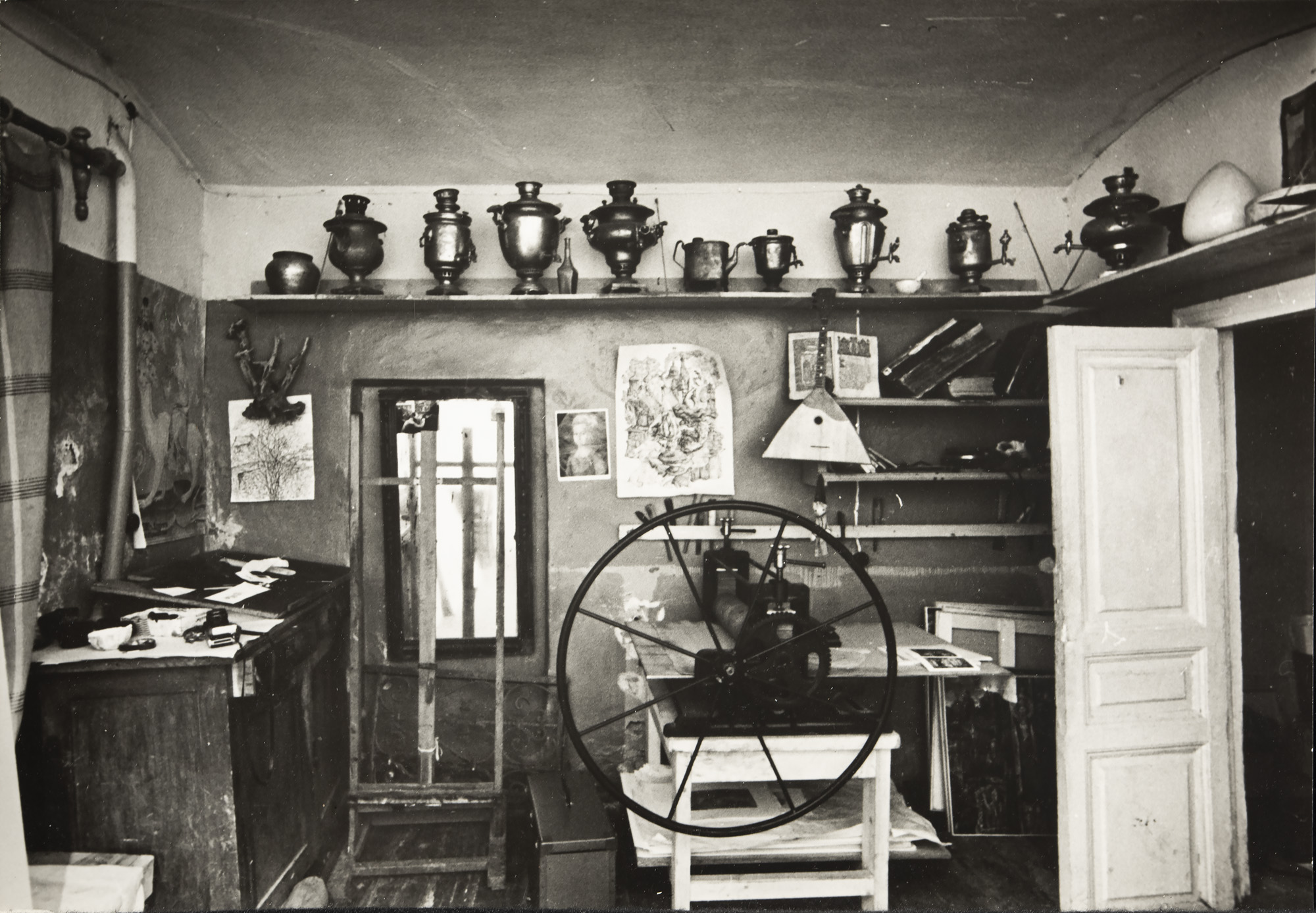
In the Studio of V. Kalinin, undated. Photograph, 36 × 51.5 cm (14 3/16 × 20 1/4 in.). Norton and Nancy Dodge Collection of Nonconformist Art from the Soviet Union. D09141