
Oscar Rabin
1928 — Moscow (Russia) | 2018 — Florence (Italy). Worked in Moscow (Russia) and Paris (France)
Oscar Rabin was a pivotal figure in the unofficial Soviet art movement, symbolizing resistance to the ideological and aesthetic constraints of socialist realism. As a central member of the Lianozovo Group, he fostered a distinctive artistic community and championed independent vision and open dialogue during a time of strict cultural repression. Rabin’s work offers a poetic yet stark reflection of Soviet daily life, using mundane objects as symbols of the era’s realities. His own style of realism, marked by tragic tension, expressive intensity, and surrealist elements, emerged in the 1950s. Notably, his technique of incorporating sand into oil paint added a textured physicality to his paintings. Through distorted proportions and warped perspectives, Rabin emphasized the absurdity inherent in Soviet existence.
Rabin was born in Moscow to Yakov Rabin, a Ukrainian Jew, and Veronika Anderman, a Latvian, both medical professionals. He lost both parents early in life—his father died when he was six, and his mother when he was fourteen. The war years brought not only personal loss but hunger, loneliness, displacement, and a constant struggle to find work.
In 1942 Rabin met the poet and painter Evgeny Kropivnitsky (1893–1979), and studied at his art studio in the Pioneer House of the Leningrad District for two years. In the early 1940s, a circle of young painters and poets had started forming around Kropivnitsky, a talented teacher, that would later become known as the Lianozovo Group.
In 1944, at the invitation of his aunt, Rabin relocated to a village near Riga, Latvia, and enrolled in the Latvian SSR State Academy of Art (now Art Academy of Latvia) in 1945. After World War II, he returned to Moscow and continued his studies at the Moscow State Art Institute (now Moscow Surikov State Academic Institute of Fine Arts) as a second-year painting student. However, unable to conform to the ideological constraints of socialist realism, he left the school in 1947 and briefly resumed study at the more progressive Art Academy of Latvia. Confronted with isolation and difficult conditions, Rabin withdrew later that year and again returned to Moscow, ending his pursuit of formal art education. This period was marked by a profound psychological crisis, exacerbated by homelessness, poverty, absence of familial support, and persistent passport difficulties.
Between 1948 and 1950, Rabin worked as a laborer and loader. In 1950, he married Valentina Kropivnitskaya, the daughter of his teacher Evgeny Kropivnitsky and Olga Potapova (1892–1971, also an artist). From 1950 to 1956, he served as foreman unloading freight cars at the Northern Water Supply Station construction, which provided him with a single-room dwelling in a former prisoner barrack in Lianozovo, close to his in-laws, where he and his wife, Valentina, lived for fourteen years. The Lianozovo settlement gave its name to the Lianozovo Group. This collective rejected socialist realism’s dogma, embracing an independent artistic approach centered on personal expression, everyday subjects, and meticulous detail. The group fostered new poetic and visual languages that significantly shaped Soviet underground art. Key members included Rabin, the Kropivnitsky family, the painters Nikolai Vechtomov (1923–2007), Lydia Masterkova (1927–2008), and Vladimir Nemukhin (1925–2016), and the poets Vsevolod Nekrasov, Genrikh Sapgir, Yan Satunovsky, and Igor Kholin.
In the late 1950s, the barrack became a recurring motif in Rabin’s work. He drew directly from his surroundings—fences, communal kitchens, churches, icons, clotheslines, cats, newspapers, and the ever-present vodka bottle. Rabin’s paintings transcended mere representation, blending squalor and grandeur to evoke a metaphysical dimension and the tragic enigma of existence. His compositions employed multiple vanishing points, unconventional spatial planes, thick impasto, bold black contours, and a muted gray-brown palette, creating a powerful, expressive intensity. The twilight atmosphere and dense textures reinforced the works’ somber mood, making them topical yet deeply personal and poetic.
In 1957, Rabin participated in the Exhibition of Works by Young Artists of the Soviet Union at the 6th World Festival of Youth and Students, earning an honorary diploma that secured his official employment at the Decorative and Design Arts Combine (kombinat) until 1967. There, he met key contemporaries including Oleg Tselkov (1934–1921), Anatoly Zverev (1931–1986), and Dmitry Plavinsky (1937–2012). This was Rabin’s sole participation in a Soviet-sanctioned exhibition.
Unlike many nonconformists, Rabin did not turn to abstraction after seeing contemporary modernist art at the 1957 festival, instead embracing figurative expressionism with a distinctive hybrid style merging still life and landscape. His landscapes often feature foreground objects of exaggerated size, imbued with symbolic weight and set against undulating or crumpled planes dotted with crooked, dilapidated houses. Through deliberate distortion of scale and proportion, objects are magnified to cosmic significance, transforming everyday items into potent symbols and inviting deeper reflection on their hidden meanings.
From the mid-1950s, Rabin’s social circle expanded to include admirers and early collectors such as George Kostakis, the photographer Evgeny Nutovich, foreign diplomats, and journalists. Starting in the late 1950s, Sunday gatherings and exhibitions regularly took place in Rabin and Kropivnitskaya’s room. These meetings formed an informal cultural space—often taking the shape of salons, exhibitions, or poetry readings—that facilitated the exchange of ideas among those associated with the Lianozovo Group and played a significant role in the development of Moscow’s unofficial artistic milieu. In September 1960, the newspaper Moskovsky Komsomolets published a critical article, “The Priests of ‘Garbage Dump No. 8’,” marking Rabin’s first public denunciation in the Soviet press. Despite this, Rabin remained prolific through the 1960s, with most works selling quickly and at high prices.
In the early 1960s, Rabin connected with Eric Estorick, the owner of London’s Grosvenor Gallery, who became a key collector and dealer, acquiring more than seventy of his paintings in five years. These works formed the basis of Rabin’s first solo exhibition in 1965 at Grosvenor Gallery. During the 1980s and ’90s, Estorick sold about thirty paintings to the collectors Dina Vierny and Norton Dodge. Proceeds from these sales enabled Rabin to purchase a three-room cooperative apartment on Bolshaya Cherkizovskaya Street, where his family moved in spring 1965.
In 1966, Rabin met the poet and collector Aleksandr Glezer, who became a significant figure in his life and career. Under Rabin’s mentorship, Glezer assembled a major collection of contemporary unofficial art while supporting himself through literary translations of Georgian and other national poets.
From the mid-1960s through the 1970s, Glezer and Rabin collaborated to organize exhibitions of unofficial artists in Moscow. An exhibition at the Druzhba Club in 1966 was shut down within two hours. Following critical press attacks and a reprimand at his job at the Decorative and Applied Arts Combine (kombinat), Rabin was forced to resign from his position there. Authorities condemned his unofficial exhibitions and artistic approach, accusing him of distorting Soviet reality with grotesque imagery that defied ideological and stylistic norms. His rejection of socialist realism’s mandated optimism in favor of a social realism focused on the Soviet “little man” challenged the dominant paradigm.
Despite many obstacles, in 1968–69, Rabin secured commissions to illustrate books such as Tamara Zhirmunskaya’s Care, Vladislav Fatyanov’s Save the Spring, and Vladimir Gordeychev’s Knots. These projects enabled him to join the City Committee of Graphic Artists.
In 1974, when all hope of organizing an indoor exhibition for unofficial artists had vanished, a radical decision was made to hold an open-air exhibition on a vacant lot in Belyayevo district on the outskirts of Moscow. Rabin was one of the key organizers of and participants in this event, now famously known as the Bulldozer Exhibition. The event became a landmark in Soviet art history when authorities violently dispersed it using bulldozers and water cannons, drawing global media attention. The international outcry compelled the Soviet government to ease restrictions, leading to the 1974 Second Autumn Open-Air Review in Izmailovo and a 1975 indoor exhibition at VDNKh’s (Exhibition of Achievements of National Economy) Beekeeping Pavilion.
Rabin continued his activism despite escalating risks: arrests, dismissals, accusations of “parasitism” (the crime of avoiding socially useful labor or simply being officially unemployed), and personal hardships. Many participants, including Glezer, emigrated or were expelled. Rabin himself was expelled from the City Committee and faced criminal prosecution threats. Increasing pressure culminated in direct calls for his emigration. In January 1978, Rabin, his wife Valentina Kropivnitskaya, and their son, Alexandre (also an artist) immigrated to France by way of West Germany. That summer, the USSR stripped Rabin of his citizenship. Left behind were relatives, friends, artworks, and his Moscow apartment. In Paris, Rabin was granted citizenship in 1985 and provided a studio near the Centre Pompidou at 22 rue Quincampoix, where he lived and worked the rest of his life.
From the late 1970s through the 1980s, Rabin participated in more than fifty international exhibitions, including at venues located in major cultural centers such as New York, Geneva, Venice, and Düsseldorf. Most exhibitions were held in private galleries, and many were supported by his longtime friend Glezer.
Despite his exile, Rabin remained steadfast in his artistic vision. His Parisian paintings blended Russian and French motifs, substituting Soviet symbols such as Pravda and vodka with Le Figaro and calvados. Whereas these elements carried social critique in the works Rabin created in the USSR, in his exile they became expressions of nostalgic remembrance for a lost homeland.
In 1990, during perestroika, Rabin was officially reinstated as a Russian citizen by decree of Mikhail Gorbachev, alongside other prominent exiles such as Alexander Solzhenitsyn and Vladimir Voinovich.
In 1993, the State Russian Museum hosted a landmark joint solo exhibition of Rabin and Kropivnitskaya, showcasing more than 120 works and publicly acknowledging their significant contributions to Russian art.
Throughout the 2000s, Rabin emerged as a living classic of contemporary Russian art, receiving recognition from leading state museums and cultural institutions. In 2006, he was awarded the inaugural State Prize in Contemporary Visual Arts “Innovation” for his contributions. The Pushkin State Museum of Fine Arts mounted a major family exhibition in 2007, coinciding with the publication of the first monograph on Rabin by the Russian Museum. In 2008, the Tretyakov Gallery presented the retrospective Three Lives, and Rabin was elected honorary academician of the Russian Academy of Arts. He received the Order of the Russian Academy of Arts “For Service to Art” in 2013.
Valentina Kropivnitskaya died in 2008. Rabin later married the artist Tatyana Lysak-Polishchuk in 2017.
Rabin died in 2018 in Florence, shortly before the opening of the exhibition Two Way at the Saint Petersburg Art Academy in Florence. He was interred at Père-Lachaise cemetery in Paris.
Ksenia Karpova
Photo portrait: Oscar Rabin, 1968. Photo by Igor Palmin. Garage Archive, Moscow. IP_F594

Night, 1957. Oil on canvas, 62.5 x 85 cm (24 5/8 x 33 7/16 in.). Norton and Nancy Dodge Collection of Nonconformist Art from the Soviet Union. 1998.1307

Christmas in Khimki-Khovrino, 1965. Oil and gold paint on canvas, 53 x 99 cm (20 7/8 x 39 in.). Norton and Nancy Dodge Collection of Nonconformist Art from the Soviet Union. 1998.1306
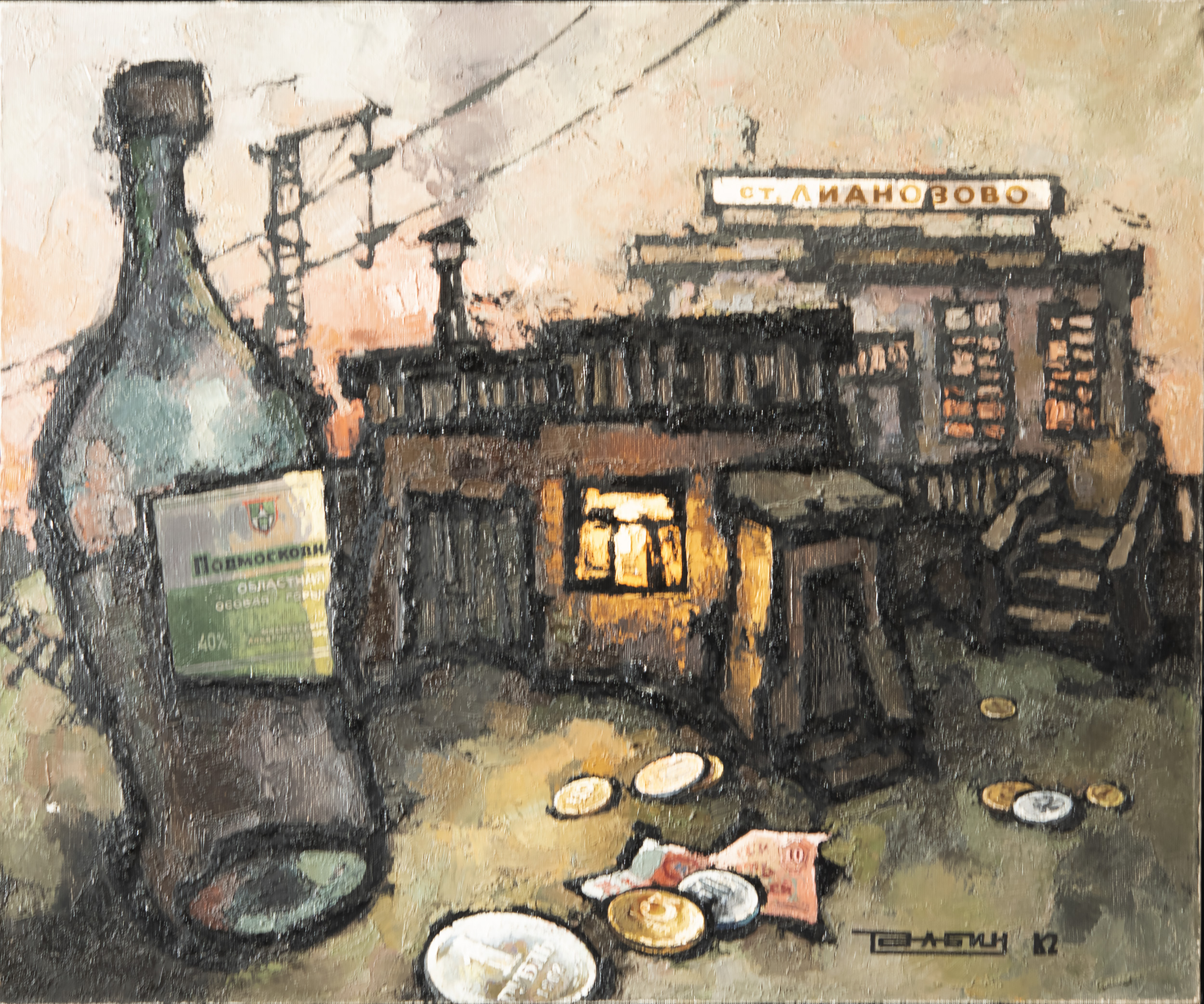
Lianozovo, 1962. Oil on canvas, 64 x 79.5 cm (25 3/16 x 31 5/16 in.). Norton and Nancy Dodge Collection of Nonconformist Art from the Soviet Union. 1995.0906
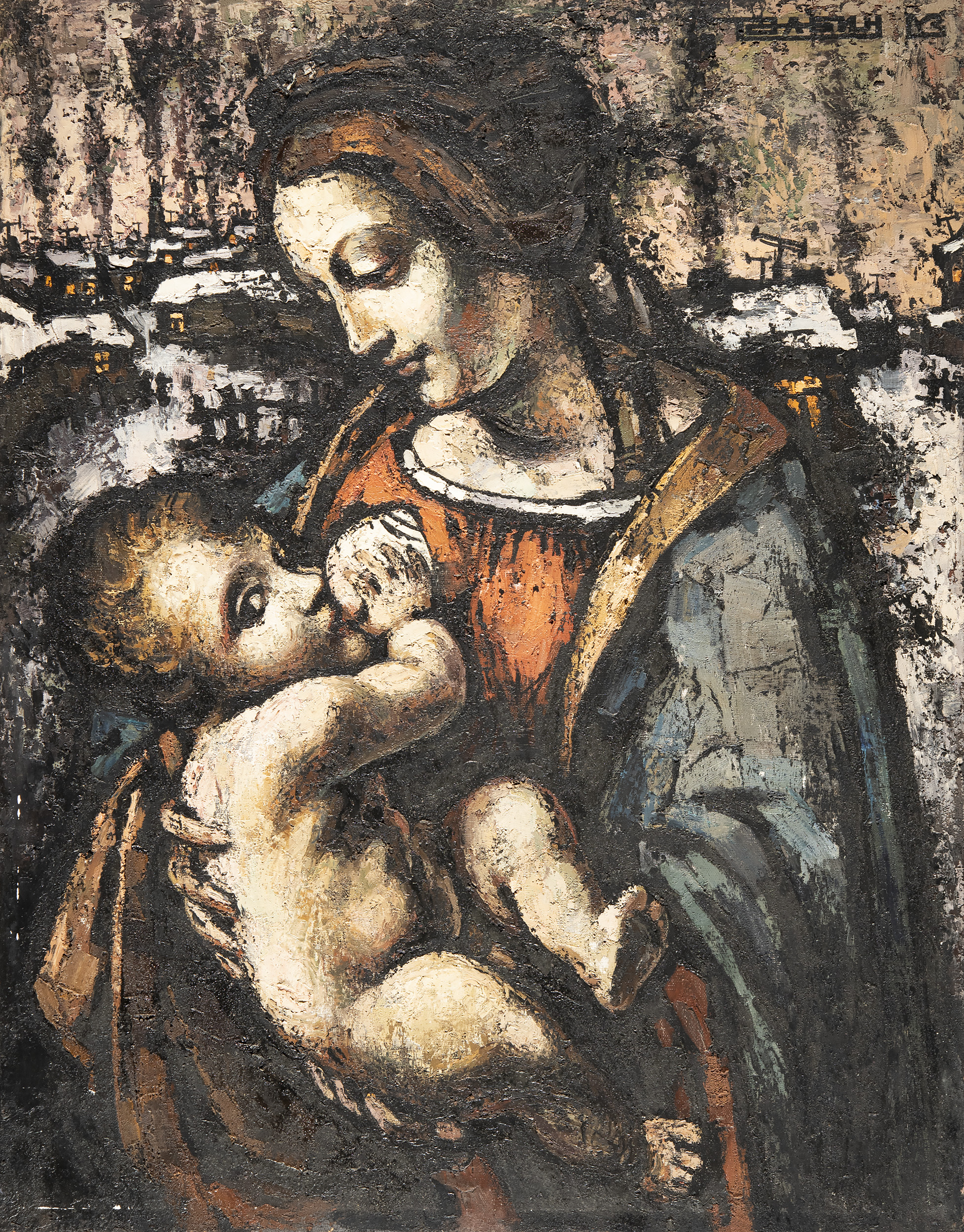
Lita Lianozovskaia, 1963. Oil on canvas, 86.4 x 67 cm (34 x 26 3/8 in.). Norton and Nancy Dodge Collection of Nonconformist Art from the Soviet Union. 1991.0839

Moscow Evening, 1968. Oil on canvas, 59.5 x 78.5 cm (23 7/16 x 30 7/8 in.). Norton and Nancy Dodge Collection of Nonconformist Art from the Soviet Union. 1997.0665

Still-Life with Fish and Pravda, 1968. Acrylic and oil on canvas, 90 x 110.5 cm (35 7/16 x 43 1/2 in.). Norton and Nancy Dodge Collection of Nonconformist Art from the Soviet Union. 1998.1302

Ferris Wheel in the Evening, 1977. Oil on canvas, 80.2 × 110.7 cm (31 9/16 × 43 9/16 in.). Norton and Nancy Dodge Collection of Nonconformist Art from the Soviet Union. 1995.0904