
Boris Kudriakov
1946 — Leningrad (USSR) | 2005 — Saint Petersburg (Russia). Worked in Leningrad (USSR) / Saint Petersburg (Russia)
Boris Kudriakov is one of the central figures of Leningrad’s postwar school of photography. Photographer, prose writer, poet, and artist, he belongs to the so-called Leningrad’s second culture. In scholarly works, this phenomenon is most often associated with Leningrad’s uncensored literature of the 1960s–70s. Artists from similar circles are usually considered by art historians in connection with various institutional practices of the artistic underground (apartment exhibits, work with children’s books, participation in rare public exhibitions). Specifically, in the case of Kudriakov, however, the term second culture captures the very essence of his exceptionally diverse body of work: despite the fact that photography was his primary “work” and “love” from his younger years, his creative literary production always paralleled his visual work, and some of their characteristics undoubtedly coincided. The second culture saw itself as a separate literary civilization that was the direct successor of Russian modernism. Introducing into artistic photography the same discourse of free truth—the truth of “the streets,” that is to say, natural language, irony, and the absurd—Kudriakov became the founder of a powerful tradition in Saint Petersburg photography.
Kudriakov was born, lived, and died in Leningrad, which in 1991 again became Saint Petersburg. However, stylistically and aesthetically, his city always remained Leningrad, the imperial city that had lost its capital status, slowly bringing to ruin its own buildings, as well as its residents. Living in this city was difficult, dark, and cold, but not to live in it, for such an artist as Kudriakov, was impossible.
He began taking pictures at the age of ten: “I’m lying on the sofa. Outside, it’s 1956–57. A dusty Smena-1 camera is hanging on a nail on the wall (it belongs to my brother, but he’s in the army). For some reason, I picked it up, clicked the shutter a few times, and liked the sound of the spring (it was so cheerful).” [1] This account cannot be verified, but within Kudriakov’s coordinate system, it is logical: photography came to him almost by accident. At first, he and a friend mainly shot young women sunbathing by the walls of the Peter and Paul Fortress, but after he participated in a photography club and a photography school, it became a profession for him. He was even paid for it (work trips on geological expeditions brought in decent money, which was immediately spent on photo equipment). Such employment allowed him to make art on the side: most of all, he was interested in “expeditions” around the city, photographing its less recognized side. It was this pursuit that he would share with Boris Smelov, with whom he would either compete or work side by side—it was not clear which—for many years, and with whom he would be constantly compared.
In 1968, Kudriakov returned from the army and quickly found his way to the most uncensored of all of Leningrad’s unofficial circles at the end of the freewheeling 1960s. “Back then, we already understood that there were two worlds: the ‘Soviet sycophant’ world and the ‘unauthorized artistic’ world. This [latter] circle wasn’t large. In the whole city, there were about twenty meeting spots—private apartments.” [2] Here, he met Konstantin Kuzminsky, a central figure in the unofficial institutionalization of those who belonged to the second culture. He came to Kuzminsky’s apartment with Smelov, whom he had just met at the photo club of the Vyborg Palace of Culture. It was in Kuzminsky’s apartment, too, that he saw his first apartment exhibits and began to take part in them (one example: the exhibition Under the Parachute, 1974). An enormous role in his formation as an artist was played by the library in this apartment: above all, by rare editions of the Russian modernists—Khlebnikov, Kruchenykh, the OBERIU (Association for Real Art)—all those who shaped his own artistic and literary languages. There, too, he met prose writers and poets, alongside whom he began publishing his work in samizdat magazines and collections: Gleb Gorbovsky, Vladimir Erl, Viktor Sosnora, Sergei Dovlatov, Venedikt Erofeev, and Slava Len. This circle would roughly become his own for many years. But in photography, “his own circle” consisted almost exclusively of Boris Smelov.
They became “Petit-Boris” and “Grand-Boris” (thanks to Kuzminsky, who gave them names based on their height). Together, they wandered around the city for virtually days on end. One shot images of a perfect geometry, the other captured “dishevelment.” One reflected eternity in his photographs, the other captured the moment. And this was not the “decisive moment” taught by Henri Cartier-Bresson. Kudriakov’s moment was a “moment of passing time,” of that which will never exist again. His relations with time were colored either by Buddhism (his work in the deserts of Mongolia let itself be felt) or by mysticism, much facilitated by the alcoholic tripping he and Smelov engaged in jointly. However, the main point of divergence between the two Borises was aesthetics.
Kudriakov was fundamentally anti-aesthetic. In his Leningrad, captured from its underside, where living people and dead things were never pleasing to the eye, the “beautiful” nonetheless sometimes broke through (nothing to be done about the perfect curves of the canals). His streets were always dirty, with clumps of black melting snow or piled up with garbage, and his courtyards, with their tattered roofs, shabby walls, and half-blind windows, were not simply “wells,” but conglomerations of forms and volumes that could have been dreamed up by Piranesi. His people are funny, small, and lost. The only ones alive among them are children, friends, and nude women. His still lifes are assembled out of things that happened to be in proximity to one another for an instant, by accident. Not for nothing is one of his most famous still lifes arranged against the background of the flame of a burning book (1971, ZAM, D15831). Kudriakov made a cult out of the ugliness of the everyday: “Borya Smelov and I argued a lot about his still lifes. I’d tell him: ‘You keep trying to re-create the silver of the Dutch painters’—that empire-style aesthetics for the bathhouse director. But you should know how to make a composition out of the commonplace, for example, out of three bricks.” [3]
In the 1970s, text and other mediums began to penetrate into Kudriakov’s photographs. He made collages. Some consist of a photograph (or several) pasted onto a paper foundation, with a signature. Others comprise a photograph with a note pasted beside it (1976, ZAM, D15835). A third type reveals the narrative-forming inscription within the photograph itself (1980, ZAM, D15827), which often gives this format a resemblance to sots art. Complex photo collages, printed from three (or even four or five) negatives, also stand out among these works: the internal narrative component of such works is often unreadable, but their visual rhetoric is far plainer. Kudriakov likes to juxtapose surfaces, the great and the small, the cold and the hot, the close-up and the long shot.
The comparison with the practices of the Moscow conceptualists and sots artists here is almost accidental, of course, born of chance, which was so dear to Kudriakov. Among the “garbage” in his photographs, here and there, scraps of Soviet existence show up, the absurdist juxtaposition of which fascinated many artists of the 1960s–70s. Over the strict conceptual precision of quoting what is familiar, however, Kudriakov preferred the impetuous aesthetics of reflecting the ugliness of the ordinary. Over the stylistically sterile texts in the works of the Moscow artists, he preferred inscriptions that refer not to collective but to individual memory (“Sponge was stolen in the bathhouse,” “Argued with friend N,” “Left for the South,” “Janitor turned out to be an asshole,” “DND [people’s volunteer militia] beat me for a long time for this photo”). He did something similar in his prose as well, playing with the poetics of possibility as his main artistic technique.
Chance as an artistic principle was embraced by the next generation of Saint Petersburg photographers. While the brilliant Smelov had practically no students, Kudriakov, whether he desired this or not, became surrounded by successors. The city as it appears in the photographs of Alexander Kitaev, Alexander Chezhin, and Igor Lebedev carries within it the attributes of the “disheveled” Leningrad once discovered by Kudriakov. This trajectory has proved to be very strong.
Kira Dolinina
Translated from Russian by Ilya Bernstein
Notes:
1. Kudriakov, Boris. ″Razgovor s mirom cherez predmety″: Interv'yu s Dmitriyem Pilikinym״ [Conversation with the world through objects: Interview with Dmitry Pilikin]. In Novoe Literaturnoe Obozrenie 77, no. 1, 2006.
2. Ibid.
3. Ibid.

Landscape with Photographer's Shadow, 1974. Photograph on paper, 30 × 28.9 cm (11 13/16 × 11 3/8 in.). Norton and Nancy Dodge Collection of Nonconformist Art from the Soviet Union. D15829
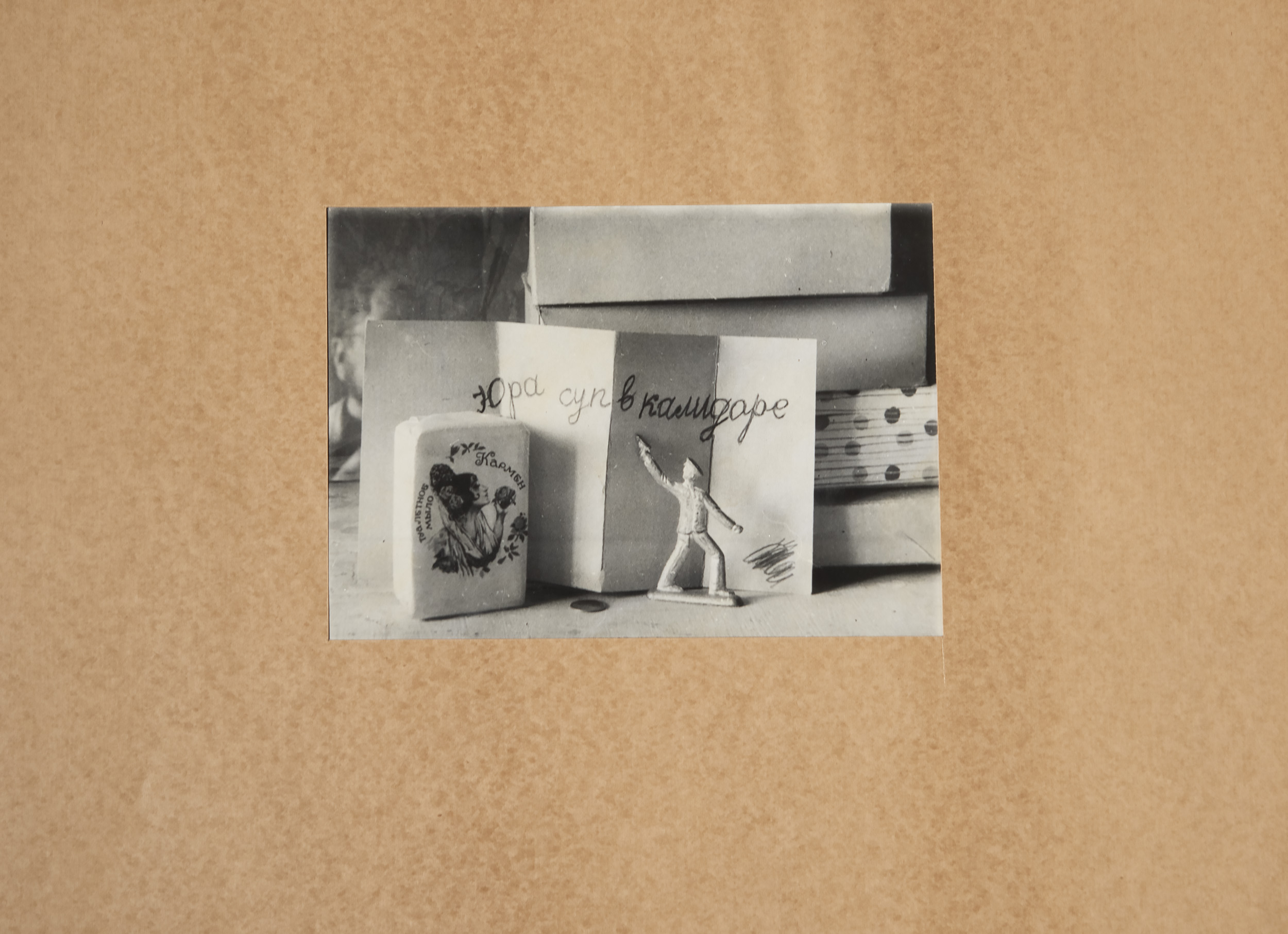
Soap in Front of "Whim," 1980. Photograph on brown paper, 24.8 x 32.2 cm (9 3/4 x 12 11/16 in.) / 41 x 51.7 cm (16 1/8 x 20 3/8 in.). Norton and Nancy Dodge Collection of Nonconformist Art from the Soviet Union. D15827

Burning Still Life, 1971. Photograph on paper, 16.7 x 23.4 cm (6 9/16 x 9 3/16 in.) / 35.3 x 50.5 cm (13 7/8 x 19 7/8 in.). Norton and Nancy Dodge Collection of Nonconformist Art from the Soviet Union. D15831

Obvodny Canal, 1976. Photograph and paper collage on paper, 38.8 x 50.9 cm (15 1/4 x 20 1/16 in.). Norton and Nancy Dodge Collection of Nonconformist Art from the Soviet Union. D15835

Sometimes, 1973. Photograph on paper, 21.1 × 31.5 cm (8 5/16 × 12 3/8 in.). Norton and Nancy Dodge Collection of Nonconformist Art from the Soviet Union. D16161