
Boris Smelov
1951 — Leningrad (USSR) | 1998 — Saint Petersburg (Russia). Worked in Leningrad/Saint Petersburg (Russia)
Boris Smelov is one of the most significant legends from the art world of Leningrad/Saint Petersburg during the 1970s–90s. His way of seeing this city—poor and austere; graphic and dying; a city of shadow people, talking sculptures, and architectural fantasies; a city of snow and water—became something like a textbook on the visual mythology of Saint Petersburg: you will not truly recognize this city if you have not seen Smelov’s photographs.
Until his posthumous solo exhibition at the Hermitage Museum in 2009, Smelov’s work was known mainly to art critics and photographers. Subsequently, he became famous, and his trademark angles entered into the common parlance of amateur digital photography. The originals did not suffer in the least from such democratic replication, since, by contrast with Aleksandr Rodchenko (1891–1956), whom Smelov greatly admired and from whom he clearly borrowed a thing or two, angles are just a minor element of his artistic language. His poetics has to do with the elusiveness of reality, a refusal to treat time as a concrete phenomenon, memento mori, and the sands of Arcadia slipping between one’s fingers in every frame. He learned rather late about Barthes and Baudrillard, but as illustrations his pictures would have certainly suited their texts.
Surprisingly, although the list of Smelov’s exhibitions is impressive, his foreign exhibitions (and even exhibitions in Moscow) were few. He remains, as it were, a locally revered saint of the city on the Neva. At the same time, Smelov's photographs are held in many museums around the world; art critics and collectors understood at a glance the value of these works and their indispensability in a collection for a complete history of photography in the second half of the twentieth century. In his oeuvre, a romantic vision of the city’s space as an all-encompassing void and “Dostoevsky’s Saint Petersburg” (a photographic cycle created in 1974–75 inspired by the atmosphere of Dostoevsky’s texts) were united in the most natural way. Thus, one of the most rootless, impoverished, and sad heroes of the Soviet underground became a museum artist first, and only later, posthumously, acquired a wide audience.
Smelov was born in Leningrad, on Vasilyevsky Island. On Vasilyevsky Island, forty-six years later, he was found frozen, without a coat, in the snow, on the steps of a chapel on Bolshoy Prospect. Such a circular composition of his life might have appealed to Smelov because classical precision and compositional оrder were sacred to him. His mother was a pediatrician, his father a film projectionist. After his parents divorced, he lived with his mother, older brother, and grandmother, a former student of the Bestuzhev Courses (the most prominent women’s higher education institution in tsarist Russia), surrounded not so much by valuable things as by antiques, messengers from another age and another life. All of Smelov’s future still lifes to some extent came out of this world of reflections and textures of a lost existence.
During his childhood, Smelov studied drawing, joined a photography club at Boris Ritov’s photography studio in the Zhdanov Young Pioneer Palace, and attended a secondary school that specialized in physics and mathematics—a set of skills worthy of a future photographer, which by 1970, he already considered himself to be. After graduation, Smelov entered the Leningrad Institute of Precision Mechanics and Optics (sources differ as to his years of study), but never graduated. In 1972–73, he studied in the Department of Journalism of Leningrad State University. In 1973, he quit his job as a photographer at the Khudozhnik RSFSR publishing house. Subsequently, he had several other jobs as a photographer. Owing to his employment at the Leningrad Decorative and Applied Arts Combine, he was able to obtain a studio.
But far more important for his biography is the fact that in 1968, at the photography club of the Vyborg Palace of Culture, he met Boris Kudryakov, and through him the poet Konstantin Kuzminsky, who at the time was the center of one of the subcultures of Leningrad’s unofficial art scene. It was Kuzminsky who dubbed him Petit-Boris (while Kudryakov, based on his height, became the Grand-Boris of the duo), the name by which Smelov was known in the city. Kudryakov was older, more experienced, and likewise photographed “the city behind the facades.” This immediately became the main subject for both. “We walked down Moskovsky Prospect at night, turned toward the port, drank beer there, continued walking to Kalinkin Bridge, napped there for fifteen minutes, had sushki (hard sweet bread rings) for breakfast, and walked to New Holland Island. He shot with my Moscow camera, I with his Leica. Sometimes, we would shoot something from the same spot with the same camera, but we would remember the frame number. After developing the film, we’d look at the negatives. The shots would be completely different!” [1]
The fact that Smelov was remarkably talented was obvious to connoisseurs at once, both those who praised him and those who saw in his works something alien to socialist realism. This talent was innate; it did not come from studying masterpieces of photography. For many years, among his professional points of reference, Smelov cited only Henri Cartier-Bresson (1908–2004) and Josef Sudek (1896–1976), whose work Soviet people were allowed to know. Smelov himself, in an interview with Sovetskoe Foto, described his method without reference to any great masters: “In general, I consider myself a representative of emotional, intuitive photography, and when I shoot, I trust my feelings more than any preliminary conceits.” [2]
Smelov appeared in the official field of Soviet photography in the mid-1970s, but did not make the authorities happy. Several of his photographs were published in the magazine Zhurnalist (March 1974, no. 3). The “critical analysis” of these photographs that followed in the very next issue read more like a takedown: seasoned Novosti Press Agency (APN) photojournalists Viktor Akhlomov and Valery Shustov did not like their “relentless gloom” and “murky psychologism.” [3] In 1975, Smelov mounted an exhibit/report of twenty-seven photographs at his photography club, which the Vyborg district committee of the Communist Party of the Soviet Union (CPSU) shut down on its first day. Most of his exhibitions in Russia before the beginning of perestroika were held in private apartments, the first of which, Under the Parachute, took place in Kuzminsky’s apartment in 1974.
Such a strange semiofficial, semiunderground dual existence was characteristic of many independent photographers of the late Brezhnev-era stagnation. At that time, amateur photography clubs sprang up all over the Soviet Union, and their activities were censored far less than those of artists’ or writers’ associations. Photography, as a means of technological reproduction, was seen by Soviet authorities less as a source of artistic objects than as a way of reflecting and extolling the wonderful realities of life in the USSR. Large collective photography exhibitions were a common practice. The works of photographers who were “independent” but belonged to photography clubs appeared regularly in such shows. The same may be said of the publication of photographs by these artists in the Soviet press, where they appeared with far greater frequency. Thus, Smelov’s photos were exhibited along with those of the other members of the Leningrad art group in four shows of that group’s work at the Leningrad Youth Palace (1982–88), and in 1979, the magazine Sovetskoe Foto (circulation 252,000) published a laudatory article about Smelov’s still lifes, with three illustrations, in its “Photo Debut” section. His works appeared at international exhibits as well, in which he was featured as one of the foremost young Soviet photographers. In the first half of the 1970s, his photographs were sent to several international exhibits organized by the Fédération internationale de l'art photographique (FIAP), and at one of them he won a gold medal (Bucharest, 1977).
Meanwhile, Smelov’s life unfolded almost entirely in the unofficial realm: the Leningrad cultural underground, habitual gatherings at several cafes on Nevsky Prospect beloved by artists and bohemians, apartment exhibits, readings, and concerts. But his existence was marked by alcoholism and poverty. The poverty was intentional: he spent all of his money on photography, often even lacking change for the tram. Kudryakov later recalled how, during their last meeting, several days before Smelov’s death, they “with a smile began to calculate how much [they] had spent on photography over thirty years. Each had spent a sum equal to the cost of three two-room apartments.” [4]
In 1974, in Kuzminsky’s apartment, Smelov met Dmitry Shagin (b. 1957) and his mother, the artist Natalia Zhilina (1933–2005), who became his family. For some time, his existence ceased to be utterly destitute. He and Zhilina lived in his studio on Pravda Street, and Shagin actively involved his stepfather in the happenings of the Mitki group, with their exhibits and large circle of admirers. Among the Mitki, the works of Vladimir Shinkarev turned out to be closest to Smelov’s poetics: his Mrachnye Kartiny [Gloomy Pictures] series is replete with the same emptiness, fog, and streetlights seen through the mist of the humid atmosphere of Saint Petersburg, which first appeared specifically in Smelov’s work.
Perestroika led to numerous exhibits abroad, but in essence changed nothing: Petit-Boris remained a legendary figure of “the other Saint Petersburg.” Saint Petersburg is his principal and almost his only subject. His portrait series are about the people of this city. His genre photographs are about the people on the streets of this city. His still lifes are about fragments of this city’s past, about the Dutch paintings of this city’s foremost museum, the Hermitage. While seemingly alive, what could be better suited to the existence of an imperial museum in a Soviet country than the genre of vanitas?
Despite the fact that Smelov himself, according to others’ reminiscences, never referred to his city as Leningrad, but only as Saint Petersburg (and certainly not as Piter, its commonly used nickname), his gaze is precisely a gaze from Leningrad: a gaze from that city in which “Saint Petersburg” was not just the name of the city, but the definition of an aesthetic frame of reference, a cultural code, a signifying text, and an addition of one’s own word to what was a goal and a joy. The Saint Petersburg of Smelov, like the Saint Petersburg of Joseph Brodsky, is a Saint Petersburg seen through the eyes of Leningrad’s children, who mixed together the remnants of imperial stateliness with the putrid smell of a dying city. Their page of the “Saint Petersburg text,” for all the deliberate timelessness of their art, can be pinpointed chronologically with precision: the appalling neglect of the ponderous decades of peace becomes in their work the classical ringing of a splendid emptiness.
The Saint Petersburg of Smelov is a deserted, black-and-white city of straight lines and well-lit courtyards, the fanciful geometry of canals and the profiles of rear facades, a city of classical ruins—a still-life city, in which the sumptuous, intricately realized still lifes in the bay window of Smelov’s apartment on Vasilyevsky Island, scintillating and shining, are more alive than the passersby wandering along the almost-always-empty streets, bridges, and embankments. The white marble statues in the Summer Garden or on Saint Petersburg’s facades live a far fuller life than the residents of the buildings. And rapid motion is permitted only to raindrops, a white pigeon, and a spider crawling on Apollo’s cheek.
Smelov’s city is the city of solitude. He was solitary himself, and out of the Punktum group, which he assembled in 1995, only his stepdaughter, Maria Snegirevskaya, became his pupil. He drank a great deal, and wandered around a great deal, saying that he would like to die of vodka. And so it happened. And ten years later, in the same Hermitage Museum, there was an enormous solo exhibition of his work, and another ten years later, a hall in the museum was named after him. He would not have been surprised, knowing his own worth, but he could hardly have predicted that he would force the world to see Saint Petersburg through his own eyes.
Kira Dolinina
Translated from Russian by Ilya Bernstein
Photo portrait by Vladimir Peshkov
Notes:
1. Kudryakov, Boris. “Borja Smelov,” in Boris Smelov: Izbrannoe [Boris Smelov: Selected works]. ed. Valery Valran. Saint Petersburg: Borey-Art, 2009: 17.
2. Smelov, Boris. “Neobkhodima tayna” [Necessary secret]. Sovetskoe Foto, no. 10 (1988): 24–25.
3. “Molodyye glaza i vechnyye istiny (Tvorcheskaya masterskaya)” [Young eyes and eternal truths]. Zhurnalist, no. 3 (1974): 24–29.
4. Kitaev, Aleksandr. “O Borise Smelove,” Mediafilosofiia 3 (2007): 184.
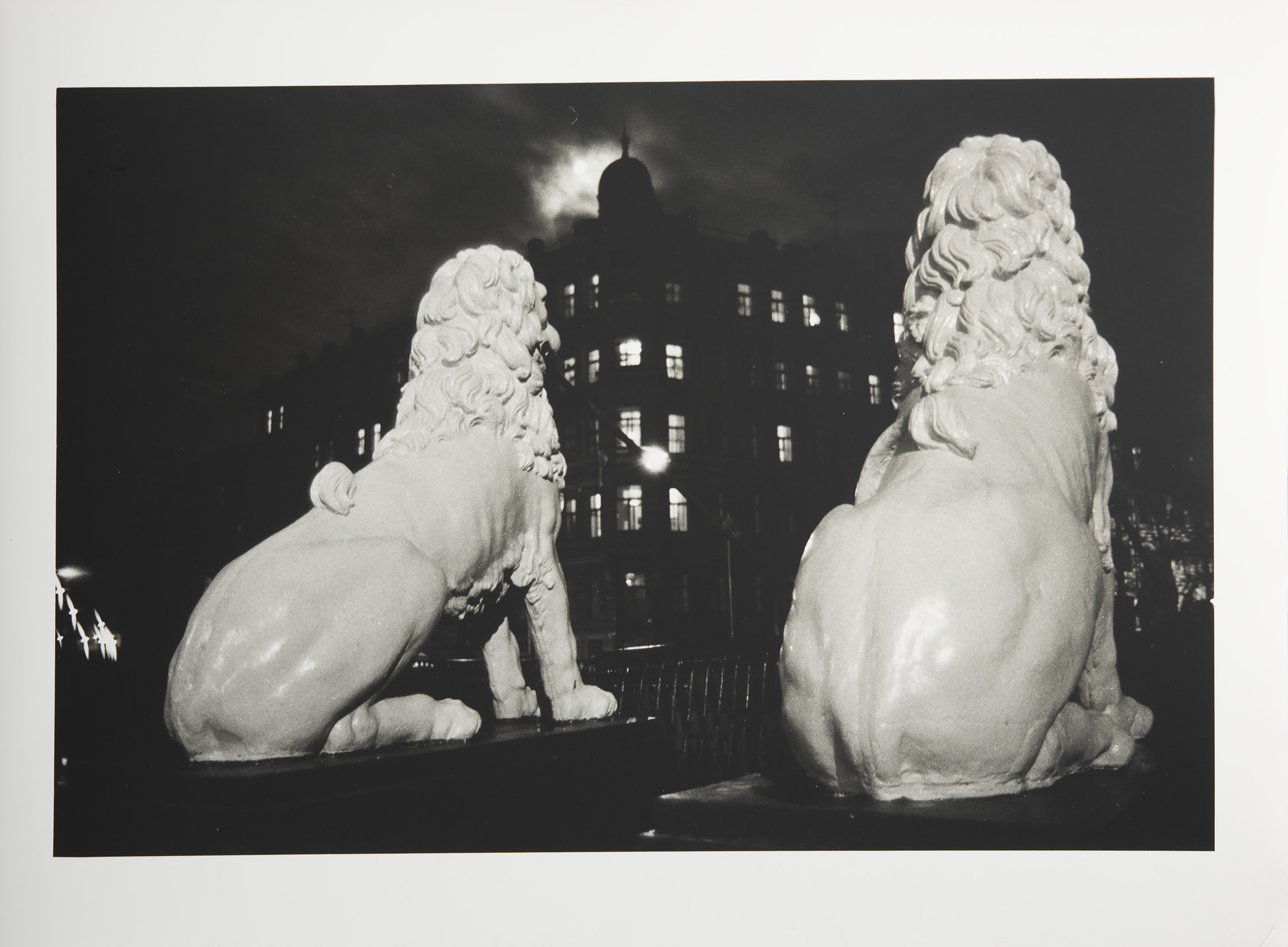
Lions Bridge, 1983. Photograph on paper, 24 × 36 cm (9 7/16 × 14 3/16 in.). Norton and Nancy Dodge Collection of Nonconformist Art from the Soviet Union. D14148

Apollo with Spider, 1991. Gelatin silver print on paper, 38.4 × 25.9 cm (15 1/8 × 10 3/16 in.). Norton and Nancy Dodge Collection of Nonconformist Art from the Soviet Union. D14843
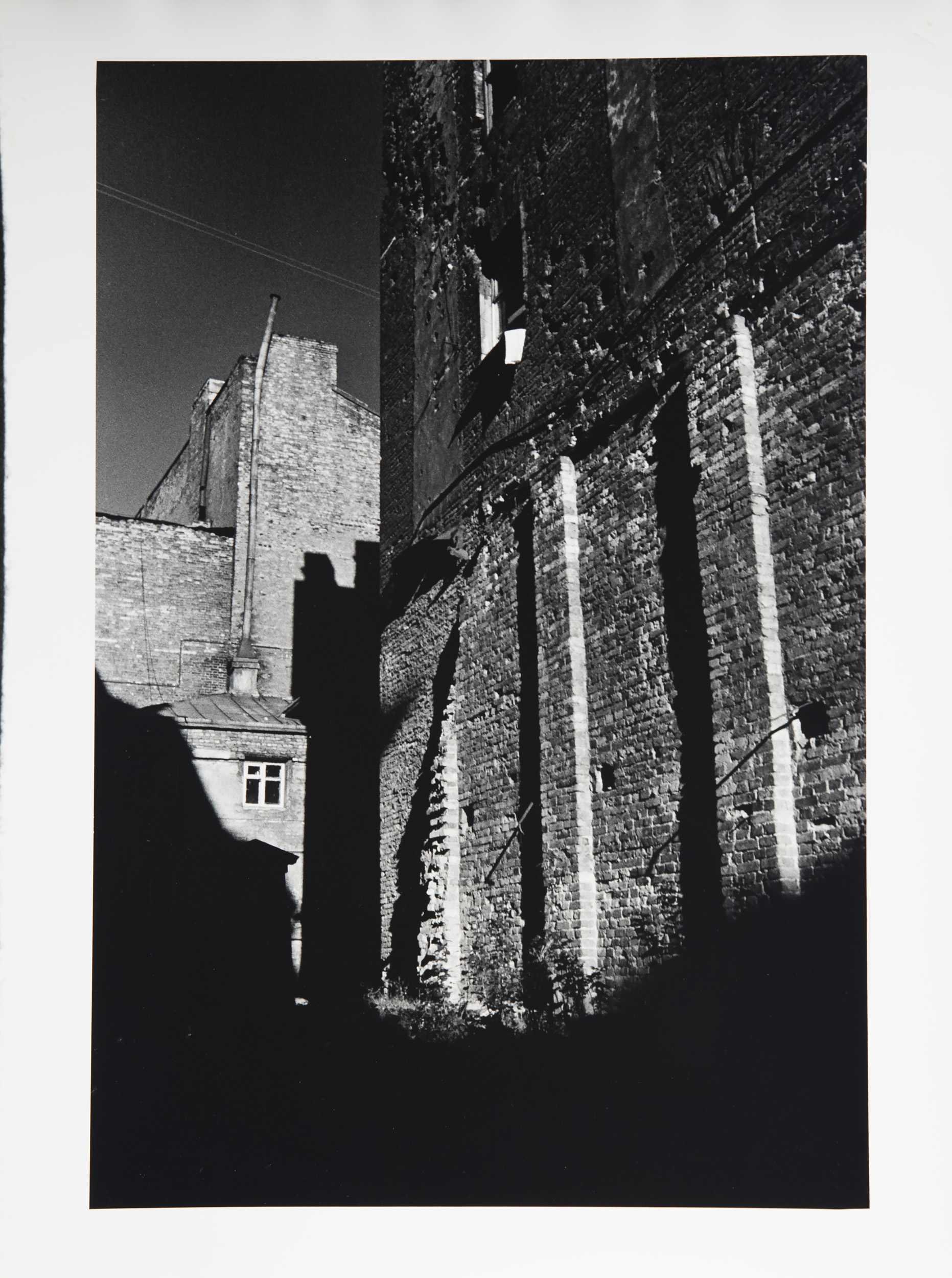
Wall, 1971. Photograph, 36 × 24 cm (14 3/16 × 9 7/16 in.). Norton and Nancy Dodge Collection of Nonconformist Art from the Soviet Union. D14140

Untitled, 1972. Photograph on paper, 31.7 × 22 cm (12 1/2 × 8 11/16 in.). Norton and Nancy Dodge Collection of Nonconformist Art from the Soviet Union. D16022

Fisherman, 1982. Gelatin silver print on paper, 21.9 × 32.3 cm (8 5/8 × 12 11/16 in.). Norton and Nancy Dodge Collection of Nonconformist Art from the Soviet Union. 2000.1383