
This article has been featured in the catalogue published on the occasion of the exhibition at the Zimmerli Art Museum in 2022.


The years following the inception of perestroika policies and encompassing the collapse of the Soviet Union remarkably transformed Kyiv’s art scene, successfully launching Ukrainian contemporary art as a truly global phenomenon. The calm waters of the culturally provincial capital of the Ukrainian Soviet Republic became radically stirred with new and daring art made publicly visible for the first time since the avant-garde period.
As if in a crooked mirror, the overabundance in art styles and the limitless production of new meanings reflected the emptiness of the hollowed-out Communist ideology and late socialist realist art. This article traces and documents the diverse artistic manifestations of these transitional and exhilarating years in Kyiv while providing some historical artworks for context.
Kyiv’s artistic response to the emergent geopolitical shift was hybrid, eclectic, and heterogeneous, ranging from an organically grown version of local postmodernism to late modernist abstract painting. Both trends were compared to their Western analogues of the time. For instance, the distorted figuration of the neo-expressionist canvases by the groups Paris Commune and Resolute Edge of National Post-Eclecticism was dubbed “Ukrainian transavantgarde.” [1] Such a simplistic definition was ignorant of the local implications of the artists’ stylistic choices, particularly the enduring influence of the decaying socialist realist style. Similarly, the art of the Painterly Preserve group, while recalling color-field minimalism, was primarily grounded in the group’s metaphysical exploration of the Ukrainian identity’s relation to its landscape and a vehement rejection of socialist realist painterly storytelling.
All these experiments, formally divergent yet united by the principle of innovation, gradually gained access to the public by occupying the old exhibition venues and awing unsuspecting viewers. The major art sensation of this time was the bizarre and provocative painting Cleopatra’s Sorrow by Arsen Savadov and Heorhii Senchenko (1987, Arman foundation), shown at the Moscow All-Union Youth Exhibition in 1987. It was radically different from the majority of the work shown there and did not fit into either conformist or nonconformist canons. It provoked so much media interest that it impelled even the main and most conservative Soviet newspaper, Pravda, to react with a scathing critique that only contributed to the artwork’s roaring success. [2] A handful of exhibitions subsequently transformed the Ukrainian art scene in Kyiv, among them Kyiv-Tallinn (1987), The First Soviet-American Exhibition (1988), Crooked Caponnier (1992), and Kyiv-Mohyla Academy (1993). Many of the early exhibitions were put together by artists; the first show was a project of Sergei Sviatchenko, famous for his collages, and the last two were organized by Anatoly Stepanenko, a pioneer of body art and performance art in Kyiv since the late 1970s.
The kaleidoscopic multitude of new painting styles was certainly indebted to the perestroika policies of glasnost (openness) and uskorenie (acceleration), thus reflecting the need of Ukrainian late Soviet artists to catch up with history. The artists were suddenly flooded with information, about both Western art and theories (postmodernism being the most popular at the time) and their own previously forbidden and crossed-out pages of history. Another influence was the symbolic collapse of Soviet reality, when so many established notions suddenly became obsolete and hollow, prompting a major release of empty signs yearning to be filled with new meanings. Vitaly Chernetsky, the scholar of postmodern Ukrainian literature, posited that the late Soviet Empire was a case of an “excess of ideological signification overwhelming and fragmenting the perceiving subjects.” [3] Regarding painting, its excesses were plenty, both in the size and quantity of canvases as well as in the expressivity of the painterly matter and the over-signification of the content. The surplus of meaning was generated in a postmodern manner, through citations and metaphoric appropriations.
Perestroika was delayed in Ukraine, since the notorious Volodymyr Shcherbytsky, first secretary of the Ukrainian Communist Party (in office from 1972 to 1989), provided the most conservative approach to governance during perestroika’s defining years. The historian Serhii Plokhy described Shcherbytsky as “Brezhnev’s protégé [who] crushed the national revival under way in Ukraine, turning it into an exemplary Soviet republic and a bulwark of Moscow’s rule in the USSR.” [4] Shcherbytsky had overseen the persecution of Ukrainian artists and dissidents in the 1960s and 1970s, with many artists and writers imprisoned and their works destroyed by the authorities. [5] His relentless vigilance contributed to the fact that before perestroika, Kyiv, as the republic’s capital, did not harbor a full-fledged nonconformist movement in the vein of other Ukrainian cities such as Odessa, Lviv, or Kharkiv. Primarily, Kyivan artists enticed by styles diverging from those officially endorsed worked on them clandestinely, in their private studios, and did not seek publicity. Thus, the title “Kyivan hermits,” given by the art historian Borys Lobanovsky [6] to a small group of abstract painters working in Kyiv during Shcherbytsky’s rule, could be applied to many artists working in the years before Gorbachev. Set against their reclusive silence, perestroika painting was furiously loud.
1. The Moscow art critic Leonid Bazhanov, in his review of the 1988 all-USSR exhibition, had defined the new art trend as “Ukrainian neobaroque of the transavantgarde type,” both in publications and in conversation with Ukrainian art critics like Oleksandr Soloviov. Leonid Bazhanov, and Valery Turchin. “Ritorika Totalnogo Somnenia” [The rhetoric of total hesitation], Tvorchestvo, no. 2 (1989). Oksana Barshynova, “From an Interview with a Well-known Curator and Art Critic, Oleksandr Solovyov, One of the Ideologists of the New Ukrainian Art of the Second Half of the 1980s to the Beginning of the 1990s,” in New Ukrainian Wave, ed. Oksana Barshynova (Kyiv: National Art Museum of Ukraine, 2009), 30–35. It was later defined as New Wave, a title confirmed by the eponymous exhibition at the National Art Museum of Ukraine in 2009.
2. D. Gorbuntsov, “Glubokie Korni” [Deep roots], Pravda, May 18, 1987; E. Gorchakova, “Davaite Sporit” [Let’s argue], Moskovskiy Komsomolets, April 15, 1987; L. Nekrasova, “Skvoz prizmu romantizma” [Through a lens of romanticism], Moskovskaia Pravda, March 1, 1987; Oleksandr Sidorov, “Ravnenie na…?” [Should we take them for a model…?], Tvorchestvo no. 8 (1987): 16–17; Olga Kholmogorova, “Deistvo, Mirazh?” [Action, mirage?], Tvorchestvo, no. 8 (1987): 12; Vladimir Levashov, “Molodost Strany: Zametki s vystavki” [Youth of the country: notes from the exhibition], Dekorativnoe Iskusstvo SSSR, no. 9 (1987): 2, 22. Oleksandr Soloviov, “Po Tu Storony Ochevidnosti: Predvaritelnye Razmyshlenia po Povodu Odnogo Iavlenia [Beyond that side of the obviousness: preliminary reflections concerning a certain phenomenon] Iskusstvo, no. 10 (1988): 35–36.
3. Vitaly Chernetsky, Mapping Postcommunist Cultures: Russia and Ukraine in the Context of Globalization (Montreal: McGill-Queen’s University Press, 2007), 30.
4. Serhii Plokhy The Last Empire: The Final Days of the Soviet Union (New York: Basic Books, 2014), 53.
5. For example, the imprisonment of the poets Vasyl Stus and Ivan Drach and the interpreters Ivan Svitlychny and Valeriy Marchenko and the destruction of the monument Memory Wall by Ada Rybachuk and Volodymyr Melnychenko in Baikove cemetery in Kyiv in 1982.
6. Borys Lobanovsky, “Kievskie anakhorety. Obrashchenie k abstraktnym formam v tvorchestve riada kievskikh khudozhnikov 50-kh-60-kh godov” [Kyiv hermits: Turning to abstract forms in art by several Kyiv artists of 1950s–1960s), Vizantiiskii Angel, 1997, no. 3, 31–40.


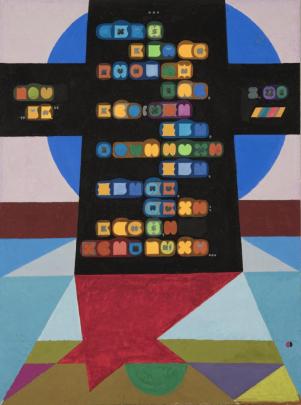

The artists of the 1960s and 1970s carved out creative alternative spaces at a time when Kyiv’s Communist leaders aimed to solidify the city’s reputation as a stronghold of Soviet official culture. These artists should not be considered direct predecessors but rather evidence of the interstitial nature of the artistic fabric of the Ukrainian capital and the lack of sound connection between generations. The limited access young Ukrainian artists in the 1980s had to Western trends and theories was far greater than their practically nonexistent knowledge of local avant-garde artists who had been physically eliminated in the 1930s [7] and their legacy hidden or destroyed. [8] In the absence of direct access to avant-garde art, the perestroika generation had only the specters summoned by their teachers, some of whom had been apprentices to the legendary first roster of professors at the Ukrainian State Academy of Arts (1917–22). [9] The avant-garde tradition, refracted through both the socialist realist style and Ukrainian folklore motifs, could be detected in most art practiced in Kyiv during the 1960s and 1970s.
Alla Horska—a steadfast member of the 1960s generation who saw her artworks destroyed by the authorities, experienced surveillance and interrogations, and was expelled from the Union of Artists—was killed in 1970 in a still-unsolved crime, allegedly by the KGB. Together with her co-members of the Kyiv Club of Creative Youth (existed 1960–64), including Opanas Zalyvakha, Horska discussed issues beyond the sphere of art, including the politics of Russification, Stalinist purges, and the silencing of evidence of the Holocaust during the Nazi period in Kyiv. [10] Horska’s Untitled (Silence) (1964, ZAM, D00622) is a drama set in three primary colors, where blue and yellow—the colors of the Ukrainian national flag forbidden by Soviet authorities—dominate, while red accentuates the anguish of the silenced and expressively distorted naked female figure. A merging of the personification of Ukraine and a self-portrait of the persecuted artist is conveyed by the angular dynamism of the roughly outlined figure as well as by its expressive primitivism. Horska’s husband, Victor Zaretsky, absorbed the Byzantine tradition by way of Fedir and Vasyl Krychevsky, founders of the Ukrainian Academy of Arts (later called the Kyiv Fine Art Institute), who in turn had been influenced by the art of Gustav Klimt. Zaretsky’s use of gold leaf, saturated colors, and an ornamental mosaic structure in his painting Leda (1980, ZAM, D11287) appeared archaic and fantastical, symptomatic of Soviet reclusiveness, yet also resulted in a sincere and beautiful treatment of the ancient Greek myth. Although not a dissident artist like Horska, Hryhorii Havrylenko was nevertheless fired from his teaching position at the Kyiv Fine Art Institute in 1962 for his gravitation toward dangerous formalism. It was during this time that Havrylenko became preoccupied with abstraction, which he called nonobjective (nepredmetne) art. [11] In his series Compositions (1962–63, ZAM, D15618, D15982), Havrylenko layered multiple semitransparent coatings of gouache or watercolor, building luminous architectonic structures with shifting dynamic surfaces.
The heritage of Kazimir Malevich was also pertinent for the art of Florian Yuriev, the Siberian-born son of a persecuted geneticist, and Oleksandr Dubovyk, the son of a censored poet. Versatile in his creativity, Yuriev was a musician, violin maker, architect, poet, and artist striving to synthesize all arts into a Gesamtkunstwerk by translating poetry and music into a language of color. [12] Yuriev’s works on paper Siberian Snow (1960, ZAM, D21075) and On Lena River (1967, ZAM, D21080) represent his childhood memories of a Siberian concentration camp relayed as poems and ciphers. Dubovyk combined the austere, flat geometry of Malevich with baroque ornamentation and thus could not exhibit his work from 1968 until 1989. His abstraction is logocentric and calculated, yet also symbolic, with such recurring motifs as a flower bouquet morphing into a shape suggesting a human head. In Black Square (1980, ZAM, D23055), Dubovyk references the famous work by Malevich, but in place of the titular figure is the likeness of a black cube adorned with a lattice of brightly colored ornamental forms floating on top of dynamically placed squares of yellow, green, red, and blue.
Politically speaking, artists of the 1960s and 1970s illustrate a spectrum of relationships with the Communist regime, from dissident activity resulting in death and imprisonment as in the cases of Horska and Zalyvakha, to existence on the margins of the official art system as in the cases of Yuri Lutskevych and Viktor Ryzhykh, or practicing outside Soviet art institutions altogether as Valery Lamakh and Hryhorii Havrylenko did. Artists like Lutskevych, Ryzhykh, and Halyna Neledva can be grouped under the umbrella term of “permitted” (razreshennoe) art, suggested by the Moscow art critics Vladimir Levashov and Ekaterina Degot to describe artists suspended between their affiliation with official art institutions and their investment in unofficial aesthetics. [13] Confined to semipublic short-term shows and deprived of monumental state commissions or positions of power within institutions, these artists anticipated many features that became highly relevant for the generations of the eighties. Intellectual, expressive, and prone to symbols, citations, and theatricality, their art was sometimes dreamlike and withdrawn. However, their interest in mythology and historical styles, including the Ukrainian baroque, greatly contributed to the boisterous freedom of perestroika art.
Still, the continuity between generations was not completely organic during this time. After Cleopatra’s Sorrow by Savadov and Senchenko became synonymous with scandal, Savadov brought a reproduction of it to Zaretsky, only to discover that the teacher who had endorsed many of his earlier experiments did not approve of this one. Thus, perhaps for the first time, the rupture between generations of Ukrainian artists did not happen due to some violent historical event like war or purges but because of the rapid change of scenery and vertigo brought about by the geopolitical shift of perestroika.
7. “Executed Renaissance” (Rozstrilyane vidrodzhennya) was a term referring to a generation of Ukrainian poets, artists, and writers who were either eliminated or forced to commit suicide by the authorities during the Stalinist terror. The term was coined by the Polish publicist Jerzy Giedroyc while he was working on an anthology of Ukrainian literature in 1958. For further information on the phenomenon of Executed Renaissance, see Yury Lavrinenko, Rozstrilyane Vidrodzhennia: Antolohiia 1917–1933 [Executed Renaissance: An Anthology] (Kyiv: Smoloskyp, 2004).
8. Special Fund, an exhibition of the forbidden Ukrainian avant-garde at the National Art Museum of Ukraine in 2015, showcased many artworks seen for the first time since they were forbidden by the authorities in the 1930s.
9. The Ukrainian art academy was founded in 1917 by the short-lived Ukrainian republic Tsentralna Rada (1917–18).
10. In 1964, a monumental stained glass window dedicated to the Ukrainian poet Taras Shevchenko by Horska, Zalayvakha, and other artists was destroyed the night before its opening. Zalyvakha was imprisoned for anti-Soviet propaganda from 1965 to1970, and she was among the signers of Letter of 139 demanding a stop to political repression in the USSR in 1968.
11. Mykola Kryvenko. Khudozhnyk Hryhorii Havrylenko. [An artist Hryhorii Havrylenko, from Ukrainian], KyivDaily, October 3, 2018.
12. According to this theory, each sound has its own color, facilitating the translation between the languages of music and visual arts. Thus, the artist aimed to reconcile time (music and poetry) and space (painting and color). Halyna Skliarenko’s entry on Florian Yuriev in Olga Balashova and Lizaveta German, eds. Iskusstvo Ukrainskikh Shestidesiatnikov [Art of the Ukrainian 1960s generation] (Kiev: Osnovy, 2015), 266.
13. Ekatarina Degot and Vladimir Levashov “Razreshennoie Iskusstvo” [Permitted art], Iskusstvo, no. 1 (1990): 58–61.


Inconceivable yet inevitable, [14] the shattering collapse of the Soviet Union was perceived by many as the perfect “end of history” event. [15] The deserted landscape of Cleopatra is apocalyptically hedonistic, while the painting Untitled (Horse) (1987, ZAM, D10952), made by Savadov shortly afterward, follows suit by featuring an assemblage of scattered and forlorn ruins. To diminish the eschatological mood, though, in both paintings the artists outlined many objects with a garish red contour, ironically reminding their viewers that they are only looking at a picture, an artifice. While both paintings seem to present the same cartoonish noir universe, Untitled is unpopulated. Yet, among the oversized decorative architectural fragments, there is a stone bust of a horse bizarrely animated and snorting fumes out of its angry nostrils. The canvas is also connected to two paintings from the series Gardens Old and New (1988–89, ZAM, D21728, D21729), again made in tandem by Savadov and Senchenko. Bright in color but exuding the same derelict and phantasmagoric ambience, they reflect the moment of grandiose collapse of empire, its reverberations resonating even in the provinces.
While Russia was going through the trauma of empire loss, [16] Ukraine was painfully discovering its own provinciality and exclusion from the world’s library of art. Thus, allusions to antique ruins and other spoils of Western culture abound in Ukrainian neo-expressionist painting, as seen in the monumental canvas Sacred Landscape of Pieter Bruegel (1988, ZAM, 1993.0591) by Senchenko, an oil rendering of Bruegel’s ink drawing The Beekeepers and the Birdnester of 1568, included in the 1988 Moscow Youth exhibition. The reevaluation of history connects such art to the Western postmodern tradition; Ukrainian artists additionally questioned and analyzed the forbidden avant-garde along with officially sanctioned socialist realism. However, unlike Western postmodernists, they were not trying to undermine the canon, since they had not yet discovered it. After peeling off the layers of socialist realism, they saw the porous nature of Ukrainian art history, with gaping voids in the place of the crossed-out names, purged artists, and destroyed artworks. As a result, Ukrainian postmodernism was not as uncompromising toward older authorities as its Western counterpart was. With such definitions as novye nezhnye (“new tender”) applied to it, the new art did not favor ironic distance as a device. [17] Oleksandr Roitburd and Mikhail Rashkovetsky, in their article “On the Intimate Art” (1989), declared that the Ukrainian transavantgarde possessed a human face, alluding, tongue in cheek, to the famous slogan of the Prague Spring. [18] Senchenko, speaking about his now-famous Sacred Landscape, announced that its primary goals were neither citation nor deconstruction but rather the “permanently lasting moment of transgressive transition into otherness.” [19]
Nowhere else was excess in painting more evident during perestroika than in Kyiv art squats, buildings emptied out for reconstruction and temporarily occupied by artists, first on Lenin street (1989–90) and then on Paris Commune street, the latter lending its name to the group of artists who worked there from 1990 until 1994. Kilometers of canvas were covered with oil painting in those squats, bristling with the creative energy of young artist-residents affected and challenged by the immense success of Cleopatra’s Sorrow and the imminent collapse of the Soviet Union. Students of the Kyiv Fine Art Institute (now National Academy of Fine Arts and Architecture) such as Oleksander Hnylytskyj, Valeria Troubina, and Oleg Holosiy witnessed the absurd incongruity of the rigorous socialist realist method of their education to the world in flux around them. Still, their training was easier to disavow than completely dismiss. The outcome of their protest against the official method was a carnival of freedom erupting on large-scale canvases filled with expressive and ornate figuration. The accelerated pace of time was echoed in the speed with which the paintings appeared in squats; the special term nonfinitism was invented by the artists who refused to endow their creations with academic finish but could pronounce them ready at any moment.
14. Alexei Yurchak, Everything Was Forever, Until It Was No More: The Last Soviet Generation (Princeton, NJ: Princeton University Press, 2006).
15. The idea was introduced in Francis Fukuyama, The End of History and the Last Man (London: Penguin, 2012). On the relevance of the concept for the Ukrainian art scene of the early1990s, see Kateryna Stukalova, “(Ne)vtrachene desiatylittia: Mystetstvo v sotsialno-politychnomy konteksti 90-x rokiv” [(Not)Lost decade: Art in the social-economic context of the 1990s], Korydor, October 12, 2016.
16. “Russia is going through a trauma of losing empire.” Myroslav Shkandrij, Russia and Ukraine: Literature and the Discourse of Empire from Napoleonic to Postcolonial Times (2001; Montreal: McGill-Queen’s University Press, 2009), 264.
17. Oleksandr Roitburd and Mikhail Rashkovetsky, “O dushevnom iskustve” [On the intimate art], in Dekorativnoe iskusstvo 12, no. 386 (1989): 24–26.
18. “Socialism with a human face” was a slogan of the Slovak politician Alexander Dubček in 1968.
19. Oleksandr Soloviov’s interview with artists of the Paris Commune Art Squat of 1989, Korydor, December 1, 2016.


Rapidly executed, emotional, and dynamic, the paintings produced by Paris Commune artists often assumed a shape of phantasmagorical pseudo-narration, presenting shallow carcasses of dreamlike stories with no beginning and no end. Situated in flat or decorative spaces, their characters appeared to be trapped in some mysterious unpronounced dramas or partaking in esoteric rituals. Holosiy’s The Angel Has Come (1992, Voronov Art Foundation) and Troubina’s Bowing (1985, ZAM, D23109) reverberate with religious resonance but contain no direct allusions to any particular religion. The same quality is present in the untitled canvas by the Odessa artist Oleksandr Roitburd (1985, ZAM, D24270), who frequented the Paris Commune squat. Suspended in some indefinite space and surrounding the totem on a pedestal are floating fragments of figures, one bearing a likeness to the artist and the other gesturing to viewers to keep their silence regarding the mystery they have had a chance to witness but not comprehend. Far from being ironic, their paintings were solemn and enigmatic, with such subjects as angelic visitation retaining on Holosiy’s canvas the pathos of a sacred event while the paint exploded in expressive materiality. The appeal to the unconscious and the thrill of mystery and myth are qualities of the neobaroque pertinent to the Paris Commune artists as well as globally in the late eighties. For Ukrainian artists, it was an opportunity to explore the heritage of the “Cossack baroque” of the seventeenth- and eighteenth-century Hetmanate era. [20] Hnylytskyj’s Yearning (1988, collection of Liudmyla and Andriy Pyshnyy) is a formally baroque Paris Commune canvas, with its pronounced corporeality and staged drama set in motion by the undulating texture of the canvas surface.
Even more immersed in the exploration of the national tradition was the group called the Resolute Edge of National Post-Eclecticism, founded by Oleg Tistol and Kostiantyn Reunov in 1987 and joined by Marina Skugareva, Yana Bystrova, Aleksandr Kharchenko. In 1991 Tistol and Mykola Matsenko developed a parallel artistic program under the name NatsProm. [21] The group was connected to late Moscow conceptualism by their residence in the Furmanny Lane art squat in Moscow during the late eighties. There they were called nats-artists—on the model of sots-art—because of their exploration of national stereotypes in their post-conceptual painting. [22] These artists indiscriminately combined modernist aesthetics with Soviet clichés, audaciously borrowing from the languages of the avant-garde, Soviet propaganda, and Western advertisement to invent national symbols for a country that had yet to attain statehood. For Tistol, the controversial Pereyaslav Treaty of 1654, which sealed Russia’s protectorate of Ukraine, merited inclusion among those symbols, together with a pestilent pop-song visual, an allusion to an Old Master painting, or a Soviet cigarette pack design. [23] His prominent perestroika canvas Reunification (1988, PunchukArtCentre) appropriates the Soviet historical cliché of brotherhood between the Ukrainian and Russian nations. Two embracing figures are shadowed by their nonidentical embracing doubles, all four engulfed by multilayered riotous painterly matter erasing the borders between figures and surroundings. Tistol assembles not only fragmented particles of Ukraine’s distant past but also the ideological and pop culture debris quickly accumulating on the ruins of a not yet fully disintegrated Soviet Union.
This excess in the production of meaning through staggering chains of signification was complemented on the canvases of the Resolute Edge by a cornucopia of formal devices. Combining the bright lattice of gestural brushwork with stenciled patterns and letters as well as dripping paint, Reunov’s painting Only There (1990, Voronov Art Foundation) also features a virtuoso academic painting of a monumental female nude in a complex contortion. The woman is running toward the viewer while simultaneously pointing backward beyond the horizon line. The ambiguity of running away from the desired direction harks back to the urgency of the civilizational choice for Ukraine, eternally suspended between East and West yet forced to choose a direction during each transitional historical moment. The subject of the faceted multipanel oil-on-paper work Piłsudski by Tistol and Matsenko (1993, Abramovych Foundation) is the ill-fated 1920 Treaty of Warsaw, signed by the Polish Józef Piłsudski and the Ukrainian Symon Petliura against Bolshevik Russia. The ornamental repetitiveness of the two equestrian figures puts history in perspective, as viewers recognize in one of the figures the features of Bohdan Khmelnytsky, responsible for signing the Pereyaslav Treaty in 1654. This whimsical constellation of symbols relates the Resolute Edge’s output to the neobaroque, where the surplus of meaning signals both overabundance and catastrophic decay in accordance with the baroque’s predilection for contrast.
20. A period of national revival and blossoming of the arts in Ukraine, accompanied by wars and political turmoil giving birth to a Ukrainian identity.
21. Tistol and Matsenko met at the Lviv Art Academy in 1979. They began collaborating in 1991, exploring similar subjects as the Resolute Edge. The title NatsProm, from “National Crafts or National Production,” appeared in the mid-1990s.
22. Konstantin Akinsha, “Poetikasurzkikaili Kotleta Po-Kievski” [Poetics of Surzhyk or a Chicken-Kiev], Dekorativnoe Iskusstvo SSSR 12, no. 385 (1989): 27.
23. Tistol’s series Kazbek is referred to here.


The neobaroque was also invoked through the image of Ukraine’s natural bounty, with its beautiful landscapes and fertile terrain juxtaposed against the invisible threat of the Chornobyl nuclear catastrophe. Dangerously beautiful and alluring, the Ukrainian land was a fata morgana [24] for generations of Ukrainians deprived of the ability to rule their own territory. The concept of the Ukrainian landscape was explored by the collective the Painterly Preserve, founded in 1992 by artists gravitating toward abstraction. Even though the group’s name was formulated after the perestroika years, one of its most socially active members, Tiberiy Silvashi, had been on the forefront of change since the late eighties and had organized plein-air painting expeditions in Sedniv (in 1989, 1989, and 1991), where figurative and abstract painters worked together, cross-fertilizing one others’ art with new ideas.
The Painterly Preserve group foraged the Ukrainian countryside in search of pure pictorial sensations, discovering the Greenbergian idea of medium specificity [25] simultaneously with the realization of its historicity. Their formal experiments were timely in the late Soviet context, since the socialist realist method had been formally blind for decades, with didactic content prevailing over formal explorations. Nevertheless, their intention of protecting the painterly medium by its own means and saving it from the dictates of a text did not stem primarily from the group’s strict adherence to modernist aesthetics. Their painterly reductionism was informed to a greater extent by subjects outside of pure painting, such as Christian spirituality for Oleksandr Zhyvotkov, the transcendent energy of color for Silvashi, or the mythology of the Ukrainian landscape for Oleksandr Babak and Anatoly Kryvolap. As the Ukrainian critic Oleksiy Tytarenko said about Kryvolap, “his famous stripes condense the Ukrainian sensation of landscape, its density and austerity.” [26] Silvashi’s Guest (1982, ZAM, D23052) and Midnight (1981, ZAM, D23121) demonstrate the gradual erosion of subject matter on his canvases and the prevalence of the materiality of color that would soon overcome his rudimentary storytelling, transitioning into pure abstraction.
Whether excessive in painterly matter and colors or in signification, Kyivan painting of the 1980s and 1990s was multifaceted and prodigious. Oozing radioactive and symbolic meaning, the large-scale canvases reflected a postmodern hopelessness in the face of an overabundance of the past and at the same time a great euphoria in a historic transitional moment anticipating and defining the future.
24. Mykhailo Kotsyubynsky, Fata Morgana (Kharkiv: Folio, 2017). The first version was published in the magazine Kievskaia Starina in 1904. It was rewritten in 1910 to include the events of the 1905–7 revolution in the Russian Empire. It depicted the tragic and futile quest of a peasant family to attain a plot of land.
25. “In turning his attention away from subject matter of common experience, the poet or artist turns it in upon the medium of his own craft.” Clement Greenberg, “Avant-garde and Kitsch” (1939) in Art in Theory, 1900–2000: An Anthology of Changing Ideas, ed. Charles Harrison and Paul Wood (Malden, MA: Blackwell, 2003), 541.
26. Oleksiy Tytarenko, Introduction to Landschaft of the “Painterly Preserve,” ex. cat. (Kyiv: National Art Museum of Ukraine, 2002), 5.
This article has been featured in the catalogue published on the occasion of the exhibition at the Zimmerli Art Museum in 2022.