
Mari Kurismaa
1956 — Pärnu (Estonia). Lives and works in Tallinn (Estonia)
Mari Kurismaa (née Nõges) was born in Pärnu in 1956, but her family soon moved to Tallinn. In 1974 she enrolled in the Interior and Furniture Design Department of the Estonian State Art Institute, from which she graduated in 1979. Her thesis was an interior concept for the architect Vilen Künnapu's flower shop in Tallinn’s Old Town—one of the first postmodern buildings in Soviet Estonia. After graduation, while officially employed at the Mistra textile factory, she continued to work with Künnapu and other architects on various projects. However, owing to the poor quality of the materials available at this time of economic stagnation in the Soviet Union and the conservative tastes of the owners, these plans were not realized to any significant extent.
At the same time, Kurismaa underwent a period of intense creative exploration, experimenting with a variety of mediums and techniques, from small-scale drawings and collages to actions in urban space. She made some original designs for carpets and costumes for Mimeskid [Mimesques] (1981), the first performance of modern pantomime in an Estonian theater. It is language that seems to have attracted her most, however. In a series of drawings made between 1978 and 1980, most of which are now in the Dodge Collection, Kurismaa explored verbal language in itself and as the material of art.
In her early drawings and prints, the artist used a variety of technical charts and bureaucratic forms on which she painted poetic words such as USUB [believes] in large black block letters. Her use of stencils instead of handwriting, aimed at a more objective expression, is reminiscent of conceptual art practices. On the other hand, spreading the poetic word across the otherwise empty surface of the page, over the tables and boxes, creates an uncanny estrangement that in turn recalls surrealism.
The juxtaposition of two different modes—visual and verbal—recurs in other drawings and prints. In Untitled (1980, ZAM, D14443), the word TAEVAS [heaven], written in black block letters and using a stencil, covers the notional sky above the horizon. In another print, Untitled (1980, ZAM, D14441), the sky can be seen through the stencil letter blocks. The artist has said of these experiments, “I was interested on the one hand in words as an expression of the world, and on the other in their mediating role, as an obstacle to a direct connection with the real world.” [1] In addition to the forms and charts she used in several drawings, she employed other common industrial surface materials such as wallpaper, kraft paper, and plywood.
Meanwhile, Kurismaa became interested in the process of creation itself, arranging performative actions in Tallinn. Lüüriline tsükkel: Sõnad Tallinnas [The Lyric Cycle: Words in Tallinn] (1980), cocreated with Mari Kaljuste, took place during three weeks in three seasons and consisted of writing words in different locales in Tallinn using materials ranging from chalk and sticks to snow, boiling water, kefir, and rubbish, and documenting the events with photographs. For example, they wrote LINNUD JA LOOMAD [birds and animals] with snow on the wall of a house, UNI [dream] with boiling water on snow, or KALDAD [shores] with kefir on the asphalt of a street. Each action was meticulously planned but left the poetry to be interpreted by any passerby. Randomness and temporality were also underlined by the fact that weather conditions determined how long the inscription survived. The action explored letters and words as material objects in a specific urban space and at the same time as concepts that evoke associations.
In the early 1980s, Kurismaa turned toward the solitary practice of painting, starting to pursue a form of geometric abstraction. She herself has attributed this shift to being more confined to home with small children [2], yet there is nothing in these paintings to suggest motherhood. With neutrally classical and descriptive titles such as Vaade [View], Monument [Monument], and Natüürmort [Nature Morte], her paintings—at times unexpectedly large in scale—depict haunting and dreamlike spatial situations or arrangements of objects, which are often simply geometric shapes. Despite the artist’s early interest in conceptual art, motifs in her paintings such as eggs indicate an affinity with surrealism.
The artist’s paintings have been interpreted as an expression of metaphysical space, a concept popularized by Künnapu, who in turn borrowed it from Giorgio de Chirico, the founder of metaphysical painting. According to Künnapu, every place has its own metaphysical dimension—a poetic, enigmatic spatial atmosphere—which Kurismaa conveys in paintings such as Siseõu [Inner Courtyard] (1985, private collection).
Despite their apparent emptiness and silence—the words most often used to describe Kurismaa’s paintings—they are in fact very playful. Simple geometric objects such as spheres, pyramids, and rectangles, which seem to indicate the basic elements of spatial design, as well as various objects from the arsenal of metaphysical painting such as colonnades, columns, and towers, act as props. As in Vaikelu terrassil [Still Life on the Terrace] (1985, ZAM, 1992.1098), the space in the painting becomes a stage that seems to be awaiting some kind of action or rearrangement. The theatricality is also accentuated by dramatic lighting, with great contrasts of light and shadow, as in Linnas [In the City] (1986, ZAM, 1992.1062). These dreamlike spaces subvert the order of reality and allow us to look beyond the visible surface into a magical world. As the artist has said, she is less interested in free invention than in revealing what has been hidden. [3]
The focus of Kurismaa’s later paintings shifted from space and its organization to objects, or rather fragments of objects, whether body parts from ancient sculptures or signs such as music clefs that become material solids and leave shadows.
At the end of the 1990s, Kurismaa gave up painting and returned to the profession she had studied. Since then, she has designed countless interiors and exhibitions and is renowned as a restorer of old interiors.
Mari Laanemets
Photo portrait: Mari Kurismaa, 1987. Photo by Ruth Huimerind. Courtesy of Ruth Huimerind
Notes
1. Mari Kurismaa, “Looming ja avatud reaalsus: Seosed sürrealismi ja taoismiga” [Creation and Open Reality: Connections with Surrealism and Taoism], MA thesis, Tallinn Art University, 1994.
2. Annika Koppel. “Vaikuses paistab kõik selgemini: Intervjuu Mari Kurismaaga.” [Everything Seems Clearer in the Silence: Interview with Mari Kurismaa], Päevaleht, November 17, 1991.
3. Tamara Luuk, The Abundance and Modesty of Repeating Patterns: Digital Guide to the Exhibition Repeating Patterns (Tallinn: Tallinn Art Hall, 2020).

Still Life on the Terrace, 1985. Oil on canvas, 106.7 × 96.5 cm (42 × 38 in.). Norton and Nancy Dodge Collection of Nonconformist Art from the Soviet Union. 1992.1098

In the City, 1986. Oil on canvas, 110.1 × 101 cm (43 3/8 × 39 3/4 in.). Norton and Nancy Dodge Collection of Nonconformist Art from the Soviet Union. 1992.1062

Sky II, 1980. Stencil print and diatype on paper, 30.6 × 86.5 cm (12 1/16 × 34 1/16 in.). Norton and Nancy Dodge Collection of Nonconformist Art from the Soviet Union. D14443
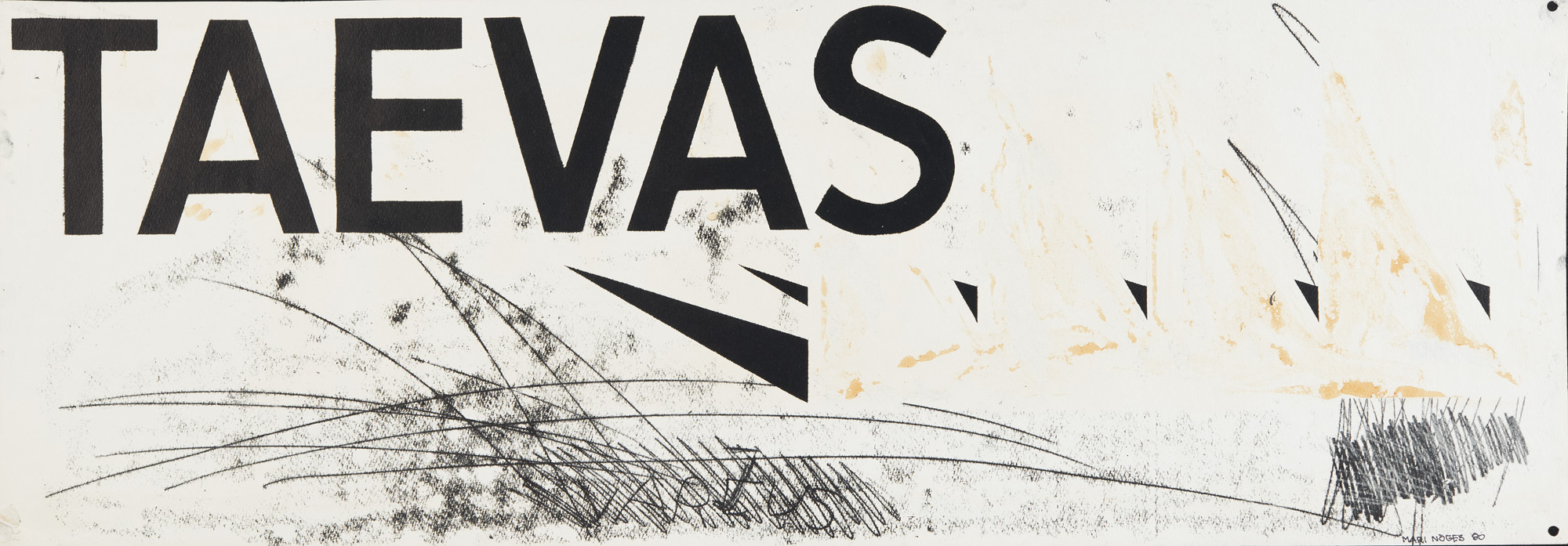
Sky I, 1980. Stencil print and diatype on paper, 30.7 × 86.4 cm (12 1/16 × 34 in.). Norton and Nancy Dodge Collection of Nonconformist Art from the Soviet Union. D14441

Cloud I, 1978-1979. Screenprint with lithographic crayon, ink, and gouache on Stencil print on paper, 30.6 × 85.5 cm (12 1/16 × 33 11/16 in.). Purchased with funds donated by Norton Dodge and Nancy Dodge. 1999.0347

Bottles, 1975. Tempera on paper, 49.7 × 49.9 cm (19 9/16 × 19 5/8 in.). Purchased with funds donated by Norton Dodge and Nancy Dodge. 1999.0333