
Odesa's Second Avant-Garde: City and Myth
Odesa historically mediated access to the outside world, as part of both the Russian (1721–1917) and Soviet (1922–1991) Empires. The myth of a dreamlike city of many cultures provided an abundant source of meanings for the artists who worked there. This exhibition explores the formal and conceptual trends in unofficial art created from the 1960s to the 1980s that helped to constitute Odessa's image and mythography. Themes range from a revival of interest in avant-garde traditions of the early twentieth century to the transformation of cultural life in the city through intricate networks of apartment shows and underground—though public—exhibitions.
Organized by Olena Martynyuk, Dodge Fellow at the Zimmerli and Ph.D. Candidate, Department of Art History at Rutgers.
This exhibition is made possible by the Avenir Foundation Endowment Fund, with additional support from Arts Trend Company.
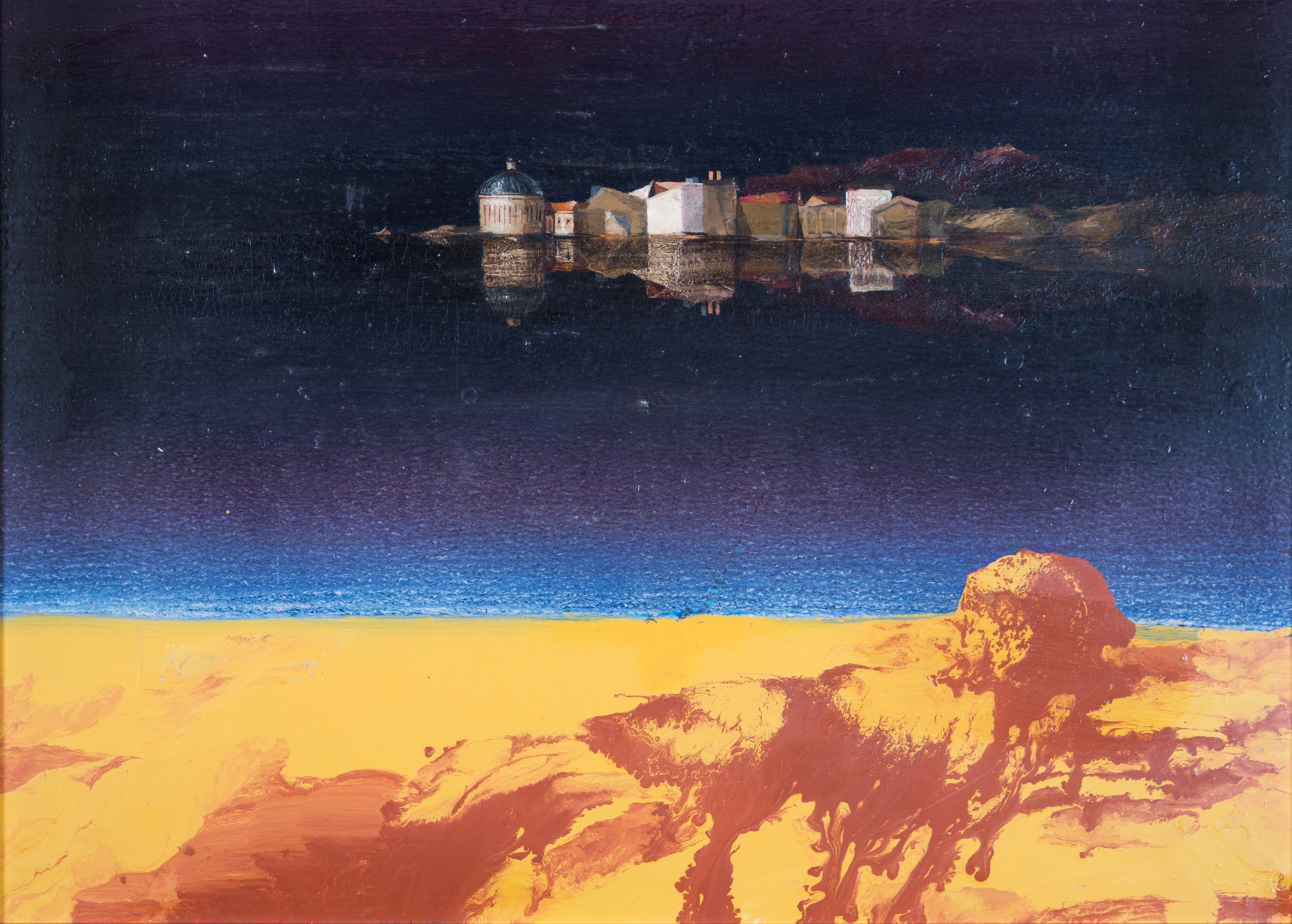
Lucien Dulfan, Reflection of the City, 1978. Oil on fiberboard. Norton and Nancy Dodge Collection of Nonconformist Art from the Soviet Union. 2013.006.012

Odesa's Second Avant-Garde: City and Myth. Installation view. Photo by Peter Jacobs

Odesa's Second Avant-Garde: City and Myth. Exhibition view. Photo by Peter Jacobs

Odesa's Second Avant-Garde: City and Myth. Exhibition view. Photo by Peter Jacobs

Odesa's Second Avant-Garde: City and Myth. Exhibition view. Photo by Peter Jacobs
Accordion Content
-
Odesa: Myth – and Reality – in Art from the Dodge Collection at the Zimmerli Art Museum at Rutgers
New Brunswick, NJ – The first exhibition at the Zimmerli devoted to artists from Ukraine, “Odesaʹs Second Avant‐Garde: City and Myth,” focuses on nonconformist artists who worked in this fabled seaport on the Black Sea from the 1960s through the late 1980s. On view at the Zimmerli Art Museum at Rutgers from April 30 to October 19, 2014, these paintings, works on paper, and collages express the independent spirit of this Ukrainian city. Artists and writers have gravitated to Odessa for more than two centuries, finding inspiration in the dreamlike city. They disregarded politics and artistic conventions, cultivating an atmosphere that has captivated people around the world. Even in light of current events in Ukraine, Odessa stands as an example of a city capable of uniting citizens whose cultures, languages, and opinions differ, but who share the humor and lightheartedness attributed to this seaside town.
“As a cosmopolitan harbor at the far edge of the Russian Empire, Odesa embraced residents and transplants from distinct backgrounds – Jewish, Ukrainian, Greek, Russian – and united them in their creative pursuits,” observes Olena Martynyuk, a Dodge Fellow at the Zimmerli and Ph.D. Candidate in the Department of Art History at Rutgers, who organized the exhibition. “These artists experimented together, searching for a local identity that combined diverse ethnicities and cultures, as well as an understanding of their place in the broader context of art history. In contrast to the harsh social and political circumstances throughout the Soviet Union at the time, the sunny climate of Odesa became – and continues to be – a metaphor for autonomy and possibility.”
On April 30, the opening reception begins at 4:30 p.m. Olena Martynyuk leads a tour through the exhibition for which she selected more than 50 works – many on view for the first time in the United States – from the Zimmerli’s Norton and Nancy Dodge Collection of Nonconformist Art from the Soviet Union. At 6 p.m., Myroslava Mudrak, Professor Emeritus from Ohio State University, presents a lecture on the art of Odesa titled “From Lucidity to Freedom: On Color and Light in the Intrepid Art of Modernist Odesa.” A renowned specialist in Russian and Ukrainian avant‐garde art, Mudrak’s studies of unofficial art began during the final years of the Soviet era, which allowed her to witness significant late 20th‐century cultural events in Odesa. She is author of “The New Generation and Artistic Modernism in the Ukraine” and “Contemporary Art from the Ukraine: An Exhibition of Paintings, Drawings, Sculpture,” among others. Visitors to the events on April 30 also have an opportunity to meet several of the artists featured in the exhibition.
During the late 1950s and early 1960s – in the post‐Stalinist, more liberal era known as Khrushchev’s Thaw – many artists from Odesa began to challenge the petrified style of Socialist Realism that had dominated Soviet art institutions since 1932. Artists were inspired by the saturated colors and Mediterranean ambiance, which was enhanced by the city’s origins as an ancient Greek settlement. They also drew inspiration from the early 20th‐century achievements of the radically innovative Russian avant‐garde and rediscovered local avant‐garde traditions.
Yuri Egorov was the recognized leader of this early generation. He had studied painting in Leningrad (now St. Petersburg), Russia, then returned to teach art in Odesa. While maintaining his official position, Egorov encouraged his students to experiment outside the confines of academic realism, as they sought to depict the very essence of Odesa. One of his students, Aleksandr Freidin, captures a contemplative mood in his 1978 painting “At the Window.” In it, a featureless figure stands in a sun‐filled room, with a clear blue sky and seemingly endless horizon outside the portal, apparently lost in thought. Another painting from the same year, “Reflection of the City” by Lucien Dulfan, embodies the city’s mythic reputation. Though reflected in the Black Sea, this distant, otherworldly cityscape seems to float in space, a world apart from its surrounding homeland and neighboring Soviet republics.
Distanced from the capitals of Kiev and Moscow, artists in Odesa enjoyed a tightly knit community, yet were not confined to a singular ideology or style. During the 1970s, apartment exhibitions became an underground outlet for sharing new work, as many artists in Odesa resisted any association with official affiliations. In addition to experiencing these “deviant” works of art, participants and guests enjoyed the prohibited diversions of jazz records and western art books. This briefly resurrected culture of the Odesa café‐cabaret (which had flourished at the turn of the 20th century) even attracted official artists as visitors, who risked their jobs to be part of such fashionable happenings.
The apartment of painter Liudmyla Yastreb and her husband Viktor Mariniuk became one of the central locations for these artistic salons. Encouraged by the reception of Yastreb’s 1979 triptych “NON,” these artists began to refer to themselves as “nonconformists,” venturing into the forbidden territory of abstraction, as well as incorporating ready‐made and found objects. Yastreb experimented with light and transformation of the form in the paintings “Old Bottles” (dated 1971) and “Big Pyramid” (1978), which burst with bold colors and dynamic compositions. Before her death in 1981, she also developed a feminist approach to the body and organized other women artists in the city.
The last generation of nonconformist artists in Odesa focused on conceptual art throughout the 1980s. Because conceptual art bypasses traditional media techniques and does not strive to solve classic painterly problems, it was a natural progression for Odesa’s artistic milieu, already familiar with non‐standard media. Sergei Anufriev, who had grown up among the apartment salons of his parents Aleksandr Anufriev and Margarita Zharkova, carried on the legacy. In addition to five of Anufriev’s solo works on paper (and one painting by his father), the exhibition includes several of his mixed media pieces as part of the collective Inspection Medical Hermeneutics, which he formed with Yuri Leiderman and Pavel Pepperstein. The group treated ideological phenomena – such as fascism or communism – as private schizophrenic deliriums that could be “treated” through conversation, in a manner similar to Freudian psychoanalysis. They conceived their artwork as illustrations to their texts, and vice versa, commenting on the correlation between image and word, a relationship important to conceptual art globally.
These artists continued their artistic resistance to official Socialist Realist dogma even as many began migrating to other cities. Many of them became integrated into Moscow’s unofficial art world, sharing display practices and theoretical interests. Inspection Medical Hermeneutics is now considered part of the Moscow Conceptualist canon. Still, Odesa’s version of conceptualism exhibited unique traits and maintained an independent spirit. It was considered more playful and surreal, with Odesa’s vitality juxtaposed against Moscow’s cool intellectualism. And this pervasive image of the exotic, sunny city further reinforced the myth of Odesa.
“The Zimmerli is very fortunate to house and develop exhibitions from the acclaimed Norton and Nancy Dodge Collection of Nonconformist Art. These works represent not only a pivotal period in the 20th century, but remain relevant as visitors try to make sense of complex relationships among nations around the world,” states Marti Mayo, the Zimmerli’s interim director.
“Odesaʹs Second Avant‐Garde: City and Myth” was organized by Olena Martynyuk, Dodge Fellow at the Zimmerli and Ph.D. Candidate, Department of Art History at Rutgers. The exhibition and related programs are supported by the Avenir Foundation Endowment Fund.
The Allen and Joan Bildner Center for the Study of Jewish Life at Rutgers invites the public to a program at the Zimmerli on Sunday, September 14. A guided tour of the exhibition “Odesaʹs Second Avant‐Garde: City and Myth” is followed by the lecture ʺInventing Odesa: Jewish Culture on the Edge of the Russian Empireʺ with Olga Litvak, a leading scholar of Jewish Eastern Europe. She explores the powerful connection between the city air of Odesa and the Jewish revival that it inspired. Through the eyes of some of its most famous Jewish residents – both the city’s admirers and detractors – we see how the temptations of Odesa changed the course of Russian‐Jewish life. Professor Litvak currently holds the Leffell Chair in Modern Jewish History at Clark University in Worcester, Massachusetts. Her recent books include “Conscription and the Search for Modern Russian Jewry” (Indiana University Press, 2006) and “Haskalah: The Romantic Movement in Judaism” (Rutgers University Press, 2012).
-
Past exhibitions collection
Odessa's Second Avant-Garde: City and Myth. Zimmerli publications, exhibition checklists (exh-00060, 203-exh-temp-box-100)
Publicity collection
"How Odessa Inspired a Jewish Renaissance: Lecture and Art Exhibit." Jewish Studies at Rutgers, No. 19, Fall 2015, English (0234, ndc-p-07, 203-pub-temp-box-148)
Oleg Syl'kin, "Khudozhniki Odessy v N'iu-Dzhersi: nostal'giia v kontekste tragedii." Golos-ameriki.ru. May 07, 2014, Russian (0235, ndc-p-07, 203-pub-temp-box-148)
Robin Bloom, "Weekly Entertainment Guide - 10 New Things to do in the New Year." Newsworks.org. January 7, 2015, English (0236, ndc-p-07, 203-pub-temp-box-148)