
Zoya Frolova
1953 — Kharkiv (Ukraine). Lived and worked in Kharkiv (Ukraine) and Riga (Latvia); works in Jersey City, NJ (USA)
Zoya Frolova graduated from Kharkiv State Academy of Design and Arts in 1976. Initially she studied there in the Department of Interiors and Equipment Design, but during her second year she switched to the Department of Monumentalist and Decorative Painting. After graduating, Frolova taught painting at the Kharkiv State Art High School until 1984. She participated in the artist residency program at the Senezh All-Union House of Creativity (Moscow, USSR) from 1980 to 1985, which stimulated her creative evolution and earned recognition for her work. At Senezh she met her future husband, artist Jānis Jākobsons (b. 1959) in 1982, and subsequently moved to Riga, Latvia, in 1984. Although she was an outsider, Frolova quickly integrated into Latvia’s art scene, and in 1986 her first solo exhibition, Ļaujiet iepazīstināt ar sevi [Let Me Introduce Myself], was held at one of the most important exhibition spaces, the House of Knowledge. The Soviet Union’s process of collapse in the end of the 1980s and beginning of the 1990s opened opportunities to exhibit internationally, and after several successful group and solo shows in Europe and the United States, in 1995 she moved permanently to the US. Today Frolova lives and works in Jersey City, New Jersey, together with her husband, Jānis.
Having experienced the creative exchange at the Senezh residency, where artists from different republics of the Soviet Union gathered, Frolova’s art of the 1980s reflected an urge to synthesize the cultural dynamics of the various Soviet regions. While living in Riga, she manifested this passion in a series of group exhibitions titled Gadījums [Coincidence] that she organized together with her husband between 1985 and 1988 during the Art Days, a major art event organized by the Artists’ Union of the Latvian SSR (1954–89). The four exhibitions brought together artists from the across region for stimulating conversations and exchange of ideas. In the late 1980s, Frolova was invited to do illustrations for Avots (Source), the magazine of the Latvian Writers’ Union, which was a bastion of critical thinking and free speech in the oppressive Soviet system. After moving to the United States, she exhibited both there and in Europe, as well as maintaining close ties with Riga’s artistic community. Expanding her idea of artistic and cultural connections between people globally and regionally, in 2018 Frolova and her husband initiated the project Tukku Magi, a museum and cultural center in Tukums, Latvia, which explores networks and connections between northern European, African, and American cultures.
While Frolova’s primary medium is painting, she also seeks expression through drawing and photography. Studies of classical painting, Russian icons, and early twentieth-century Russian painting shaped her style at the beginning of her career, later leading to an interest in hyperrealism that, with time, transformed into a figurative style incorporating aestheticized stylization of environment and characters. Through compositions combining references to art history, symbols, and mythology, the artist has developed metaphor and allegory as the core of narrative building. These combinations embody grotesque, ironic, or symbolic interpretations of social and political processes and rethink the ethical and moral problems of civilization.
In her works from the 1980s, Frolova conceptualized the absurdity and reality of the Soviet Union and its collapse, drawing a landscape of interlinked processes and people. In the center of the paintings are indeterminate figures that illustrate the cause and consequences of these processes and the resultant turmoil in society: a banquet at an enterprise (Feast, 1986), another group of figures playing with tin soldiers (The War Game, 1985, ZAM, 1996.0669), and a power play (Tug of War I, II, 1989). In the 1990s, her art gradually expanded toward a more global and universal view of power and hierarchical relationships as well as rethinking the position and possibilities of individuals in different social structures—for example, Feast of Kings (1990), Search for the New Hero (1991), Voyage (1993), and Return (1993).
Although feminism has not been an important aspect in Frolova’s work, from today’s perspective some of her paintings may be read as part of the feminist struggle. For example, the composition Afterwards (1987, ZAM, 1996.0668) depicts two women carrying a body in a bloodstained cloth. It not only draws attention to the absurdity of violence, but also indicates the woman’s position in conditions of war and political upheaval, revealing them as constant caregivers rather than decision-makers. A different approach is noticeable in works like Three Graces (1996), Variation (1996), and Beauty (1996), all exhibited in the group show Women Painting Women (1996, Mimi Ferzt Gallery), which reconsider ethical and aesthetic assumptions about the female body, its objectification, and norms of behavior.
In the twenty-first century her creative interests continue to reflect on the world and its constant changes and struggles, building on her compositions’ metaphors and allegories that combine quotes from different cultures and times. Nevertheless, the figurative element has decreased to a minimum in this period, when she mostly paints landscapes and compositions with different objects.
Zoya Frolova’s paintings have been exhibited in numerous solo and group exhibitions including the Centre Pompidou, Paris; Corcoran Gallery of Art, Washington, DC; Portland Museum of Art, Portland, Oregon; Slovak National Gallery, Bratislava; Tretyakov State Gallery, Moscow; National Museum in Gdansk; National Art Museum of Ukraine, Kyiv; Latvian National Museum of Art, Riga; and Mimi Ferzt Gallery, New York.
Her works are in the permanent collections of the Corcoran Gallery of Art, Washington, DC; Jane Voorhees Zimmerli Museum, Rutgers University, New Brunswick, NJ; Duke University Museum of Art, Durhan, NC; National Art Museum of Ukraine, Kyiv; Tretyakov State Gallery, Moscow; Slovak National Gallery, Bratislava; Latvian National Museum of Art, Riga; Presidential Collection, Riga; and Swire Group, Hong Kong.
Andra Silapētere
Photo portrait: Zoya Zrolova, Photographer unknown. Artist’s personal archive

Afterwards, 1987. Oil on canvas. 130 × 140 cm (51 3/16 × 55 1/8 in.). Norton and Nancy Dodge Collection of Nonconformist Art from the Soviet Union. 1996.0668
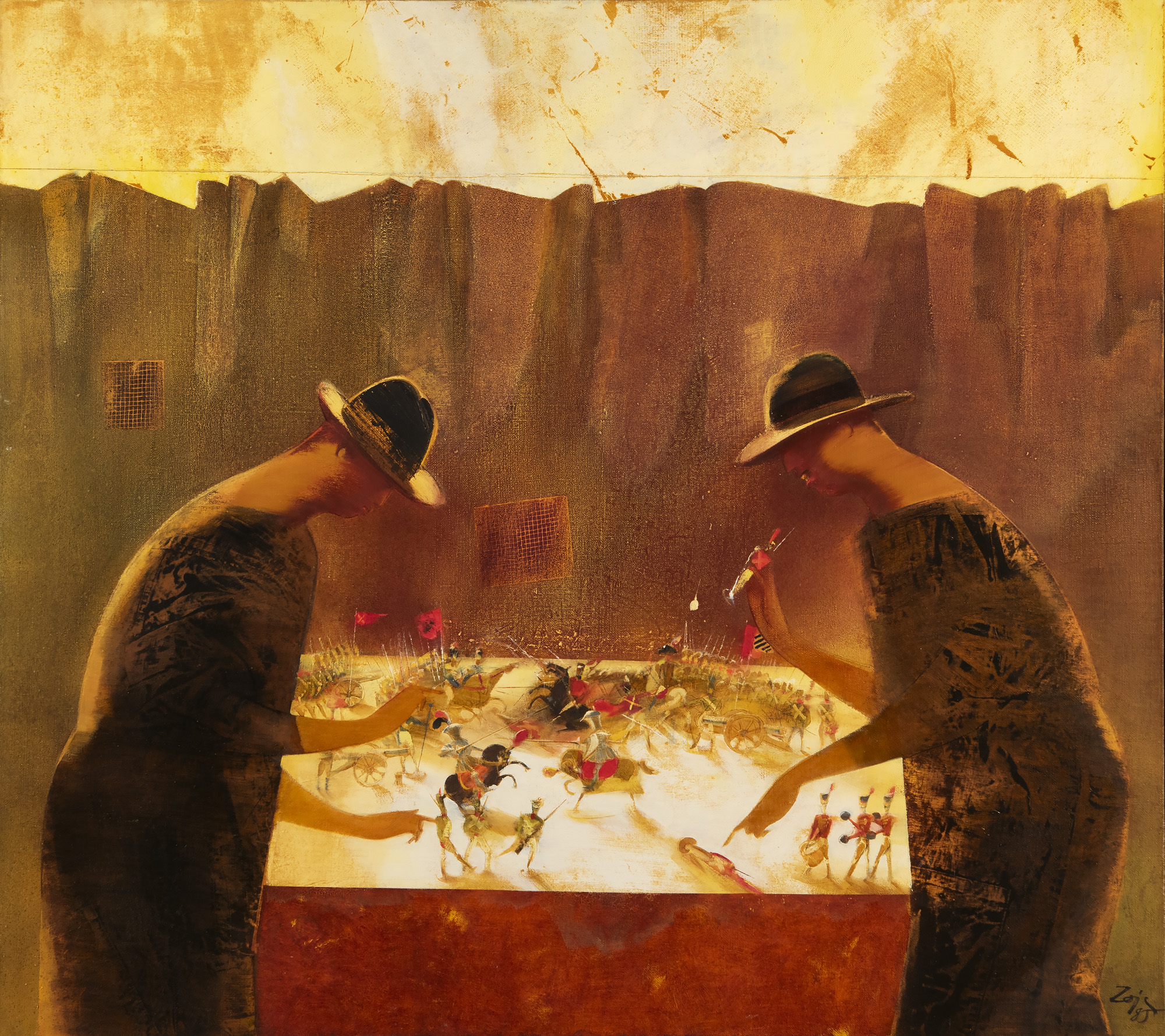
The War Game, 1985. Oil on canvas. 124.5 × 140 cm (49 × 55 1/8 in.). Norton and Nancy Dodge Collection of Nonconformist Art from the Soviet Union. 1996.0669

Solitude from the series Story of a Life, 1985. Oil on canvas, 100.5 × 100.5 cm (39 9/16 × 39 9/16 in.). Norton and Nancy Dodge Collection of Nonconformist Art from the Soviet Union. 1998.1232

Fight from the series Story of a Life, 1985. Oil on canvas, 114 × 114 cm (44 7/8 × 44 7/8 in.). Norton and Nancy Dodge Collection of Nonconformist Art from the Soviet Union. 1999.0688