
Yury Shurevych
1937 — Kemerovo (Russia) | 1997 — Odesa (Ukraine). Worked in Odesa (Ukraine), Krasnodar region (Russia, 1981–83)
Yury Pavlovych Shurevych was a Ukrainian Soviet artist who worked in monumental art and easel-based graphics. He lived and worked in Odesa in the second half of the twentieth century.
Shurevych was born on June 19, 1937, in the city of Kemerovo in Siberia (Russia). Three years after the death of his father, Pavel Shurevych, in 1941, Yury and his mother, Maria Horustovych, moved to Odesa. Between 1947 and 1951, he studied at a children’s art school, followed by studies at Secondary School No. 117. For a short time after school, he worked as a laborer in the Primorye Sanatorium until he was drafted into the army, serving in Mykolaiv. After demobilization, he studied for some time at the Odesa Art School (now the Mitrofan Grekov Odesa Art College), but he was expelled for his behavior. In 1957, Shurevych entered the Republican Art School in Chisinau (in the Moldovan Soviet Socialist Republic). He graduated in 1962 with his body of work, Новосели [Novesely, Newly Settled], created under the supervision of his teacher and supervisor, Aleksei Vasiliev (1907–1975), the People’s Artist of the Moldovan SSR.
From 1964, Shurevych worked as a monumental artist on the staff of the Odesa Art and Industrial Combine (kombinat) of the Art Fund of the Ukrainian SSR. During that time he was admitted to the Union of Artists of the Ukrainian SSR. While working as a monumental artist, Shurevych created several dozen artworks using a variety of techniques: encaustic painting (using hot wax), sandblasted stained glass, and repoussé [1], of which he often made decorative inserts for the windows of the central shoe store in Odesa.
In 1976, Shurevych designed the bar for the sea liner Shota Rustaveli. Two years later, he carried out the monumental design of the Dunai hotel in the city of Izmail. The project included lacquered paintings on levkas: Дари Півдня [Dary pivdnia, Gifts of the South], Великий букет [Velykyi buket, Big Bouquet], Захід Сонця на морі [Zakhid sontsia na mori, Sunset at Sea], and Вечірній пейзаж [Vechirniy peizazh, Evening Landscape], as well as interior designs for the restaurant Druzhba in the city of Lida in the Belarusian SSR. [2]
In 1987, he decorated the foyer of the Stroihydravlyka Factory’s Rest House with four chamotte panels, measuring 70 by 50 centimeters, which depicted a dolphin, a shell, a crab, and a flounder. [3] In a similar whimsical vein, the artist created the mosaic Казки [Kazky, Fairy Tales] (1989) for the foyer of the House of Culture’s puppet theatre in the village of Kupka, Chernivtsi region.
The painter and sculptor Valerii Basanets (b. 1941) made special note of Shurevych’s successful series of lacquered paintings created around the theme of “Youth” in the Dunai hotel in Izmail and in the foyer of the Palace of Culture and the Palace of Marriages in the rural settlement of Vyselki, located in the Krasnodar region of Russia. “In these large-scale paintings, the artist develops the ideas of his images and gives them a monumental, major, festive flavor. All the artist’s works are characterized by impeccable formal mastery of interpretation and execution, which testifies to his high level of professionalism.” [4] Shurevych worked in the Krasnodar region between 1981 and 1983. In addition to the aforementioned buildings, he decorated the central library of Vyselki with stained glass windows entitled Book Printing, Priestmonk, French Literature, and English Literature.
“Yury Shurevych is a fully formed artist with a brightly expressed individuality,” continued Basanets. “A characteristic feature of his creative individuality is his philosophical and romantic comprehension of the artistic image, which is also the basis of his artistic thinking. Shurevych is an organic and complete artist with a powerful imagination. The sources of his creativity are southern Ukrainian nature, the sea, the image of an internally beautiful, spiritual woman, children, sea life, and flowers. All of this comprises the content for both his easel and monumental works. The artist’s charming images are brought to life in wall and lacquered paintings, mosaics, repoussé, casting, and stained glass.” [4].
Shurevych’s use of varied techniques was also noted by the artist Viktor Maryniuk (b. 1939) in his recommendation for admission to the Odesa organization of the Union of Artists of Ukraine, written on May 20, 1992: “I have been acquainted with Yury Shurevych and his work for many years. . . . The artist has been engaged in various types of fine art (graphics, painting, murals, mosaics, ceramics, etc.). The author’s works are distinguished by a high level of artistic competency, originality, and expressiveness in the language of form and plasticity. They are characterized by meticulous drawing, clearly defined themes, carefully organized color schemes, and characteristic imagery.” [5] Maryniuk described Shurevych as a highly professional, mature master and emphasized that he was respected by his colleagues.
Fellow monumental artist Volodymyr Tsiupko (b. 1936) similarly characterized Shurevych’s creative energy: “His monumental works are distinguished by their professionalism. Well-balanced and connected to the environment, they not only complement, develop, and enrich it, but also become an integral organism. Rich in detail and witty invention, they are simple in construction and easily perceived. As an artist, Yury Pavlovych turned out to be a subtle lyricist in his easel works. Numerous designs and paintings reveal a world of full, strong, and saturated experiences, conveyed in an expressive and harmonious way.” [6]
In addition to the artists already mentioned, Shurevych also encountered Valentyn Altanets, Oleksandr Atsmanchuk, Volodymyr Bulany, Adolf Loza, Valentyn Matskevych, Lev Mezhberg, Eduard Pavlov, Volodymyr Synytskyi, Orest Slieshynskyi, Oleg Sokolov, and Viacheslav Tokariev. Indeed these connections flourished as Shurevych participated in the legendary underground apartment exhibitions in Odesa in the 1970s that provoked the ire of Soviet authorities.
Those who knew him well noted his introversion and complex character. Art critic Tetiana Basanets wrote that he avoided officialdom and bureaucracy, valuing independence above all else. “Contrary to the artists of his circle who interacted closely and openly, Yury almost never took part in loud art actions, preferring to be an outsider observer, not flaunting his own work. His colleagues understood him in this, and continued to respect him; actually, this behavior increased their interest and made them admire him, even prompting them to try and convince Shurevych to go through the procedure of joining the Union of Artists: he already had a number of talented pieces of monumental and decorative artwork under his belt. . . . Meanwhile, his murals, mosaics, and stained glass were of impeccable quality and always aroused the admiration of the art council and customers.” [7]
Basanets wrote that Shurevych did not consider his works displayed on the interiors and exteriors of Soviet cultural institutions to be art and rather regarded them as an opportunity to earn money from his profession. For the artist himself, the opportunity to create and fill his own noncommissioned paintings with detail was more important than the official work of monumental art. His paintings contained elements of delicate surrealism, rendered in pastel tones that were in harmony with nature.
Nature is present throughout Shurevych’s artwork in the form of flowers, stones, dry trees, mollusk shells, and nude figures. The sky consistently features as an important component of his pieces. This emphasis on nature shifted to the personal as he occasionally depicted old Odesa houses or himself and his artist friends. He worked mainly in the pastel technique, which was rare for the period. Across all works, his exquisite paintings are composed of several planes, each of which contains an element of mystery. With this atmosphere and repetition of motifs, Shurevych seemingly depicts fragments of another reality (or the artist’s own inner world), which he visited from time to time and therein found peace. By framing these ideas, Shurevych preserved these visions for himself, and the viewer, to enjoy as long as possible.
When asked for the purpose of creativity in a 2010 interview, Shurevych replied, “To convincingly portray what I want.” [7]
In 1996, a significant number of Shurevych’s works were acquired by the Choven gallery, which was connected to the Mamai art association in Odesa. The association was founded in 1990 by artists Valerii Basanets, Ihor Bozhko, Viktor Maryniuk, Serhii Savchenko, Mikhail Stepanov, Oleksandr Stovbur, Volodymyr Strelnikov, and Volodymyr Tsiupko. Shurevych maintained close connections with the group throughout his life. Despite this affiliation, Shurevych never formally joined any artistic groups.
Yury Pavlovych Shurevych passed away on January 25, 1997. He was buried in Odesa.
Kateryna Lebedeva
Translated from Ukrainian by Nathan Jeffers
Notes:
1. A form of metalwork where metal is hammered over a mold to create a small relief.
2. A bright white layer of material (composed of chalk, alabaster, calcium sulfate or similar materials), historically applied to orthodox icons before they were painted or gilded.
3. Also known as grog, this is made from crushed fired pottery that can be added to clay when making ceramics.
4. Valerii Basanets, His recommendation for Shurevych’s admission to the Odesa organization of the Union of Artists of Ukraine, May 15, 1992. Handwritten text held by Shurevych’s grandson.
5. Viktor Maryniuk, His recommendation for Shurevych’s admission to the Odesa organization of the Union of Artists of Ukraine, May 20, 1992. Handwritten text held by Shurevych’s grandson.
6. Volodymyr Tsiupko, His recommendation for Shurevych’s admission to the Odesa organization of the Union of Artists of Ukraine, May 1992. Handwritten text held by Shurevych’s grandson.
7. Tetiana Basanets, “Mii alternatyvnyi prostir, de chekaiu ne hliadacha a spivrozmovnyka” [My alternative space, where I am not waiting for a viewer but an interlocutor] in Muzeinyi provulok: Zhurnal Natsionalnoho khudozhnoho muzeiu Ukrainy 15, no.1 (2010): 124–29. Elektronna Biblioteka “Kultura Ukrainy” [Electronic library “The Culture of Ukraine”]
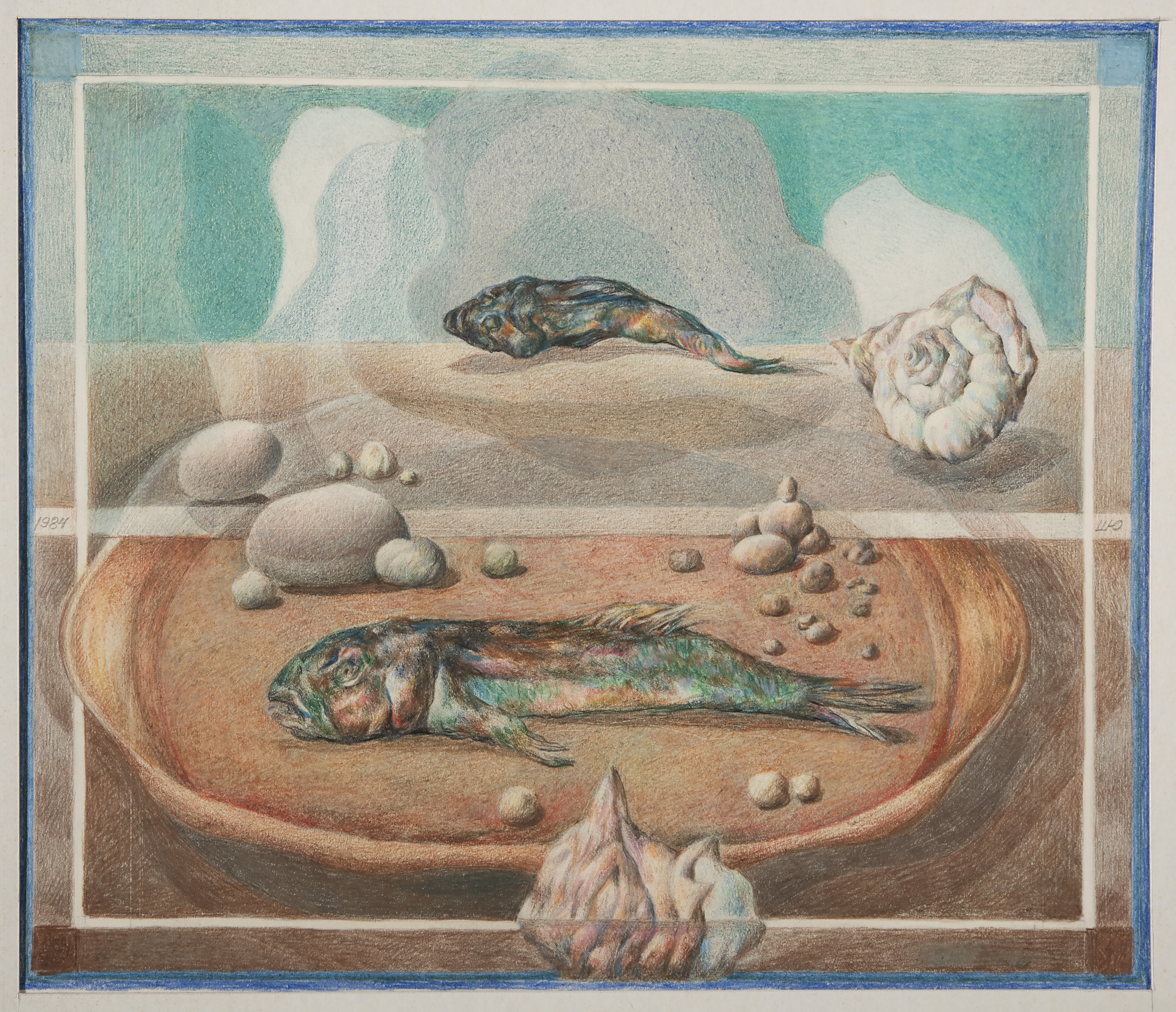
Still Life with Fish and Shell, 1984. Colored pencil on paper, 41 × 49.7 cm (16 1/8 × 19 9/16 in.). Norton and Nancy Dodge Collection of Nonconformist Art from the Soviet Union. D15713
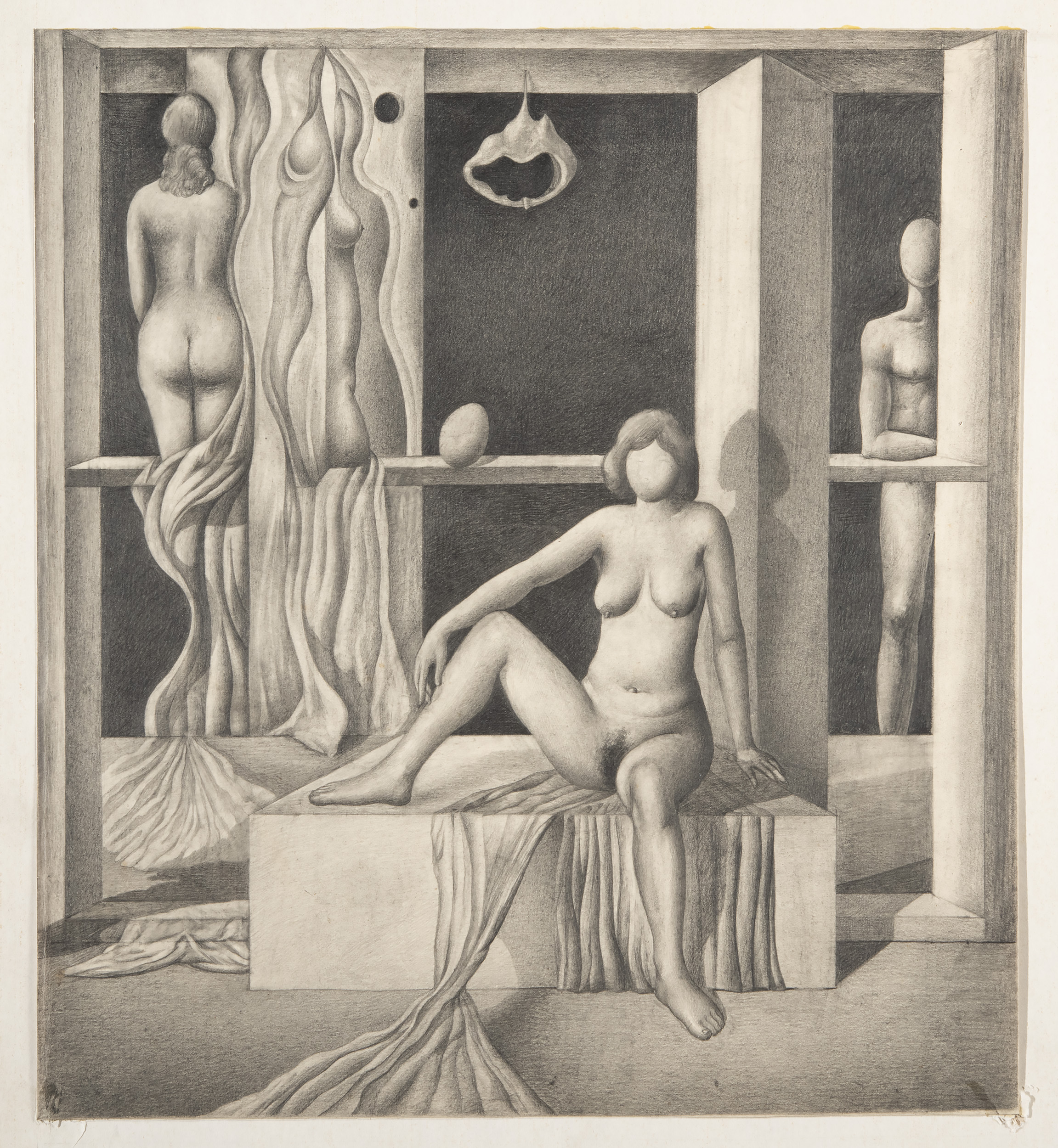
Family Portrait, 1979. Graphite on paper, 43.8 × 42.2 cm (17 1/4 × 16 5/8 in.). Norton and Nancy Dodge Collection of Nonconformist Art from the Soviet Union. D15721

Untitled, 1979. Graphite on paper, 43.7 × 41.4 cm (17 3/16 × 16 5/16 in.). Norton and Nancy Dodge Collection of Nonconformist Art from the Soviet Union. D15722