
Yevgeny Sidorkin
1930 — Lebyazhye (Russia) | 1982 — Alma-Ata (Kazakhstan). Worked in Alma-Ata (Kazakhstan)
Yevgeny Matveevich Sidorkin is recognized as a classic figure in Kazakh art, especially graphic art. His work demonstrated a synthesis of natural talent, education, and an ability to absorb and condense the distinctive culture of the Kazakh people through a deep understanding of its history, ethnography, traditions, and customs. His art dwells on the borders of strength and memory, between the clarity of the canon and the life of folk myth. The primary achievement of his work is the authentically epic nature of its images and his search for universals that are closely tethered to the ornamental decorative structure of traditional Kazakh art.
As professor and former museum director Gulmira Shalabaeva characterized the artist’s work in her monograph, “Sidorkin’s artistic method combines the professionalism of the European school of graphic design, the humanist pathos of Russian realist traditions, and the stunning poetic symbolism of traditional Kazakh masters.” [1] The gallery of images of nomadic civilization that Sidorkin created remains the highest achievement of the artistic school of Kazakhstan.
Sidorkin was born on May 7, 1930, in the village of Lebyazhye, Kirov Oblast. In 1951, he completed his studies at the Kazan Art School (after 2006, renamed the Nicolai Fechin). In 1951–52, he studied at the Latvian SSR State Academy of Art in Riga, and in 1957, he graduated from the Ilya Repin Leningrad Institute of Painting, Sculpture, and Architecture. Over the period of his studies, from 1948 to 1957, he designed and illustrated about thirty books.
Sidorkin created his first works in Alma-Ata, where he moved after finishing his education in Leningrad. Having met and fallen in love with his classmate Gulfairus Mansurovna Ismailova (1929–2013), an artist of astonishing beauty and talent, he bound his life to hers and forged a lifelong connection between her native Almaty and his own biography and artistic career.
The view of a Russian artist, immersed in the distinct identity of the Kazakh culture, offered an endless variety of thematic and figurative interpretations. The heroes and plots of fairy tales, myths, and folk legends, as well as images from classical and contemporary literature, filled the space of his graphic pages. Rather than incorporating them as an ethnographer, he tried to use their own language—and traversed the depths of time to turn to the ancient culture. He allowed myth to dictate the rhythm of his images rather than simply relying on the aesthetics of his own age.
Kazakh folklore became the main theme of Sidorkin’s work. He began work on the design of his book Kazakh Epos in 1958 for the arts platform Decade of Art of Literature in Moscow. The project immediately drew high praise and catapulted him to fame. As art critic Bayan Barmankulova wrote: “For the first volume he made his drawings in ink and gouache (1959), for the second, in linocut. While in Веселые обманщики [The merry deceivers] (1961) the artist worked in a narrative genre, he now strove toward symbolism, almost emblem. The pursuit of this goal drives him to study the language of Kazakh ornamentation, to return to the experience of Greek black-figure vase painting … and to the compositional techniques of Chinese painting, from which he learned construction through dynamic asymmetry. Every page in this series dazzles us with its compositional inventiveness and precision, with the energy of its lines, the passion of its images.” [2]
Two works in the Dodge Collection belong to a series of illustrations for the Kazakh folk epic Kyz-Zhibek, in which the book’s design is unified by a common visual concept based on the stylized ornamentation of Scythian-Saka culture. Here, the strict rhythm of the ornamentation is combined with the weightiness of sculptural forms, and the richness of decorative elements with the emphasized flatness of the relief images. The central image of competing musicians or a warrior is framed by masklike faces or expressively frozen figures. Space seems to push them out of the darkness: as they emerge, the images acquire individuality, inner tension, and emotional expressiveness.
The artist’s preferred technique, lithography, allowed him to convey the loose texture of soft pencil strokes, the irregularities of a stone surface, and the rough materiality of the relief. Through the language of printmaking, the artist reinterpreted folkloric heritage, revealing its archetypal notions of good and evil, justice and happiness, loyalty and betrayal.
Sidorkin’s turn to epic poetry and folklore—which are inextricably linked to the national character, spirit, and mindset—is by no means coincidental. For the artist, it was important to understand and feel the artistic, aesthetic, and thus moral consciousness of the people of the land where he lived and created. Sidorkin has gone down in art history as the artist who revealed the unpretentious beauty of the folk soul, its gestures, and its memory. He did not so much illustrate the epic as extract from it its rhythm, movement, and breath. It is precisely this that makes his works relevant in the twenty-first century, when questions of national identity and the right to culture, language, and image have become particularly acute.
He preferred the technique of lithography, in which his direct drawing with the lithographic crayon or ink onto the matrix—the lithographic stone—allowed for control of the tone and texture of his forms, dissolving transitions between light and shadow, and revisions to the image. Sidorkin made adjustments during the process—sometimes even using breadcrumbs—accounting for small differences between earlier and later prints. He worked in monumental media and formats as well, including architectural decoration in mosaic, relief sculpture, and sgraffito (the technique of etching a design onto a surface prepared to reveal a colored layer beneath). Examples of this decorative work in Almaty are a pediment sketch for the G. Musrepov Youth Theater (1960); sgraffito design for the Tselinny Cinema (1964); and sgraffito and relief sketch for the Sports Palace (1967).
By the 1960s, Sidorkin achieved recognition outside the USSR. He won prizes for his illustrated books and their standalone lithographic illustrations (for The Merry Deceivers and Kazakh Epos); was recognized with a gold medal at the Leipzig International Book Fair (for the lithographic series Reading Saken Seifullin) [3]; won the International Biennale of Graphic Art “Man and the Contemporary World” in Kraków in 1966; and was awarded a bronze medal at the Venice Biennale (1966). [4] The Venice work was met with high praise: “But perhaps the most talked-about works at the exhibition among visitors were those by Y. Sidorkin. These large prints immediately attract attention with their keen perception of modern life and their ability to convey it in images that preserve national character. These lithographs are very modern: bold perspectives, an unusual, intensely expressive compositional approach, and a plastic unity that emphasizes the dynamics of the action—all of this explains the heightened interest shown in Y. Sidorkin’s works.” [5]
The dynamism and fervor of equestrian competitions inspired the artist to create his 1963 series The Kazakh National Games, in which the image of a horseman is central and semiotically dominant. Four sheets are dedicated to the riding competitions—Kyz-kuu, Baiga, Kok-par, and Hunting with the Golden Eagle—the last representing an animal that has accompanied hunters since ancient times, symbolizing the national ideals of strength, masculinity, and agility.
The period from 1960 to the 1970s became the most fruitful in Sidorkin’s career. He created the series Читая Сакена Сейфуллина [Reading Saken Seifullin] (1964), Аксакалы [The Elders] (1966), and the sets of illustrations to Mukhtar Auezov’s novel Путь Абая [Abai’s Path], first in 1960 in linocut and then a version in 1971, in lithography, which brought knowledge of his work to outside the USSR. For these series, as well as The Elders, Sidorkin was awarded the Valikhanov State Prize in 1979.
The artist worked on the large-format pages of his series Из мглы веков [From the Mists of Centuries] for nine years (1970–79), depicting dramatic moments from Kazakh history. He expressed war, tremendous exertions of force, and clashes between opposing factions in complex multifigured compositions that represented fighting horsemen, vanquished soldiers, and defenseless suffering women. The stylistic foundation can be found in the Saka animal style, supplemented by accentuated lines rendering angles and figures, intricate work with texture, and a characteristic expressiveness of the images. As Gulmira Shalabaeva observed, “When he began turning to the Saka animal style, Sidorkin was accused of being uncontemporary and formalist.” [6] But in fact, he was among the very earliest artists to find endless inspiration in the ancient culture of the Turks and to actualize them through the language of art.
In the 1970s, artists undertook trips to industrial sites to draw from observation. Sidorkin’s impressions of his trip gave rise to the series На земле Казахстанской [In the land of Kazakhstan], including scenes from Baikonur, Temirtau Magnitka, and Kazakhstan’s farmlands.
Besides his own creative work, Sidorkin spent a great deal of time working with younger artists. He was often invited to lead the all-union group of graphic artists at the famous House of Creativity of the USSR Artists’ Union in Senezh, Moscow Oblast, where there were optimal conditions for work in any medium, but especially lithography. He spent years leading creative groups of young artists who had come from every corner of the country to develop their knowledge and mastery. “I have sense of humor enough not to see myself as any kind of a mentor, but I’m also sufficiently immodest to say that in twenty-five years of work I have made no shortage of mistakes, which I can now share. Everyone knows it is more pleasant to learn from the mistakes of others.” [7]
The 1970s and early ’80s were marked by a new surge in Sidorkin’s talent. The artist completed a series of large-scale easel drawings and illustrations for Mikhail Saltykov-Shchedrin’s satirical novel The History of a Town, in which the artist nimbly created satirical grotesqueries that are counterparts to the trenchant absurdities in the literary text. Also in those years, a huge four-panel lithographic polyptych, forming a single composition to accompany François Rabelais’s multivolume Gargantua and Pantagruel (1979), asserted the vital thirst for life. This work can now be understood as the artist’s brilliant and powerful swan song.
In 1981 Sidorkin was named People’s Artist of the Kazakh SSR. The following year, he passed away, in the prime of his creative life, and was buried in Alma-Ata, leaving his wife and son, Vadim Evgenevich Sidorkin (1959–2021), who was also a professional artist.
In our own time, when the self-determination of national identity has become an especially acute concern, Sidorkin’s work has taken on additional new relevance. It offers a way of seeing, an ability to discern in folklore not the past, but a present. In this sense, he is closer to the contemporary decolonial sensibility than many of his contemporaries.
Katerina Reznikova
Translated from Russian by Ian Dreiblatt
Notes:
1. Shalabaeva, Gulmira. Evgenii Sidorkin: Ontology of Artistic Method. Almaty: Kasteyev State Museum of Arts, 2020: 172.
2. Barmankulova, Bayan. History of the Arts of Kazakhstan, vol. 3, Painting. Graphic. Sculpture (Almaty: Oner, 2011), 39.
3. Shalabaeva, Evgenii Sidorkin: 76.
4. Shalabaeva, Evgenii Sidorkin: 100.
5. Goryainov, V. “Venice. The 1966 Biennale.” In Soviet Culture, September 15, 1966.
6. Shalabaeva, Evgenii Sidorkin: 166.
7. Sidorkin, Yevgeny. “Images of ‘Kyz-Zhibek.’” In Creativity 8 (1974): 42. As cited in Shalabaeva, Evgenii Sidorkin: 104.
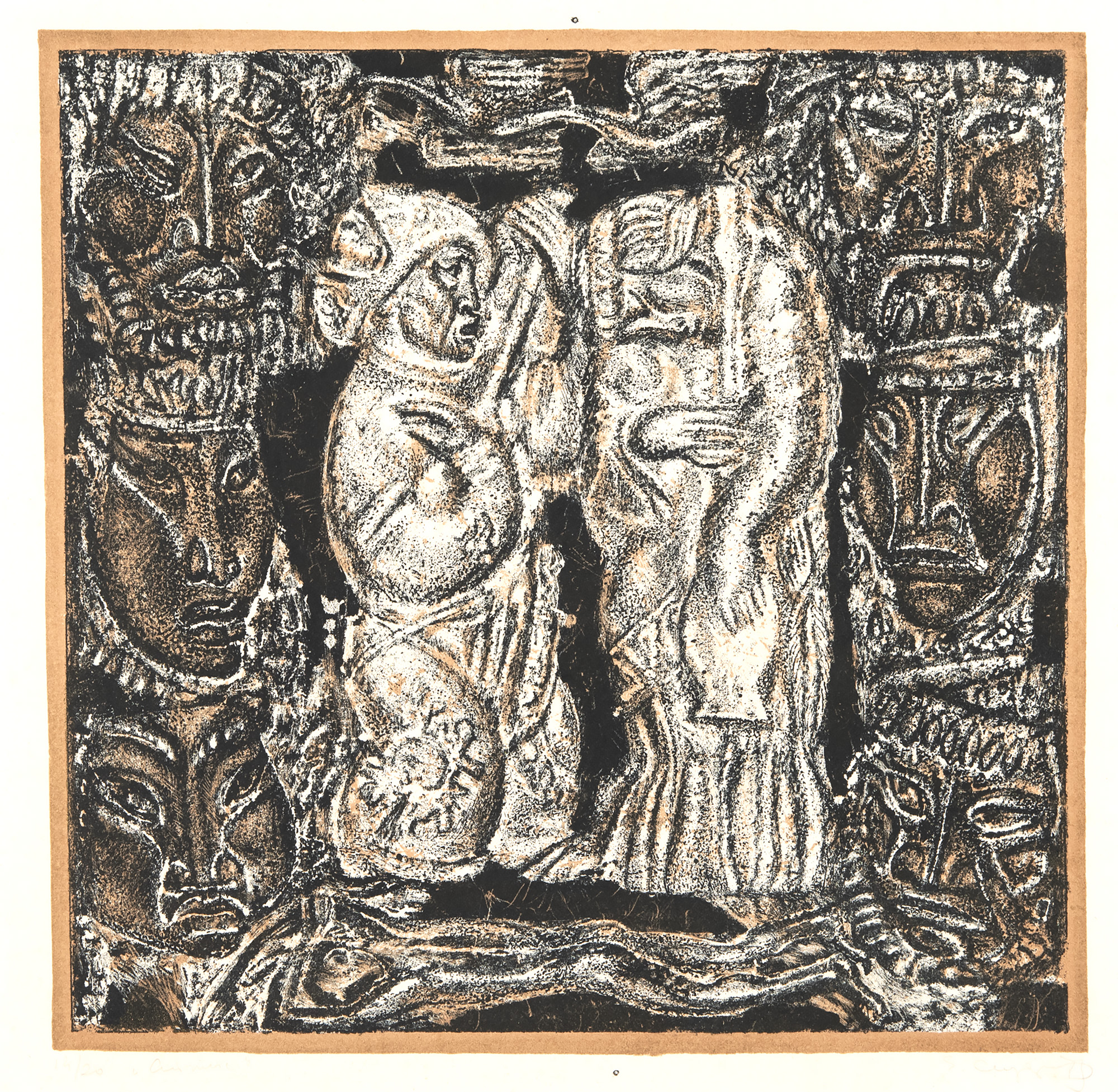
Contest, 1973. Lithograph on paper, 32.2 x 32.5 cm (12 11/16 x 12 13/16 in.). Norton and Nancy Dodge Collection of Nonconformist Art from the Soviet Union. D00972

The Warrior, 1977. Lithograph on paper, 33.2 × 32.5 cm (13 1/16 × 12 13/16 in.). Norton and Nancy Dodge Collection of Nonconformist Art from the Soviet Union. D06965

Untitled, undated. Lithograph on paper, 49.5 × 25.5 cm (19 1/2 × 10 1/16 in.). Norton and Nancy Dodge Collection of Nonconformist Art from the Soviet Union. D11841