
Yefim Ladyzhensky
1911 — Odesa (Ukraine) | 1982 — Jerusalem (Israel). Worked in Odesa (Ukraine); Krasnodar, Moscow, and Stalingrad (now Volgograd) (USSR, now Russia); Tashkent (Uzbekistan); Ashgabat (Turkmenistan); and Jerusalem (Israel)
Yefim (Yukhym) Bentsionovych Ladyzhensky was a Jewish artist born in Odesa, Ukraine. He was a film artist, a designer of exhibition pavilions, a theater artist, a painter, and a graphic artist specializing in illustration. Ladyzhensky, a member of the Union of Artists of the USSR, worked as a theater artist in major cities across the former USSR, primarily in the drama theaters of Moscow.
In 1925 and 1926, the artist studied at the Studio of Social Education in Odesa, under the tutelage of the painter Yuli Bershadsky (1869–1956). Bershadsky graduated from the Saint Petersburg Imperial Academy of Arts and then returned to his native Odesa. There, he took an active part in exhibitions, ran a private art studio (1907–1928), and, as of 1929, began work as a lecturer at the Odesa Art School (now Mitrofan Grekov Odesa Art College).
From 1928 to 1931, Ladyzhensky studied at the Odesa Art College (while his studies it was called the Odesa Polytechnic College of Fine Arts and then Odesa Art Institute) in the theater and decoration department of the painting faculty. This department was headed by the theater artist and avant-garde master Volodymyr Miuller (1887–1979). Here Ladyzhensky studied under Oleksandr Haush (1873–1947), a well-known set designer, painter and graphic artist, as well as Teofil Fraierman (1883–1957), who later became the organizer and leader of the Society of Independent Artists, which united avant-garde artists in Odesa.
After completing his studies, Ladyzhensky worked as a production designer in the state theaters of large Soviet cities including Krasnodar and Stalingrad (Russia), Tashkent (Uzbekistan), and Ashgabat (Turkmenistan). He lived in Moscow beginning in 1936 and, until 1958, worked at the Mosfilm studio. In 1939, he became a member of the Union of Artists of the USSR. During the Second World War, Ladyzhensky designed touring theatrical performances for the army. In 1942, the artist’s first solo exhibition of scenery drawings took place in Borisoglebsk.
As a film artist, Ladyzhensky took part in the production of the films Morgiana (1972) and The Last Night. In theaters, he designed more than seventy performances for plays based on the works of Nikolai Gogol, Anton Chekhov, Oleksandr Ostrovsky, Vladimir Mayakovsky, Valentin Kataev, Samuil Marshak, Maksim Gorky, Aleksei Arbuzov, Viktor Rozov, Pierre Beaumarchais, John Boynton Priestley, and Lope de Vega. He worked with theaters across Europe and in Vilnius (Lithuania), Alma-Ata (now Almaty, Kazakhstan), and Minsk (Belarus), and within Russia, including Bryansk, Saratov, Tula, and Moscow.
From 1959 to 1961, the artist worked on the design of two pavilions at the All-Union Agricultural Exhibition in Moscow. In 1960, he took part in the exhibition dedicated to the thirtieth anniversary of the Moscow Union of Artists (MOSKh). In 1962, the artist’s second solo exhibition was held in Moscow at the All-Union Theater Association (VTO). Between 1963 and 1964, the artist worked in two Moscow theaters: the Taganka Drama Theater and a branch of the Maly Theater.
Among the unrealized performances for which the artist made scenery and costume sketches were dramatic works by Odesians: Sunset by Isaac Babel and the opera The Lay of Opanas, based on the libretto by Eduard Bagrytsky. Ladyzhensky also chose books by Odesan authors for illustration such as Valentin Kataev, Samuil Marshak, and Eduard Bagrytsky.
From 1965 to 1968, Ladyzhensky worked on producing his series Isaac Babel: “Red Cavalry and Мати [Mother]. In 1967, the artist participated in an exhibition in São Paulo, Brazil. In 1969, his third solo exhibition was held in Moscow at the House of Artists. He exhibited drawings of scenery, landscapes, still lifes, and portraits. That same year he began work that would occupy him for nearly a decade, on multiple series: Одеса - місто мого дитинства [Odesa—the Town of My Childhood], Каркаси [Frames], Рослини [Plants], and Автопортрети [Self-Portraits].
The composition of works in Isaac Babel: “Red Cavalry,” along with its palimpsest of events from different time periods, gives the series a distinctly tragic atmosphere. What is real in the piece is combined with signs and symbols, with phantom images. Meanwhile the artist’s best-known series, Odesa—the Town of My Childhood, is imbued with humor and a lyrical, nostalgic melody. Its works present iconic locations in Odesa to the viewer: Привоз [Market, Chicken Row] (1974, ZAM, 1999.0738), Кафе «Колишній Фанконі» [The “Former Fanconi” Cafe] (1979), Ресторан на бульварі Фельдмана [Restaurant on Feldman Boulevard] (1979, ZAM, 1993.0204), and Толчок [Bazaar] (1968–81).
Odesa—the Town of My Childhood includes more than a hundred works painted in the tempera technique. They convey an authentic feel of the city, the noise of its crowds, the short, loud melodies of car horns, and the rustle of the wind blowing from the steppe or from the sea. These images of Odesa, which appear from the artist’s childhood memories, are both real and subjective. The key features of images in the Odesa—the Town of My Childhood series are theatricality, festivity, lyricism, and humor. Ladyzhensky’s works turn into a lens of time, one of fantasy and nostalgia. The series includes Бані Ісаковича [The Baths at Isakovich] (1974, ZAM, 1999.0735), Велике прання [Big Laundry] (1968–81), Соління скумбрії [Mackerel Salting] (1968–81), unloading at the port in У кавуновій гавані [In the Watermelon Bay] (1974, ZAM, D16506), and a walk in the park with У Саду Тверезості [In the Garden of Sobriety] (1968–81). Like a film strip, these saturated and storied images reflect the different corners and carousel life of the vibrant port city.
The images of the city created by the artist are filled with the bustle of crowds yet simultaneously feel attentive and closely tied to the life of each character depicted in its scenes. These works have a theatricality and literary character, an energy that reflects an integral part of life in that city. There is also a closeness between artist’s visual representation of Odesa and how the city is canonically described in literature. Like Ladyzhensky, the authors who lived and worked in Odesa—Kataev, Ilf and Petrov, Bagrytsky, Olesha, Babel—used the city as the context for their works, thus immortalizing their hometown. Odesa was also the place where Utiosov’s songs and Eisenstein's films were born.
In all his works, the author combines different perspectives, adds fantasy to reality, and incorporates a childhood nostalgia. V. A. Zheleznova, the author of the introductory article to Ladyzhensky”s album where works from this series are presented, noted: “Ladyzhensky's paintings are musical with a defined intonation. They speak of a festive and positive perception of the world—both then and now.” [1] In parallel with the series Odesa—the Town of My Childhood, the artist worked on Frames, Plants, and Self-Portraits, in which the leitmotif is more tragic in nature, focusing on the anxious loneliness of a person existing in the world and the transient nature of life.
In 1978, Ladyzhensky emigrated to Israel. Prior to leaving, he personally destroyed approximately two thousand of his works, unable to pay the export duty imposed by Soviet officials, and was forced to hand over thirty paintings to the Ministry of Culture of the USSR in payment for permission to take his own works abroad. [2] This tragedy took a heavy toll on the artist”s health and inflicted a painful mental wound.
He lived in Israel for only four years. During this period, he completed the series of works Вічний жид [The Eternal Jew]. He also added to his Self-Portraits series; however, the last additions were filled with tragedy and had surreal, frightening figurative foci. Ladyzhensky held three solo exhibitions in Jerusalem and Haifa. Despite this vibrant artistic career, Ladyzhensky felt extremely lonely; he was looking for his city, the people who were spiritually and mentally close to him, but he could not find them. The Odesa and Odesans of his childhood had disappeared forever, the people around him had changed, and he could not find his people in the “promised land.” His extreme disappointment with life, with people as such, his loneliness, and a feeling that his talent was unrecognized ultimately pushed the artist to suicide.
The Zimmerli Art Museum collection features works from several of Ladyzhensky’s most famous series, including works from the Odesa—the Town of My Childhood. In the painting Restaurant on Feldman Boulevard, all the visitors in white clothes are arranged around tables covered with snow-white tablecloths, against a backdrop of white curtains. The spectacle of the piece becomes clear when we see that the people depicted are frozen in a sitting position, with no chairs beneath them. We understand this is no longer reality, but a vision. The work Добрий бюстгальтер [Good Bra] (1974, ZAM, 1993.0208) grotesquely conveys the situation wherein the desire to purchase a high-quality item of lingerie turns the dressing room into the backstage of a theater. And even more grotesque is the work Дефіцитний товар з'являється у магазині [Scarce Goods Appear in the Shop] (1974, ZAM, 1993.0209), from the series Odesa—the Town of my Childhood, in which the crowd forms a siege around the rare item in question. In these pieces the artist draws on folk, primitive, and comic-book styles to skillfully tell a story.
In Смерть інтелігента [Death of an Intellectual] (1978–79, ZAM, 1993.0206) from the series Люблінське кладовище у Москві [Lyublin Cemetery in Moscow] there is not a single note of humor, although the artistic language follows the aesthetics of primitivism. The black suits of those depicted during the farewell ceremony appear as a wall of death between the warm glow behind them and the coldness of the white coffin in the foreground. In work Red Cavalry (1965, ZAM, 1993.0205), likely associated with Babel’s Red Cavalry, Ladyzhensky symbolically presents portraits of the civil war heroes in gilded frames above the silhouettes of horsemen, while above them a red ball carries the mass of the dead into the flaming sky. The deification of the dead feels ironic and even frightening here, as the contrast of the work’s dynamic red and dark blue add tension.
In Self-Portrait (1967, ZAM, 1993.0211), the image of the hero is presented in chiaroscuro, transformed into a dark silhouette against the background of a window’s frosty surface. The person exists but is depersonalized into a hollow shell, without any sign of living energy.
Olga Lagutenko
Translated from Ukrainian by Nathan Jeffers
1. Yefim Ladyzhensky, Odesa - gorod moego detstva [Odesa—the town of my childhood]. Moscow: Sovetskii khudozhnik, 1975.
2. Arkadii Kreimer, “Ladyzhensky Yefim Bentsionovych,” in Oni stavili sled v istorii Odessy [They left their mark on the history of Odesa]. Odesa-memory.
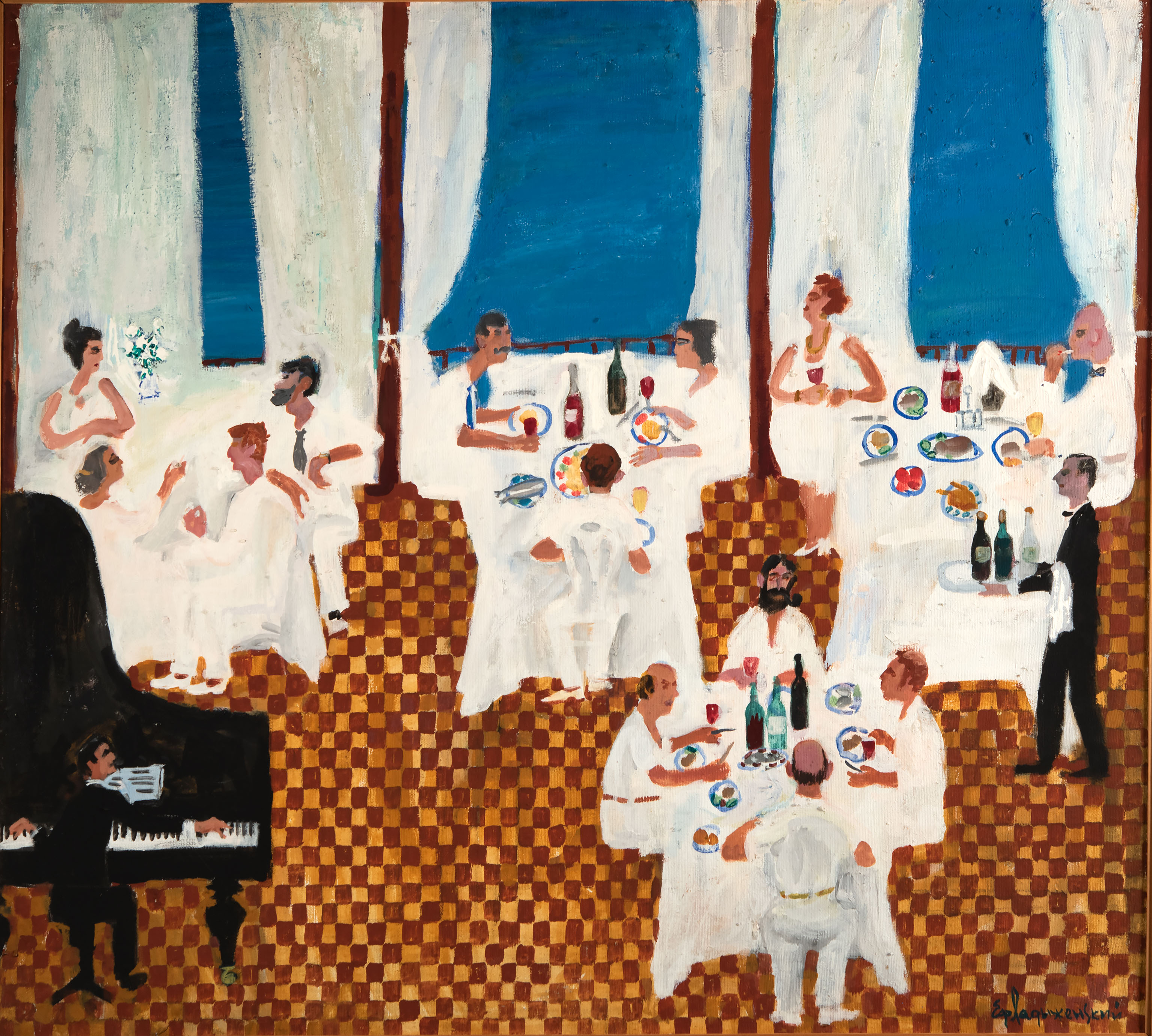
A Restaurant on Feldman Boulevard from the series Odesa—The Town of My Childhood, 1979. Tempera on canvas, 80 × 99.5 cm (31 1/2 × 39 3/16 in.). Norton and Nancy Dodge Collection of Nonconformist Art from the Soviet Union. 1993.0204
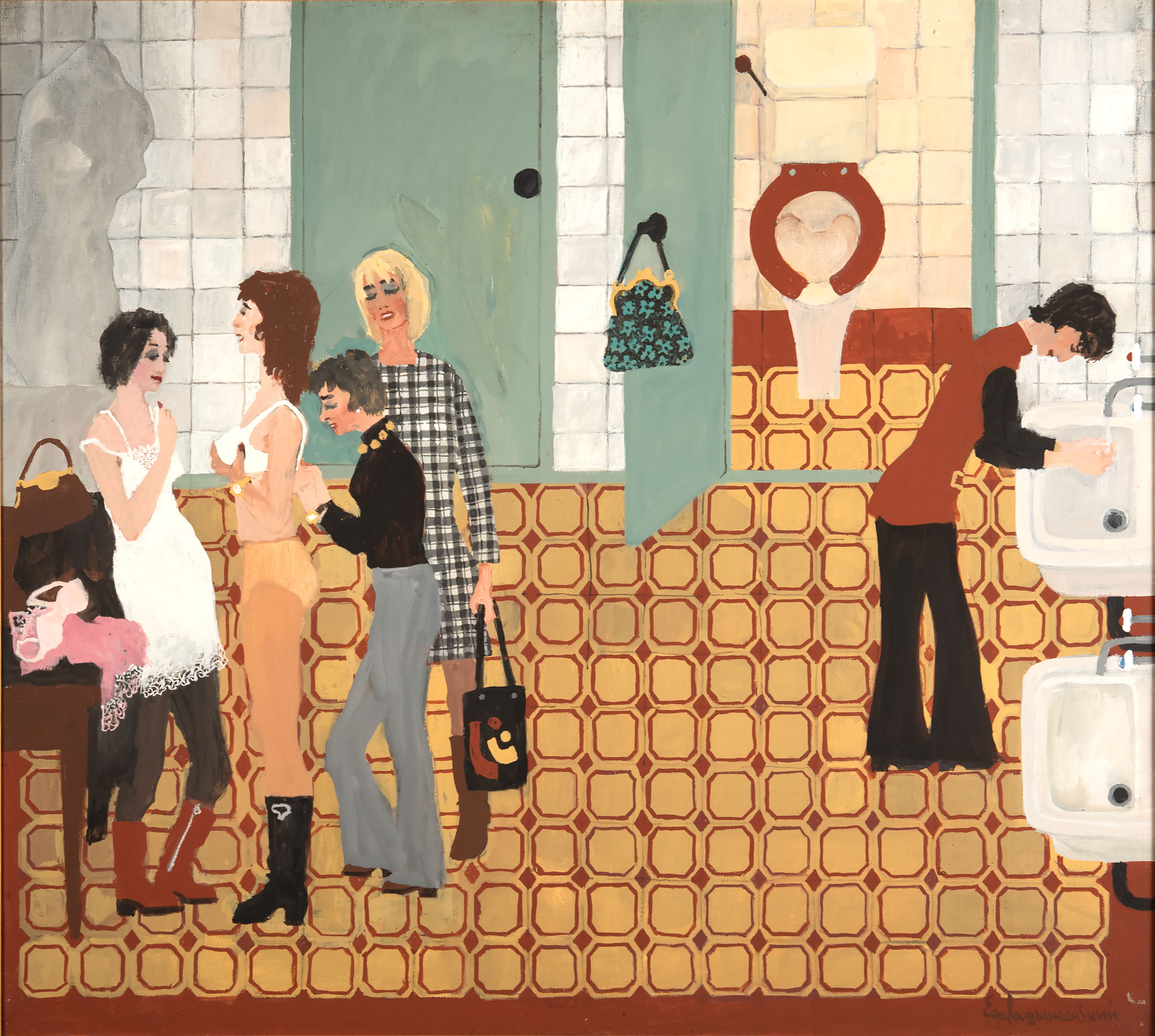
A Good Bra, 1967. Tempera on canvas, 89 × 99.5 cm (35 1/16 × 39 3/16 in.). Norton and Nancy Dodge Collection of Nonconformist Art from the Soviet Union. 1993.0208

Scarce Goods Appear in the Shop from the series Odesa—The Town of My Childhood, 1974. Tempera on canvas, 80 × 100.3 cm (31 1/2 × 39 1/2 in.). Norton and Nancy Dodge Collection of Nonconformist Art from the Soviet Union. 1993.0209

Market, Chicken Row from the series Growing Up in Odesa, 1974. Tempera on panel, 92.5 × 71 cm (36 7/16 × 27 15/16 in.). Norton and Nancy Dodge Collection of Nonconformist Art from the Soviet Union. 1999.0738
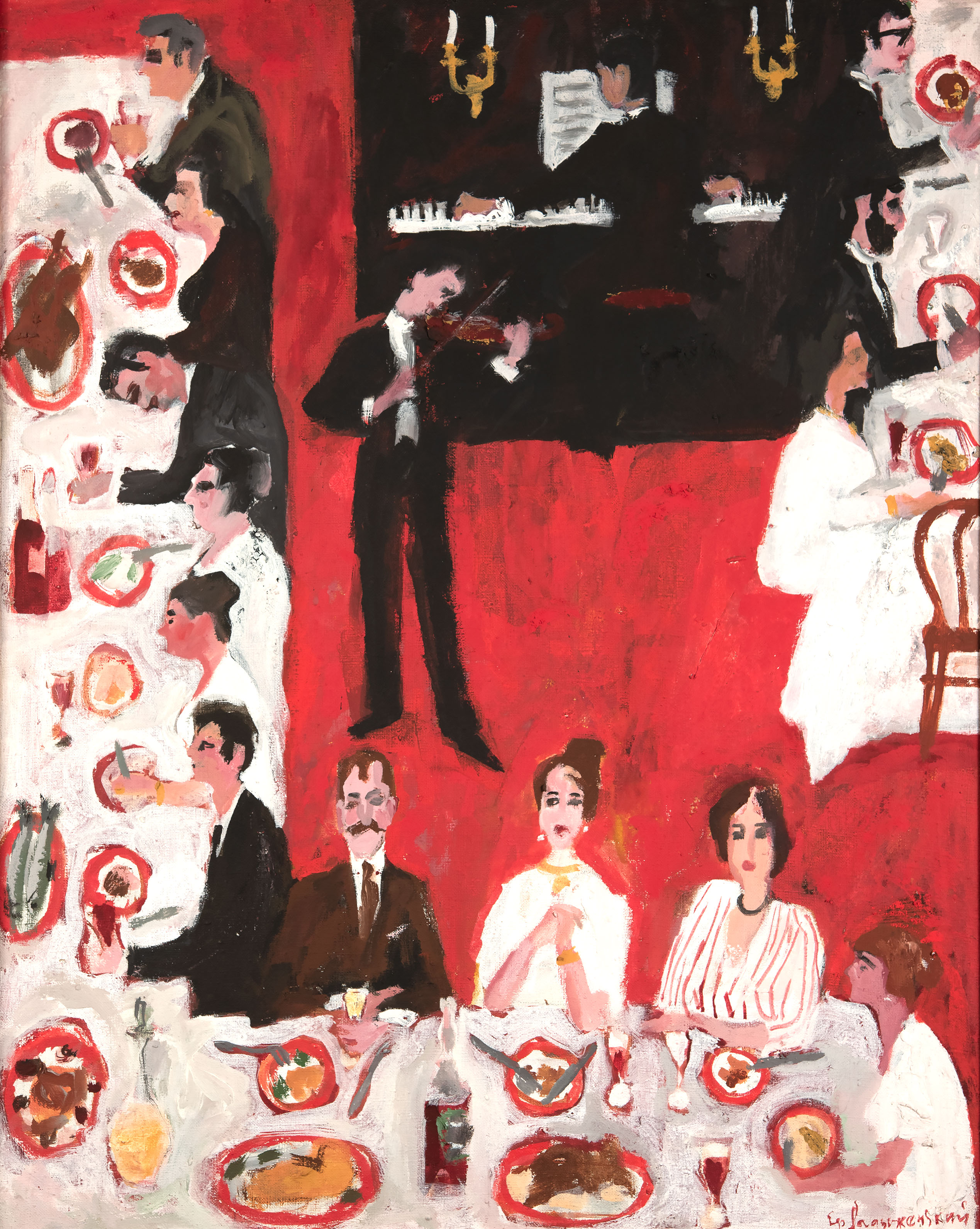
Boria—Child Prodigy from the series Odesa—The Town of My Childhood, 1974. Tempera on canvas, 79 × 64 cm (31 1/8 × 25 3/16 in.). Norton and Nancy Dodge Collection of Nonconformist Art from the Soviet Union. 1996.0688
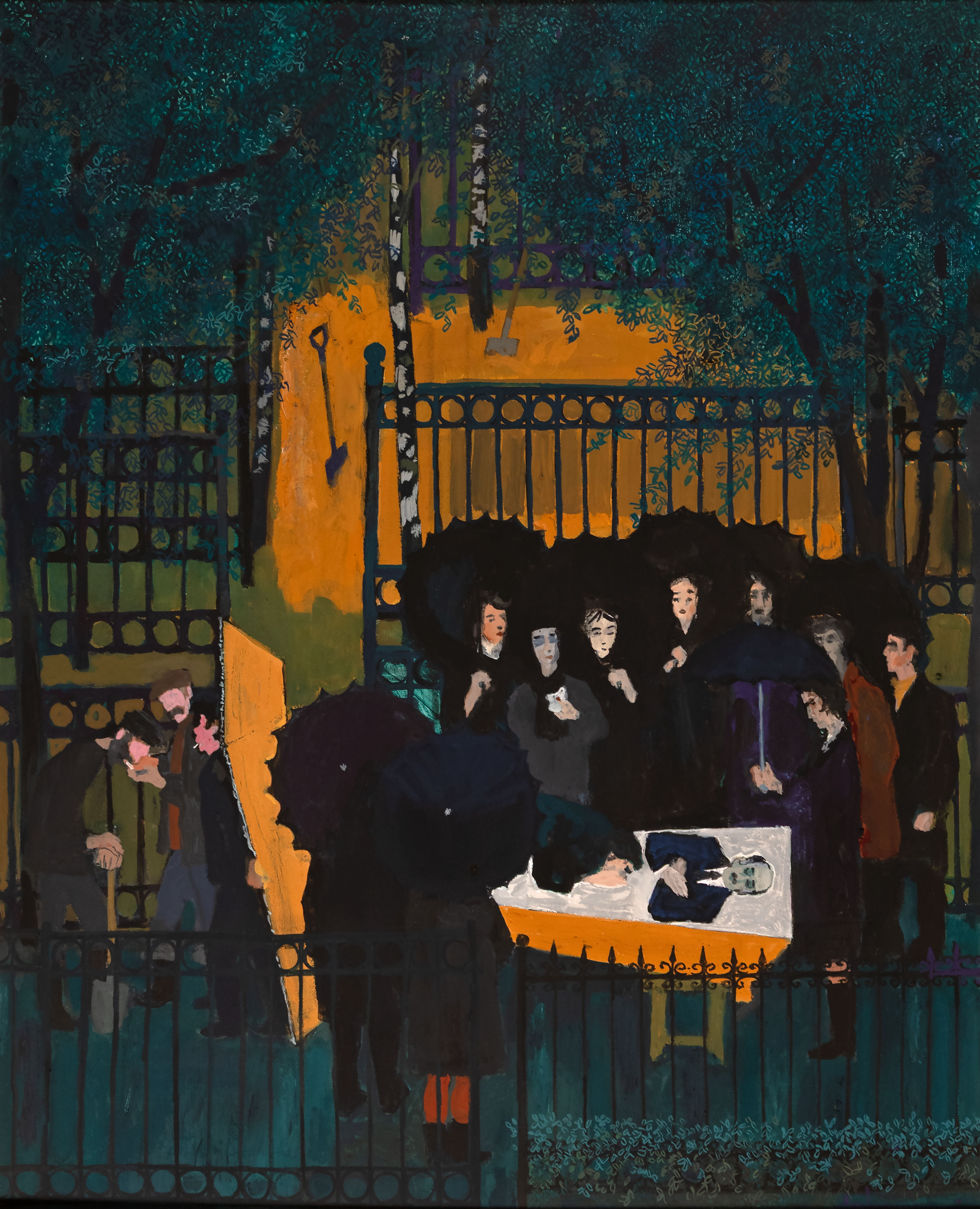
Death of an Intellectual from the series Lyublin Cemetery in Moscow, 1978–79. Tempera on canvas, 100 × 80 cm (39 3/8 × 31 1/2 in.). Norton and Nancy Dodge Collection of Nonconformist Art from the Soviet Union. 1993.0206

The Lenin Guard from the series Lyublin Cemetery, 1978–80. Tempera on canvas, 99.4 × 90.1 cm (39 1/8 × 35 1/2 in.). Norton and Nancy Dodge Collection of Nonconformist Art from the Soviet Union. 2001.0508
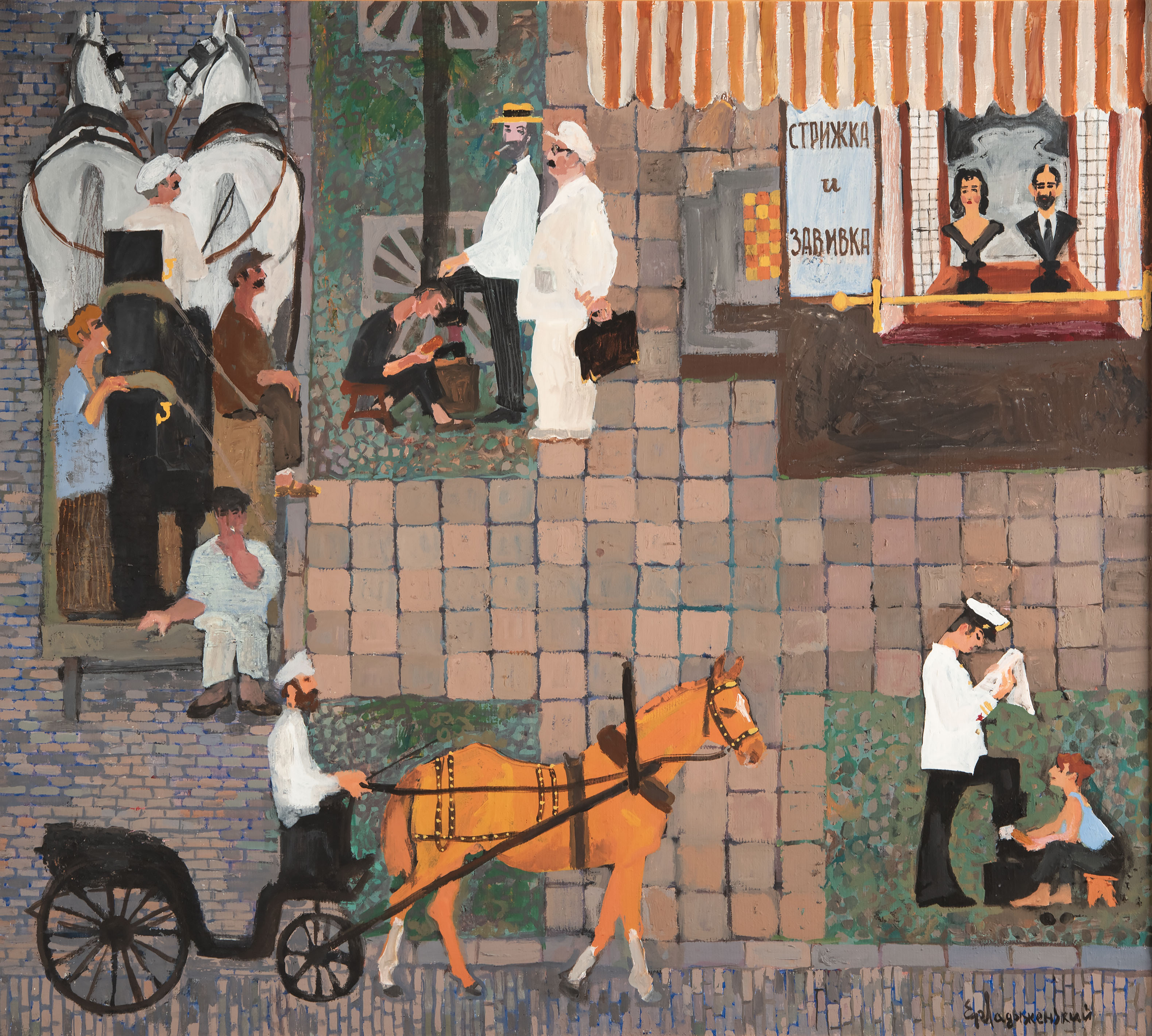
Bootblack from the series Odesa—The Town of My Childhood, 1974. Tempera on canvas, 90 × 98.5 cm (35 7/16 × 38 3/4 in.). Norton and Nancy Dodge Collection of Nonconformist Art from the Soviet Union. 1993.0207
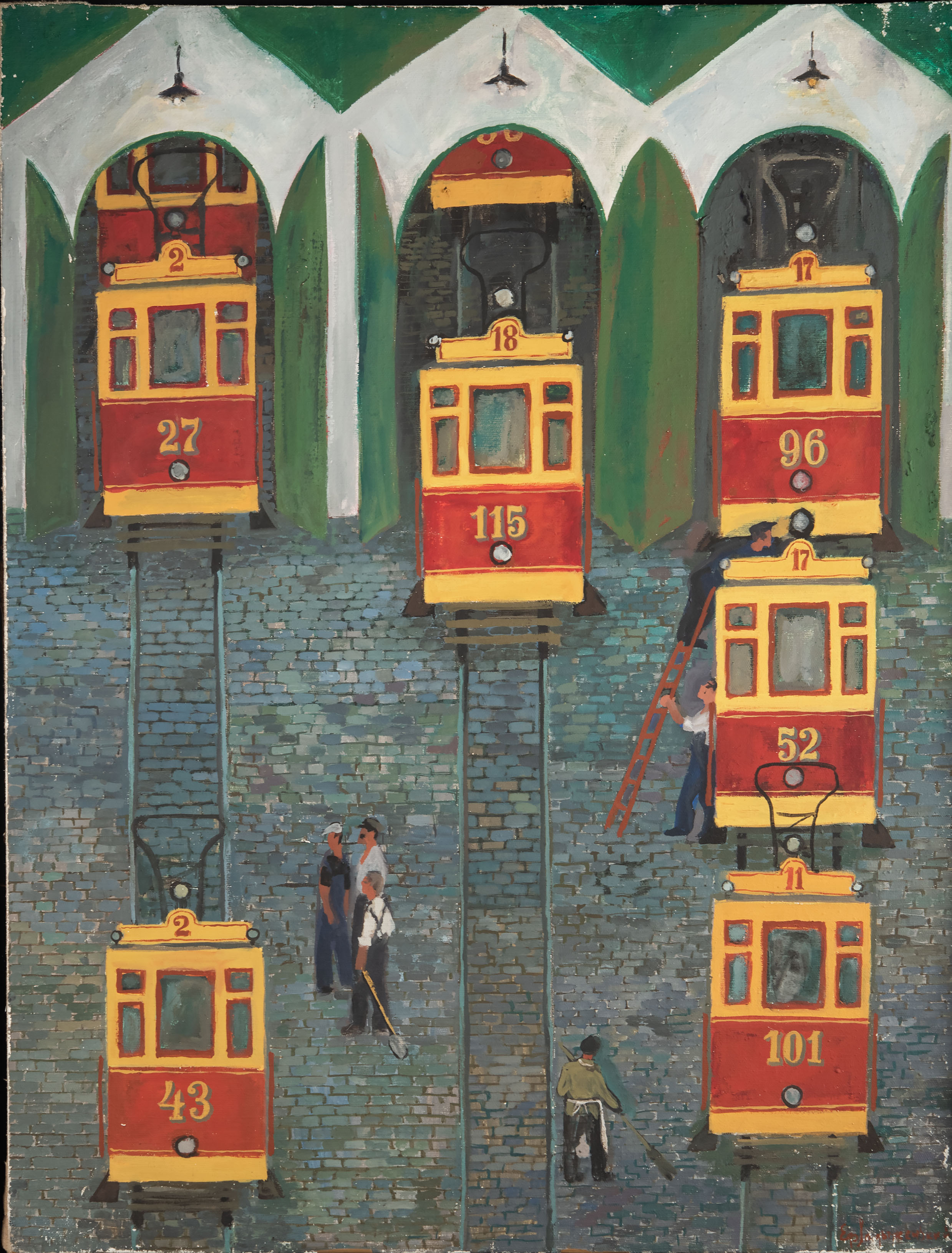
Street Car Depot from the series Odesa—The Town of My Childhood, 1974. Tempera on canvas, 90.3 × 70 cm (35 9/16 × 27 9/16 in.). Norton and Nancy Dodge Collection of Nonconformist Art from the Soviet Union. D04779
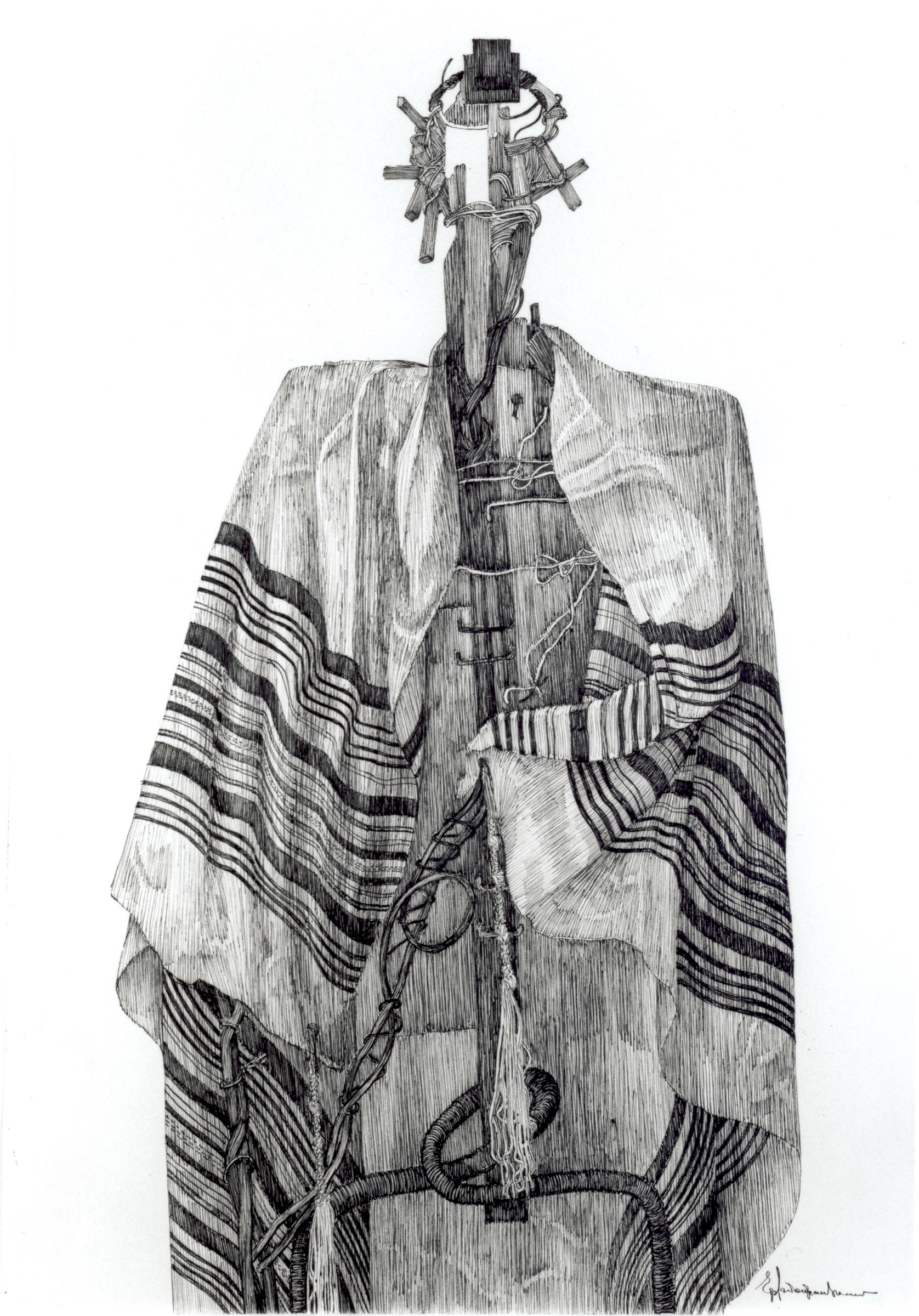
Untitled from the series Carcasses, 1971. Ink on paper, 90.4 x 62.2 cm (35 9/16 x 24 1/2 in.). Norton and Nancy Dodge Collection of Nonconformist Art from the Soviet Union. D10962