
Yakov Riumkin
1913 — Kharkiv (formerly Russian Empire, now Ukraine) | 1986 — Moscow (Russia)
Yakov Riumkin was widely recognized as a photojournalist, especially for his frontline photographs from World War II, including the Battle of Stalingrad, the Battle of Kursk, and the Soviet capture of Berlin. Throughout his long career, he worked for leading Soviet newspapers, first for the republican newspaper Kommunist in Ukraine and later for the ubiquitous publications Ogoniok and Pravda (Truth). A versatile photojournalist, Riumkin covered all topics typical of Soviet propaganda, and some of his images, such as Reichstag (1945) and Triplets (1950s, ZAM, 2004.0710) are considered iconic examples of Soviet journalistic photography.
After graduating from the Workers’ Faculty at Kharkiv University in the early 1930s, Riumkin began his career in photography as a courier for the local newspaper Vechernee Radio (Evening radio), where he later became an assistant photographer. In the second half of the 1930s, he worked for the daily newspaper Kommunist, a key print publication of the Communist Party of Ukraine that was published in Kyiv, the new capital of Bolshevik-occupied Ukraine. Starting in 1936, Riumkin's photographs appeared increasingly often on the pages of this publication, indicating his growing professional reputation.
The photographs published in Kommunist demonstrate the radical changes that the aesthetics of Soviet photography underwent during this period. In the newspaper’s static scene shots and portraits of smiling workers from the late 1930s (a style copied from genre painting), it is difficult to see any continuity with the photographic avant-garde that flourished from the 1920s to the early 1930s in Riumkin's native Kharkiv. The dramatic diagonals, dynamic perspectives and unusual shooting angles, fragmentation, and technical experiments (such as photograms and photo caricatures) seen earlier in the work of Dan Sotnyk, Lazar Frenkel, Leonid Skrypnyk, and Lev Kovaliv are replaced by wide shots, eye-level perspectives, and a clear narrative. Riumkin's photographs in Kommunist demonstrate the attempt to introduce socialist realism (proclaimed the approved method of Soviet art in 1934) into photography, as well as the Stalinist lack of trust in the medium to document empirical reality.
If, in the previous decade, a number of Soviet artists and theorists had advocated for photography as the main tool of new revolutionary art, in the Stalinist era its status plummeted. While painting began to dominate art again, the role of photography was reduced to the unambiguous illustration of a text message. The images published in the printed press frequently bear signs of rough retouching and editing, resembling early examples of AI imagery. In this period, Riumkin's photographs fall into a limited set of photographic types that are often repeated: portraits of new heroes such as soldiers, athletes, peasants and workers, posed either gazing “into the future” with forward-looking optimism or facing the camera; depictions of work and production; snowy ski scenes and other recreational landscapes in which nature is presented as orderly, accessible, and compatible with the socialist modernization project; sporting and military exercises, genre scenes (such as students in reading rooms or laughing children), construction sites and industrialization projects; and the spectacle of an anonymous, faceless mass during important celebrations of the Soviet calendar.
However, some photographs show traces of a connection with the repressed avant-garde of the previous decade. An overhead view of Kharkiv's Tevelev Square (now Constitution Square) published on June 18, 1941, depicts traffic and a tram, a symbol of urban modernization that is reminiscent of the avant-garde's fascination with mechanization and acceleration. Some portraits borrow the method of shooting from below to heroize the central figure, as well as a close-up focus on the face. These techniques would remain in Riumkin's arsenal of tools in the postwar period. Eventually, in categories such as sporting events or military exercises, photographs did become less static, resembling photojournalism done in the field, which increasingly became the professional standard outside the Soviet Union. With Nazi Germany’s attack on the USSR on June 22, 1941, the resulting sense of urgency loosened censorship and control over published images, and live reportage became a reality in the photographic practice of Riumkin and his colleagues.
During World War II Riumkin fought, was wounded, and suffered a concussion, and then served as a correspondent for Pravda, for which he was eventually awarded the Order of the Red Star. A select number of the thousands of photographs he took at the front between 1942 and 1945 were published in the album From Stalingrad to Berlin in 1960. This publication documented the key stages of countering the Axis offensive, and then the Soviet army’s victorious march to Berlin. The photos included street battles in the ruins of houses and factories during the defense of Stalingrad (now Volgograd); the defense and subsequent offensive at the Kursk Bulge; the partisan movement; the battle of Korsun-Cherkassy; the liberation of Poltava, Kharkiv, Kyiv, Zhytomyr, Vilnius, Warsaw, and concentration camps; the crossing of the Dnipro, Prut, and Oder Rivers; the capture of Gdynia, Danzig (now Gdańsk, Poland), Budapest (Hungary), Poznán (Poland), and Berlin; and finally, the signing of the German surrender.
These wartime photographs reveal Riumkin's continued use of stereotypical photographic composition and narrative in their obviously staged “lively conversations” and heroic portraits. However, a number of them demonstrate a certain weakening of these staged and dogmatic conventions. In some, the viewer sees blurred figures of soldiers in motion; full of vibrating movement and smoke, the pictures were probably taken while Riumkin was on the move with the infantrymen. Other photographs show the reality of war: vehicles stuck in the mud, destruction, bloody injuries, and death.
The most famous of all of Riumkin's frontline photographs are those documenting the Battle of Stalingrad and the capture of Berlin, including the battle for the Reichstag, the raising of the victory banner over it, and Soviet soldiers painting its walls and columns. At the same time, Riumkin made a portrait of Lidia Ovcharenko, a traffic controller from Ukraine, posted at the intersection of the Brandenburg Gate and the Reichstag who instantly became world famous as the “Lady of the Brandenburg Gate” after the photograph was published.
In the postwar period, Riumkin worked for the country's main print media outlets: the magazine Ogoniok and the newspaper Pravda. During this period and until the end of the 1950s, prewar conventions of photojournalism returned and photographs depicted one-dimensional characters such as the mother, the worker, the peasant woman, and the teacher in staged, roughly retouched images that imitated painting. Most of Riumkin's photographs from this time were portraits of famous politicians, writers, scientists, and doctors, as well as standard illustrations of elections, holiday demonstrations, scientific achievements, and trade union congresses. Printed in official publications, these photographs reinforced the main text while providing visual evidence of the event.
For example, in Ogoniok (no. 13, 1956), a photo was published announcing the birth of triplets. This scene was typical for the period and often seen in the work of various photographers, in images of a happy mother postlabor, surrounded by tightly swaddled babies, satisfied nurses and doctors, and sometimes a joyful father (e.g., ZAM, 2004.0710). The message was clear: The state and society support large families, providing them with privileges, care, equipment, and a new apartment. Celebrating multiple births, such photographs were part of a broader strategy to increase the birth rate to restore the population after the heavy losses of World War II.
Immediately after the USSR’s military victory, Riumkin traveled around the Soviet Union. His photographs of the city of Dalnii (now Dalian, China), which passed to Sino-Soviet rule after Japan's surrender, were published in Ogoniok (no. 39, 1945), followed by his photographs of Georgia, Kazakhstan, Moldova, Yugoslavia, Yakutia, Magadan, Chukotka, Azerbaijan, Bashkiria, and other countries and regions of the USSR. Riumkin photographed many sites in Ukraine, including the cities Stalino (now Donetsk; no. 37, 1959) and Kyiv (no. 44, 1963), as well as industrial and agricultural facilities such as the metallurgical plant in Makiivka (no. 5, 1947), the Azovstal plant in Mariupol (no. 17, 1948), Zaporizhstal (no. 28, 1948), the mines in Donbas, and collective farms in Pereiaslav-Khmelnytskyi (now Pereiaslav), Poltava, Cherkasy, and Kyiv regions.
Riumkin often brought back photographic portraits of local residents from his various travels. In accordance with the canons of socialist realism, they are always represented according to ethnic stereotypes: in traditional clothes, engaged in folk crafts or activities (e.g., Yakut Hunter, no. 1, 1953, and Hutsul Peasant, no. 12, 1946). Some representatives of ethnicities other than the Russians (the titular ethnic group of the Soviet Union) wear common Soviet signifiers such as typical work clothes or medals (e.g., In the Talass Valley, no. 46, 1948) to demonstrate the integration of minorities within a single national ideology.
Immediately after the war, Riumkin's photographs were mostly published as individual images, but from the second half of the 1940s, reports, also called photo essays, appeared regularly in Ogoniok (e.g., 24 Pravda Street, no. 17, 1947). As a staff correspondent for a widely circulated illustrated magazine, Riumkin had the rare privilege of seeing his photographs occasionally printed in color. While the magazine itself remained almost exclusively black-and-white, except for the cover, color inserts started to appear in the 1940s, first as reproductions of paintings and then as photographs. Compositionally, stylistically, and thematically, these images were no different from monochromatic photographs. In his practice, Riumkin often used a panoramic camera, creating images that can be considered classic examples of this photographic technique. He used panoramic photographs, which added a dynamic energy to his photo reports, to create the metaphorical images demanded of the time: representations of organized masses, endless latitudes, and abundance.
In 1955 Riumkin received the Ogoniok award for a 1954 photo report from the drifting North Pole research station in the Arctic. Along with standard subjects and compositions, the images included more dynamic and relaxed poses that appear candid, capturing intimate moments from the polar explorers' everyday lives in the Arctic night. This essay differs from most of Riumkin’s photographs at this time, anticipating the more spontaneous photography of the Thaw period, and was published in a separate album the same year. After 1954, Riumkin continued as a staff correspondent for Ogoniok and Pravda, publishing numerous photo essays and travel reports from across the USSR; selections of his work were later issued in photo albums such as From Stalingrad to Berlin (1960) and Seconds of the Century (1968).
In contemporary literature and exhibition projects, Riumkin appears mainly as a military photojournalist. However, since the 2010s, a number of Russian curators, galleries, and institutions have been actively promoting the wider legacy of this Soviet photojournalist. In 2013, the Lumiere Brothers Center for Photography in Moscow organized his posthumous solo exhibition Live, Please!, presenting selected photographs from the wartime and postwar period printed from negatives. Exhibited individually, removed from the propaganda narratives that originally accompanied them, these photographs can elicit, somewhat deceptively, new lyrical, emotional, and nostalgic readings today.
Nadiia Bernard-Kovalchuk
Translated from Ukrainian by Nathan Jeffers
Photo portrait: Ogoniok magazine, #41, 1963, p. 32.
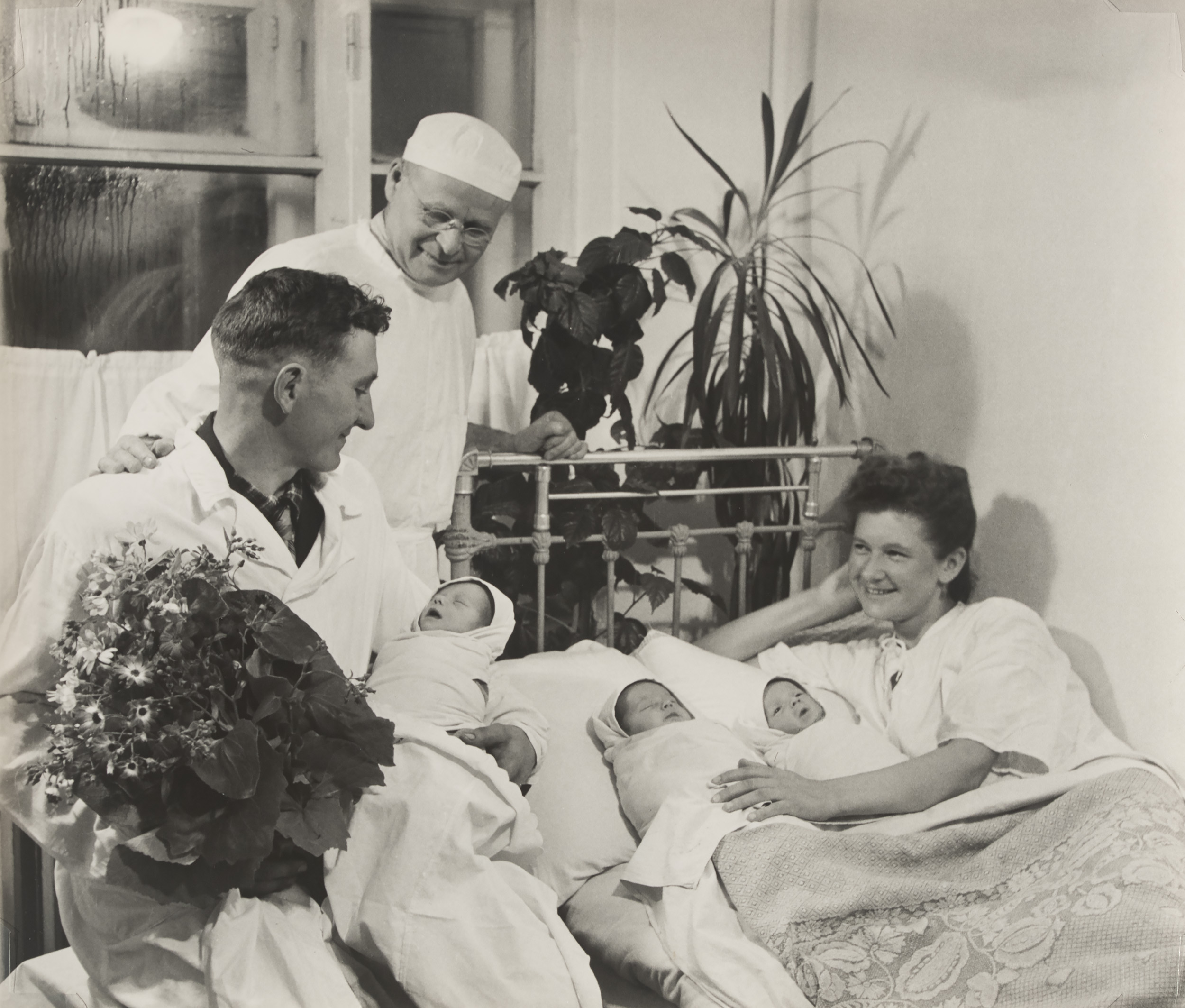
Triplets, 1950s. Gelatin silver print on paper, 30.4 × 35.7 cm (11 15/16 × 14 1/16 in.). Purchased with funds donated by Norton Dodge and Nancy Dodge. 2004.0710