
Yakiv (Yakov) Olshanetsky
1898 — Nemyriv, Vinnytsia region (Ukraine) | 1982 — Odesa (Ukraine). Worked in Odesa, Nemyriv (Ukraine) and Stalingrad (now Volgograd, Russia)
Yakiv Iosypovych Olshanetsky was a Ukrainian artist and educator. Specializing in realism, his body of work is composed of genre and urban figure scenes, portraiture, and a prolific number of landscape works. In 1936, Olshanetsky joined the Union of Artists of the Ukrainian SSR.
Olshanetsky was born on April 29, 1898, in Nemyriv, Vinnytsia region, into the family of a civil servant. He began formal art education at sixteen years old upon his move to Odesa in 1914 to study painting at the school of Yulii Bershadskiy (1869–1956). In 1917, he enrolled at the Odesa Art School. From 1921 to 1924, he studied at the Kyiv Art Institute (now the National Academy of Fine Arts and Architecture) under Lev Kramarenko (1888–1942), who also worked with the avant-garde artists Oleksandr Bohomazov, Kazimir Malevich, and Viktor Palmov.
Olshanetsky's first group exhibition took place in his native Nemyriv in 1923, while he was still enrolled at the Kyiv Art Institute.
Following his graduation in 1924, Olshanetsky returned to Odesa and became a member of the Kyriak Kostandi Society of Artists. [1] He participated in the society's annual exhibitions, including the First Autumn Exhibition of Paintings in 1926, which featured 450 works by seventy artists. The artists strove to expand creative communication among artists and further public engagement. Throughout the course of its existence, the society held ninety public reports and lectures on the visual arts and organized traveling exhibitions throughout villages in the Odesa region. These exhibitions included paintings by the young Olshanetsky: Скрипка [The Violin], Self-Portrait, and В’язні [Prisoners] (all 1925), Портрет дружини [Portrait of a Wife], Натюрморт [Still Life], Self-Portrait, and В кайданах [In Chains] (all 1927), Портрет А. Сігал [Portrait of A. Sihal] (1929, ZAM, D01405), and Working Woman (1928, ZAM, D01405). In 1929, the Kyriak Kostandi Society of Artists disbanded. At an exhibition in Kyiv in 1936, Olshanetsky received the People's Commissariat of Enlightenment (Narkompros) prize for his painting Заводська редколегія [The Factory Editorial Board] (1935).
The first of Olshanetsky's paintings to be reproduced in the press was Дівчина за піаніно [Girl at the Piano] in a 1937 edition of the journal Maliarstvo i skulptura [Painting and Sculpture]. His piece sat alongside reproductions of works by well-established artists of the period, such as Ilarion Pleszczynskyi, Dmytro Shavykin, and Serhii Hryhoriev. This publication indicates a maturation of Olshanetsky’s style and, moreover, the level of success he had already achieved by the 1930s.
In 1941, Olshanetsky had a solo exhibition in Odesa. That same year, the third year of the Second World War, he was mobilized into the Red Army and would fight in the battles at Stalingrad. Despite the war, Olshanetsky participated in a 1941 painting exhibition held in Stalingrad. In 1942, near Rostov, he found himself surrounded by enemy troops. For three years, he was in concentration camps: in Slavuta in Khmelnytskyi region of Ukraine and in Germany. "But in these difficult years, I cherished the hope of a quick return home, and to my creative work," wrote Olshanetsky in his autobiography. [2]
In November 1945, Olshanetsky returned to Odesa. Nearly all of the artist's early works were lost during the war. His first postwar artwork was Відкриття музея у звільненому місті [Opening of a Museum in the Liberated City] (1947). This was the first in a series of sketches that would capture scenes in the halls of Odesa museums in the ensuing decades.
There is a great deal of attention paid to the theme of museums in Olshanetsky’s paintings: see В музеї [In the Museum] (1936), Інтер’єр музею [Museum Interior] (1939), В музеї [In the Museum] (1963, ZAM, D08918), and Кімната колекціонера [The Collector’s Room] (1972). His still lifes are full of details; for instance, he meticulously depicts ceramic works of that time. In Натюрморт з кавуном [Still Life with a Watermelon] (1954), we see a saucer from the period and an uncorked bottle of Soviet champagne. Watermelon was a popular motif in southern Ukrainian folk art at this time, commonly depicted in still lifes with broken proportions. Olshanetsky subverts this with his realism and professional techniques, placing the celebratory Soviet champagne alongside the folk fruit ceramic, thereby deploying this motif for conversation in the context of postwar USSR.
Two of Olshanetsky's self-portraits kept in the collection of the Zimmerli Art Museum depict the artist against the background of artworks, though it is unclear whether these are in his workshop or a gallery. In one of these self-portraits (1972, ZAM, D08926), he is wearing glasses and holding brushes in his hand, with an extravagant, wide-brimmed hat that displays the artist’s playful humor.
In addition to these self-portraits, the Zimmerli Art Museum holds three of Olshanetsky’s figure portraits. In the latter half of the 1920s, he painted a series of portraits featuring women and children. For almost twenty years, from 1947 to 1965, he regularly painted Odesans in genre and urban figure scenes and classic portraiture. The museum collection possesses one portrait from the former period—Жіночий портрет (Жінка в світлому) [Portrait of a Woman (Dressed in Light Colors)] (1928, ZAM, D01406)—and two from the latter: Woman’s Portrait (1961, ZAM, D01407) and Жіночий портрет (С.М. Каушанської) [Woman’s Portrait (of S.M. Kaushanska)] (1964, ZAM, D01382).
Describing Olshanetsky’s portraiture, a journalist from the newspaper Znamia Kommunizma [Flag of Communism] wrote: "In each portrait, one can feel a loving attitude towards a person, a desire to penetrate into their inner world and simply convey, in an unfeigned way, the best that is in a person." [3]
Those portrayed included women and children, passers-by, workers (Бригадир Т. Кушко [Brigadier T. Kushko]), war heroes (Полковник С. Воронов [Colonel S. Voronov]), and fellow artists. Olshanetsky also painted portraits of the artists Mykola Sheliuto, Vsеvolod Tsumpakov, and Lavrentiy Zbarenko. The latter, in 1962, himself painted a portrait of Olshanetsky.
In 1946–58, Olshanetsky worked at the Odesa Artistic-Industrial Combine (kombinat). At the 1968 jubilee exhibition in the halls of the Odesa branch of the Union of Artists of the Ukrainian SSR in honor of the artist's seventieth birthday, more than a hundred works were exhibited. “Olshanetsky has an extraordinary sense of the sun, air, and all the colors of the day,” the artist Lev Mezhberh reportedly said after attending the show of his senior colleague. “His amazingly touching, tender attitude towards nature is striking.”
Olshanetsky knew how to depict Odesa better than anyone else. The artist constantly discovered something new in seemingly familiar streets and views. From his paintings, one can learn in detail what Odesa looked like in the mid-twentieth century. Three paintings from the Zimmerli collection are Odesa cityscapes (1960–70, ZAM, D01383, D01404, undated, ZAM, D08917). Another, Дачний двір [Dacha Yard] (1976, ZAM, D08922), depicts a quintessentially Soviet phenomenon: a plot of land in nature where city dwellers vacation in the summer. By depicting the characteristic car and soviet folding bed (raskladushka) in a backyard instead of the building of the dacha itself, he invites the viewer to engage with the scene as a paused moment of Soviet life: the family relaxes in the summer shade and the folding bed offers an afternoon nap. It is a banal scene, yet Olshanetsky masterfully conveys a sense of silence and freshness, to make this work captivating. To convey the softness of this atmosphere, the artist uses an impressionist style with gestural brushstrokes and subtle nuances in color. The forest’s cool earth tones juxtaposed against the sun-draped floral and white sheets of the lounge area only emphasize the leisurely summer dynamics of Soviet families in nature. His works are simultaneously original and comforting.
Yakiv Olshanetsky did not believe in artistic retirement and would rise at dawn to sit by the sea for hours at a time. Olshanetsky painted daily until his death on September 13, 1982.
Kateryna Lebedeva
Translated from Ukrainian by Ada Wordsworth
Portrait of the artist: Self-Portrait, 1972. Oil on canvas, 68.4 × 66 cm (26 15/16 × 26 in.). Norton and Nancy Dodge Collection of Nonconformist Art from the Soviet Union. D08926
Notes:
1. Founded in 1922, the Kyriak Kostandi Society of Artists was one of the first of its kind in the Ukrainian SSR, but it was composed mainly of former "peredvizhniki" (members of the Society of South Russian Artists). These included Ievhen Bukovetskyi, Pavlo Volokidin, Borys Ehiz, Volodymyr Zauze, Aristarkh Kobtsev, Danylo Krainiev, Havrylo Mashtaler, Ilia Repin, and Oleksii Shovkunenko.
2. Storchai, Oksana “Avtobiohrafii odeskykh khudozhnykiv 1944–1950-kh rokiv yak dzherelo vyvchennia yikhnoho zhyttiepysu: publikatsiia arkhivnoho materialu” [Autobiographies of Odesa artists of the 1944–1950s as a source for studying their biographies: Publication of archival material]. In Odeskyi khudozhnii visnyk [Odesa Art Bulletin], no. 1 (2019): 89.
3. “Sluzhieniie iskusstvy” [Service to art]. In Znamia kommunizma, August 28, 1968.

Self-Portrait, 1948. Oil on canvas, 35.4 × 48.5 cm (13 15/16 × 19 1/8 in.). Norton and Nancy Dodge Collection of Nonconformist Art from the Soviet Union. D08921
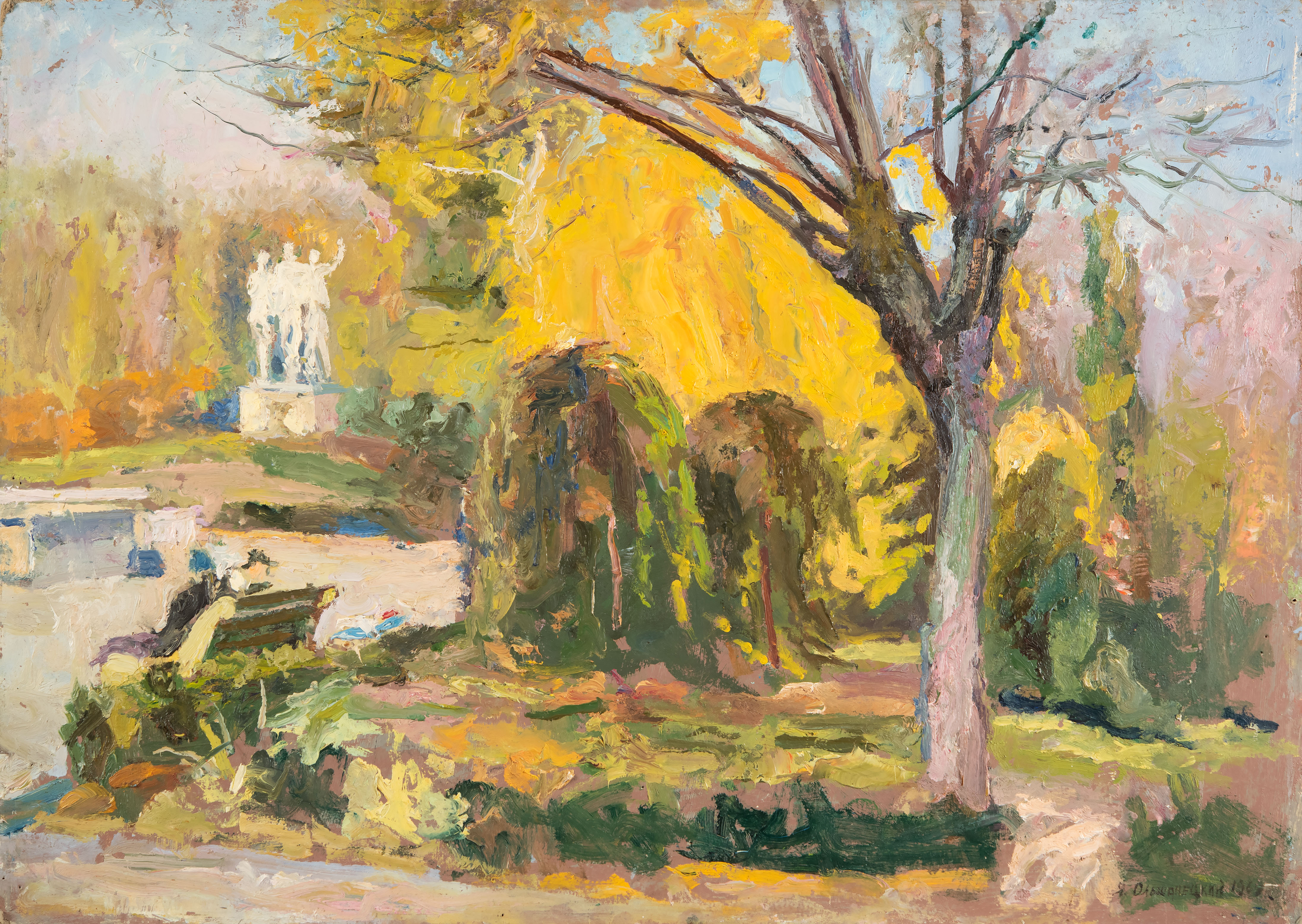
Study "Autumn," 1960s-1970s. Oil on fiberboard, 48.7 × 69.7 cm (19 3/16 × 27 7/16 in.). Norton and Nancy Dodge Collection of Nonconformist Art from the Soviet Union. D01383
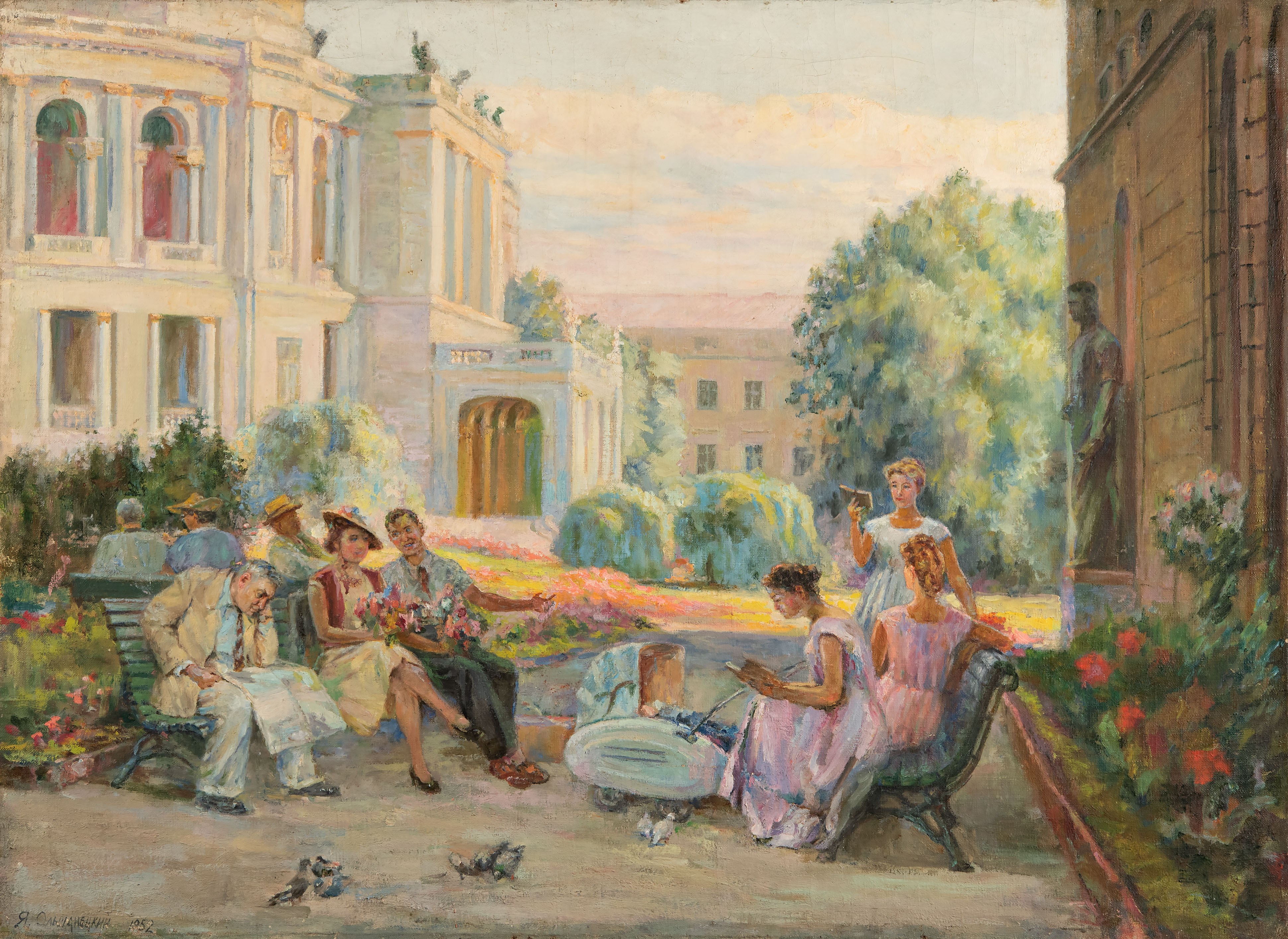
Untitled, 1952. Oil on canvas, 73.7 × 96.5 cm (29 × 38 in.). Norton and Nancy Dodge Collection of Nonconformist Art from the Soviet Union. D04747
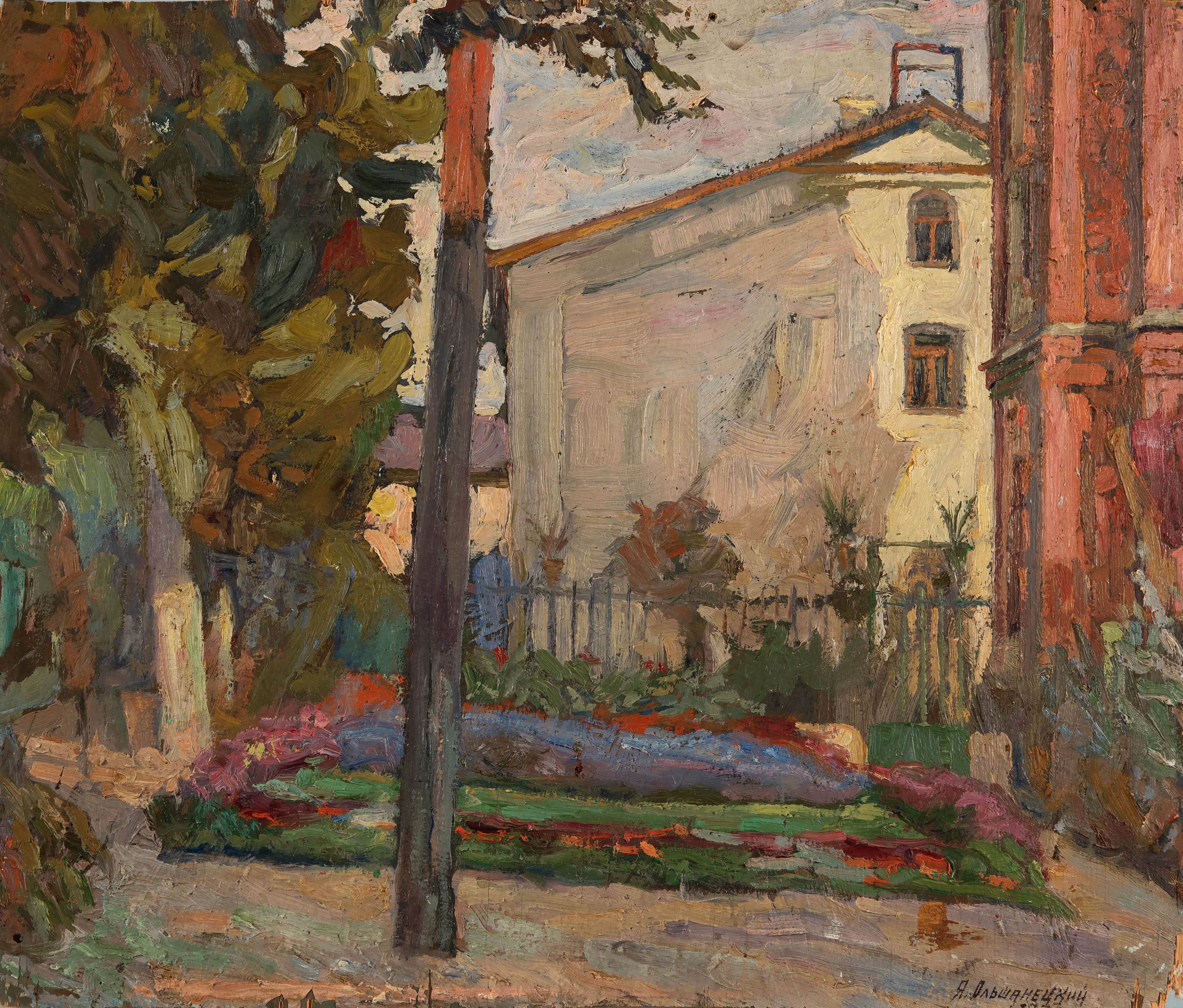
Untitled, 1977. Norton and Nancy Dodge Collection of Nonconformist Art from the Soviet Union. D08917
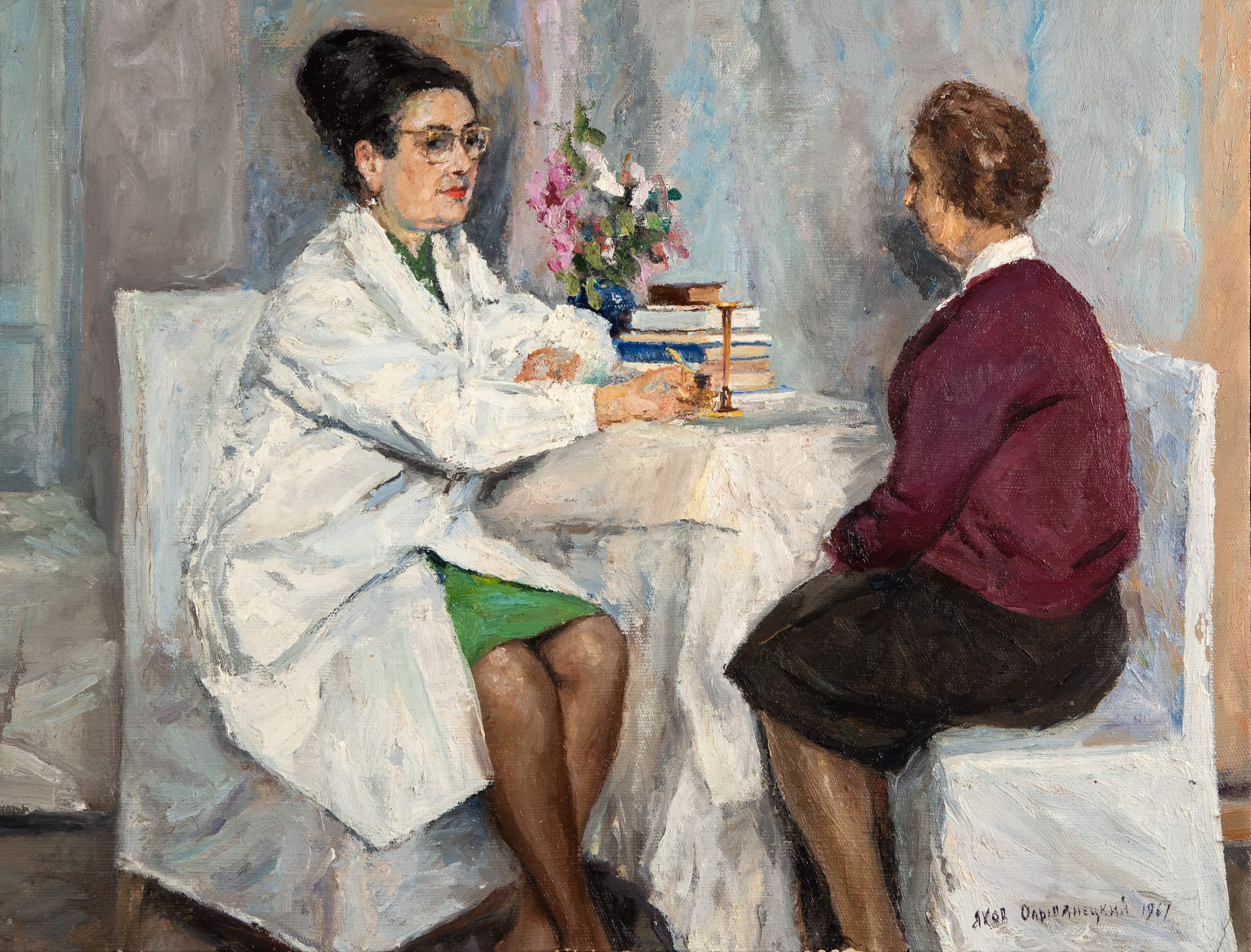
Doctor's Advice, 1967. Oil on canvas, 40.6 × 53.3 cm (16 × 21 in.). Norton and Nancy Dodge Collection of Nonconformist Art from the Soviet Union. D08919

Dacha Yard, 1976. Oil on canvas, 50.8 × 53.4 cm (20 × 21 in.). Norton and Nancy Dodge Collection of Nonconformist Art from the Soviet Union. D08922