
Vytautas Balčytis
1955 — Vorkuta, Komi Republic (USSR). Lives and works in Vilnius (Lithuania)
Born in exile in 1955 in Vorkuta, USSR (now Russia), Vytautas Balčytis returned to Lithuania with his family in 1958. After studying engineering at the Vilnius Civil Engineering Institute (now Vilnius Gediminas Technical University) from 1973 to 1979, he has worked as a photographer since the early 1980s. Art critics have associated Balčytis with the trend of the so-called banal object in Lithuanian photography. With his peers Algirdas Šeškus (b. 1945), Remigijus Pačėsa (1955–2015), Alfonsas Budvytis (1949–2003), Violeta Bubelytė (b. 1956), and others, he made his debut in 1980 at the Third Young Photographers Exhibition held at the Vilnius Photography Gallery. Together, they began to develop a distinctive direction, which accorded Lithuanian camera work a strong impetus toward conceptual manifestations. The works of these photographers in this exhibition sparked many discussions for their strong contrast to the long-dominant Lithuanian school, and they broke from the Soviet strictures on the medium. Instead of photography as a means of documenting reality, these young artists developed a passive, nonconformist, consciously boring observational eye. They began to capture the trite objects that had previously slipped past photographers’ lenses, while also seeking innovative ways of expression.
The art critic Alfonsas Andriuškevičius characterized Vytautas Balčytis’s iconography—transformer stations, kiosks, garages, billboards—as “degraded culture.” [1] Similar objects were being explored by other Lithuanian artists of that time, such as Algimantas Jonas Kuras (b. 1940), Kostas Dereškevičius (1937–2023), Arvydas Šaltenis (b. 1944), and Algimantas Švėgžda (1941–1996), who held a joint exhibition of that new aesthetic in 1973. Dominated by banal objects such as plastic buckets, cardboard boxes, sneakers, and other worthless items, their work not only failed to idealize Soviet reality but also contradicted it. Vytautas Balčytis held his first solo exhibition with abstract painter Eugenijus Cukermanas (b. 1935)—such collaboration could also be seen as an indication of photographer’s direction of vision and expression.
The breakthrough that occurred in Lithuanian photography during the 1980s and the emerging tendency to speak about subjective experiences and everyday life was called “the aesthetics of boredom” by art critic and historian Agnė Narušytė. [2] The monotony observed in photography in these years and the strategy of slowing down time to exploit randomness and banality helped to express detachment from an ideologically charged social environment. Photographers Alvydas Lukys (b. 1958), Gintautas Trimakas (b. 1958), Gintaras Zinkevičius (b. 1963), Remigijus Treigys (b. 1961), and others worked in a similar manner. They approached the dilapidated Soviet environment, revealing the unfamiliarity and alienation of everyday life and demonstrating a quiet disregard for the lies of Soviet state propaganda. It was a rebellion against the clichéd representation of idealized society and a criticism of the artistic and cultural norms of that time. The effect of their work was reinforced by small print sizes, sometimes poorly exposed photos, scratches, and similar deliberate features of “non-quality.”
Balčytis’s photographs from different periods are linked by a conceptual and stylistic commonality. His prints are characterized by a small format, the brownish tones of an aged photograph, printed to the edge, and a miniature quality. His view captures a strict geometric composition, a clearly defined main subject, and minimalism of objects, details, textures, tones, and the gentle pulsation of muted light. Light is a defining character of Balčytis’s photographs. He transforms the light that flashes in the city’s corners and around its plain, serviceable structures into an aesthetic experience. With his urban and trivial subjects, Balčytis expands the meaning of the ordinary environment. In Narušytė’s words, Balčytis’s works are like “photographic poetry . . . haiku in a strict form, in which banal everyday life is suddenly illuminated by a sense of touching transcendence, the rhythm of the world, and the harmony of being.” [3]
Although there is a continuity to the types of objects Balčytis chooses, they mark the passages of epochs and social spaces. After initially capturing the oppression of everyday life in the Soviet era and the signs of that era—benches, shop scales, a pay phone, the Russian word счастье (happiness) on a bleak building’s facade—when independence was restored, he went on to explore the scars of the Soviet legacy. In the housing complexes that sprang up during the Soviet era, he photographed crumbling facades, hollowed-out and bricked-up windows, bridges, warehouses, and giant empty billboards. Balčytis is also known as one of the most attentive observers of urban landscapes in Lithuanian art, able to detect and record unchanged, preserved places that have escaped the effects of modernity. The history of the city in Balčytis’s photography begins with the photographs of Vilnius in the 1980s, through the series Lietuvos miesteliai [Lithuanian Towns], and moves on to later photographs of urban remains that are hardly recognizable.
Balčytis has been living in Vilnius since 1973, making the capital a natural model for his photographs, as illustrated in his series Vilniaus vaizdai [Views of Vilnius], begun in 1986, as well as his first books in the 1990s, Vilnius: Vardas ir žodis [Vilnius: Name and Word], and Apie Vilnių [About Vilnius]. However, the city is just a medium in his photographs, a space in which he unfolds an existential state. Like a flaneur, Balčytis walks the city streets in search of fragments that interest him—and he blurs the line between document and symbolic image. According to Andriuškevičius, Balčytis is characterized by “the attitude of a city dweller toward the world: he photographs the city as his own (without romanticizing it, without being surprised, without fear) and he looks at the countryside (nature) without sentiment. . . . The author is offering a viewer not an interesting fragment of visual surroundings, but an interesting photograph.” [4]
The Lietuvos miesteliai series is Balčytis’s best-known work and one of the three for which he was awarded the Lithuanian National Prize for Culture and Arts in 2006. Having started the project in 1988–91 with Alfonsas Budvytis with the aim of capturing the changing imagery of Lithuania’s small towns, he continued on his own, developing the theme patiently and consistently for the next couple of decades, capturing the places that years ago got stuck somewhere between the city and the countryside. The several hundred photographs in the series have documentary, historical, and ethnographic value, in addition to their artistic significance. In these towns, Balčytis photographs only architecture—from afar and while walking through the streets. He never captures people, who are present only through their traces. In this way, the towns become unified, as if in an attempt to distill the typical characteristics of a Lithuanian settlement.
With their evocative brown toning, which in the Lietuvos miesteliai series is reminiscent of prewar photography, Balčytis’s photographs present another significant theme: time. His images capture a unique interplay between the present and the past. As Agnė Narušytė describes it, “Balčytis’s photographs represent a collision of two temporal speeds—the gradual fading of the past and the swift vanishing of the present. This collision results in the past, perhaps the consciousness of it embodied in various objects, gradually displacing the present.” [5]
Vytautas Balčytis has had over twenty individual exhibitions in Lithuania and abroad—in Chicago, Stockholm, Görlitz, Bologna, Bremen, and London. His works are in the collection of the Lithuanian National Museum of Art, the National Museum of Lithuania, and MO Museum, all in Vilnius, as well as museums abroad, including the National Museum in Wrocław, Poland, the National Museum and the Museum of Art in Łódź, Poland, and the Fonds National d’Art Contemporain in Paris, France, along with private collections.
Asta Vaičiulytė
Portrait: self, 2022. Courtesy of the artist
Notes
1. Alfonsas Andriuškevičius, “Vytautas Balčytis ir degradavusi kultūra” [Vytautas Balčytis and degraded culture]. In Lietuvių dailė: 1996–2005 [Lithuanian art: 1996–2005] (Vilnius: Vilniaus dailės akademijos leidykla, 2006).
2. Agnė Narušytė, The Aesthetics of Boredom: Lithuanian Photography 1980–1990 (Vilnius: Vilniaus dailės akademijos leidykla, 2010).
3. “Banaliojo objekto fotografas: pokalbis Nacionalinės premijos proga” [Photographer of the banal object: Conversation on the occasion of the National Prize], interviewed by Eglė Deltuvaitė. 7 meno dienos 736 (December 22, 2006): 9.
4. Alfonsas Andriuškevičius. “Vėl—tapyba ir fotografija” [Again—painting and photography]. In Alfonsas Andriuškevičius and Jolanta Marcišauskytė-Jurašienė, Pro A. A. prizmę [Through A. A.’s lense]. (Vilnius: Modernaus meno centras, 2013), 297.
5. Agnė Narušytė, “Vytauto Balčyčio temos ir potemės: Vytauto Balčyčio fotografijų paroda ‘Lietuvos miestai, miesteliai ir peizažai’ Prospekto galerijoje [Vilniuje]” [Themes and subjects of Vytautas Balčytis: Exhibition of Vytautas Balčytis’s photographs “Lithuanian cities, towns and landscapes” at the Prospekto Gallery (Vilnius)].” 7 meno dienos 583 (October 3, 2003): 9.

Vilnius, 1987. Gelatin silver print on paper, 11.9 × 18.2 cm (4 11/16 × 7 3/16 in.). Norton and Nancy Dodge Collection of Nonconformist Art from the Soviet Union. D15077
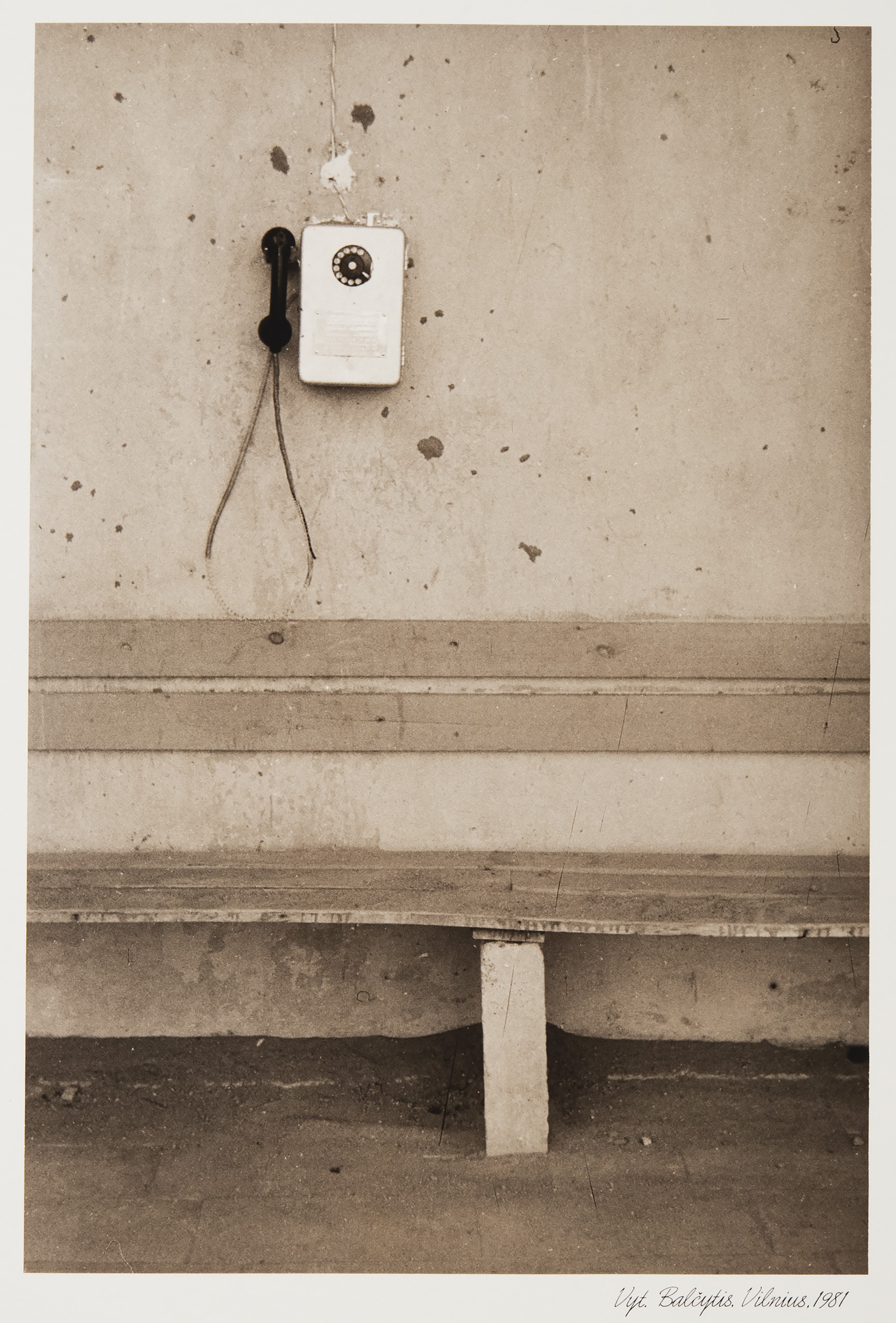
Vilnius, 1981. Gelatin silver print on paper, 18 × 12.4 cm (7 1/16 × 4 7/8 in.). Norton and Nancy Dodge Collection of Nonconformist Art from the Soviet Union. D15079

Nida, 1981. Photograph on paper, 11.8 × 18.2 cm (4 5/8 × 7 3/16 in.). Norton and Nancy Dodge Collection of Nonconformist Art from the Soviet Union. D15076

Palanga, 1984. Photograph on paper, 12 × 18.2 cm (4 3/4 × 7 3/16 in.). Norton and Nancy Dodge Collection of Nonconformist Art from the Soviet Union. D15071

Vilnius, 1986. Gelatin silver print on paper, 17.8 × 11.8 cm (7 × 4 5/8 in.). Norton and Nancy Dodge Collection of Nonconformist Art from the Soviet Union. D15070