
Volodymyr Strelnikov
1939 — Odesa (Ukraine). Lived and worked in Odesa (Ukraine); lives and works in Munich (Germany)
Volodymyr Strelnikov, considered one of the founding fathers of the Odesa nonconformist movement in the 1960s, is a Ukrainian painter who has worked in oil and watercolor, as well as pen and ink and various mixed-media techniques. Strelnikov, an active organizer of and participant in apartment exhibitions, was forced to flee the Soviet Union in 1978, leaving his family behind. In 1998, back in Odesa, he established the pro-Ukrainian artistic group Mamai, which united most of the unofficial artists from the 1960s in their search for a new identity.
Strelnikov’s grandfather taught calligraphy in Odesa and left his family a large library. During times when he needed money, the artist sold these books at the Starokonny Market, a legendary flea market in Odesa. At the age of twelve, he met the artist Alexander Anufriev (1940-2024), whose parents, like Strelnikov’s, worked in Sovetskaya Gavan (Khabarovsk region). Following his mother’s lead, Strelnikov at first studied to be an obstetrician, but in 1959 he reconnected with Anufriev in Odesa, and together they entered the Odesa Art School. Both artists rebelled against the archaic and dogmatic educational strategies of the school and dropped out in 1960. In 1964 Strelnikov had his first solo show, on the walls of the Komsomolskaya Iskra [Komsomol sparkle] newspaper editorial office. In 1966 he was the subject of another exhibition, this one at the collector Alla Shevchuk’s apartment, and the artist even managed to sell some works. [1]
Around this same time, Strelnikov began to frequent Moscow, where he became acquainted with the Lianozovo Group painters. He also made friends with the artists Erik Bulatov (1933–2025), Ilya Kabakov (1933–2023), and Viktor Pivovarov (b. 1937). Even while living in provincial Odesa, the artists traveled to Moscow, where they engaged with the most progressive Russian artists of the time; yet they consciously chose to pursue different approaches, developing them in an independent and authentic manner. It is often said that it was Strelnikov and Anufriev who brought the idea of apartment exhibitions from Moscow to Odesa. Regardless, it was clearly their energy and enthusiasm that led to the launch of the Odesa nonconformist movement of the 1960–70s. If Anufriev is often called the heart of the group—which initially consisted of himself, Strelnikov, Viktor Maryniuk (1939–2026), Valerii Basanets (b. 1941), Liudmyla Yastreb (1945–1980), and Valentyn Khrushch (1943–2005)—it has been said that the “intellectual load of aesthetic justification was carried by Strelnikov.” [2] Due to his trips to Moscow, Strelnikov was well informed about Western art history (he particularly fancied Paul Klee). He also had a keen interest in ancient civilizations, especially the Black Sea and Mediterranean cultures.
Strelnikov liked to progressively explore the formal qualities of a painting. He adhered to the principles formulated by the Russian avant-garde painter Pavel Filonov (1883–1941), the founder of analytical realism, who believed that the pictorial form should grow by itself like a living organism. This approach manifests in Strelnikov’s works on paper, where it is not so obvious if the hand is being led by the drawing or the other way around. A striking example is Graphics 6 (1983, Dymchuk Collection), in which the sheet of paper is densely covered with filigreed, machinelike lines of remarkable precision. These curves coalesce into the silhouette of a head, its mouth twisted in a scream and eyes wide open. At the beginning of the 1960s, Strelnikov started the ambitious project 100 Landscapes of Odesa, conducting long walks and drawing from life. Eventually most of the works were destroyed by the artist, who is his own harshest critic. Later he switched to oil painting and in the 1990s experimented with wood planks, as he calls them. He also revisited working in washed watercolor and pen and ink.
Throughout Strelnikov’s career he has drifted between the figurative and the abstract, often inclining to nonobjectivity. Whereas the city of Odesa featured prominently in his work from the 1960 and ’70s, his emigration in 1978 to Germany prompted minimalistic abstraction and meditative graphic works. With the possibility of visiting Ukraine again arising in the 1990s, the artist revisited the landscape of his homeland in softer lyrical series of washed watercolor, such as The Walks (end of the 1990s–mid-2000s), which celebrates the sea, flat steppes, and southern sun.
Despite not being a member of the Union of Artists, in the 1960s Strelnikov was commissioned to decorate the Central House of Books and Jubilee Restaurant on Deribasovskaya Street in Odesa. None of the design has survived; it was removed in the last part of the 1990s, in the course of rapid gentrification. The ’60s was the period of apartment exhibitions, hosted by the Anufrievs, musician Volodymyr Asriev, artists Oleg Voloshynov (1936–2020) and Valentyn Khrushch, and the collectors Evgeniy Suslov and the family of Gluzman. By 1968, when Soviet tanks invaded Czechoslovakia and the news spread via the radio station Voice of America (which eventually was jammed), the optimistic mood had been replaced by doubts and the awareness of the exclusion and marginality facing artists with no public representation. Together with the Ukrainian artists Feodosii Humeniuk (b. 1941), Volodymyr Makarenko (b. 1943), and Vitaly Sazonov (1947–1986), Strelnikov participated in the 1975 and 1976 Moscow apartment exhibitions of Ukrainian nonconformist artists and was consequently harassed by the Soviet authorities. “Of course,” said Strelnikov, “the KGB did not like such actions; they began to call me, ‘pressure’ me, so that I would not go to Moscow. They persecuted me, threatened me, and this ended in emigration.” [1]
In 1978, Radyanska Ukraina [Soviet Ukraine] published a scathing article about Strelnikov, prompting his emigration to Vienna. In the Soviet context, such public denunciation in the press typically signaled official disapproval, often leading to exclusion from state institutions and effectively ending an artist’s ability to receive commissions or continue professional activity. He did not stay long in Vienna, accepting an invitation from Myroslava Mudrak at the Ukrainische Freie Universität [Ukrainian free university] to partake in an exhibition in Munich. The next year he settled in Munich, where he found a welcoming Ukrainian diaspora, helping him build a strong Ukrainian identity. Yet another devastating article about his work was published in the newspaper Radyanska Dumka [Soviet thought] in 1988, replete with phrases like “treason to the Motherland” and “recruited by the West,” but unlike a decade before, the article could not do any harm because the artist no longer lived in the USSR. In the 1980s, although actively exhibiting in Germany, Strelnikov ached to return to Odesa, and he started to frequently visit. This was shortly before Ukrainian independence was proclaimed in 1991. In 1998, back in Odesa, he, together with other nonconformist artists and younger colleagues, established the pro-Ukrainian artistic group Mamai, which continued the tradition of intellectual community, prioritized the Ukrainian language, and advocated for Ukrainian identity. [3] This was still unusual in the predominantly Russian-speaking Odesa of the 1990s.
Kateryna Filyuk
Photo portrait: at the opening in NT-Art gallery, Odesa, 2009. Photo by Serhiy Savchenko
Notes:
1. Владимир Стрельников: Для меня в искусстве самым главным всегда была свобода [Volodymyr Strelnikov, “For me, the most important thing in art has always been freedom”], Art Ukraine, June 26, 2013.
2. Сергей Князев. "Второй одесский авангард: пространство и перспективы" [Sergey Knyazev, “Second Odesa avant-garde: Space and perspectives”].
3. Cossack (Kozak) Mamai is a distinctive embodiment of the Ukrainian national character and the most popular figure in Ukrainian folk painting from the 17th to the 20th centuries. Depictions of Cossack Mamai appeared in various media—primarily oil and tempera—on wood, canvas, paper, the walls of peasant homes, and household items such as dishes and ceramic tiles. He is typically portrayed as a calm and amiable Cossack, seated in a squatting position, smoking a pipe and playing the bandura.
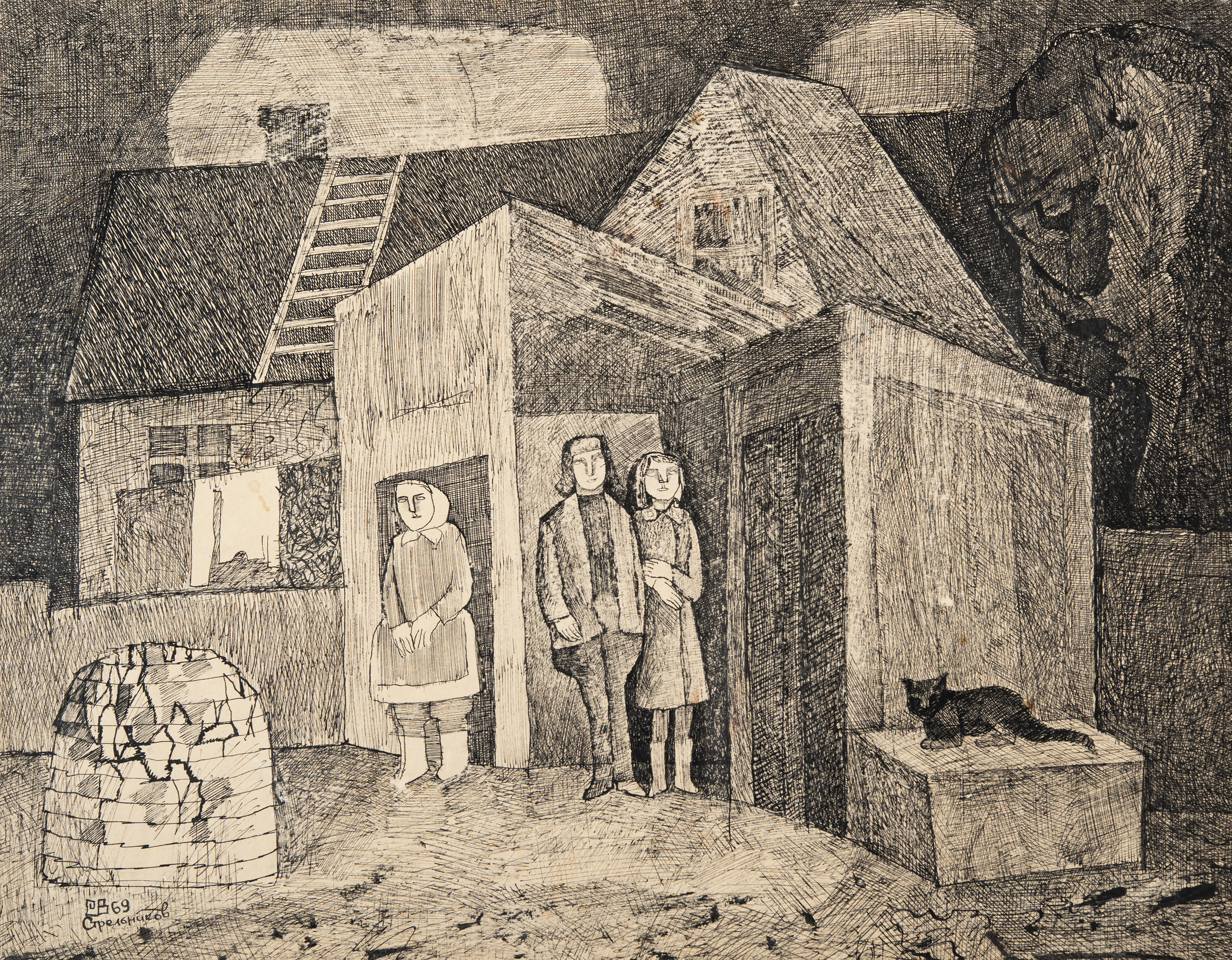
Three Figures, 1969. Ink on paper, 31.3 × 40.1 cm (12 5/16 × 15 13/16 in.). Norton and Nancy Dodge Collection of Nonconformist Art from the Soviet Union. D04646
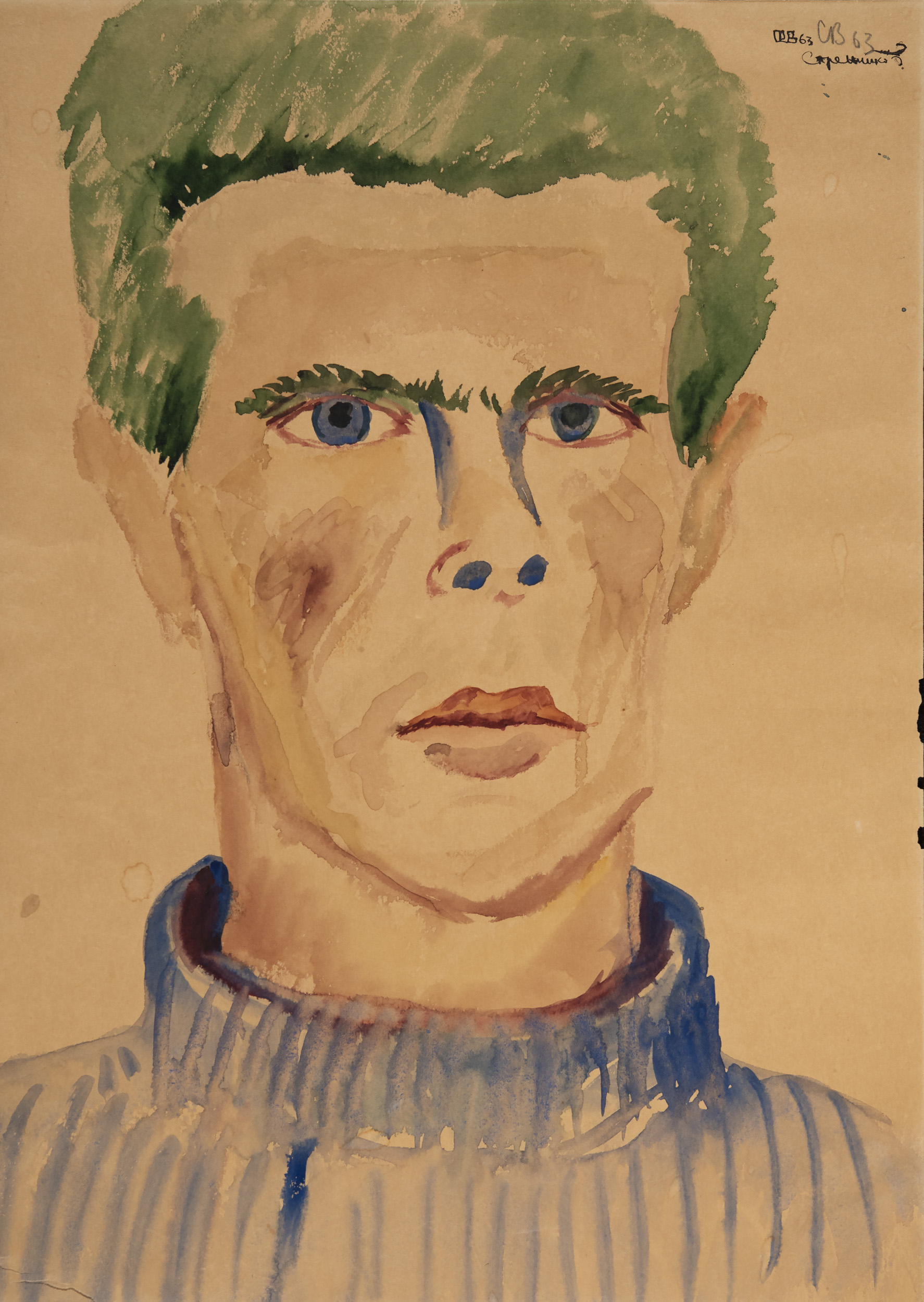
Untitled (Self-Portrait), 1963. Watercolor on paper, 35 × 23 cm (13 3/4 × 9 1/16 in.). Norton and Nancy Dodge Collection of Nonconformist Art from the Soviet Union. D04647

Siphon Repair, 1973. Watercolor on paper, 23.4 × 32.1 cm (9 3/16 × 12 5/8 in.). Norton and Nancy Dodge Collection of Nonconformist Art from the Soviet Union. D04649
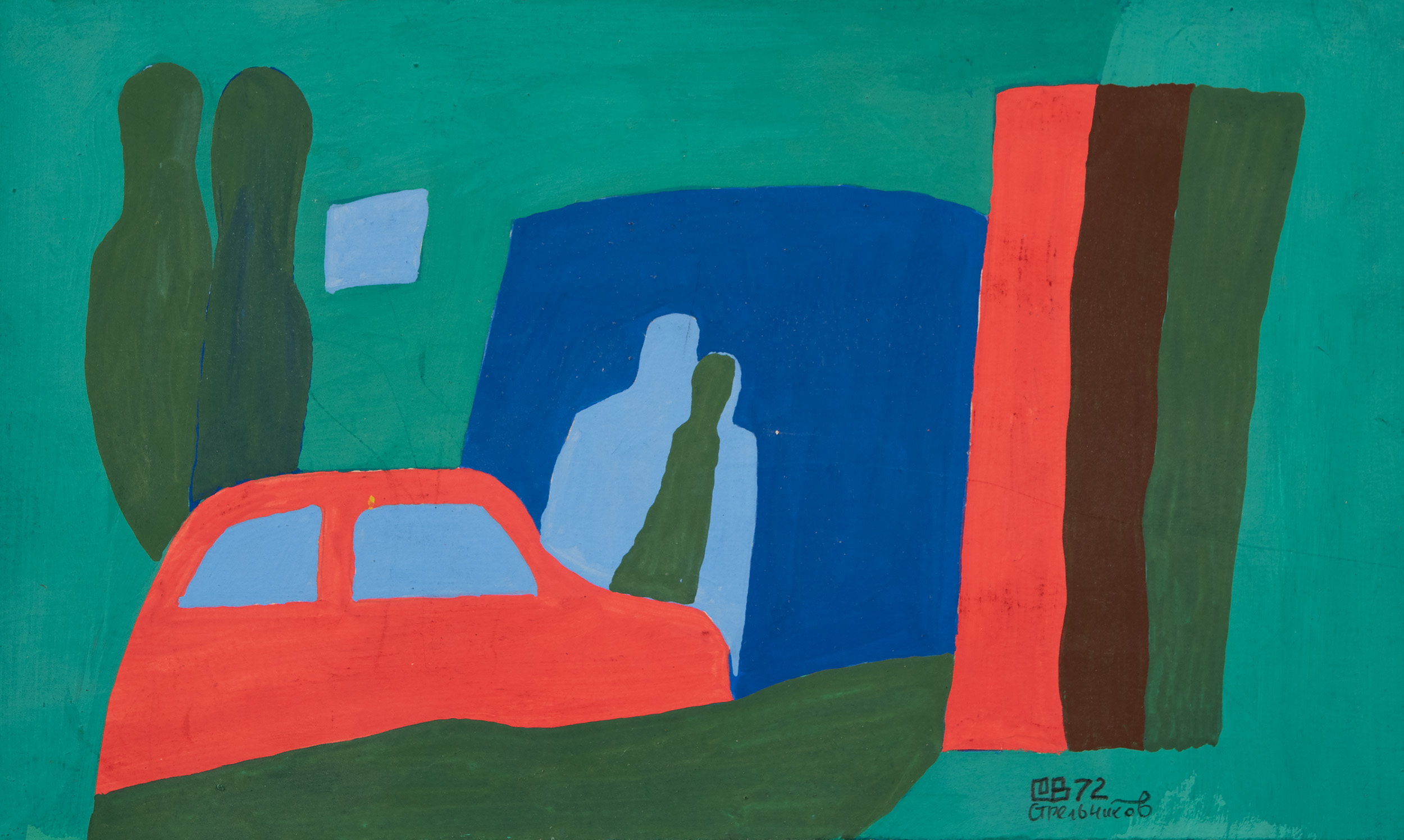
Untitled, 1972. Gouache on paper, 13.4 × 22.3 cm (5 1/4 × 8 3/4 in.). Norton and Nancy Dodge Collection of Nonconformist Art from the Soviet Union. D04650
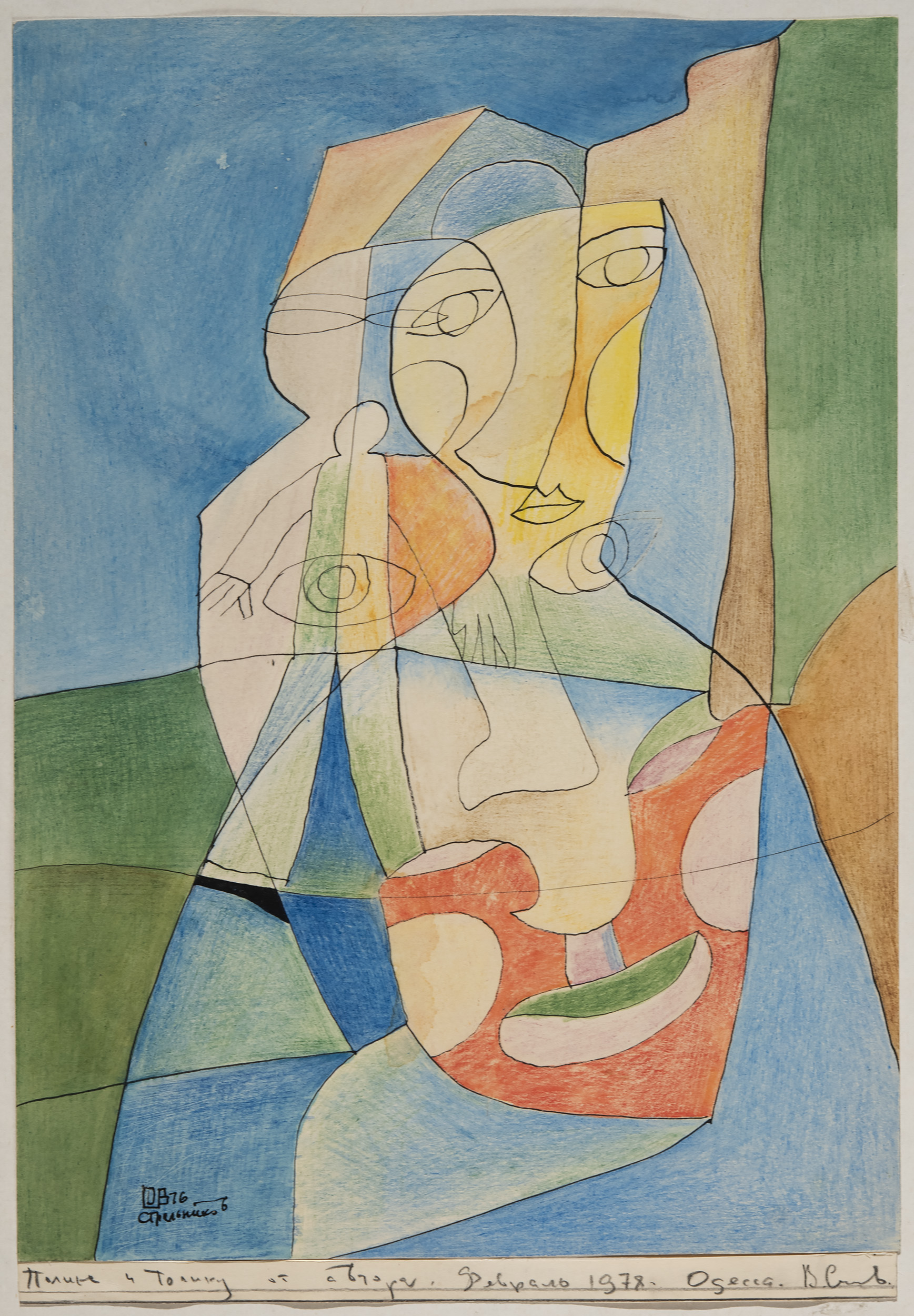
Untitled, 1976. Colored pencil and ink on paper, 29.4 × 21.1 cm (11 9/16 × 8 5/16 in.). Norton and Nancy Dodge Collection of Nonconformist Art from the Soviet Union. D04651