
Volodymyr Pasyvenko (Pasivenko)
1939 — Obychiv, Chernihiv Oblast (Ukraine). Lives and works in Kyiv (Ukraine)
Volodymyr Pasyvenko is a Ukrainian painter and graphic artist, known primarily for his monumentalist works, especially murals. He was a member of the Union of Artists of the Ukrainian SSR and has been a People’s Artist of Ukraine since 2006. Since the 1970s, his work has engaged with the themes of man and nature, culture and memory. His painting is influenced by Ukrainian folklore and surrealism, as well as by symbolism.
Pasyvenko was born on August 8, 1939, in the village of Obychiv, in the Malodivytsky (now Prylutsky) region of the Chernihiv oblast. He has lived in Kyiv since 1959. In 1967 Pasyvenko graduated from the Moscow Higher School of Art and Industry’s department of industrial art. While there he studied with Oleksandr Korotkevych and Dmytro Terekhov.
Pasyvenko worked as an artist-designer for the aircraft designer Oleg Antonov, and then as a monumentalist at the Art Fund of Ukraine until 1998. During this time, he created a number of monumentalist and decorative murals in Kyiv and Moscow, the most famous of which are Українське народне весілля [Ukrainske narodne vesillia, Ukrainian Folk Wedding] and Ніч на Івана Купала [Nich na Ivana Kupala, Night of Ivan Kupala], in the Hotel Ukraina in Moscow (1978–79); the cycle Людина і огонь [Liudyna i vohon, Man and Fire], Людина і земля [Liudyna i zemlia, Man and Earth], Людина і вода [Liudyna i voda, Man and Water], and Людина і небо [Liudyna i nebo, Man and Sky], in the library of the Kyiv Polytechnic Institute (KPI) (1978–81); the decorative compositions Відлуння століть [Vidlunnia stolit, Echoes of Centuries] and Стародавній Київ [Starodavniy Kyiv, Ancient Kyiv] in the restaurant Золоті ворота [Zoloti Vorota, Golden gate] (1984); as well as Біль Землі [Bil zemli, Earth’s pain], Тривога [Tryvoha, Worry], and Діалог [Dialoh, Dialogue] in the Volodymyr Vernads’kyi National Library of Ukraine (1987–89).
Pasyvenko’s talent as a monumentalist was most vividly revealed in the murals mentioned above that he created for two libraries in Kyiv: the Scientific and Technical Library of the new KPI building and the Vernads’kyi National Library. The murals created for the library of the KPI are located on four floors and are dedicated to the four elements, that is to say, the foundations of human life. The artist represented the themes through images of universal and cosmic significance. The compositions are imbued with a powerful dynamism; when approached, they reveal their multilayered nature whereupon new details, new worlds, and new characters emerge. Trends characteristic of Ukrainian art in the 1970s and 1980s are reflected in these artworks—namely, the ideas that socially significant issues could be solved on the levels of the individual, personal, and subjective, as well as the complexity of artistic language, a language saturated with symbols, quotations, and images taken from world cultures.
These tendencies are also characteristic of the murals in the central lobby of the Vernads’kyi National Library, created in collaboration with Volodymyr Priadko. The encaustic panel Earth’s Pain reveals that the main purpose of science is the protection of life on earth. [1] The artists expressed this opinion through symbolic and metaphorical images: the flames of human cruelty, violence, and ignorance rage around the central figure of a mother with her daughter in her arms, akin to a modern Madonna. In addition to more general images, there are references to specific events, for example, a fragment of the fourth reactor of the Chornobyl nuclear power plant, and next to it, the figure of a grieving old woman surrounded by huts filled with radioactive material. The image includes a large number of symbols and references to world culture (including the central section of Raphael’s famous The School of Athens, 1509–11) that indicate both the richness of humanity’s cultural heritage and its fragility. The artists departed from a more static composition, which was generally characteristic of Ukrainian mural painting of the time, and introduced a heightened sense of dynamism, of constant development, of movement, and of the clash of multidirectional forces. Pasyvenko, together with Priadko, received the Taras Shevchenko National Prize of Ukraine in 1998 for the murals in the Vernads’kyi National Library.
Since the 1990s, Pasyvenko has been working on paintings for Orthodox churches. In particular, he took part in the restoration of Saint Michael’s Golden-Domed Monastery, which was destroyed by the Soviet authorities in 1937. In 1998, together with a group of artists, he created the compositions Собор архангела Михаїла і всіх небесних сил [Cathedral of the Archangel Michael and All Heavenly Powers] and Святий Михаїл — митрополит Київський і Святополк Ізяславич — великий князь київський [Saint Michael, Metropolitan of Kyiv, and Sviatopolk Iziaslavych, Grand Duke of Kyiv], on the walls of Saint Michael’s, as well as paintings on the western wall in the Varvara Chapel (1999–2000). In 2010–11, Pasyvenko painted Третій Вселенський собор в Ефесі [The Third Ecumenical Council in Ephesus], in the reconstructed Assumption Cathedral of the Kyiv Pechersk Lavra (blown up in 1941 during the Nazi occupation). In his church paintings, the artist relied on preserved archival materials and artworks in museum collections, achieving the stylistic authenticity of Ukrainian Baroque with its bright, fresh colors, illusionistic details, and richness of decorative elements. For example, in the murals of the Assumption Cathedral, Pasyvenko convincingly reproduced the specific characteristics of the clergy’s clothing, fabric texture, and decoration, and he gave each figure an individual pose and unique gesture, lending to the scene the feeling of an authentic historical event.
In parallel with his work as a monumentalist, Pasyvenko creates paintings and graphic works, which he has been exhibiting at Ukrainian and all-union exhibitions since 1967. The artist’s first solo exhibition took place in 1970 in Kyiv.
The influence of surrealism on Pasyvenko’s easel works is clearly visible, a surrealism that he combines with Ukrainian folklore. A number of his landscapes have a symbolic and romantic character; they are elegant and have a subtly nuanced tonality. Examples are Альтанка Михайла Глінки в Качанівці [Altanka Mykhaila Hlinky v Kachanivtsi, Mykhailo Hlinka’s Alcove in Kachanivka] (1984–86) and Золотий вечір на річці Удай [Zoloty vechir na richtsi Udai, Golden Evening on the Uday River] (1987). While his monumental works are marked by their dynamism, expression, and excitement, Pasyvenko’s easel works are more meditative and contemplative, emphasizing silence and tranquility. His monumental works are devoted to social issues, whereas in easel paintings, he foregrounds the value of individual human experience, forever subject to the concepts of beauty, love, sadness, and pain. In his paintings Прийшла весна до маминої хати [Pryishla vesna do mamynoi khaty, Spring Came to My Mother’s House] (1971–72) and Час цвітіння калини [Chas tsvitinnia kalyny, The Time of Viburnum Blossom] (1982), he reveals a piercing nostalgia for his childhood, for untouched nature, and the purity and sublimity of human feelings, which, in his opinion, need to be protected. Сон [Son, Dream] (1964–87) is based on a dream that the artist had in 1964 and immediately captured on canvas. These are the memories of a boy in the postwar years, when only women were left in his native village; thus, the painting is dedicated to the woman who protects Life itself (the blooming viburnum acting as a "tree of life"). In the painting Луг спогадів і надій [Luh spohadiv i nadii, The Meadow of Memories and Hopes] (1986), Pasyvenko uses the surrealist technique to create a kind of dreamlike reality, in which elements of reality and universal cultural memory are combined, and where the artist’s dream of uniting humanity through the power of art is declared.
In 1987 Pasyvenko took part in the exhibition Pohliad [Look], which was a milestone in the history of Ukrainian art. Pohliad was held at the Kyiv Polytechnic Institute and featured the unofficial art of monumentalists from the 1960s to the 1980s. The organizers were the well-known artists Viktor Hryhorov (1939–2002), Oleksandr Borodai (1946–2019), Dmytro Nagurnyi (1946–2019), and Ernest Kotkov (1931–2012); the works of thirty-seven artists in total appeared. In 1990 an album of the artworks exhibited, also entitled Pohliad, was published with an introductory article by Nina Velihots’ka. The exhibition also lent its name to an artistic association founded at the Kyiv organization of the Union of Artists of Ukraine, which Pasyvenko joined.
In 2009 Pasyvenko was elected a corresponding member of the National Academy of Arts of Ukraine. In the 2000s and 2010s, the artist continued his easel painting, carrying forward the recurring theme of the fragility of human life, culture, and nature: Єднання земного і небесного [Yednannia zemnoho i nebesnoho, Unity of Earth and Sky] (2005), Каяття [Kaiattia, Repentance] (2010), Доля [Dolia, Fate] (2017), and Ніч яка місячна [Nich iaka misiachna, Moonlit Night] (2020), among others. In these works, the use of surrealism is significantly reinforced by symbolism, with an emphasis on the spiritual and on the connection between heaven and earth personified by fantastic creatures and images from folklore and Christian history.
Oksana Barshynova
Translated from Ukrainian by Nathan Jeffers
Notes:
1. Encaustic is a wall painting technique in which melted wax is used as a binder for paints. It was widespread in ancient times and was used to paint icons and portraits.

Untitled, 1965. Colored ink on paper, 27 × 19.2 cm (10 5/8 × 7 9/16 in.). Norton and Nancy Dodge Collection of Nonconformist Art from the Soviet Union. D10401
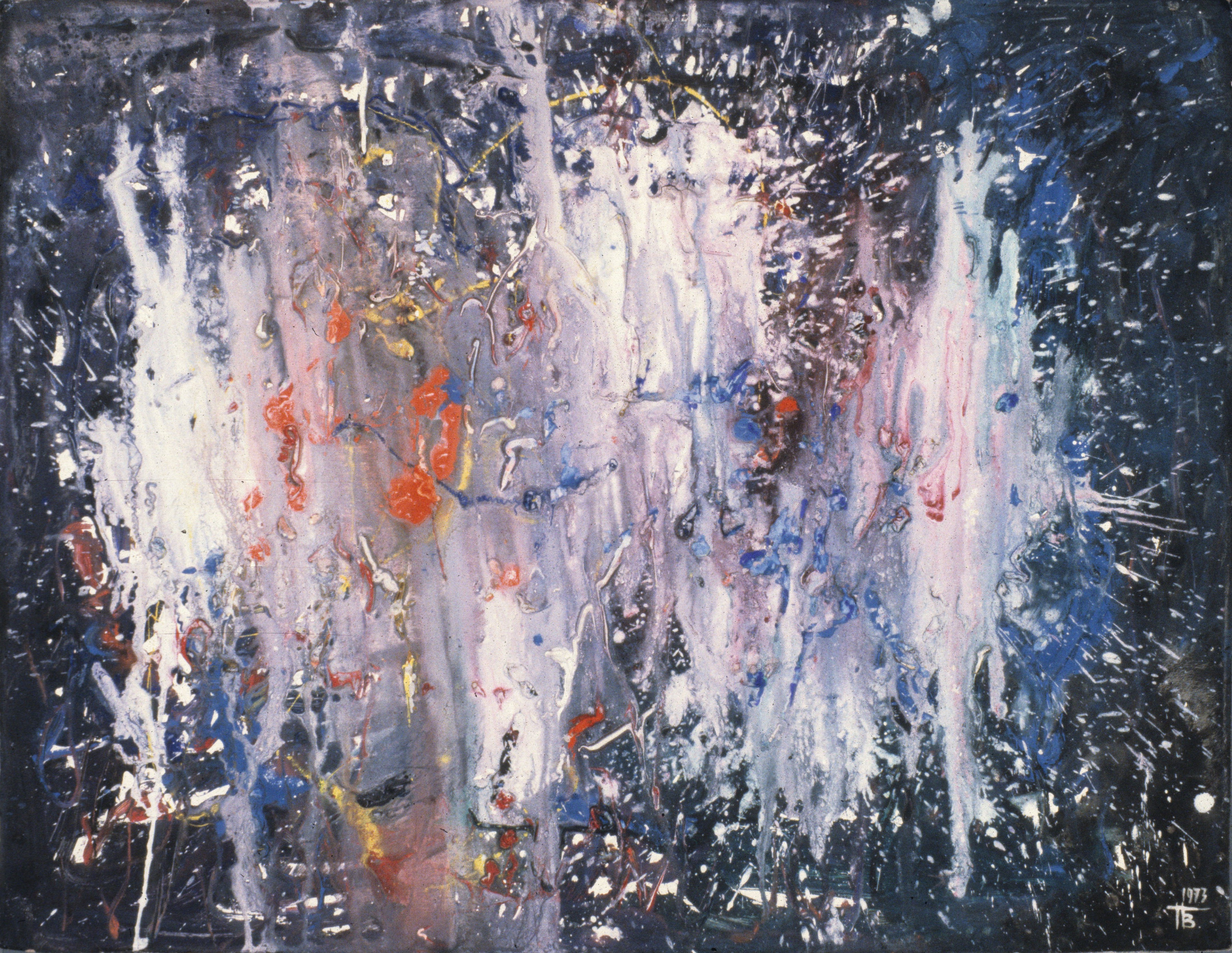
Untitled, 1973. Tempera on paperboard, 84.5 x 110 cm (33 1/4 x 43 5/16 in.). Norton and Nancy Dodge Collection of Nonconformist Art from the Soviet Union. D10286