
Volodymyr Naumets
1945 — Lviv (Ukraine) | 2025 — Cologne (Germany). Lived and worked in Odesa (Ukraine), Moscow (Russia) and Cologne (Germany)
Volodymyr Naumets is a monumentalist, painter, graphic artist, and creator of conceptual artworks, texts, performances, and art objects. He is also a prominent representative of Odesan and Moscow unofficial artistic circles. In his oeuvre, conceptualism combines with a Christian worldview to create “sacred conceptualism,” a unique and original kind of art. Works by Naumets refer to iconographical and modernist traditions (abstraction, surrealism, primitivism), as well as to neoexpressionism, and focus on issues of light and how to activate the surface texture of his artworks.
Born on June 9, 1945, in Lviv, Naumets later moved to Izmail, Odesa Oblast, with his family, and eventually settled in Odesa. In 1964 he graduated from the Odesa Art School, where he had studied with Mykola Zaitsev (1907–1972) and Dina Frumina (1914–2005), along with other future representatives of Odesa’s unofficial art scene, such as Viktor Maryniuk (1939–2025), Liudmyla Yastreb (1945–1980), Volodymyr Tsiupko (b. 1936), Stanislav Sychov (1937–2003), and others. In 1970 Naumets graduated from the Moscow Higher School of Art and Technology (his painting teacher was the famous representative of the severe style, Helii Korzhev [1925–2012]).
While studying in the monumentalist department at art school, Naumets became interested in the mosaics and frescoes of Ancient Rus’ and the figurative and symbolic language of its iconography. After completing his education, he worked as a restorer, experimenting with the material levkas [1] and developing his skills in Roman mosaics. He became a member of the International Association of Mosaic Artists (Ravenna, Italy) in 1988.
In the 1970s, Naumets joined the circle of Moscow nonconformists. He became a member of the Moscow City Committee of Graphic Arts, which had a famous exhibition hall at 28 Malaia Gruzinskaia Street, and joined the Group 21 in 1976. In February 1982, the group held an exhibition at Malaia Gruzinskaia, featuring mostly lyrical and geometric abstraction.
All the while, Naumets maintained contact with Odesa, constantly communicating with like-minded people there. In 1973 he collaborated with Valentyn Khrushch (1943–2005) and got him interested in abstraction and in the work of the artist Antoni Tàpies (1923–2012), who was an important influence on Naumets and other Odesan artists from the unofficial art scene. Naumets’s work Тютюн вранці і ввечері [Tiutiun vrantsi ta vvecheri, Tobacco in the Morning and Evening] (1973), dedicated to Khrushch and marked by the influence of Arte Povera, belongs to this period. It was also during this period that Naumets, along with other Odesan nonconformists, participated in the legendary unofficial exhibition Contemporary Art from Ukraine, held in 1979 in Munich, London, Paris, and New York.
In the late 1970s and early 1980s, Naumets became closer to the representatives of Moscow conceptualism and participated in the activities of the Collective Actions (KD) art group. In his easel works of this time, he used conceptualist methods to generate new interpretations of the language of religious art, for example, in his Аналіз категорії знаків [Analiz katehorii znakiv, Analysis of the Category of Signs] (1981).
The artist staged various performances and actions in Moscow (Отстригание дыма [Ostriganie dyma, Cutting the Smoke], 1982; Дарунок [Darunok, Gift], 1982; and Знак на снігу [Znak na snihu, Sign on the snow], 1983–84), among others). Naumets became a link between the conceptualists of Odesa and Moscow, involving Odesan artists in the Moscow circle and organizing actions in Odesa. For example, he introduced the young Odesan Serhiy (Sergey) Anufriev (b. 1964), who was his assistant at the time, to one of the founders of the KD group, Andrei Monastyrski, symbolically bequeathing Anurfriev to Monastyrski in his art action Gift.
Cutting the Smoke was an art action in which Naumets cut the smoke from his pipe filled with his favorite tobacco, Golden Fleece. In so doing, Naumets was symbolically referring to ancient Greece, to continuity and integrity in both the flow of life and cultural tradition.
While performances by Naumets in Moscow were largely influenced by the conceptualists there, his actions in Odesa were more focused on interpreting Christian signs, symbols, and rituals using conceptualist methods, which came to be called sacred conceptualism. Unlike those of his Odesan colleagues, the artist’s works are practically devoid of irony. A typical example is Акція на Чорному морі [Aktsiia na chornomu mori, Action on the Black Sea] (1982; photo documentation by Viktor Ratushnyi). As a child, while fishing on a boat with his father, the artist noticed a black cave in a high bank. Later, in 1982, dressed in dark clothes and carrying a light wooden cross on his shoulders, he climbed a rock and entered the cave. As he disappeared into the darkness, he left behind a bright cross that, owing to its size, blocked the entrance to the cave. Photos were taken both outside and inside the cave, from which the Black Sea shimmered through the cross. Based on some of the black-and-white photographs of Action on the Black Sea, the following year Naumets made silkscreen prints, with the human figure appearing behind the cross in the darkness of the cave becoming an important image for him.
The influence of conceptualist practices, in particular his sacred conceptualism, is evident in graphic works by Naumets of the early 1980s. While working with a limited set of signs (crosses, orbits, and others), he created images, sometimes emotionally and sometimes rationally, experimenting with a narrow color range (often using ocher or earth tones) and with a range of tone (from white to black), examples of which are from his Untitled series (1982, ZAM, 2013.006.025.1 7, 2013.006.025.1 9, 2013.006.025.3 2) and the untitled works (1982–83, ZAM, 2013.006.025.2 4, 2013.006.025.3 6, 2013.006.025.2 5, D01339), all of which are in the Zimmerli Collection.
In the mid-1980s, Naumets turned away from geometric and linear forms saturated with symbolism and moved toward texture and color. At this time, he joined Детский сад [Detskii Sad, the kindergarten] squat in Moscow (1985–86), whose founders included the artist’s good friend from Lviv, Mykola Filatov (b. 1951). The squat was characterized by an atmosphere of freedom and an openness to the latest trends, including the painting experiments of the New Wave. Naumets was actively interested in postmodernist trends, in particular neoexpressionism. He created large expressionist paintings, experimenting with different materials and techniques, such as aerosols. In his works on Christological themes, for example, Untitled (1985, ZAM. D10077, D10079, D10080), he abstracted the original image as much as possible, complicating the texture and building contrasting colors while maintaining a connection with the iconography of the crucifix.
In 1989 he moved to Germany, settling in Cologne, and periodically visiting Odesa and Moscow.
The priority of his creative journey in the 1990s was the search for light, and the artist strove to dematerialize painting. His project Світлові дошки [Svitlovi doshky, Light Boards] (1992–96) is dedicated to this; it includes the movement of the viewer and light in the real-time working of the piece. The piece was composed of several translucent screens with neon tubes creating luminous outlines that somewhat resemble iconographic figures. The epigraph for it was taken from the Apostle Paul’s statement: “For this world in its present form is passing away” (I Corinthians 7:31). These “light boards” were specifically devoid of any harmonious integrity; rather, they are evidence of a courageous effort by a modern person to return to what was once lost. The materiality of the object, unlike with a real icon, is an obstacle to rather than a step toward the light, which is also slipping away.
In the late 1990s, Naumets created twelve mosaics based on a free artistic interpretation of Orthodox themes, using only gold smalt in twenty shades (Золоті мозаїки [Zoloti mozaiyky, Golden Mosaics], 1997–2002)). The series of mosaics was influenced by his trip to Mount Athos in the 1980s, where Naumets created canonical icons and mosaics for the Panteleimon Cathedral. However, in his series, he used a contemporary artistic language based primarily on the aesthetics of modernism (some of his works evoke associations with the works of Mark Rothko [1903–1970] and Tàpies), employing modern materials and technologies.
In the 2000s, the artist focused on the theme of death, which was prompted by the deaths of his friends Valentyn Khrushch and Mykola Morozov. Thus, the series Танець смерті [Tanets smerti, Dance of Death] (second half of the 2000s) appeared, for which Naumets covered paper with a solution of bitumen varnish and applied a sepia pen drawing. This technique created the impression of old, faded, and burnt manuscripts with graphic images.
Volodymyr Naumets has played a prominent role in Ukrainian exhibition life. In 2012 he participated in several projects at once: Cutting the Smoke at the Odesa Museum of Contemporary Art, Просвет [Prosvet, Enlightenment] at the Odesan gallery Khudpromo, as well as Art Kyiv Contemporary at the Mystetskyi Arsenal in Kyiv. A solo exhibition of his work was held in 2018 at the Odesa Art Museum.
Oksana Barshynova
Translated from Ukrainian by Nathan Jeffers
Notes:
1. Levkas is a bright, white layer made up of chalk, alabaster, calcium sulfate, or other material that was historically applied to orthodox icons before they were painted or gilded.
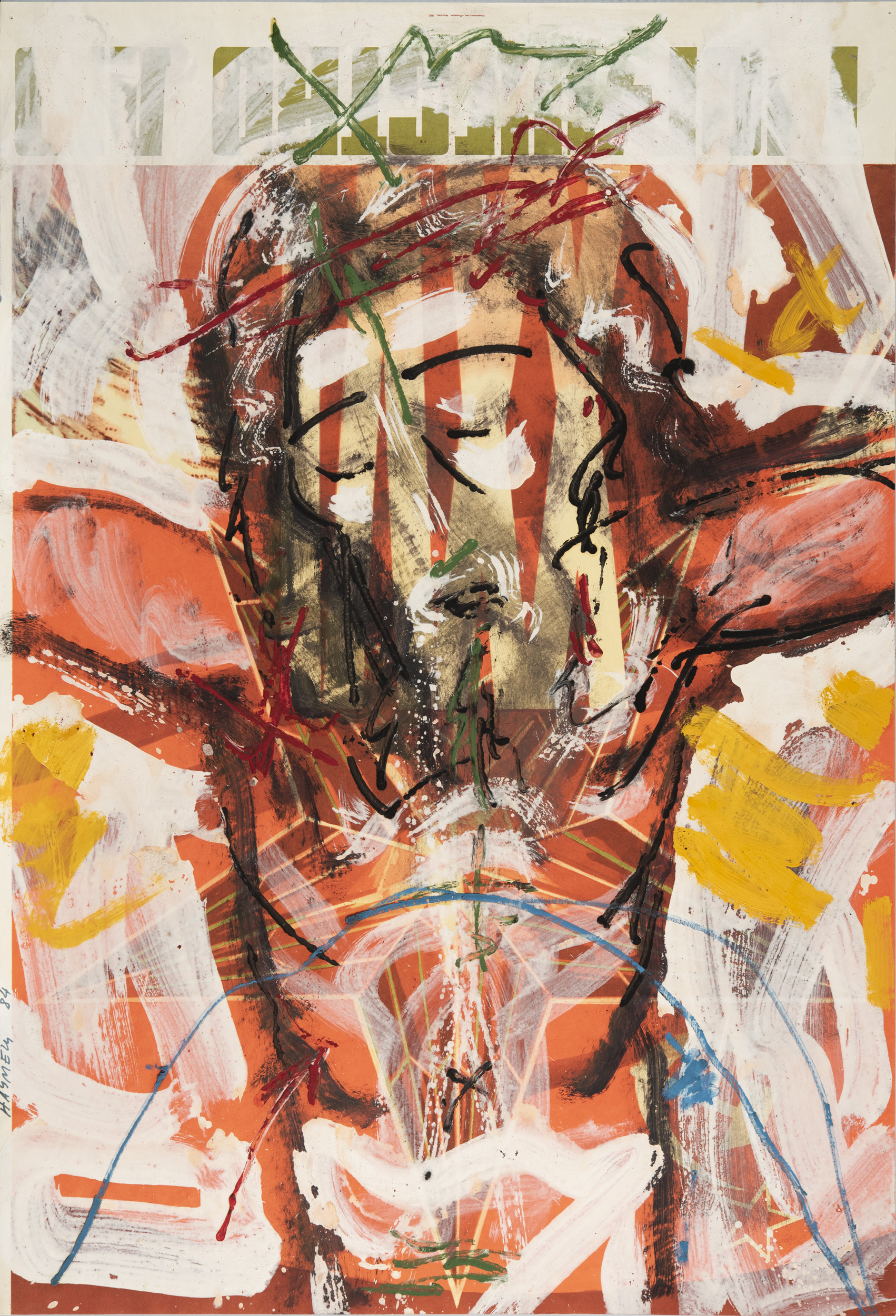
Untitled, 1984. Unidentified medium, 98 × 67 cm (38 9/16 × 26 3/8 in.). Norton and Nancy Dodge Collection of Nonconformist Art from the Soviet Union. D10075
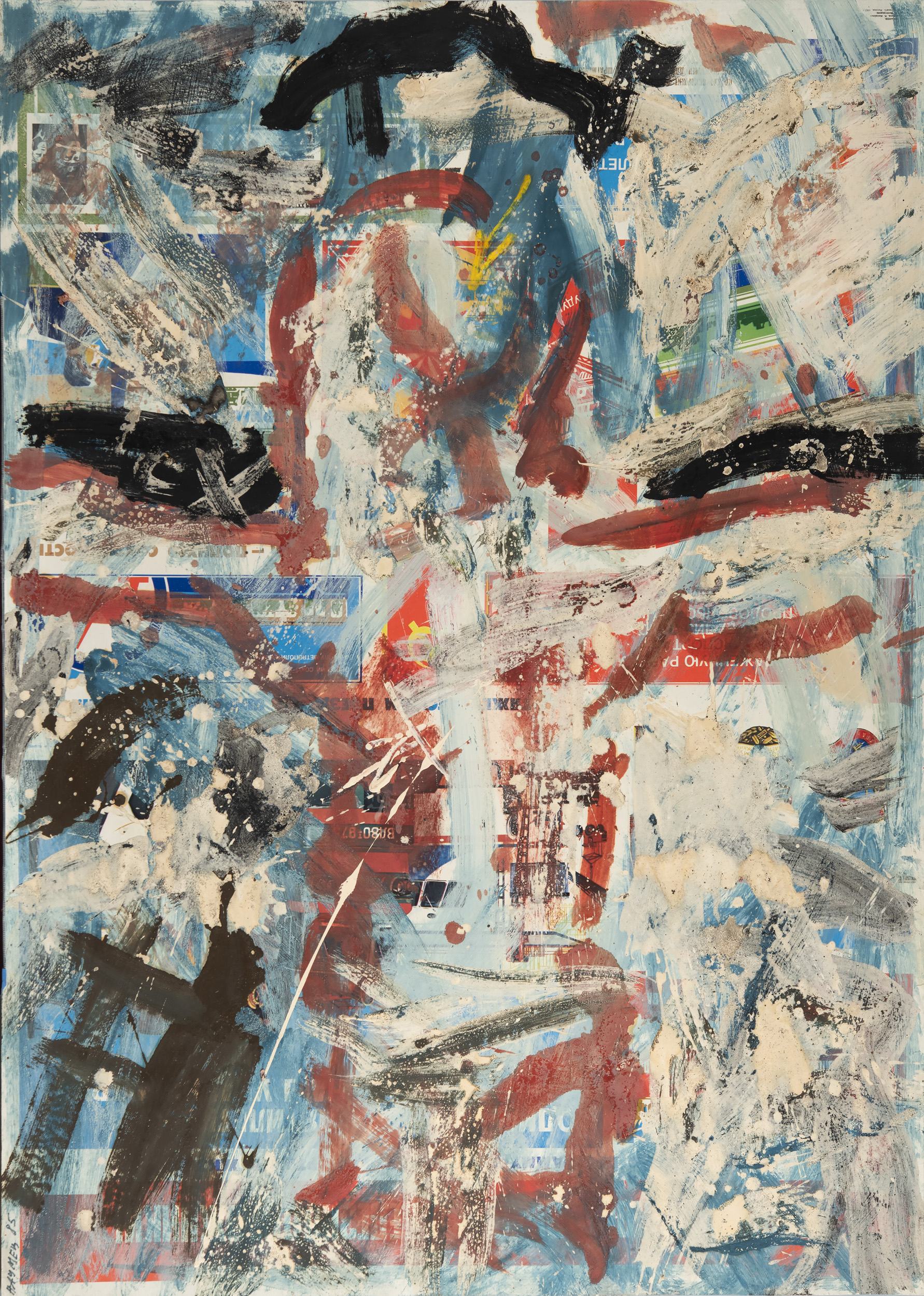
Untitled, 1985. Unidentified medium, 106 × 80 cm (41 3/4 × 31 1/2 in.). Norton and Nancy Dodge Collection of Nonconformist Art from the Soviet Union. D10079

(Untranslated) from untitled series, 1983. Gouache and ink on photocopy paper, 42 x 29.5 cm (16 9/16 x 11 5/8 in.). Norton and Nancy Dodge Collection of Nonconformist Art from the Soviet Union. 2013.006.025.01
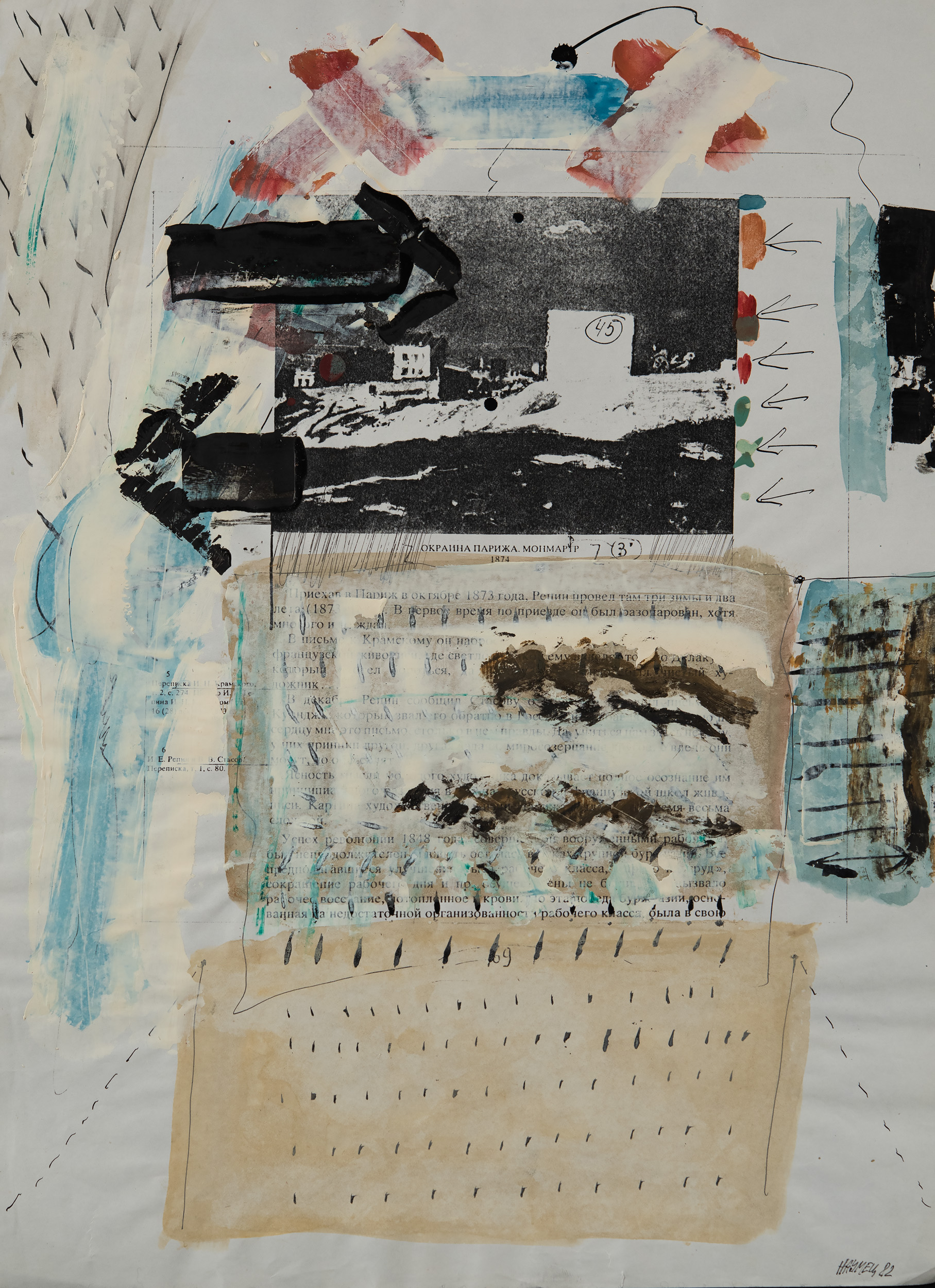
(Untranslated) from untitled series, 1982. Gouache, watercolor, and ink on photocopy paper, 41.9 x 29.6 cm (16 1/2 x 11 5/8 in.). Norton and Nancy Dodge Collection of Nonconformist Art from the Soviet Union. 2013.006.025.09

Volodymyr Naumets and Sergei Anufriev. Thirty-two works from the series Up. Photodocumentation of the performance, 1982. Gelatin silver print on paper, 24 × 29.8 cm (9 7/16 × 11 3/4 in.). Norton and Nancy Dodge Collection of Nonconformist Art from the Soviet Union. D10031.25

Volodymyr Naumets and Sergei Anufriev. Thirty-two works from the series Up. Photodocumentation of the performance, 1982. Gelatin silver print on paper, 24 × 29.8 cm (9 7/16 × 11 3/4 in.). Norton and Nancy Dodge Collection of Nonconformist Art from the Soviet Union. D10031.32