
Volodymyr Bakhtov
1954 — Zolote, Luhansk region (Ukraine). Worked in Parutyne, Mykolaiv region (Ukraine), Bad Saulgau (Germany)
Volodymyr Bakhtov is a graphic artist, printmaker, painter, photographer, and land artist, and is the inventor of a technique of drawing with light called heliograffiti. In 1975 he graduated from the department of Graphic Arts of Odesa State Pedagogical Institute (now the South Ukrainian National Pedagogical University), after which he moved to the Mykolaiv region of Ukraine. From 1981 to 1988, he worked in Moscow in the graphic studio of the “Senezh” House of Artists. In 1989 he moved to the village of Parutyne in Mykolaiv, where in 2004 he founded—with his wife, the artist Tetiana Bakhtov (b. 1952)—the Bakhtovs’ House, which operates as a creative laboratory and art gallery.
Bakhtov began his career as a printmaker and book illustrator, and achieved great success in this field, as evidenced by his significant artistic output and extensive exhibition history. In his etchings he works with symbols, with light and darkness, addressing both historical and contemporary themes. He illustrated a book of poems and symphonies by Dmytro Kremen titled Elegy of Trojan Wine (2001), and the book Scythian Odyssey (2020) by the prominent 1960s poet Lina Kostenko. He has also made works using tempera painting, photography, and video. The artist’s creative searches led him to experiments in the field of land art; he was one of Ukraine’s earliest practitioners in that realm.
In 1995 Bakhtov developed his own technique known as heliograffiti—a term he coined—which he has been working in since then. The technique involves spatial drawing with fire. The choice to use fire, rather than modern electrical devices, refers to the ancient Greeks’ perception of fire as one of the four elements. The artist uses a burning torch to re-create the contours of disappeared antique Greek buildings, recording it with a long exposure time on his camera. The path of the fire source is thus transformed into lines that correspond to the silhouettes of ancient architectural structures. Heliograffiti celebrates photography as a medium that uniquely captures the mysticism of a performance that once happened in darkness. The location itself plays a crucial role—three-dimensional objects appear to be exactly where they originally stood. [1] The remains of buildings located on the archaeological landscapes of the ancient Greek settlement of Olbia, for example, seem to be resurrected, at least for a moment. [2] Bakhtov’s project Reconstruction of Space (early 1990s) includes a heliographic reconstruction of architectural structures and a performance called “Terra-theatre,” which features real people who are painted with natural clay of different colors and dressed in antique costumes. Each re-created pantomime, recorded as a photo or video, references a particular scene from ancient mythology, such as Gigantomachia, Amazonomachia, and Centauromachia. These two techniques, Terra-theatre and heliograffiti, were also captured on monumental (4 by 1.5 meter) photo panels and displayed in the exhibition Ancient Codes of Ukraine: Sacred Reconstructions (2019, Museum of the Ukrainian Diaspora, Kyiv), a retrospective of the artist’s work.
These projects illustrate Bakhtov’s interest in the historical past of the south of Ukraine, particularly Olbia, where the ancient history of the northern Black Sea is concentrated and where the artist finally permanently settled. The artist always felt a special connection with Oikoumene after his maritime journeys to the Mediterranean. [3] Since the 1980s, Bakhtov has been exploring through a series of etchings the relationship between the ancient Greeks and the Scythians, an ancient nomadic culture that once inhabited the steppes of modern-day southern Ukraine. However, his special attention to the south can be traced back to the mid-1990s, when he began, together with his wife, to implement a number of projects exploring the region. In these projects Bakhtov acts as a researcher who studies documents, working on the reconstruction of the historical past of the northern Black Sea region, thus helping Ukrainian audiences learn more about their own history through art.
Among the artist’s major works are series of etchings, including On the Banks of the Dnipro Liman (1983), Small Rivers of Ukraine (1983), Tavria–Ancient Land (1985), Winds of Cimmeria (1986), Mysteries of Tavria (1986–87), and Memories of Civilization (1992–99), and series of paintings, including Cosmogony Myths (1991) and Olbian Mysteries (1999). Bakhtov also designed the Olbian exhibits in the Staroflotski Barracks in the Mykolaiv Regional Museum of Local History, and in the Ancient Tira Museum in Bilhorod-Dnistrovskyi, Ukraine.
Since 1976 Bakhtov has participated in regional, republican, all-union [4], and international exhibitions. The weakening of state control during the perestroika of the late 1980s enabled the presentation of his art in projects across the world, including Switzerland, the United States, France, Bulgaria, Portugal, Greece, Turkey, and Germany. Among the shows abroad were Tradition and Search (1984, Paris), Young Talents from the USSR (1989, Antwerp), and Man, Family, Society (1989). He also participated in various graphic biennials and triennials in Berlin (1991), Krakow (1994, 1997, 2003), Varna (1995, 2003), and Cairo (2004). Since 1989 Bakhtov has been the subject of more than twenty solo exhibitions, many of which took place in Kyiv, Mykolaiv, and Berlin. In the past two decades, his projects have been mostly presented in Ukraine.
Bakhtov has received several awards over the course of his career, including a silver medal of the Paris Salon of French Artists Society “Grand Palais” (1984). From 1984 to 1987, he was a Scholar of the Union of Artists of Ukraine. In 2019 he was nominated for the Taras Shevchenko National Prize of Ukraine for his project Ancient Codes of Ukraine: Sacred Reconstructions in the graphic arts category. His works are held in the collections of the Tretyakov Gallery, Moscow; the Ministry of Culture of Ukraine; the National Museum of Serbia, Belgrade; and in institutional and private collections across Europe and the United States. He became a member of the National Union of Artists of Ukraine in 1982, and an Honored Artist of Ukraine in 1999. He is also a member of the international association Constellation of Graphics.
In 2022 the Bakhtovs moved to Bad Saulgau, Germany, where they implemented the project Drawing the World Together–2, helping children of Ukrainian refugees in Germany. Now back in Ukraine, Bakhtov continues to pursue a career accompanied by research, experimentation, hard work, and passion. His voice is a unique contribution to Ukrainian art, and especially to the northern Black Sea region, which has drawn more attention from the general public and the government thanks to his innovative projects.
Anna Luhovska
Notes:
1. Alla Miroshnichenko, Antychni rekonstruktsii Bakhtovykh: Heliohrafiti Olvii [Ancient reconstructions of the Bakhtovs: Heliograffiti of Olbia], Ukrinform, January 23, 2019.
2. Olbia (Pontic Olbia) was an ancient Greek colony founded in the sixth century BCE on the northern coast of the Black Sea, near the mouth of the Dnieper River, in present-day Ukraine. Its archaeological site lies close to the modern village of Parutyne, where Bakhtov has lived since 1989. Olbia served as a major trade and cultural center, linking the Greek world with the nomadic peoples of the Eurasian steppe.
3. Oἰκουμένη [the inhabited (earth)] is a concept in ancient Greek thought, originally meaning the known and civilized parts of the earth as opposed to unknown or barbarian lands. In classical and Hellenistic contexts, it often denoted the Greek cultural sphere or, later, the Roman Empire as the center of the civilized world.
4. The terms “republican” and “all-union” refer to the scale of these organized events, with “republican” indicating exhibitions held within the Ukrainian Soviet Republic and “all-union” denoting those encompassing the entire Soviet Union.
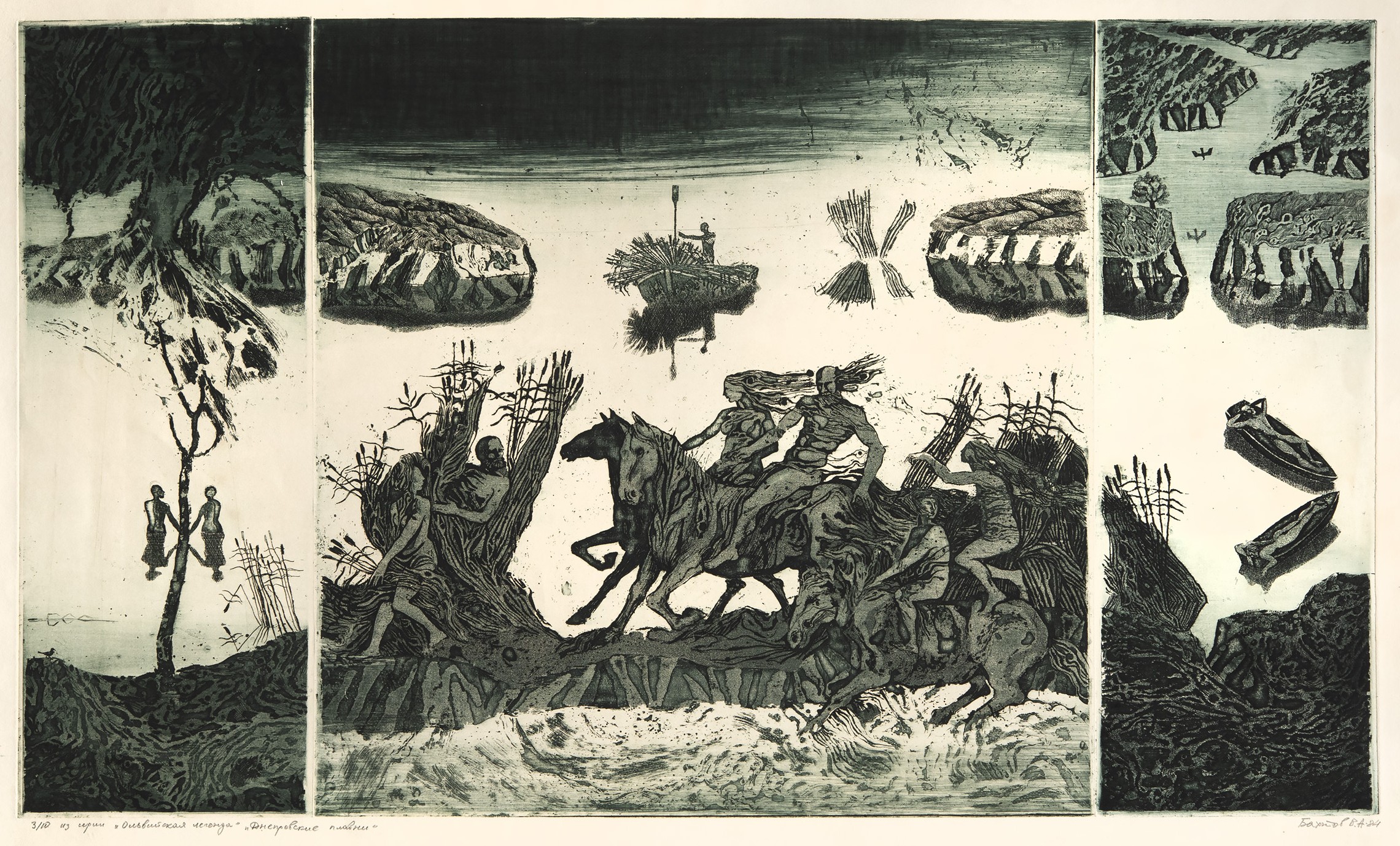
The Dnieper, 1984. Etching and aquatint on paper, 49.8 × 82.7 cm (19 5/8 × 32 9/16 in.). Norton and Nancy Dodge Collection of Nonconformist Art from the Soviet Union. D04025
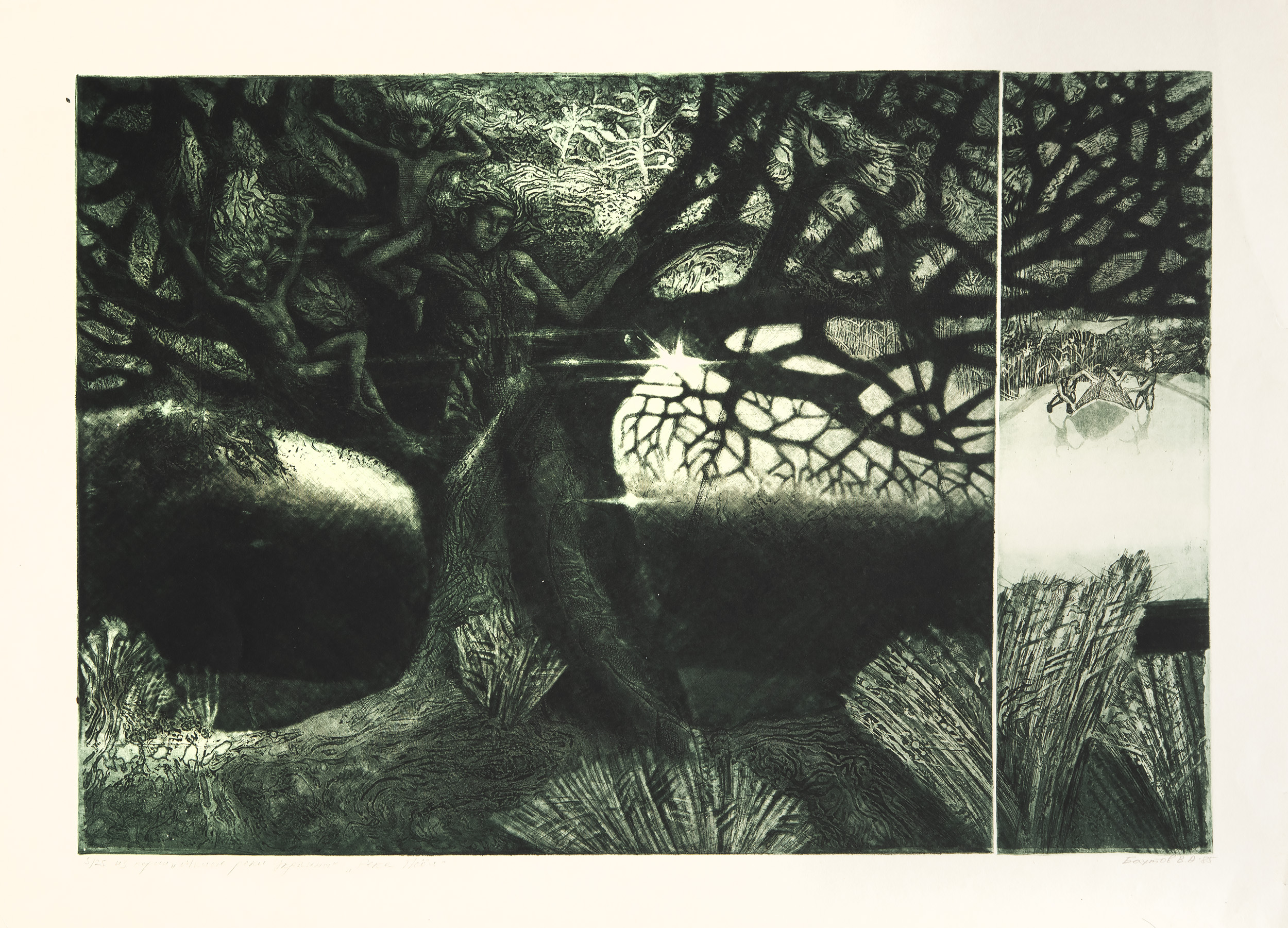
Psiol River from the series Small Rivers of the Ukraine, 1985. Mezzotint (?) on paper, 49.5 × 70.5 cm (19 1/2 × 27 3/4 in.). Norton and Nancy Dodge Collection of Nonconformist Art from the Soviet Union. D08341
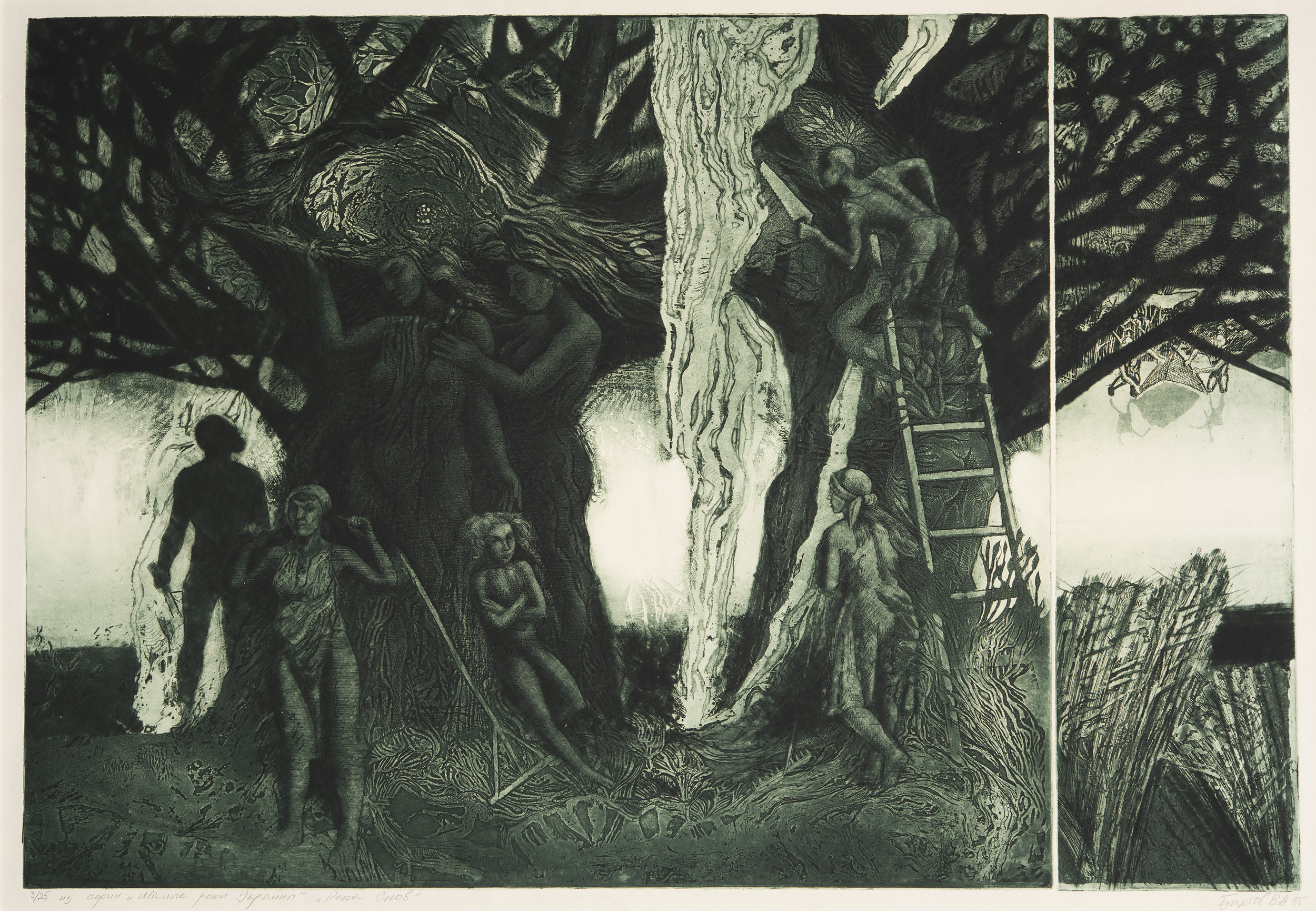
River of Dreams from the series Small Rivers of the Ukraine, 1985. Etching and aquatint on paper, 50 × 71.3 cm (19 11/16 × 28 1/16 in.). Norton and Nancy Dodge Collection of Nonconformist Art from the Soviet Union. D08342
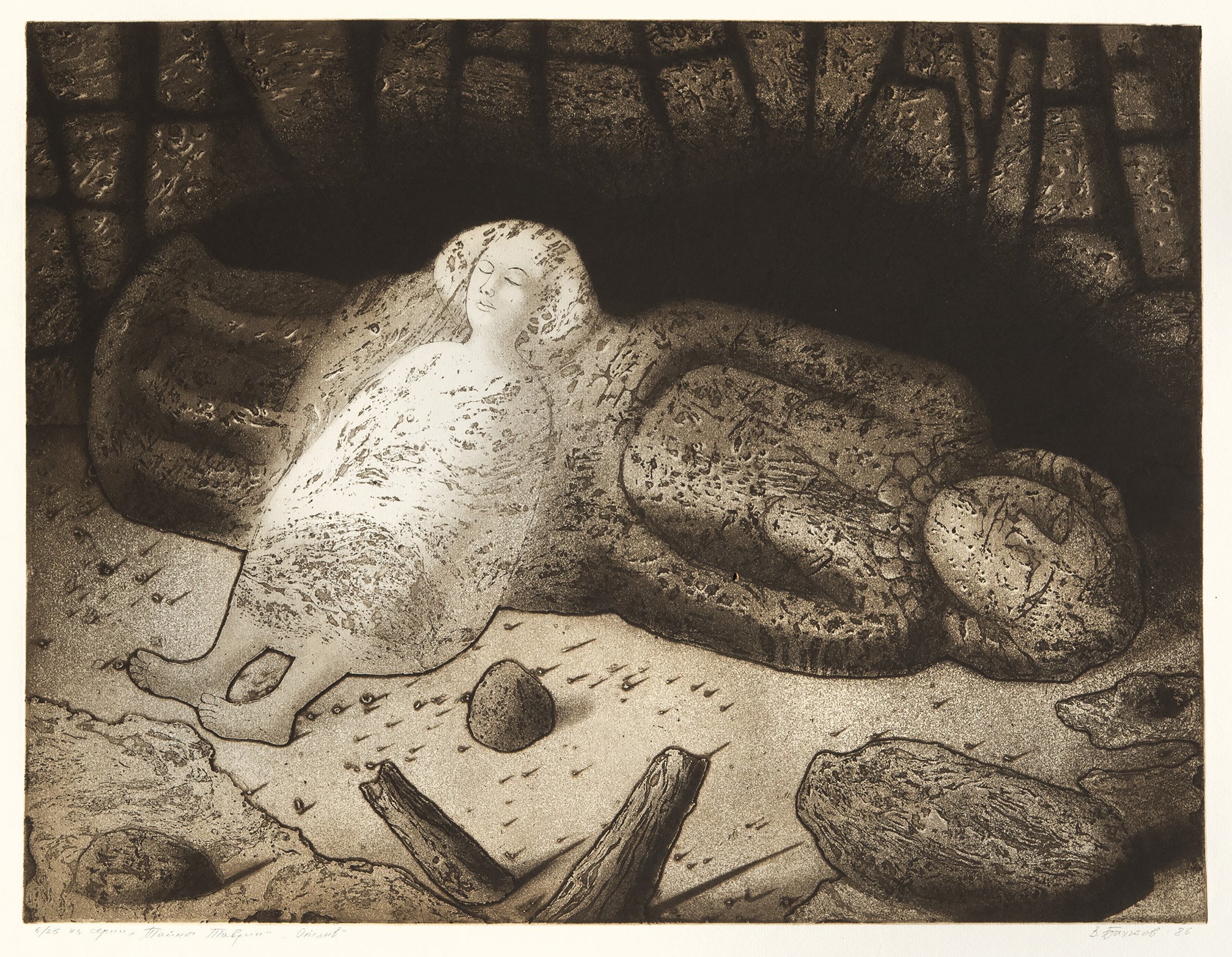
Ebb from the series Tavria's Mysteries, 1986. Etching and aquatint on paper, 49.8 × 64.9 cm (19 5/8 × 25 9/16 in.). Norton and Nancy Dodge Collection of Nonconformist Art from the Soviet Union. D07981

Squall, 1986. Aquatint and etching on paper, 49.9 × 58 cm (19 5/8 × 22 13/16 in.). Norton and Nancy Dodge Collection of Nonconformist Art from the Soviet Union. D07982
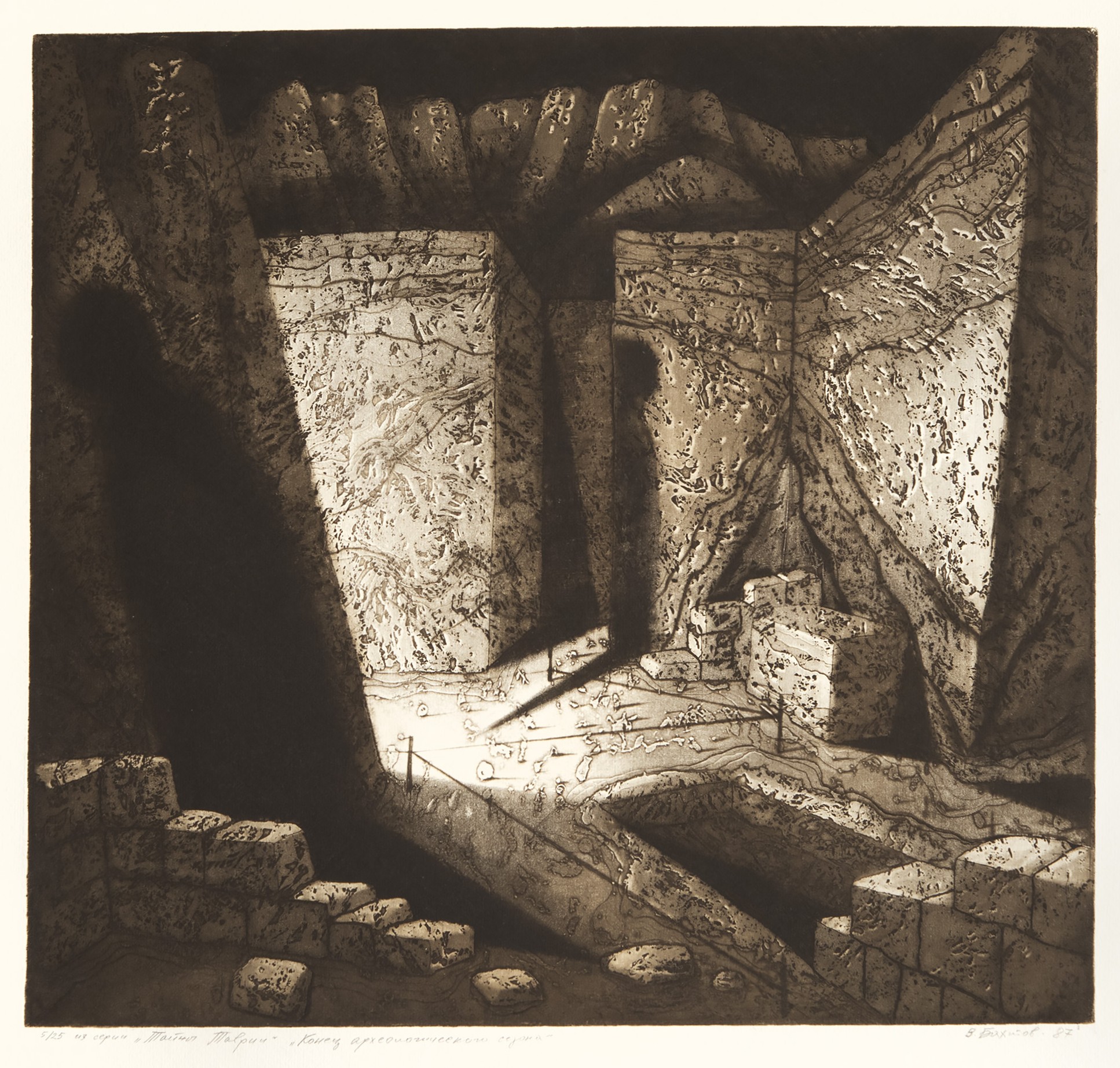
End of the Archaeological Season, 1987. Etching and aquatint on paper, 49.8 × 55.3 cm (19 5/8 × 21 3/4 in.). Norton and Nancy Dodge Collection of Nonconformist Art from the Soviet Union. D07983

Warm Stone, 1986. Etching on paper, 49.8 × 64.8 cm (19 5/8 × 25 1/2 in.). Norton and Nancy Dodge Collection of Nonconformist Art from the Soviet Union. D07984
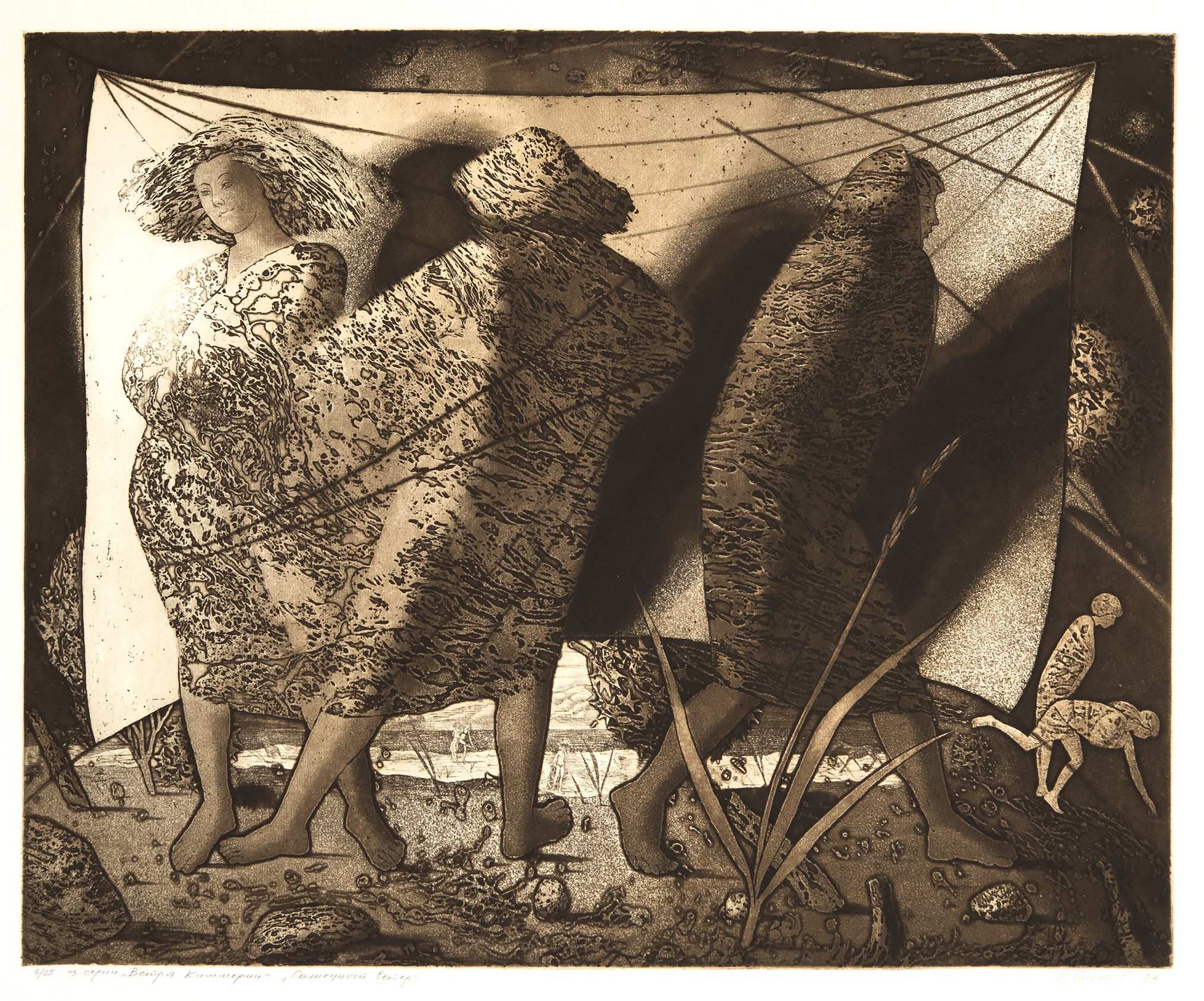
Solar Wind, 1986. Etching and aquatint on paper, 49.5 × 64.9 cm (19 1/2 × 25 9/16 in.). Norton and Nancy Dodge Collection of Nonconformist Art from the Soviet Union. D07991