
Vladimir (Vova) Kandelaki
1943 — Tbilisi (Georgia). Lived and worked in Tbilisi (Georgia), Philadelphia, PA (USA); currently lives in Tbilisi (Georgia)
Born in Tbilisi, Vladimir (Vova) Kandelaki emigrated to the United States in 1990. From his earliest years as an artist, his works satirizing the Soviet regime led to trouble with the authorities, including his exclusion from official Soviet exhibitions.
Kandelaki’s father, noted architect and caricaturist Andro Kandelaki, was a major influence, helping inspire his artistic leanings. His mother and grandmother introduced him to the world of fairy tales and literature and sparked his interest in folklore, which would figure prominently in his oeuvre.
In 1958–63, Kandelaki studied at Iakob Nikoladze Tbilisi Art College. In 1963–69, he completed graduate and postgraduate studies at the Tbilisi Academy of Arts. During his years at the Academy, Kandelaki and his fellow students created views of Tbilisi from the ancient fortress of Narikala. The artist produced views from other mountains as well, including Svaneti, in addition to a series of works devoted to Tusheti, a mountainous area in northwest Georgia. Since 1960, the artist has traveled to different parts of Georgia—Imereti, Kakheti, Khevsureti, Svaneti, and Tusheti—as well as to Azerbaijan, Chechnya, and Dagestan. During his travels, which lasted for decades, the artist amassed a collection of Caucasian weapons, musical instruments, and everyday objects such as dishes. And in 1998, he established a foundation to support Georgian culture; the foundation is no longer extant.
Beginning during the stagnation (zastoi) era of the 1970s, the artist depicted religious themes—themes that were prohibited, as the Soviet Union was officially an atheist nation. He also portrayed quintessentially Soviet motifs such as marches, parades, and feasts in a satiric or absurdist manner. The latter works speak to the ways in which the symbols that permeated all aspects of Soviet society were used to create a false sense of reality. The Soviet authorities discerned “dangerous” messages in both his series of feasts and his handling of national themes and sense of nostalgia, leading to critical attacks on his work and his frequent exclusion from official exhibitions.
Kandelaki’s critical slant became more pronounced from the late 1970s, when he turned to motifs such as blank banners, “Ilyich lamps” (light bulbs), and houses of cards—metaphors for a political system on the verge of collapse. For him, as for other nonconformist artists associated with sots art, parodying Soviet clichés, symbols, images, and motifs became a means of challenging the official style of socialist realism and all that it embodied.
In his extended series Ilyich Lamps (1979–97), Kandelaki turned to a motif ubiquitous throughout Soviet mass culture, which associated the titular Bolshevik leader with electricity and the power of light. The artist explored this theme in various media—paintings, graphic works, and assemblages—some of which are included in the Norton and Nancy Dodge Collection (ZAM, D14196, D10562, D10563, D10367, D10177, D10366). In some cases, the “Ilyich lamp” appears on the streets of Old Tbilisi; in other cases, it is pictured beside an electricity meter or as part of a parade procession. It is an integral component of his images of a house of cards (ZAM, D10365, D14196, 2001.0429, 2001.0423), in which the light bulb “sees” that these fragile pyramidal constructions cannot be reinforced by additional cards or scaffolding. These constructions, the artist suggests, will soon collapse like a house of cards, similar to what happened to the Soviet system (D10365, 2001.0429, 2001.0423).
Central to Kandelaki’s oeuvre is his native Tbilisi—which the artist has rendered as a dreamlike or fairy-tale version of the city of childhood memories, with old balconies seen against the backdrop of church silhouettes (when, in actuality, Tbilisi was now already full of Khrushchevkas, the ugly, standardized Soviet apartments erected throughout the Soviet Union starting in the Khrushchev Thaw). In Autumn (1983) and Autumn Celebration in Tbilisi (1984–85), Tbilisi is populated with wine vessels, huge foodstuffs—corn, wheat, pumpkins, grapes, pomegranates—and other symbols of fertility, loaded on wheelbarrows that are followed by throngs of people moving in festival processions.
In some instances, typical aspects of a Soviet parade—a huge hammer and sickle, flags, banners (often blank), and motifs such as trucks, tires, and boxes—invade a spring festival in the manner of a foreign body. In Day Before the Festival (1979–80), a truck that was to carry a giant globe with a red flag gets a flat tire, while preparation for the public holiday continues in the parallel world.
In the magical city pictured in Kandelaki’s Large City Bottle (1984), a jug has morphed into a house with a balcony, while the center is populated by Easter grass. [1] Its green hue contrasts with the overall tone and may be read as a symbol of life and renewal. The scene also features grapes on wheelbarrows and a plethora of traditional wine vessels—pitchers, jugs, bowls, horns—but it is obvious that the vitality of a Dionysiac festival has turned into a fever dream amid the Soviet reality.
Kandelaki has also created decorative compositions, in which, as in miniatures and murals, he combined different time periods and locales in a single image. The works evoke the concept of simultaneity, typical of Georgian medieval art. Images such as Decorative Motif (1967), Family (1968), Carrying of the Banner (1969, ZAM, D20954), Georgian Motif (1972, ZAM, D20702), and Muse (1972) feature other unusual combinations in the form of dichotomies: interior and exterior, real and mythical, secular and religious. Depicted outlined worlds are bound together as a whole in which figures of a woman and a child, luminaries, ornaments, humans, and animals are identified as signs of archetypal significance.
At various points of his career, Kandelaki also created objects and assemblages reminiscent of Robert Rauschenberg’s Combines. These works join everyday and antique objects—a suitcase, a cradle, a clock, icons, bottles, saddles, swords—with paintings, allowing the artist to narrate his personal identity, family, and past and contemporary reality.
In a series of works from the 1980s, the artist depicted another motif with symbolic resonance: the peacock (D10183, D14424). In this cycle, the beautiful bird represents the homeland or the creator. Since antiquity, the peacock has symbolized revival and beauty, eternal life, pride, and freedom. In Kandelaki’s memoirs, the artist points to another quality of this fantastic bird—it is the first to sense imminent danger, of which it warns fellow animals by screaming. [2] It tries to save itself on a high branch but it falls victim to the predator due to its long and amazing tail. One of the works in the Dodge Collection features just a feather in a cage (D00837). However, here, as well as in other works of the series, the cage is not fully intact; bars are removed in places, suggesting the possibility of liberating the captive bird. In several years, the fantastic creature would liberate itself—Georgia gained independence on April 9, 1991, several months prior to the dissolution of the Soviet Union in December of that year.
In 1990, prior to Georgian independence and the Soviet collapse, Kandelaki immigrated to the United States. After the initial difficult years following immigration, Kandelaki acquired his residence permit. In the early ’90s, he met the staff of the MORA Museum of International Art and then the collector Norton Dodge, who became interested in his work.
After immigrating, the artist continued to critique the Soviet system. From the early 1990s, the Soviet ruble, either torn or scattered, often appeared in his work as commentary on the unraveling of the Soviet Union. For instance, creased banknotes appear among cigarette butts or the remains of a fish meal in An Empty Nest (1993, current whereabouts unknown), while red banknotes with Lenin’s visage atop the US Capitol figure in works such as Gone with the Wind (1993) and Lenin in Washington (1992, current location unknown); the latter’s title can be read as an allusion to Soviet films such as Lenin in Poland (1966).
While living in Philadelphia post-immigration, as in his youth, the artist has explored the city’s streets and gardens, recording his impressions and sensations in collages featuring the use of text. Kandelaki also revisited the theme of feasts. A giant pumpkin, a recurrent motif in his processions, is “introduced” at Halloween. But in this new context, the feast’s formerly golden palette transforms into dark colors, and the image acquires a mystical aura. Also post-immigration, beginning in 1995, the tree of life began to reappear in the artist’s oeuvre; for earlier instances, see the two 1985 ink drawings from the Dodge Collection, both untitled (D11959 and D11960). As a universal symbol and archetypal motif in Georgian myths and legends, the tree of life is connective of worlds; in the unreal environment created by the artist, the oak is shown as a phantasmagoric creature that communicates with the viewer. Elsewhere, a tree’s thick trunk undergoes transformation and morphs into a sacred animal—a deer or bear. Inhabited by either butterflies or peacocks, the tree, which changes its mood and color (sometimes, blue; at other times, pink), grows only in a utopian landscape. To borrow the title of Kandelaki’s 1999 solo exhibition: for the artist caught “Between Two Worlds,” these magical trees personify a unifier of the worlds, so elusive in reality.
Ketevan (Keti) Shavgulidze
Translated from Georgian by Nino Gabunia
Notes:
1. A work titled Jug was seen as promoting alcoholism and removed from an exhibition at Moscow’s Manege Exhibition Hall.
2. ladimir Kandelaki, “Queen of Spades.” Artist’s website.
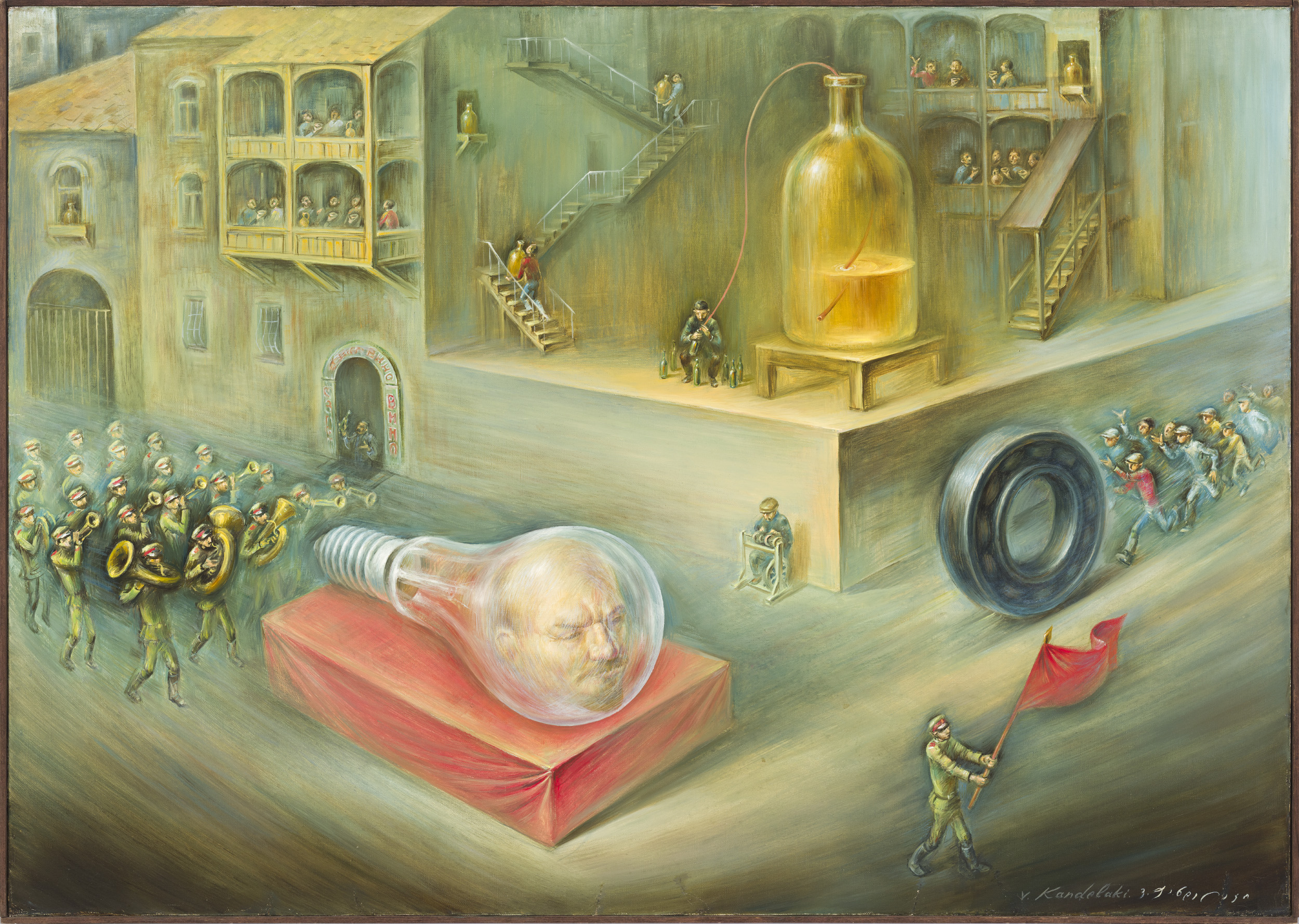
Illyich's Lamp and the Bearing from the series Holiday Parade, 1979–83. Oil on canvas, 80.5 × 114.5 cm (31 11/16 × 45 1/16 in.). Norton and Nancy Dodge Collection of Nonconformist Art from the Soviet Union. D10177
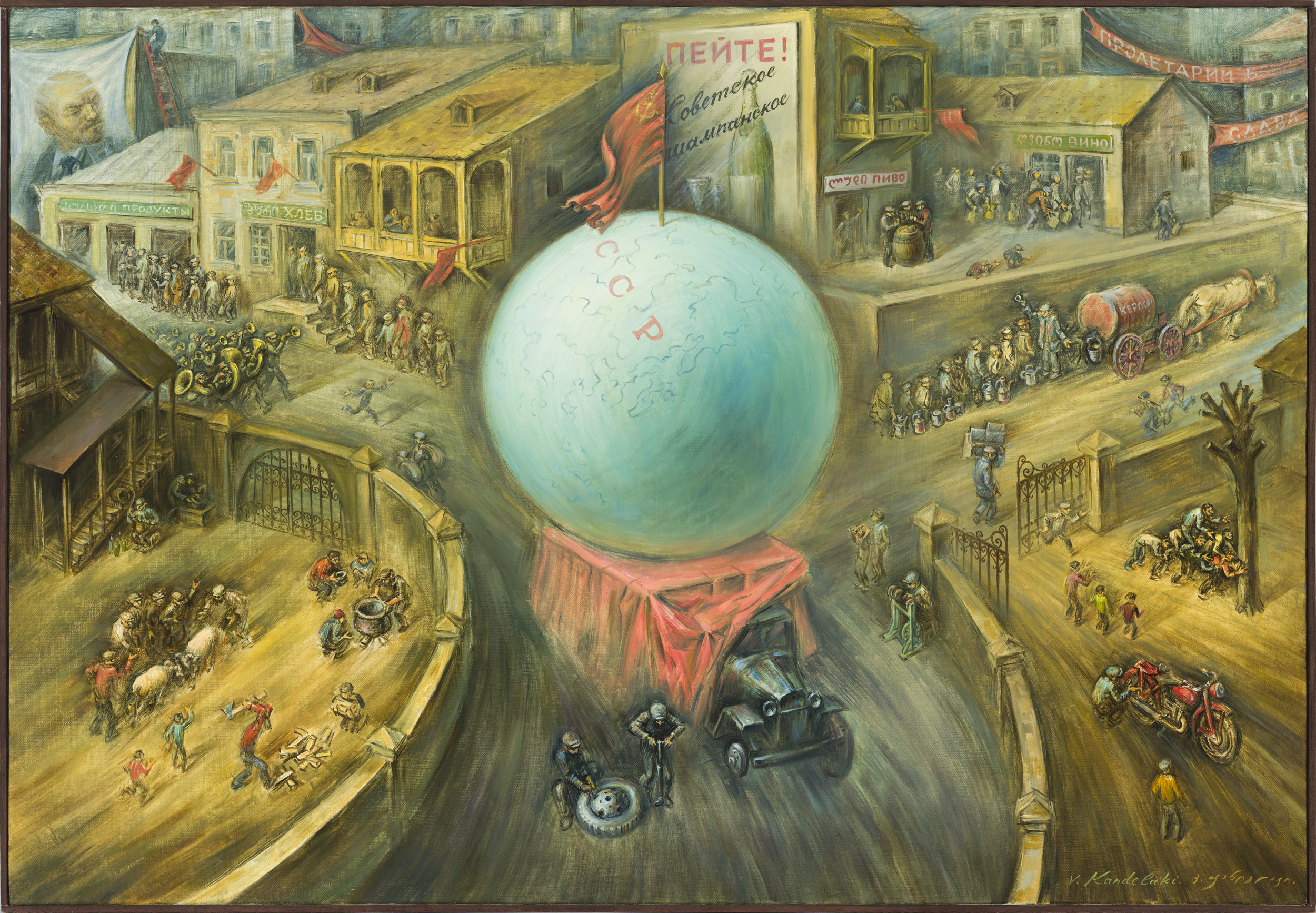
Parades, 1978. Oil on canvas, 80.5 × 115 cm (31 11/16 × 45 1/4 in.). Norton and Nancy Dodge Collection of Nonconformist Art from the Soviet Union. D10178
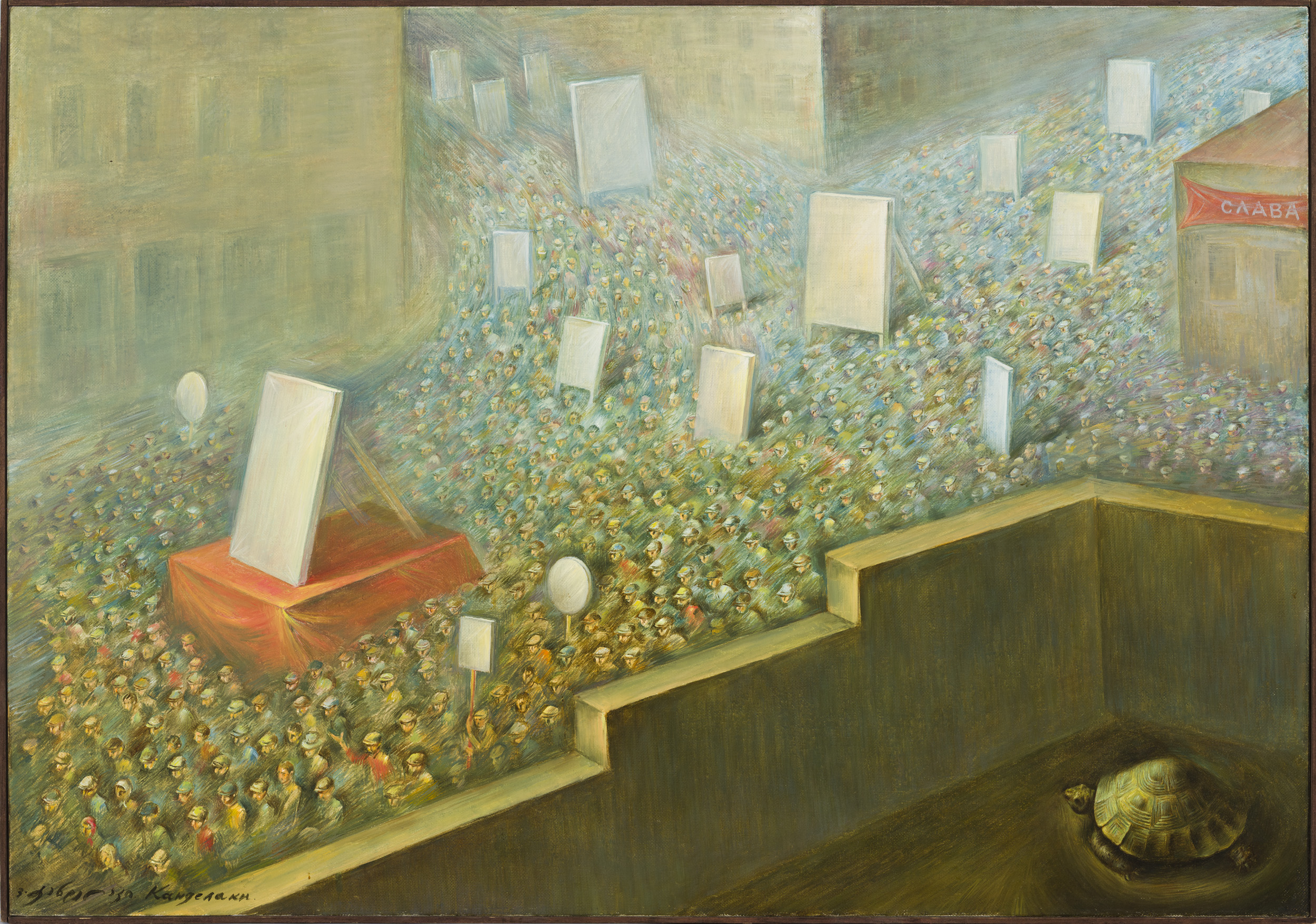
Faceless Parade—Hopeless Tortoise, 1985. Oil on canvas, 81 × 116 cm (31 7/8 × 45 11/16 in.). Norton and Nancy Dodge Collection of Nonconformist Art from the Soviet Union. D10179

Parade, 1979. Graphite on paper, 46 × 35.7 cm (18 1/8 × 14 1/16 in.). Norton and Nancy Dodge Collection of Nonconformist Art from the Soviet Union. D10562

Autumn Celebration in Tbilisi, 1984–85. Oil on linen, 80.5 × 174 cm (31 11/16 × 68 1/2 in.). Norton and Nancy Dodge Collection of Nonconformist Art from the Soviet Union. D16816
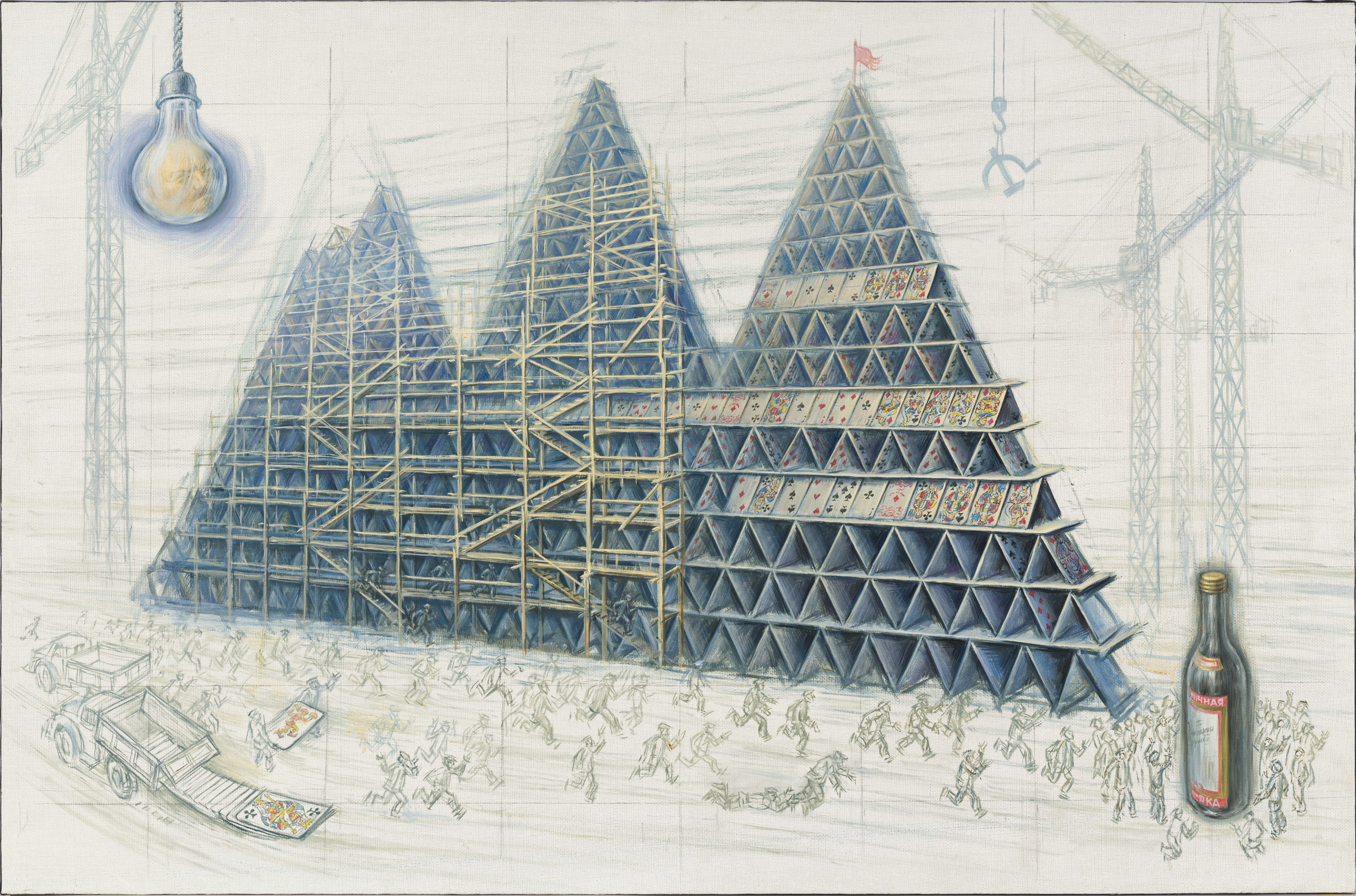
Untitled, undated. Oil on canvas, 95.8 × 145.5 cm (37 11/16 × 57 5/16 in.). Norton and Nancy Dodge Collection of Nonconformist Art from the Soviet Union. D14196
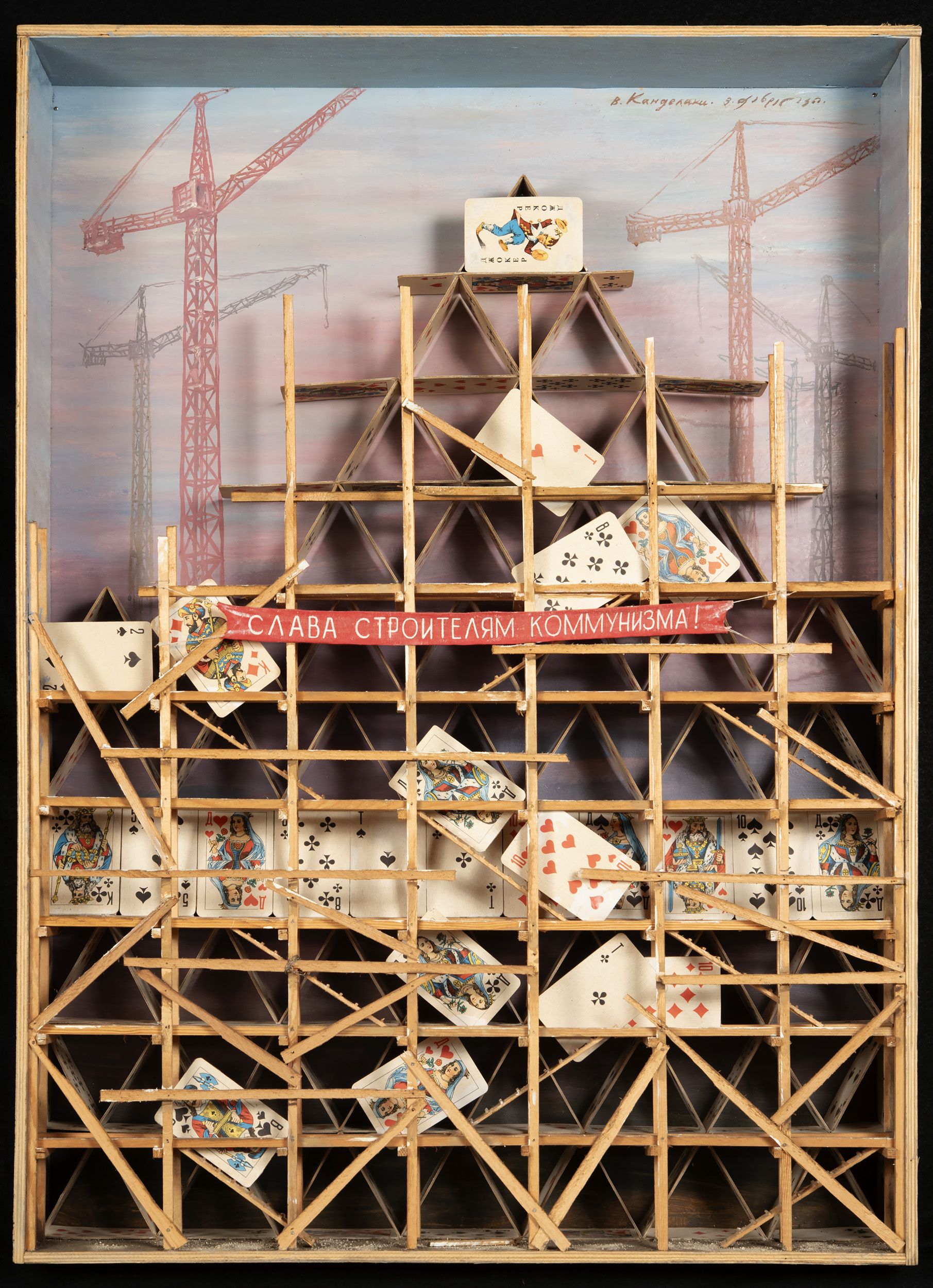
A House of Cards, 1986. Mixed media on panel, 91 x 66.5 x 13 cm (35 13/16 x 26 3/16 x 5 1/8 in.). Purchased with funds donated by Norton Dodge and Nancy Dodge. 2001.0423
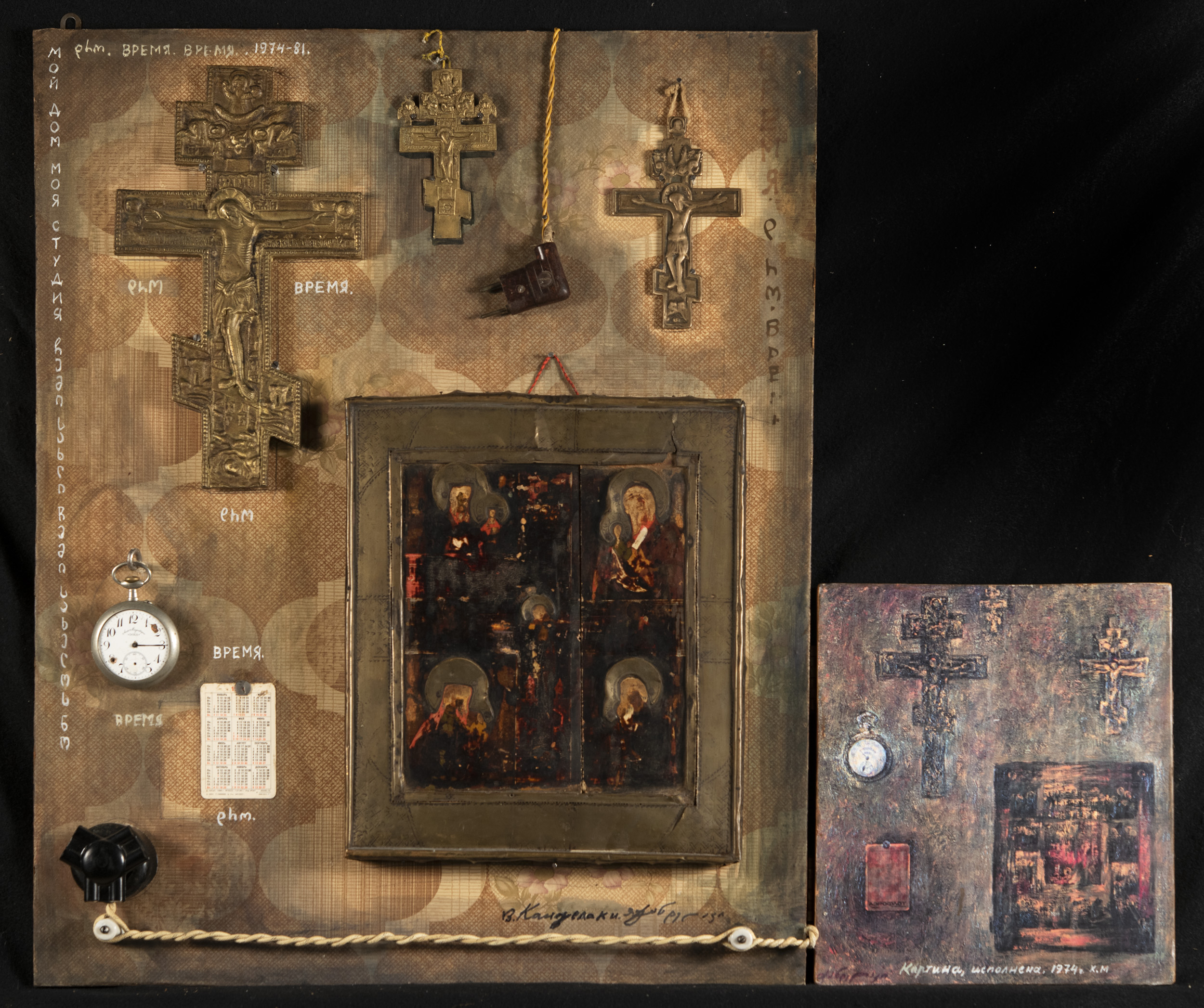
Time, 1974–81. Mixed media and collage on wood, 75 x 88 x 7 cm (29 1/2 x 34 5/8 x 2 3/4 in.). Purchased with funds donated by Norton Dodge and Nancy Dodge. 2001.0424
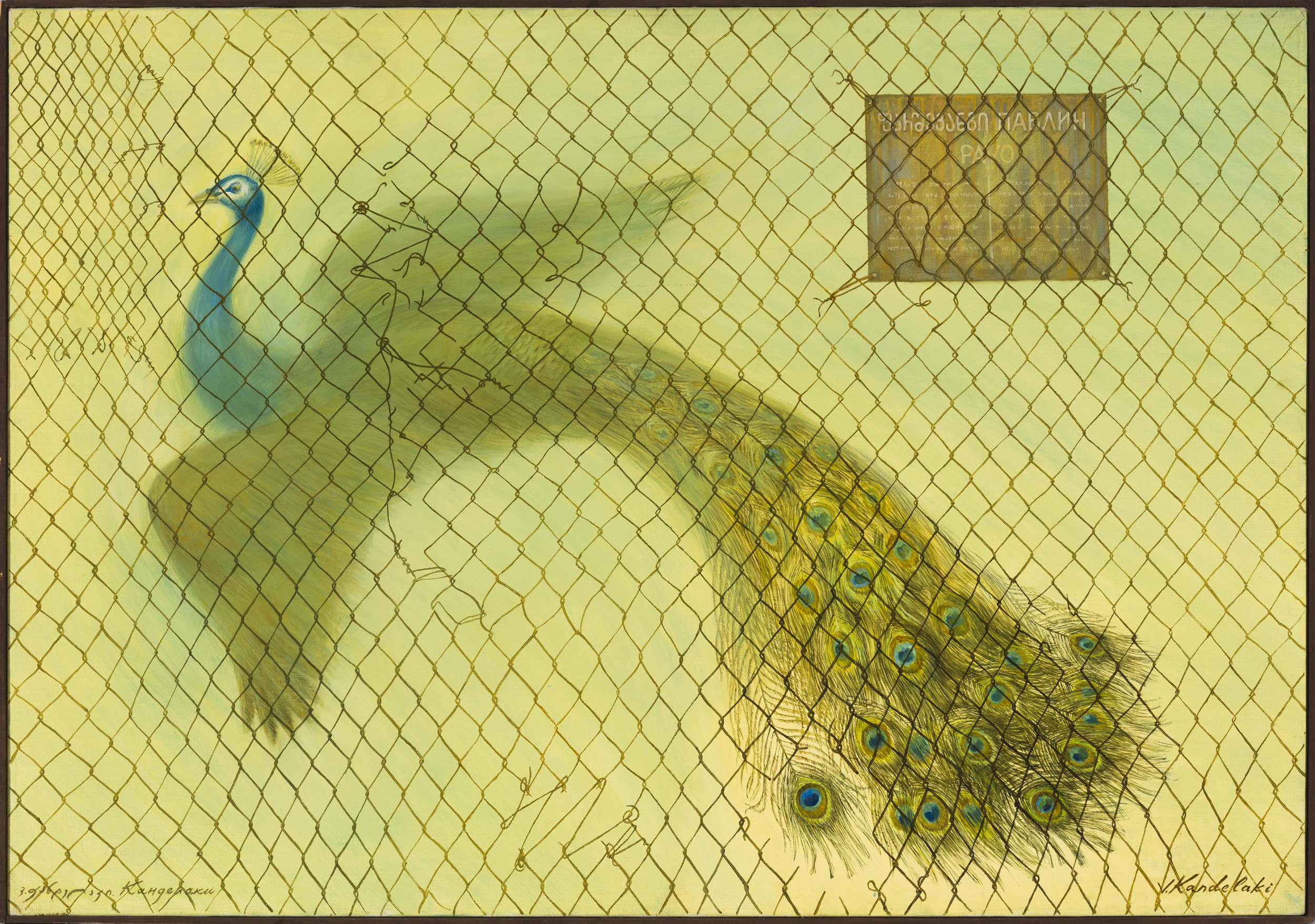
Peacock, 1984. Oil on canvas, 81.5 × 116.5 cm (32 1/16 × 45 7/8 in.). Norton and Nancy Dodge Collection of Nonconformist Art from the Soviet Union. D10183