
Vladimir Shinkarev
1954 — Leningrad (USSR) | 2026 — Saint Petersburg (Russia). Worked in Saint Petersburg (Russia)
Artist and writer Vladimir Shinkarev studied two disciplines in his youth: paleontology at Leningrad State University, beginning in the early 1970s, and painting and preparatory courses at the Mukhina Higher School of Art and Industry (“Mukha,” which today is the Stieglitz State Academy of Art and Design) along with drawing at the Academy of Arts beginning in 1974. He grew up in a family of geologists and worked with his mother in expeditions in the Urals during his childhood. He says that he did not write any of his books behind a desk: he wrote his first novel, Maxim and Fyodor, over the course of two years during boring operations in the Novgorod region, where he was investigating core samples extracted from swamps. It was published in 1980, when he was twenty-five years old. Maxim and Fyodor is the story of two friends, a Zen teacher and his pupil, both aesthetes and alcoholics. It spins itself effortlessly, and at the same time capriciously, here in the vein of The Tales of Ise, the tenth-century Japanese collection of poems, and there along the lines of Russian folk rhymes. Shinkarev printed six copies, and from the moment five of them went out into the world, he became a legend of underground samizdat postmodernism.
An ironic intellectual with diplomas from an English-language school and Leningrad State University, Shinkarev felt equally out of place as a student at the geology department and out in the field. It was his art studies that introduced him to a romantic brotherhood of young people who had rejected Soviet socialization for the sake of their own creative freedom. After assessing the unavoidable bureaucratization of the students at the Academy of Arts, a privileged ideological institution, Shinkarev—at the time working as a stoker in a boiler room—became close with the circle of artists around Mukha graduate Alexander Florensky (b. 1960). After connecting this group with another friend of his, Dmitry Shagin, Shinkarev invented an idiosyncratic philosophy of life and a collective nickname for the group, “Mitki” (1984). Mikhail Gorbachev’s perestroika was just beginning, and the publication of Shinkarev’s book Mitki in 1985 became one of the first signs of change. The book at once became a source of quotable lines and jokes. Тhe smart-aleck pacifism, good-naturedness, and insouciance of the Mitki group found an echo in youthful hearts all over the country, giving rise to a pilgrimage of young people from Moscow, Nizhny Novgorod, and other cities to Leningrad, which continued into the 1990s.
The 1980s were also when Shinkarev created his first famous paintings. He had been participating in unofficial exhibitions since the mid-1970s, and in 1981, he joined TEII, the Fellowship for Experimental Fine Art—the first official “labor union” of independent artists. In 1985, he began to exhibit his work as part of the Mitki group. On the eve of this event—his breakthrough to the forefront of life as part of a circle of friends—Shinkarev made a painting that was subsequently perceived as a masterpiece: Dancing Alone (1983), depicting a man awkwardly dancing in a room beneath a bare light bulb. The painting was a symbol of difficult times when a human being is especially lonely, since social interaction is impossible, and yet in the peripheral, private folds of this existence is left to himself and can experience the most profound freedom—the freedom of moving all of himself, even if in a confined space. From 1985 to 1989, Shinkarev created compositions depicting the life of Leningrad: Procession of the Cross, a view of a semi-forbidden—in those years—Easter night service in the Alexander Nevsky Lavra; and Going to Kindergarten, a landscape in a new housing development in which, in the predawn half-light of the northern city, a mother and daughter—two grotesque, bundled-up balls, one slightly bigger than the other—wander across the snowdrifts. The geological experience of Shinkarev’s childhood and youth also found expression in his painting: his murky ochre palette—only occasionally pierced by bright colors, which emerge like sprouts from the gloom—breathes the spirit of the womb of the earth. In his horizontal landscapes—the Gloomy Pictures series—the vacant space of the ghostly city of Saint Petersburg is swathed in the winds of the boundless northern sky.
In the 1970s, during his years of study, Shinkarev had become interested in the avant-garde artist Pavel Filonov’s idea of “made paintings” (sdelannye kartiny). In contrast with the diligently delineated details of Filonov’s compositions, however, “madeness,” for Shinkarev, pertains to the inner construction of empty space and the rhythm of freely moving words. By the 1990s, thanks to his inner discipline, he became a painter of the broadest scope, working in literally all traditional genres: landscapes, portraits, still lifes, and narrative compositions. These include the views of Saint Petersburg from the series Gloomy Pictures, which conclude the modernist tradition of the twentieth century; the series Nocturnal Still Lifes, which depict things in a frozen state of expectancy, as if they were replacements for human beings; the historical portrait of Peter I, radiating the blind energy of power; and finally, the painting Death (2002), in which the themes of death and the motherland contaminate one another (an old Soviet woman in a white kerchief in a hospital room in which all beds are empty).
The 1990s, however, demanded more of the artist. The view that painting was outmoded was gaining ground, as well as the idea that even if it was permissible in the space of a gallery or museum, it could appear only within the framework of a conceptual project. It took Shinkarev almost an entire decade to think through this challenge, and by the end of the century, he had created the first of his mega-projects—the painting cycle World Literature, which was exhibited at the Russian Museum in 1999. From that moment on, the unique position of Shinkarev as painter and thinker in contemporary Russian art and world art was confirmed. In the early 2000s, Swiss art dealer Bruno Bischofberger, who represented both Andy Warhol and Jean-Michel Basquiat, came to Saint Petersburg; in 2004, he saw the catalogue of the World Literature exhibition in the home of a translator and visited Shinkarev’s studio on Vasilyevsky Island. “What a handsome man!” Bischofberger said, clearly with reference both to the artist himself and to his spiritually elevating art.
In 2006, Shinkarev completed the next series of his Gesamtkunstwerk—the project World Cinema, which, after being exhibited in Saint Petersburg, was shown in Zurich and remained there. This was followed by World Painting, which in Russia was seen only by visitors to his studio, so quickly did it depart for Switzerland: Bischofberger aimed to possess all of Shinkarev’s work and published a two-volume catalogue of it. The figurative encyclopedia of literature, painting, and cinema that Shinkarev brought into being is, on the one hand, an exemplary conceptual catalogue of the highlights of world culture; on the other hand, though, it is the embodiment of a condition of living on the outermost margin of culture that is unique to Saint Petersburg: a romantic state of being on a sharp bright edge, at the junction with nonbeing. One might relate this feeling to the view from the Hermitage Museum—a museum of world masterpieces from whose windows may be seen the restless current of the Neva River, the cause of catastrophic floods and the route to the shores of the vast and vastly empty Ladoga Lake, a pivotal node in the passage “from the Varangians to the Greeks” and back again. Shinkarev’s work, in other words, combines a love for European cultural heritage (the “Greeks”) with a rough, brutal, and sometimes tragic worldview (the “Varangians”).
In his subtle, shimmering textures, Shinkarev reproduces not only great compositions and quotes from world masterpieces, from Fragonard’s paintings to Visconti’s films, from the paintings of Vasily Perov to those of Gustave Moreau, but the very fragility of the work of art, the creation of thought—its simultaneously worldwide and otherworldly way of life. Into the latest ideas of conceptual cultural studies with their taxonomic series, Shinkarev deftly implants a tragic and purely personal understanding of art as that absolutely powerless event, manifest only to a few, which nonetheless sustains life for centuries on end.
Ekaterina Andreeva
Translated from Russian by Ilya Bernstein
Photo portrait by Vladimir Peshkov
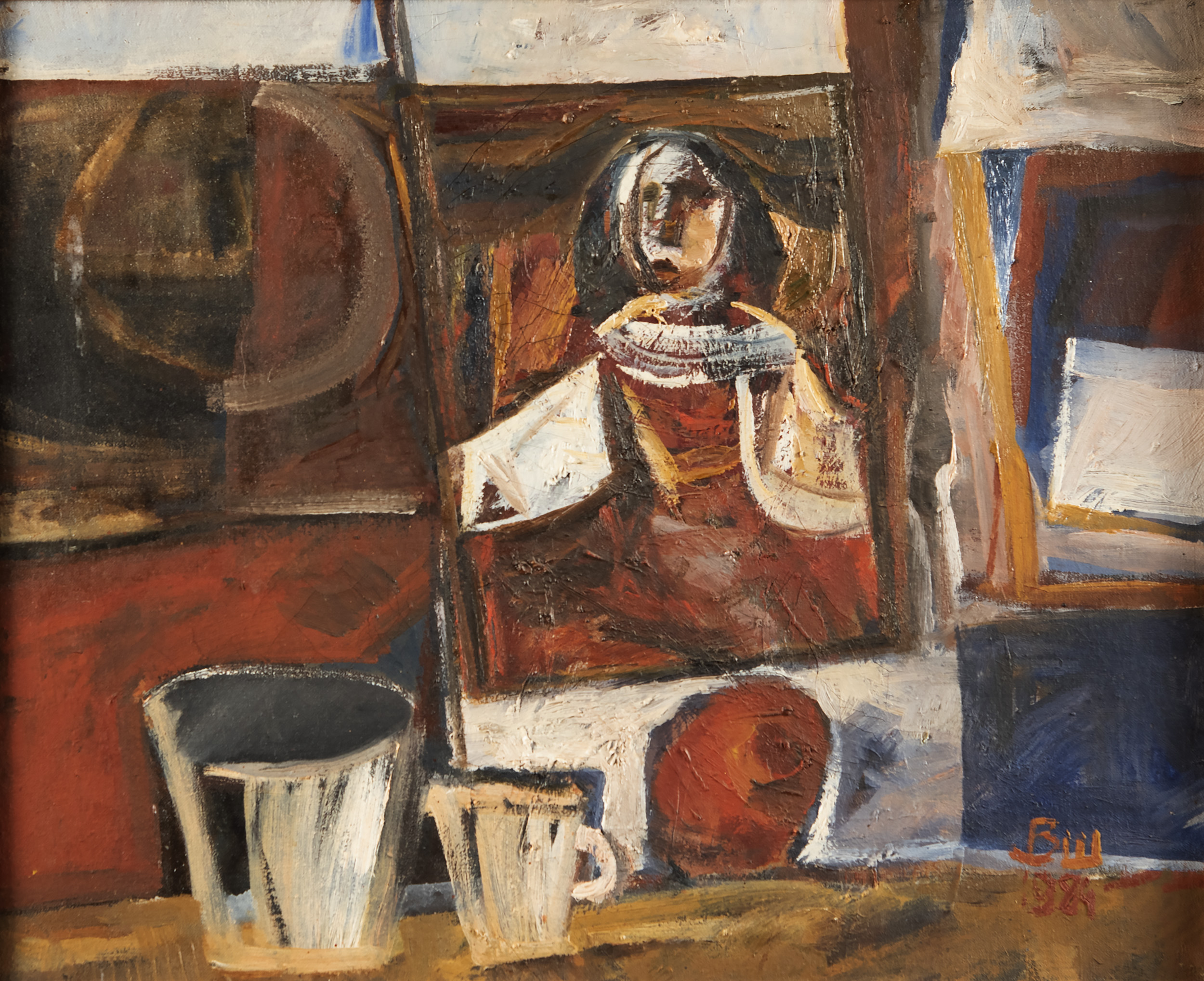
Still Life with Portrait, 1984. Oil on linen, 36 × 44 cm (14 3/16 × 17 5/16 in.). Norton and Nancy Dodge Collection of Nonconformist Art from the Soviet Union. D21983

Poppy Field, 1983. Tempera on plywood, 30 × 28.5 cm (11 13/16 × 11 1/4 in.). Norton and Nancy Dodge Collection of Nonconformist Art from the Soviet Union. D21218