
Vladimir Kotlyarov (Tolsty)
1937 — Moscow (Russia) | 2013 — Paris (France). Lived and worked in Moscow and Saint Petersburg (Russia), Paris (France)
Tolsty was born as Vladimir Solomonovich Kotlyarov in Moscow and acquired the nickname Tolsty (meaning “Fat Guy” in Russian) during his school years. He graduated from Moscow State University with a diploma as an art historian but hardly ever worked as a scholar, preferring odd jobs. A skilled restorer, he took part in the restoration of historical sites of the then-Soviet Crimean Peninsula (now Ukrainian, annexed since 2014 by Russia). There, he was in touch with underground artists and authors, and although he later claimed that the bohemian crowd did not fully accept him because he did not devote himself entirely to the arts but also worked at technical jobs, those encounters were important in forming his personality as a radical anarcho-nonconformist. [1]
Parallel to his study as an art historian, Tolsty also received instruction at a welding technology college and training as a military pilot, even taking part in military flights. He then worked as a programmer on one of the first Soviet electronic computer machines at a military plant. Later, he participated in geological expeditions in Siberia and programmed automated ticket-booking systems for Soviet railways.
In 1979, Tolsty gave up his membership in the USSR's Communist Party and moved to France with his wife and daughter. At Moscow's Novodevichy Cemetery, where his ancestors are buried, he left a cenotaph with his name and the dates “1937–1979” (the year he was born and the year he left the USSR).
In Paris, he immediately immersed himself in the large community of Russian-speaking emigrés. The writers and poets Eduard Limonov and Alexei Khvostenko and the artists Vagrich Bakhchanyan and Valentin Maria Til Samarin became his friends and allies. Proclaiming an art strategy that he named vivrisme (from the French vivre, “to live”), he declared that the very life of an artist should be regarded as their art, filled with passion and play, and that the body and soul are instruments for the creation of such art. He has called himself “a total artist” (un artiste total).
“This notion covers many aspects,” he wrote of vivrisme in 1982. “One of them is, as I think, that the artist is not only and not so much the organizer of space as the organizer of life. This is not far removed from biblical conceptions. And those who worked at Tassili-des-Ajjer, Altamira and Fond-de-Gaume, did they paint frescoes? No, they changed the way we think about life. They changed life itself! They were the first conceptualists.” [2]
As a part of vivrisme, Tolsty turned his correspondence with friends and colleagues into art, becoming Russia’s most prominent mail artist. The “postcards,” sent by regular mail, were pieces of hard cardboard much larger than standard postcards, decorated with glued-on photos and magazine cutout illustrations and glitter, with messages written in relief paint. Each piece was a palimpsest of texts and imagery, and as it was delivered throughout the world, even to the USSR, it acquired even more layers of unique personal history, along with numerous stamps and seals. Tolsty also used to mail three-dimensional objects, mainly found objects that he turned into works of art by means of redecoration, adding inscriptions and collages and sending them like parcels. Now, the largest collection of Tolsty’s mail art is kept in the Museum of Communications in Saint Petersburg, Russia, alongside other examples of the genre.
Apart from his mail art, Tolsty has converted other objects into art. He has covered currency notes with written poetic statements to the extent that their value could not be discerned. The notes became thick and hard from the paint layers and collage, and it is sometimes difficult to tell that such an object was once paper currency. As an anarchist, Tolsty resisted capitalism and the power money has over people; he wanted creativity, not gold, to be humanity’s most worshipped value. He explained his project as follows: “Money perverts humanity, turning men into criminals, martyrs and the damned. Poetry and art soften the soul and bring men closer to God! You warrior poets, help your fellow men, transform money into works of art!” [3]
Four years after his arrival in France, Tolsty started his own magazine, Muleta (the Spanish word for the bright red cloth that a corrida fighter uses to tease the bull). Tolsty was a bullfighting fan, and it might be said that he saw himself as a matador who stood against the mainstream Russian-emigré press, with its insipid lamentations against the Soviet regime. He wanted to publish authors who were passionate, impudent, and “improper,” such as Eduard Limonov or Natalia Medvedeva—fellow artists who were poets, musicians, and performers, all at once, turning their lives into art. Opposed to “being nice” and “behaving” in the Russian-speaking community or any other, he did not mind publishing a caricature that turned the face of Alexander Solzhenitsyn into that of Joseph Stalin. He also founded his own publishing house, Vivrisme, publishing his own texts as well as those by Yulia Kisina, Alexei Khvostenko, Yuri Arabov, and others.
Tolsty’s own life was a continual happening. He reacted to many world events and even anticipated some, as in 1981 when he appeared naked in Rome's Trevi Fountain, screaming “Keep the Pope safe!” He was arrested for a week by the Italian police, and soon after, an Islamist activist tried to assassinate the Pope. In the Paris Tuileries that same year, he “appropriated” bronze statues by hugging them and driving them into live actions that he called “visuance.” He explained the concept: “Visuance is a set of actions performed by the artist within the limits of time and space, using color (in painting), volume (in sculpture), movement and plasticity (in theater, pantomime), social situations (in life, for example). Visuance may or may not be accompanied by music, lighting effects and other complementary artifices, modifying the plasticity of the environment. The aim is to create a picture (or a world, a microwave, a macro-fantasy…). But the result is always extravagant and distinct from the course previously taken by life. Repetition of visuance is impossible.” [4]
After the collapse of the Soviet Union, Tolsty was a frequent guest in Russia but continued to live in Paris. He was happy that his works could be exhibited in his home country and that the Popov Museum of Communications in Saint Petersburg acquired his mail art for its collection. In 1990, Tolsty founded the Post Poésie poetry movement. Over the years, he participated in exhibitions in France, Italy, Germany, Austria, Russia, the United States, and Japan.
Anna Matveeva
Notes:
1. “I have burnt my life!,” fragments of 2004 interview with Vladimir Kotlyarov Tolsty, Art Investment, 2013.
2. Tolsty to Professor Felix Philippe Ingold, 1982. Artist's website.
3. “Money-art,” May 30, 2015. Artist's website.
4. “Visuance,” June 2, 2015. Artist’s website.

Untransliterated, 1985. Photograph on paper, 39.9 × 29.9 cm (15 11/16 × 11 3/4 in.). Norton and Nancy Dodge Collection of Nonconformist Art from the Soviet Union. D19308

He Took His Turn, undated. Oil, playing cards, and felt on canvas, 56 × 56 cm (22 1/16 × 22 1/16 in.). Norton and Nancy Dodge Collection of Nonconformist Art from the Soviet Union. D06111
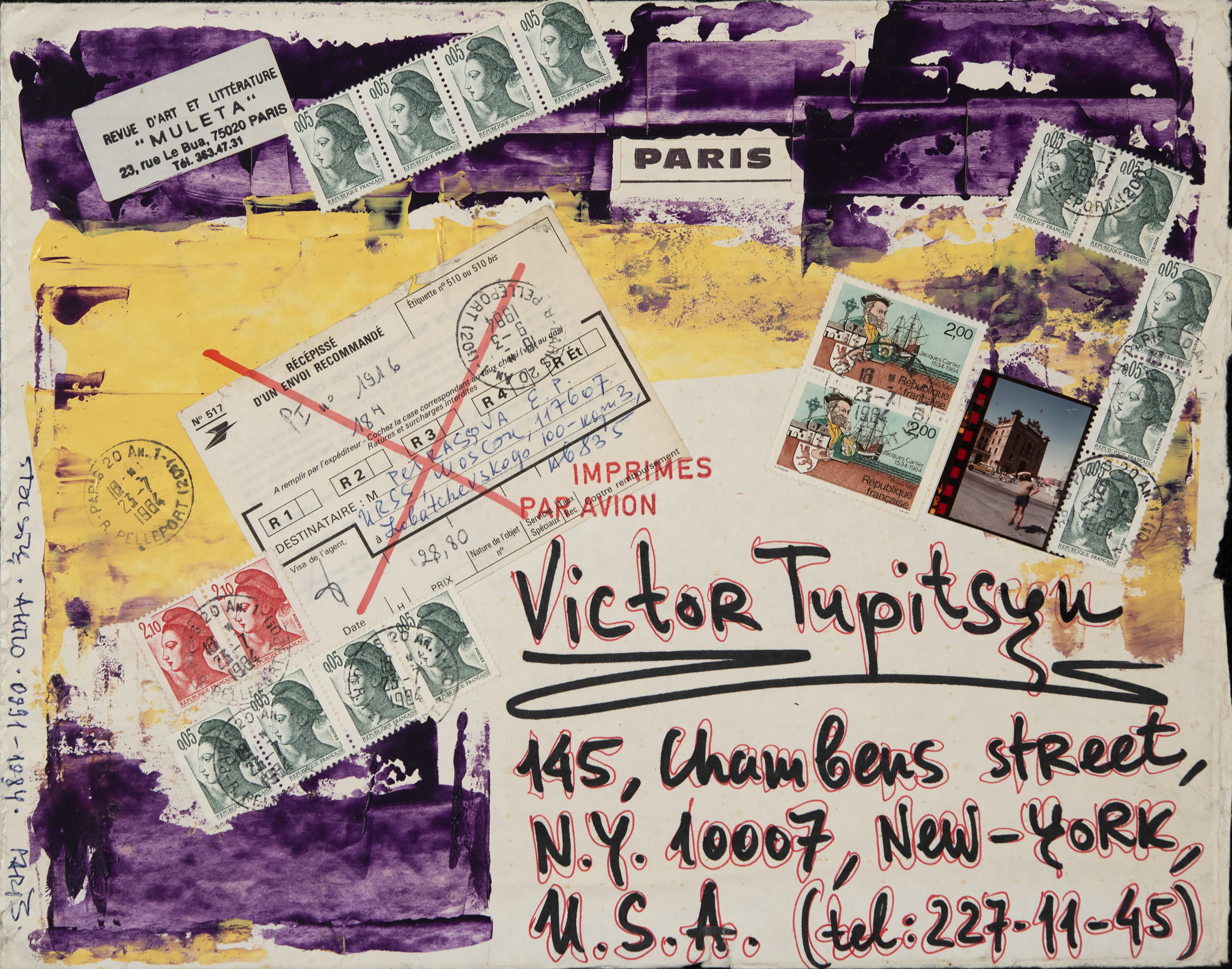
Untitled, undated. Collage on paper, 23.5 x 30 cm (9 1/4 x 11 13/16 in.). Norton and Nancy Dodge Collection of Nonconformist Art from the Soviet Union. D18921

N.3, 1979. Oil on canvas, 105.5 x 154 cm (41 9/16 x 60 5/8 in.). Norton and Nancy Dodge Collection of Nonconformist Art from the Soviet Union. D07741