
Vive Tolli
1928 — Tallinn (Estonia) | 2020 — Tallinn (Estonia). Lived and worked in Tallinn (Estonia)
Vive Tolli (née Pajusoo) was a prolific graphic artist and illustrator, as well as a highly recognized lecturer. She was one of the most remarkable innovators in Estonian printmaking in the late 1950s and ’60s. Tolli graduated from the State Art Institute of the Estonian Soviet Socialist Republic (now the Estonian Academy of Arts) in 1953. She created free compositions and also illustrated close to fifty books, including children’s literature, poetry, novels, and fairy tales. Most of Tolli’s work has been in intaglio, and her proficiency with copperplate became her trademark. Tolli’s oeuvre centers around universal themes such as nature, historical architecture in Tallinn’s Old Town, theater, and folk art. Her interpretations of the past also include works based on villages left empty after the mass deportations of Estonians under the Soviet regime.
For her graduation work, Tolli depicted the milieu of beach villages in Kalapüük Kihnu saarel [Fishing at Kihnu Island] (1953, Art Museum of Estonia). She was familiar with fishing and fishermen’s work from her summers on the Estonian island of Muhu and, from the 1960s, time spent at Lohusalu, where Tolli and her husband, the sculptor Lembit Tolli (1927–2013), had a summer house. She has emphasized that all the places, characters, and situations in her “fisherman’s epic,” from Muhu poiss [Muhu Boy] (1960) to Tühjaks jäänud kodu [Empty House] (1968) (both private collection), are taken from life. Tolli’s personal style of mediating folklore first emerged in Kuldpulma pilt [Golden Wedding Picture] (1963, Art Museum of Estonia), which depicts her ancestors. She stated that Estonian fairy tales and works by the notable Estonian poet Marie Under first inspired her to depict folk stories and ballads in free compositions during the early 1960s. [1]
Most of Tolli’s early works relate to bodies of water: fishermen, seaside scenes, and sea or lake-themed legends. Eventually, these bodies of water began to come alive with mermaids and other sea people and creatures. Merilehmad [The Sea Cows] (1963, Art Museum of Estonia), Rändav järv (Rändjärv) [Traveling Lake] (1967, ZAM, D19409), and Järve haud [Lake Grave] (1967, Art Museum of Estonia) were inspired by Marie Under’s ballads. The Sea Cows marks the emergence of folk poetry as a major theme for the artist, as well as her long creative connection with Under’s poetry. In 1967 Tolli made four graphic works about different lakes, each of which has its own story. Traveling Lake can be associated with legends that highlight humankind’s careless relationship with nature and its consequences. According to folk tradition, the lake can move from place to place and appear or disappear unexpectedly—as a punishment for polluting the water, for example, or violating some other communal prohibition.
Another of the artist’s themes is the garden. See päev kuulub aednikule [This Day Belongs to the Gardener] (1966, Art Museum of Estonia), Suletud aed [Closed Garden] (1966, ZAM, D19410], and Aednik [The Gardener] (1966, Art Museum of Estonia) relate to Tolli’s childhood summers on Muhu, as well as her move in 1965 from the city center to a house with a garden in the suburbs. Her garden images are very often based on medieval depictions of scenes from several different points of view at the same time.
Aed müüri varjus I [Behind the Walls I] (1974, ZAM, D05633) combines the mystery of the Gothic urban space and the motif of lush nature, creating symbolic “windows.” The work also evokes the Estonian capital Tallinn, one of the artist’s favorite subjects. The city’s Old Town is not only historic but also an inspiring living environment and cultural center. Depicting architecture has greatly diversified Tolli’s work, dictating novel spatial solutions, introducing complex rhythms, and making her art more polyphonic, as in Pika jala tänava maalid [Paintings on the Pikk Jalg Street] (1980, ZAM, D03834).
From the beginning of the 1970s, Tolli’s style gradually changed. The previous dark etchings were replaced by airy, light copperplate images. Sensitive contours began to play a more important role. After 1973, when the Finnish folklorist Leea Virtanen sent Tolli a copy of Oskar Loorits’s Religion of the Livonian People, Tolli delved more deeply into ethnographic topics.
Tolli has mentioned that a book by the English artist Laura Knight had an important impact on her creative life. [2 ] This influence is especially apparent in her depictions of the circus and the theater such as Duett [Duet] (1972), Torniteater [Theatre in the Tower] (1984), and Tantsiv eit [Dancing Doyenne] (1987) (all Art Museum of Estonia), as well as in her emphasis on different fabrics and woven materials as in Garderoob [Wardrobe] (1972, ZAM, D03945) and description of natural phenomena such as snow, fog, and wind as imaginary, spread-out fabrics.
In 1988, when the drive for Estonian independence gained momentum, Tolli started work on Koguja [The Collector] (1989, Art Museum of Estonia), which was dedicated to Jakob Hurt, one of the leaders of the national awakening movement in the nineteenth century.
In her later years, Tolli gradually moved away from mythology to a more self-expressive and abstract approach. She recalled that her encounter with abstract art happened relatively late in her career. The Estonian poet and critic Ilmar Laaban, whom she visited in Stockholm, introduced Tolli to modern art in the Stockholm Museum of Modern Art in the early 1960s. Although she had blended abstract elements with realistic ones in earlier works (as in her curved shapes representing the lakes of Porkuni or her combination of architectural forms and geometric details in her symbolistic gardens, where flowers resemble huge embroidery more than natural plants), Tolli reached full abstraction only in the last decades of her career. These works are more generalized than earlier work and use symbols with very broad meaning. Abstract etchings on the theme of folk art conveyed meaning in very dense images such as Põlispaik [Hereditary Farm] (1990, Art Museum of Estonia). At one point Tolli started using more silkscreen in works such as Ingele [To Inge] (1997), and later on her interest also expanded to chine collé, as seen in Ükssarv [Unicorn] (2008) (both Art Museum of Estonia).
The artist created several impressive compositions in different shades of her characteristic deep blue that are based either on a sacred space, as in Katedraal [The Cathedral] (1996–97, private collection), with the basic plan of Saint Mark’s Basilica in Venice); or on celestial phenomena such as the mystical, sensual Komeet [Comet] (1997, Art Museum of Estonia) or Jälg [Trace] (1997, Art Museum of Estonia), which presents a symbiotic dialogue between Earth and the sky. Tolli worked as a freelance artist until 1982, when she also began to teach at the State Art Institute. She rose to the rank of associate professor in 1987 and to a professorship in 1992. Students have almost unanimously stated that Tolli changed the prevailing atmosphere at the school. As a lecturer, she encouraged students to engage with philosophical topics, and she taught art individually and creatively, encouraging her students. Tolli’s home was a meeting place for cultural people for many years.
Eda Tuulberg
Photo portrait: Vive Tolli, 1982. Photo by: Kalju Suur. Eesti Kunstmuseum SA. EKM j 54909 FK 199
Notes:
1. Vappu Thurlow, Vive Tolli: Läbi kohtade aegade kätte (Helsinki: Fonet Kustannus OY, 2011).
2. Thurlow, Vive Tolli.
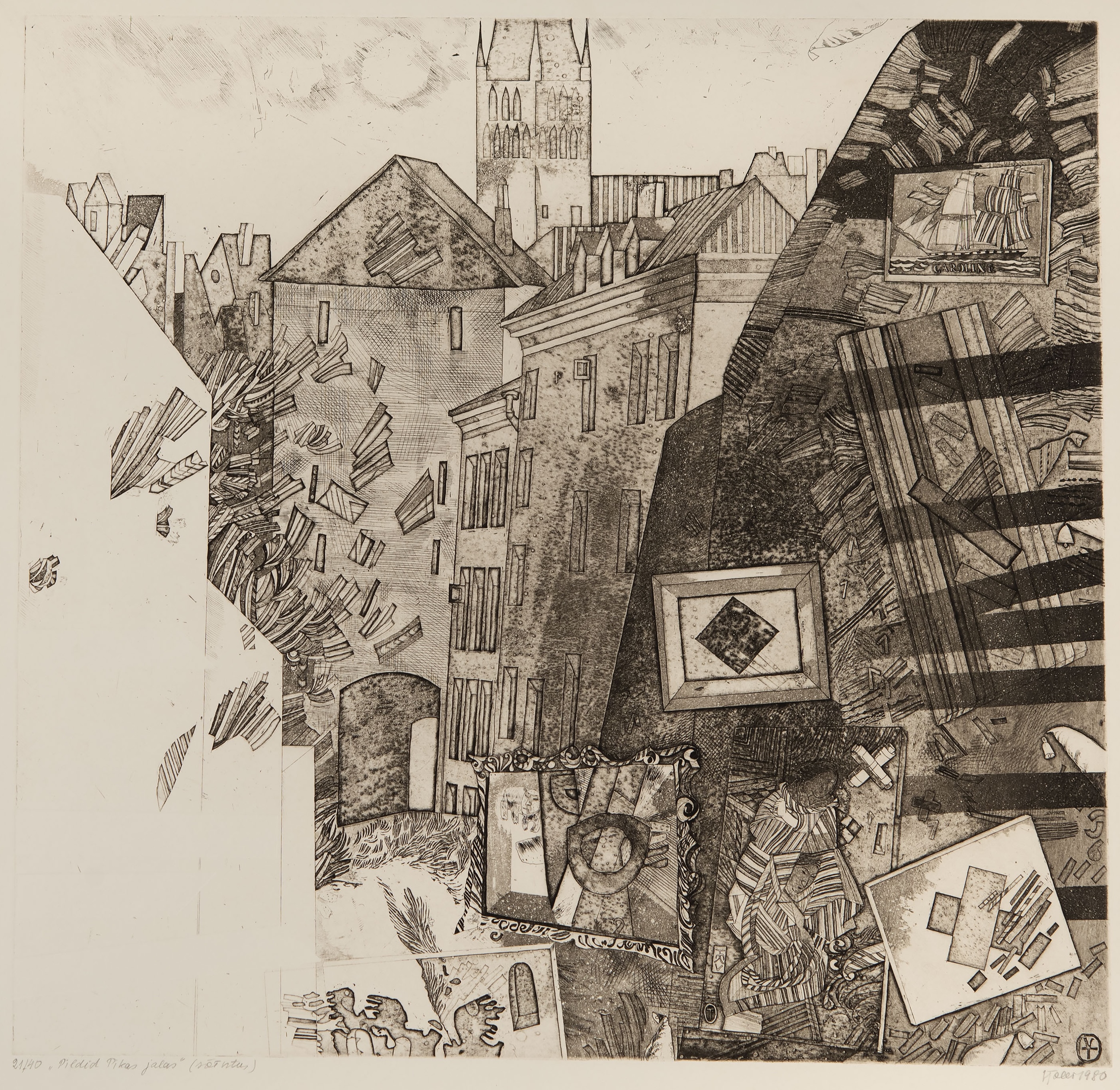
Paintings on the Pikk Zalg Street, 1980. Etching and aquatint on paper, 49.8 × 51.5 cm (19 5/8 × 20 1/4 in.) / 62.3 × 58.7 cm (24 1/2 × 23 1/8 in.). Norton and Nancy Dodge Collection of Nonconformist Art from the Soviet Union. D03834
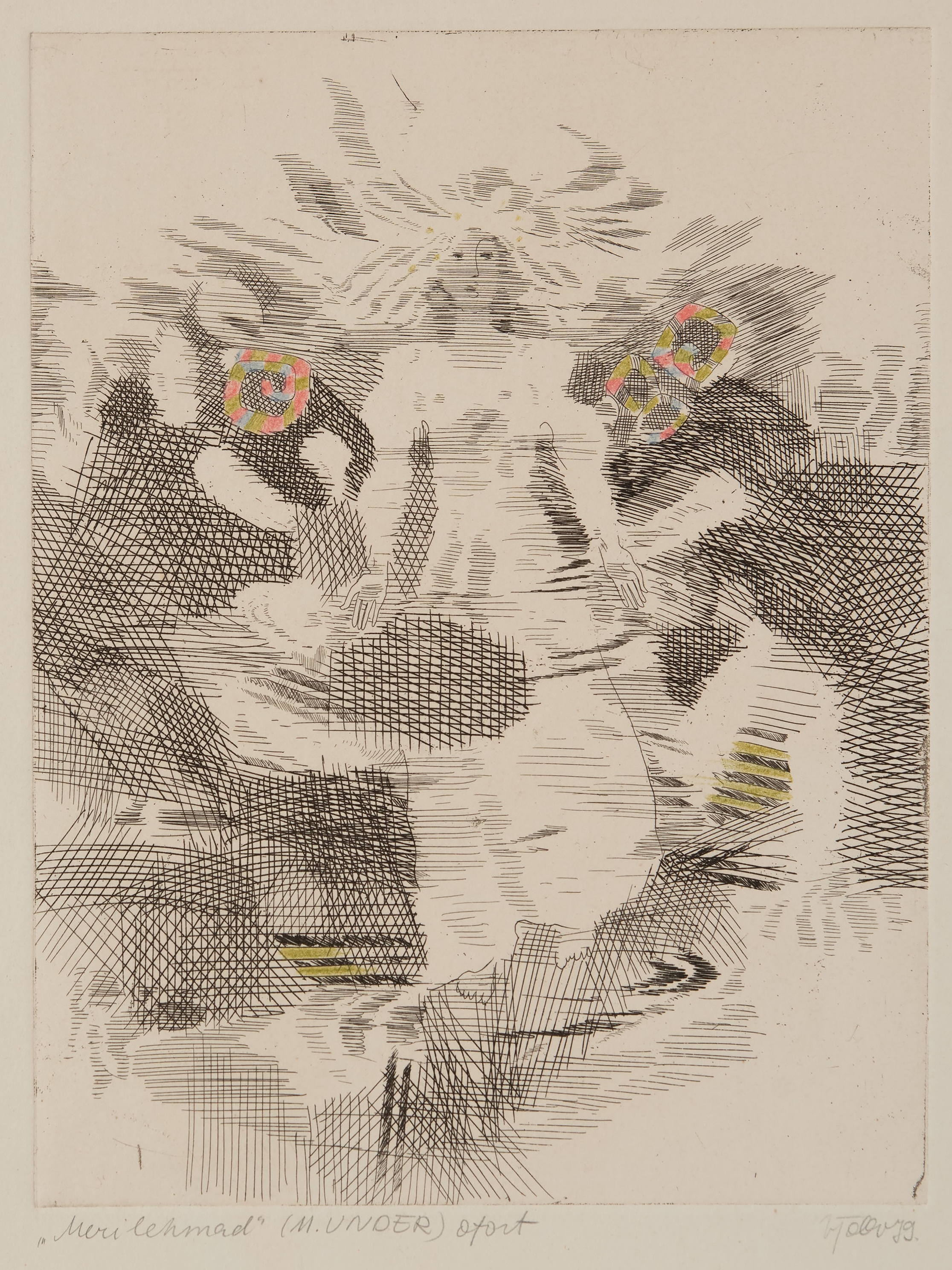
Sea Cows from the series Folk Motifs, 1979. Handcolored etching on paper, 22 × 17.6 cm (8 11/16 × 6 15/16 in.) / 38.3 × 23.6 cm (15 1/16 × 9 5/16 in.). Norton and Nancy Dodge Collection of Nonconformist Art from the Soviet Union. D03904
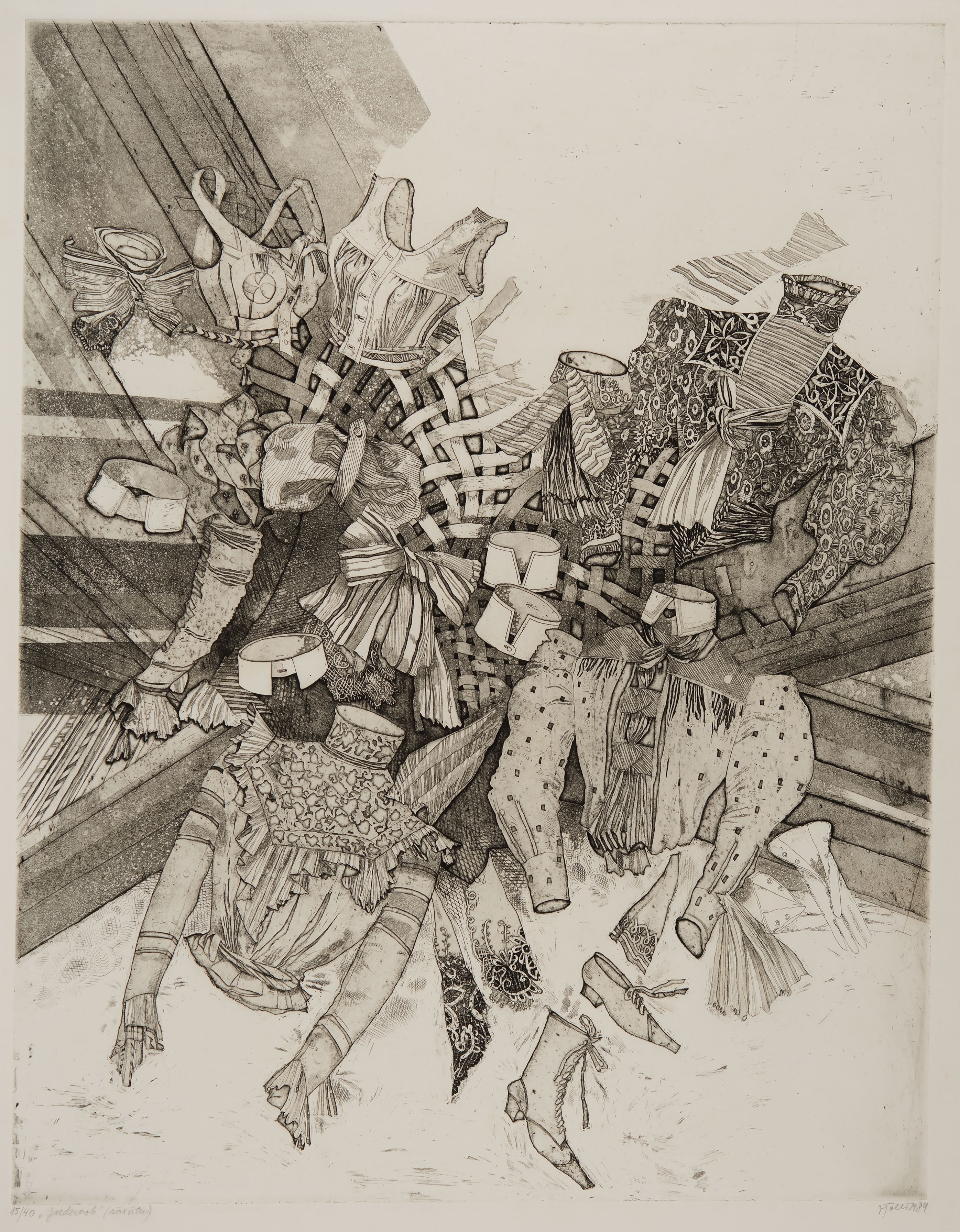
Wardrobe, 1984. Etching and aquatint on paper, 61.6 × 49.3 cm (24 1/4 × 19 7/16 in.) / 73.7 × 60.6 cm (29 × 23 7/8 in.). Norton and Nancy Dodge Collection of Nonconformist Art from the Soviet Union. D03945
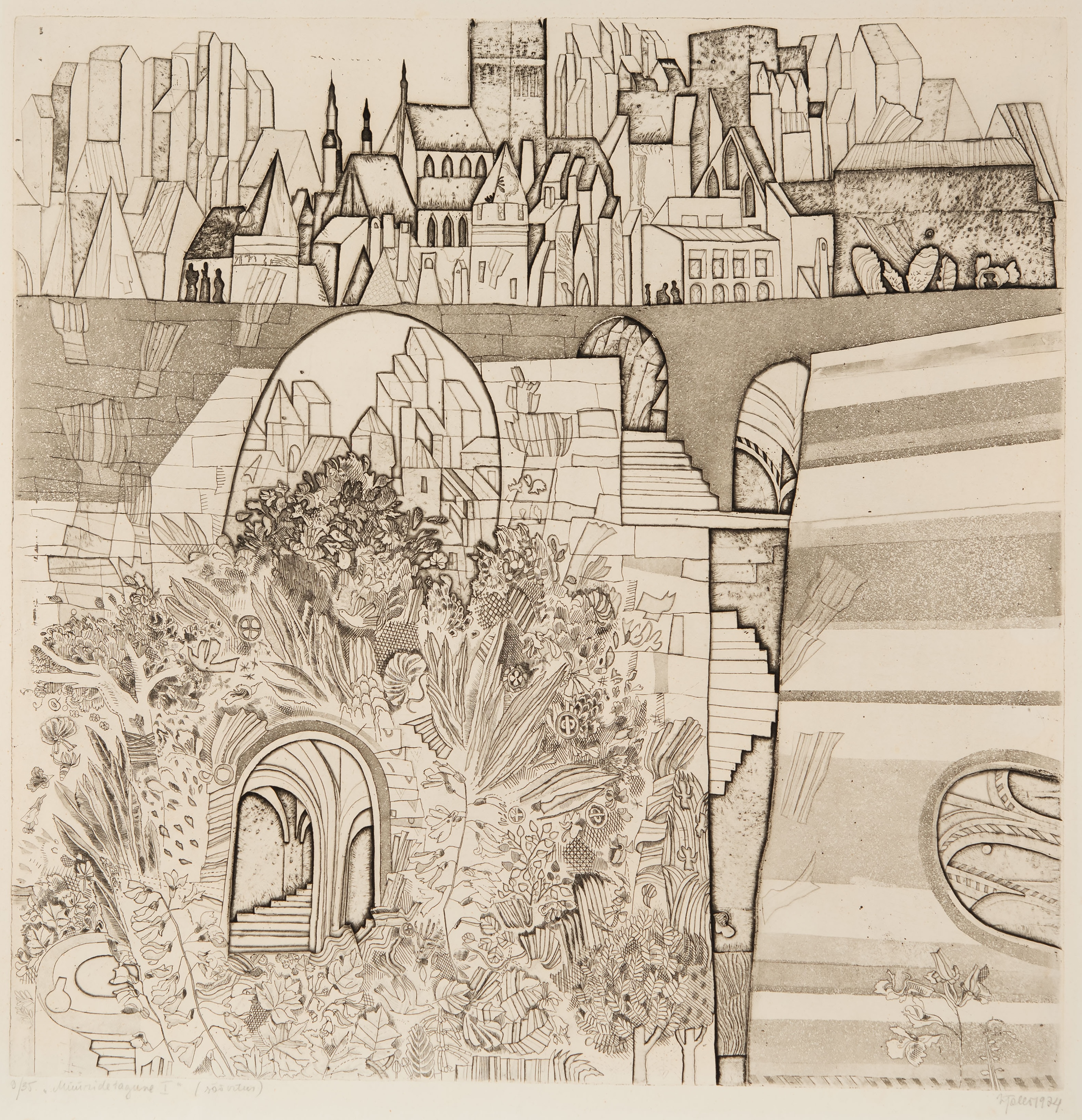
Behind The Walls I, 1974. Etching on paper, 49.3 × 51.4 cm (19 7/16 × 20 1/4 in.) / 58.3 × 58.9 cm (22 15/16 × 23 3/16 in.). Norton and Nancy Dodge Collection of Nonconformist Art from the Soviet Union. D05633
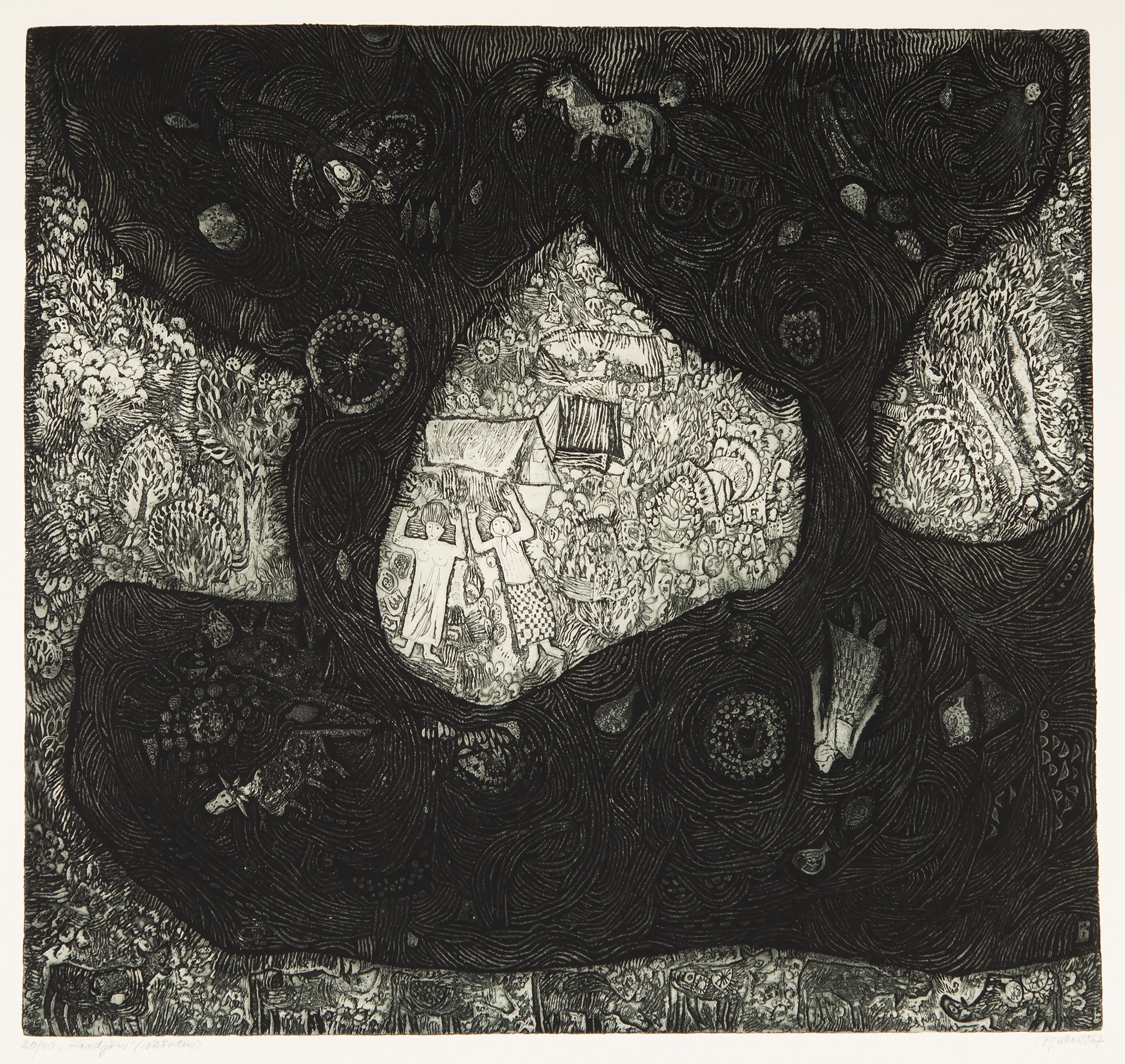
Traveling Lake, 1967. Etching on paper, 49.4 × 54.5 cm (19 7/16 × 21 7/16 in.) / 64.8 × 71.4 cm (25 1/2 × 28 1/8 in.). Norton and Nancy Dodge Collection of Nonconformist Art from the Soviet Union. D19409
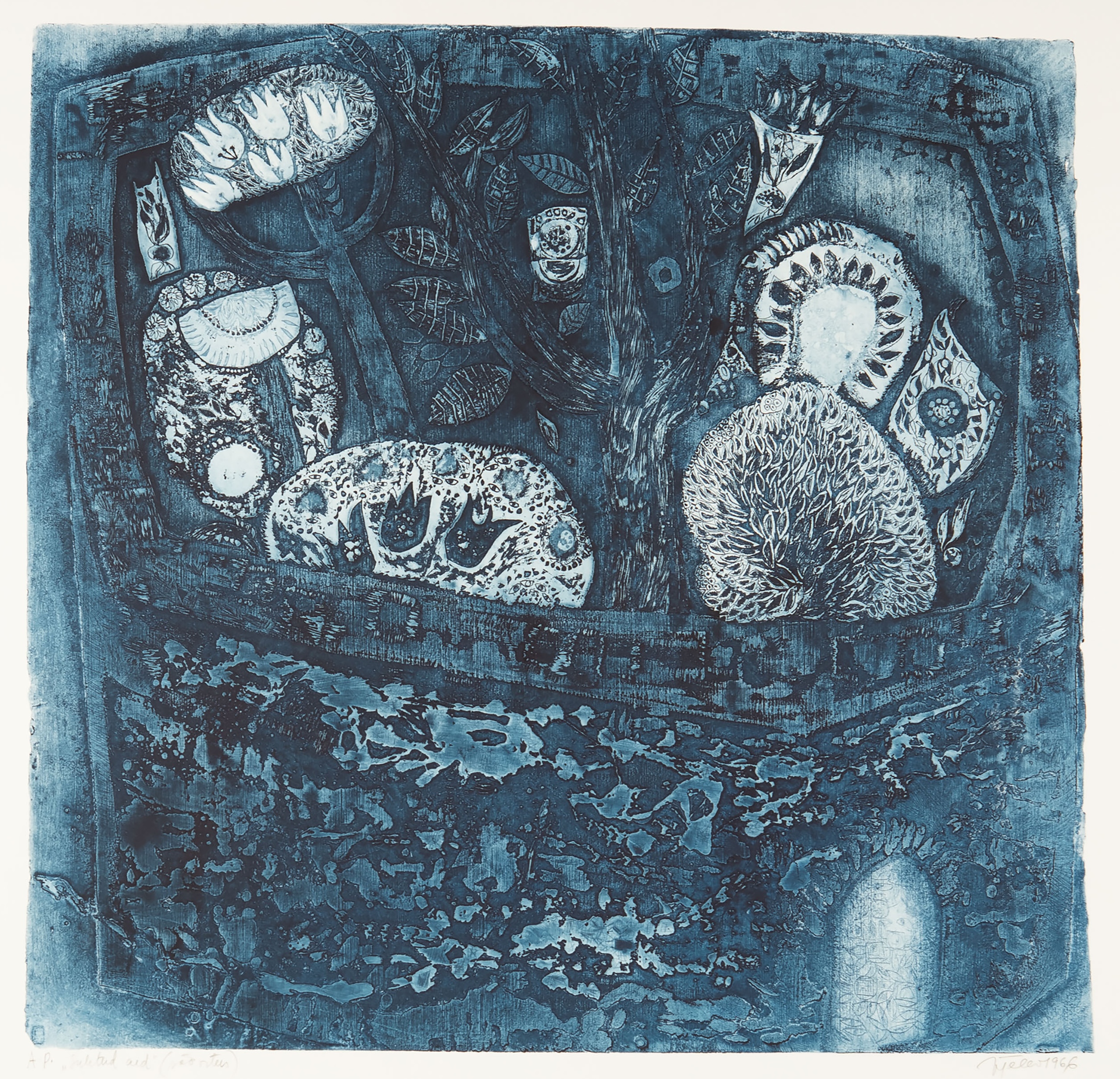
Closed Garden, 1966. Etching and aquatint on paper, 49 × 50 cm (19 5/16 × 19 11/16 in.) / 65.8 × 72 cm (25 7/8 × 28 3/8 in.). Norton and Nancy Dodge Collection of Nonconformist Art from the Soviet Union. D19410