
03/12/2016 - 07/21/2016

1962 — Leningrad (USSR) | 1990 — Tukums (Latvia). Worked in Leningrad (USSR)
Viktor Tsoi, the famous frontman of the band Kino, which has remained a cult favorite in Russia since the 1980s, was going to become an artist in his youth.
Like many bright Leningrad boys, he went to the Serov Leningrad Art School, informally known as Tavricheskaya Art School (now N. K. Roerich St. Petersburg Art School), from 1974 to 1977, and was even accepted at an art college, but instead he attended the vocational school SPTU No. 61 (Professional Technical School 61, now the art and restoration lyceum) and studied to be a cabinetmaker. He drew and carved netsuke figures, but then his musical career began to take off, and in just a few years he became quite famous. Art and music appeared in Tsoi’s life in parallel: his first band, with the ironic name Палата №6 [Palata 6, Ward 6] [1] was formed when he was in art school. Although Tsoi continued to explore both music and art, he chose to study at the art school’s design department.
He didn’t last long there, however: he was kicked out only a year later, for failing to meet academic standards. He worked at a factory and attended night school, but the monotonous work was so dull that his mother allowed him to quit and focus on self-development—he was only sixteen years old at the time. His mother said that this was the best decision of her life. [2] She recalled that Viktor read voraciously during that time, though Tsoi’s father said he did nothing at all for two years: “He lay belly up on the couch, maybe going to see friends once in a while.” [3] (It was during this time that Tsoi wrote the wonderful song Бездельник [Bezdel’nik, Slacker].) [4] Tsoi then applied to a vocational school to become a woodcarver and even worked for a short time in the restoration workshops of the Catherine Palace in Tsarskoye Selo (Russia). But the prestige of the place did not interest Tsoi—his passions were music and drawing, and everything that got in the way was a hindrance. So, in order not to be charged with social parasitism, [5] Tsoi found jobs that did not interfere with his creative work. Music was always a part of his life: he periodically played in the band Автоматические удовлетворители [Avtomaticheskiye udovletvoriteli, Automatic satisfiers], founded by the already famous punk rocker Andrei Panov (Svin); then, along with the guitarist Alexey Rybin, he started the band Гарин и гиперболоиды [Garin i giperboloidy, Garin and hyperboloids]—an ironic allusion to the title of Alexei Tolstoy’s novel The Hyperboloid of Engineer Garin—which, in 1982, became Kino.
The band was extraordinarily popular among young people in the Soviet Union during and after perestroika, and their songs are still celebrated today. Tsoi became an icon and remains one to this day. Alexander Gorbachev called him “the premier rock star in the history of Eastern Europe … A man who was certainly more popular in the Soviet Union than Jesus Christ, and at the same time was completely closed-off to the outside world.” [6] Perhaps that is what made him so magnetic: Tsoi gave off the aura of someone intimately familiar and yet unattainable.
With each successive album, the band’s rock music became lighter, and it eventually morphed into a New Wave sound. But its strength was in the lyrics, because their author, Viktor Tsoi, was first and foremost a poet, as these examples suggest:
“Those who ran away from home at fifteen / Aren’t likely to understand those who went to an elite school / Those who have a good life plan / Aren’t likely to think about anything else” (from the song Boshetunmay, on the album Gruppa Krovi [Blood Type], 1988); “We want to see further than the windows of the house across the street / We want to live, we are tenacious, like cats” and “We were born in cramped apartments in new districts / We lost our innocence in the fight for love” (both from the song Dal’she deistvovat’ budem my [We will take it from here], on the album Gruppa Krovi [Blood Type], 1988); “And there are still white, white days / White mountains and white ice / But all I need is / A few words / And space to take a step forward” (from the song Mesto dlya shaga vpered [A place for a step forward], on the album Zvezda po imeni solntse [A star named sun], 1989); “And able to reach the stars / Not thinking that it is a dream / And fall, scorched by a star / Named the Sun” (from the song Zvezda po imeni solntse [A star named sun], from the album Zvezda po imeni solntse [A star named sun], 1989).
Tsoi lived in a creatively rich period, as paradoxical as that may sound, given that these were the last years of Soviet stagnation. In parallel with the musical history of Kino and other Russian rock groups (Akvarium, Zoopark, Alisa, AVIA, Auktyon), artistic history was being written in Leningrad. The leader of the local young art scene of the 1980s, the artist Timur Novikov, along with his friend Ivan Sotnikov, organized the group Новые художники [Novye khudozhniki, New artists] in 1982. Soon it turned into a larger movement that was gradually joined by many young artists and musicians, including the band Kino—after all, half the members were artists. TheNew Artists, active 1982–91, included many now-famous personalities of the art world, Timur Novikov, Ivan Sotnikov, Oleg Kotelnikov, Evgeny Kozlov, Sergei Bugaev (Afrika), Inal Savchenkov, Andrey Khlobystin, and others; the electronic music band Novye kompozitory [New composers]; musicians of the band Kino; and Sergey Kuryokhin and his Pop-mekhanika [Pop-mechanics]. Tsoi was not the only musician who painted; so did the drummer Gustav (Georgy Guryanov, the modern painter whose works have fetched the highest prices) and Kino’s session bass guitarist, Andrei Krisanov. Gustav introduced Tsoi to Novikov, while Krisanov was already a member of the New Artists when he began to play in concerts with Kino. The artists sang, the musicians painted, and both wrote poetry and prose. Members of the New Artists designed Kino and Pop-mekhanika concerts, as well as some of Kino’s record covers— everything merged into a continuous creative flow.
Once Kino became famous, it was increasingly difficult for Tsoi to engage in his artistic practice consistently, but he often took part in the New Artists’ exhibitions. Evidence of his desire to continue to paint is a canvas with the text “Картину написать не успел” [Kartinu napisat’ ne uspel, I didn’t have time to paint the picture], (1989, oil on canvas, collection of Rinat Akhmetchin and Elena Akhmetchina), a kind of accidental conceptualism (irony was characteristic of both Tsoi’s poetry and his visual art).
Although Tsoi only managed to draw from time to time, he never stopped—he continued to draw marker-on-paper comic stories about square-headed men in the naive style of the American New Wave. The New Artists were aware of the works of their peers on the other side of the Iron Curtain quite early, and Tsoi was clearly influenced by New York artist Keith Haring, who was barely known at the time in the USSR, even in the artistic community (see note 8). Rather than oilcloths, he mostly used smaller pieces of paper and drew dynamic cartoon-like compositions with colored felt-tip pens. Novikov aptly described his friend’s works as “expressive shapes with elements of ornamental decorativism.” [7]
At the same time, Tsoi was also creating completely different works: bright paintings using an acidic acrylic in the style of Soviet magazine graphics. These works, done on paper or on small pieces of oilcloth, reflect his drawing talent. Like all of the New Artists, Tsoi also experimented with collage, making works that mocked the typical Soviet poster, including Untitled (boxer), 1986 (ZAM, D10210); Untitled (factory worker), 1986; and Untitled (cosmonaut), 1986. Just as Kino was in vogue at the time, so was the artwork of its members.
In 1984, the artists met the American actress and singer Joanna Stingray when she came to Leningrad. She was impressed by these talented young artists and musicians, and she fell in love with underground Soviet culture—and with Kino’s guitarist, Yuri Kasparyan, whom she married. The other members of the band and many of the New Artists were her close friends as well. In 1986, she brought recordings of the best Soviet rock bands back to the US and released the album Red Wave—Four Underground Bands from the USSR. She also showed the works of the New Artists to Andy Warhol, who sent signed Campbell’s soup cans back to Leningrad. [8] As Kino’s popularity grew, Tsoi was also invited to act in films—he acted in eight of them in the last years of his life. The most popular were Рок [Rock] (1988), by Alexei Uchitel; Игла [Igla, Needle] (1988), by Rashid Nugmanov; and Асса [Assa] (1987), by Sergei Solovyov. To this day, Асса, Tsoi, and Kino have a kind of cult status. Audiences went to see the film because of its stars, Boris Grebenshchikov and Viktor Tsoi (though only Grebenshchikov’s voice is featured, while Tsoi performs the song “Перемен” [Peremen, Changes] on stage at the end of the film). The song became a symbol of perestroika, although the musicians claimed that they were talking about changes within themselves and noted the date of the song’s creation—the beginning of 1985.
Even when Kino was popular, however, Tsoi continued to work odd jobs—since for the state, full attendance at semi-legal concerts did not signify employment. Despite the beginning of perestroika, socialist norms were still in effect, and another cult place for Tsoi fans appeared: Камчатка [Kamchatka] [9], a boiler house where many representatives of the informal Leningrad music world worked and where Tsoi got a job in 1986 and worked until 1988. [10]
During the filming of Асса, Tsoi met Natalia Razlogova, who worked on the film as an assistant director, and he decided to move to Moscow with her. There, he began to draw more, in the style he’d already established. For him, drawing was a way to relax in between rehearsals and concerts. The couple spent the summer of 1990 in Latvia with friends. Early in the morning of August 15, Tsoi—who had only recently learned to drive—left to go fishing. He fell asleep at the wheel and got into a fatal car accident. At that moment, the music playing in his car was that of his friends’ band New composers.
Yulia Lebedeva
Translated from Russian by Jane Bugaeva
Photo portrait by Sergei Borisov, 1985
Notes:
1. An ironic title referring to Anton Chekhov’s story about an insane asylum.
2. Tsoi, Valentina Vasilievna. “The Legend of Viktor Tsoi.” In the book Viktor Tsoi. Poems. Documents. Recollections. Saint Petersburg: Novy Gelikon, 1991.
3. Quoted from an interview with Viktor’s father, Robert Tsoi, in the newspaper Komsomolskaya Pravda in 2010.
4. “How to write songs lying on the couch: ‘Bezdelniki’ [Slackers] by Viktor Tsoi and the band Kino.” Yandex Dzen, December 7, 2024.
5. In the Soviet Union, it was unlawful to be unemployed. In this regard, it was especially difficult for creative people who could not legalize their artistic activities in any way and were obligated to get jobs in the service sector. Singer Boris Grebenshchikov sang about his friends in the 1980s: “a generation of janitors and watchmen.”
6. Gorbachev, Alexander. Viktor Tsoi. The Hero’s Journey. Biopic exhibition “Viktor Tsoi. The Hero’s Journey.” DI Dialogue of Arts. MMOMA Magazine, no. 1, 2022: 101-102
7. Artist Viktor Tsoi. [Exhibition brochure] Saint Petersburg : New Academy and Institute of History of Contemporary Art, 2001
8. This story is described in detail in the article “The History of Andy Warhol’s Gifts to Leningrad Artists,” by Ekaterina Andreeva, in Interkontakty. From the History of International Artistic Relations of Leningrad. St. Petersburg in the Last Quarter of the Twentieth Century. Collection of Articles and Materials. St. Petersburg: Institute of History of Contemporary Art at the St. Petersburg Archive and Library of Independent Art, Free Culture Partnership, 2000.
9. Today, Камчатка [Kamchatka] is the Club-Museum Kotel’naya Kamchatka [Kamchatka boiler room].
10. In 1984, Kino released the album Nachal’nik Komchatki [Kamchatka boss], but Tsoi did not get a job at the Kamchatka Boiler Room until 1986.

Happy New Year, 1986. Pastel and collage on paper, 52.8 × 46.5 cm (20 13/16 × 18 5/16 in.). Norton and Nancy Dodge Collection of Nonconformist Art from the Soviet Union. D10217
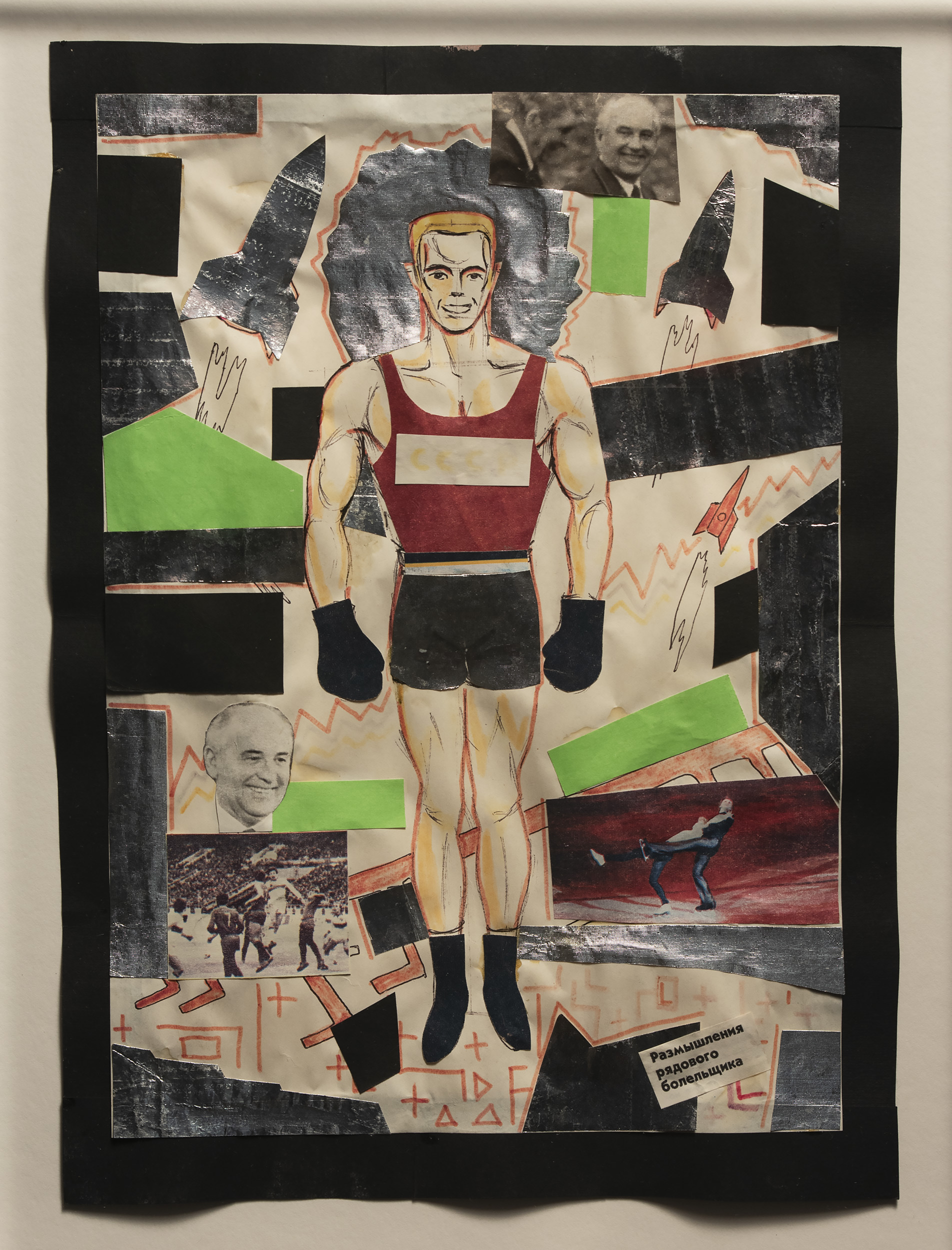
Untitled (boxer), 1986. Ink and paper collage on paper, 33 × 24 cm (13 × 9 7/16 in.). Norton and Nancy Dodge Collection of Nonconformist Art from the Soviet Union. D10210
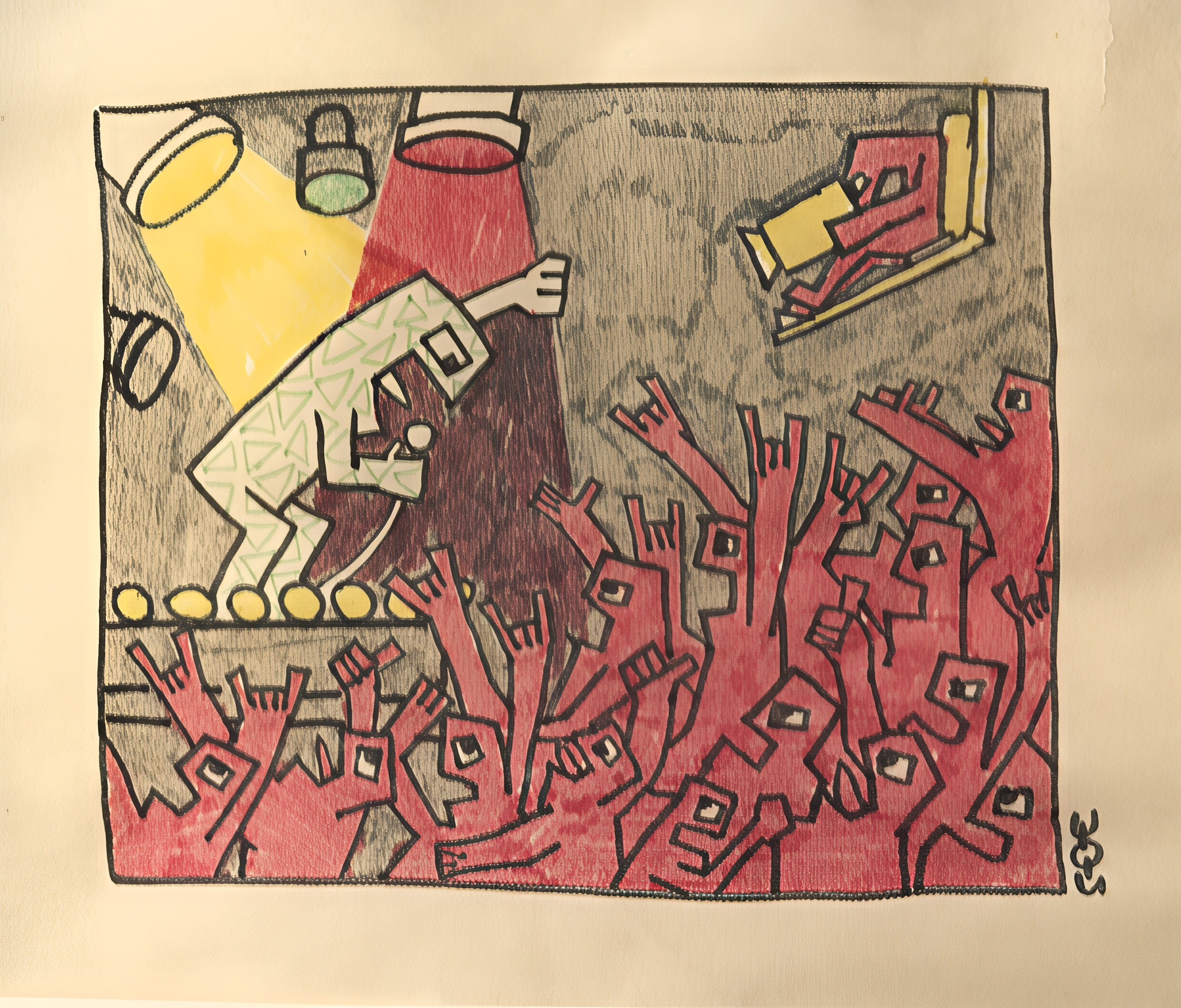
Untitled, 1985. Felt-tip pen on paper, 13.3 × 16 cm (5 1/4 × 6 5/16 in.). Norton and Nancy Dodge Collection of Nonconformist Art from the Soviet Union. D10228
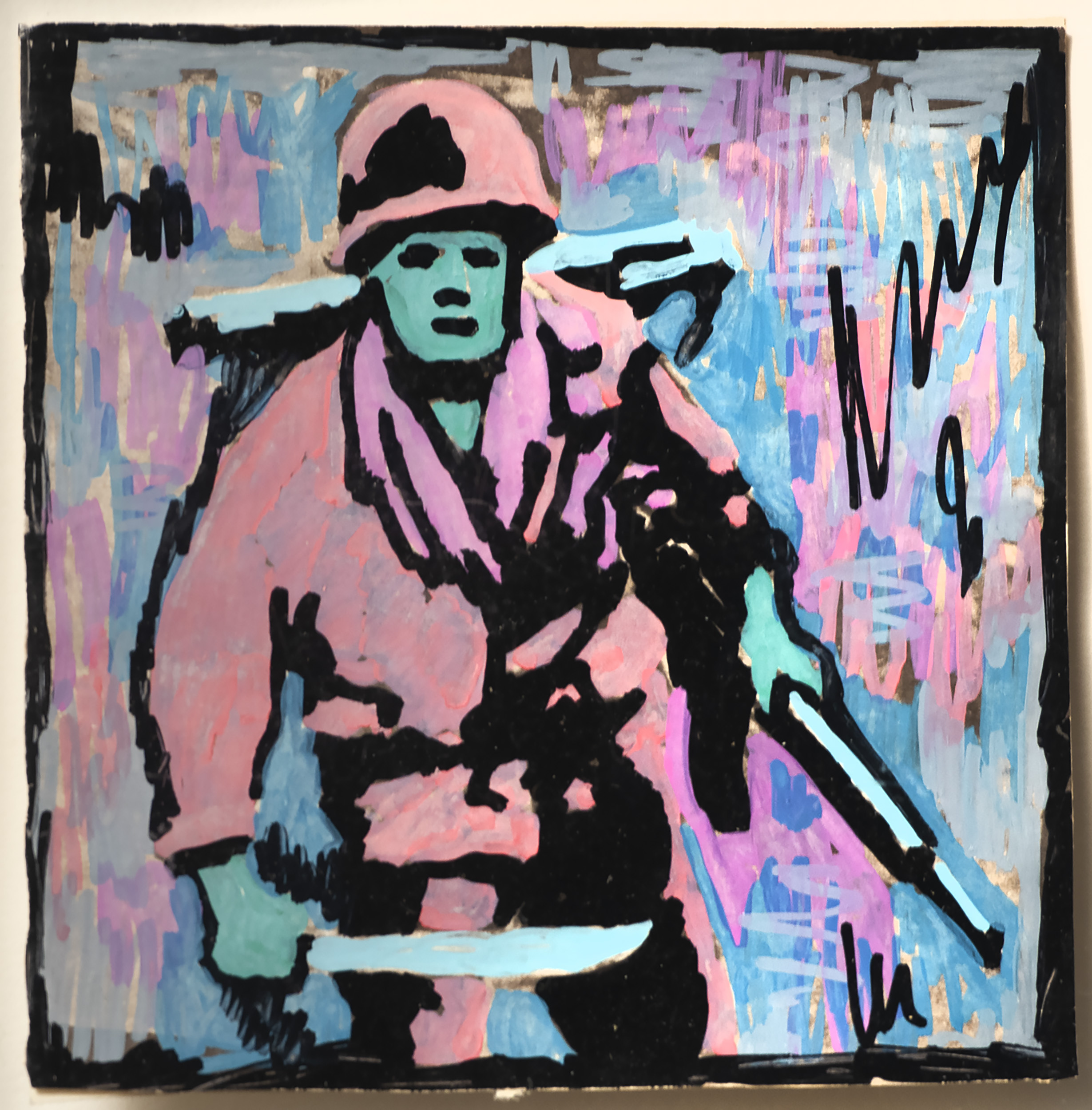
Untitled, 1985. Ink and gouache (?) on paper, 9.5 × 9.2 cm (3 3/4 × 3 5/8 in.). Norton and Nancy Dodge Collection of Nonconformist Art from the Soviet Union. D10232
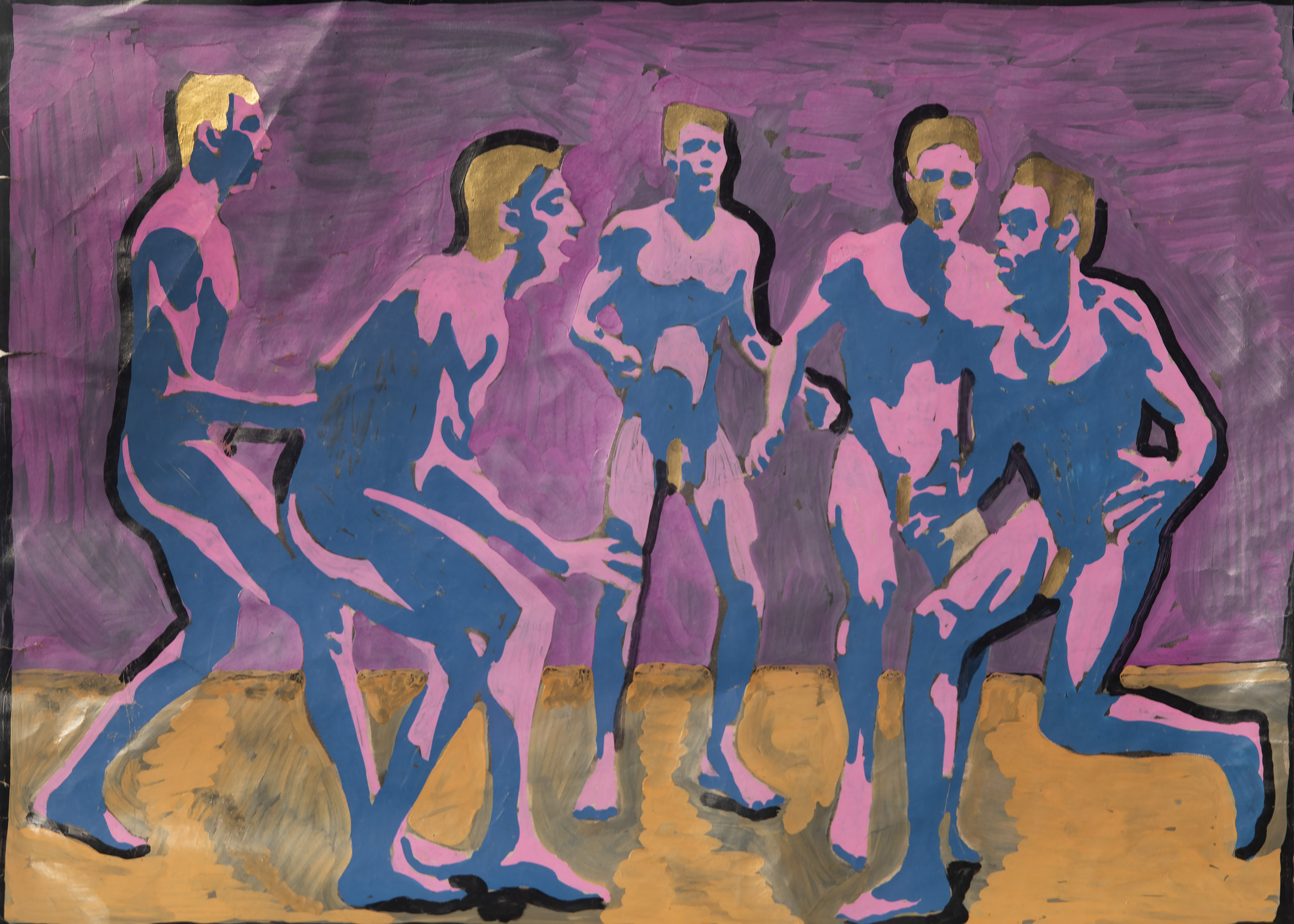
Untitled, 1985. Ink and paint on photograph, 17.5 × 26 cm (6 7/8 × 10 1/4 in.). Norton and Nancy Dodge Collection of Nonconformist Art from the Soviet Union. D10235
Selected Exhibitions
1980s exhibitions of the Novye khudozhniki [New Artists] at various venues in Leningrad, USSR
1985 S Novym Godom! [Happy New Year!], Leningrad Rock Club, Leningrad, USSR
2001 Khudozhnik Viktor Tsoi [The artist Viktor Tsoi], New Academy and Institute of History of Contemporary Art, Saint Petersburg, Russia
2010 Udar kisti [Brush stroke], State Russian Museum, Saint Petersburg, Russia
2012 Novye idut! Gruppa “Novye khudozhniki” 1989–1991 [The new ones are coming! “New Artists” 1989–1991], Moscow Museum of Modern Art, Moscow, Russia
2022 Obraz gruppy “KINO” v kulʹture i iskusstve. K 60-letiiu Viktora Tsoia [The band Kino in culture and art. For the 60th birthday of Viktor Tsoi], Diaghilev Contemporary Art Museum, Saint Petersburg State University, Russia
2025 Istochnik pitaniia [Power source], Stella Art Foundation, Moscow, Russia
Selected Publications
Conversation between Ekaterina Andreeva and Georgii Gurianov in Timur Novikov: Vrat’ tol’ko pravdu! [To lie only the truth!]. Saint Petersburg: Palmira, 2007.
Gorbachev, Alexandr. Viktor Tsoi. Putʹ geroia. [Viktor Tsoi. A Hero’s Path.] Biopic exhibition. DI Dialogue of the Arts. №1 2022, p. 101–109.
Interkontakty. Iz istorii mezhdunarodnykh khudozhestvennykh sviazei Leningrada / Peterburga poslednei chetverti XX stoletiia. Sbornik statei i materialov. [Intercontacts. From the History of International Artistic Connections of Leningrad / St. Petersburg in the Last Quarter of the 20th Century. Collection of Articles and Materials]. Saint Petersburg: Institute of the History of Contemporary Art at the Saint Petersburg Archive and Library of Independent Art, Free Culture Partnership, 2000.
Khlobystin, Andrei. Shirozervoliutsiia. Ocherki peterburgskoi kulʹtury vtoroi poloviny XX veka. [Shirozervolution. Essays on St. Petersburg culture of the second half of the 20th century.]. St. Petersburg: Borey Art Center, 2017.
Lebedeva, Yulia. Okolo “nolia”. O vystavke gruppy “Novye khudozhniki” v MMSI [Around “Zero.” About the exhibition of the “New Artists” at Moscow Museum of Modern Art]. Artchronika, November 27, 2012.
Lebedeva, Yulia. Pokolenie Ikhs, pokolenie nolʹ [Generation X, Generation Zero]. ArtGuide, April 24, 2023.
Novikov, Timur, and Andrei Khlobystin. Khudozhnik Viktor Tsoi [The artist Viktor Tsoi]. [Exhibition brochure] Saint Petersburg: NAII Institute of Contemporary Art History, 2001.
Novikov, Timur. “Leningradskoe iskusstvo 1980-kh godov; ‘Novye khudozhniki’” [Leningrad art of the 1980s; “New Artists”], in Timur Petrovich Novikov. Lectures. Saint Petersburg: NAII, Gallery D-137, 2003.
Novozhenova, Aleksandra. "Viktor Tsoi, Timur Novikov i drugie v MMSI. 'Novye khudozhniki' 30 let spustia" [Viktor Tsoi, Timur Novikov and others at MMOMA. “New Artists” 30 years Later]. Afisha Daily, October 30, 2012.
Novye idut! Gruppa “Novye khudozhniki”. 1989–1991. [The new ones are coming! The group “New Artists”. 1989–1991]. Moscow: Moscow Museum of Modern Art,Maier, 2012.
Obraz gruppy “KINO” v kulʹture i iskusstve. K 60-letiiu Viktora Tsoia. [The band Kino in Culture and Art. For the 60th birthday of Viktor Tsoi.]. [Exhibition Brochure] Curator Andrei Khlobustin. Diaghilev Contemporary Art Museum, St. Petersburg State University. June 23–September 5, 2022.
Stingray, Joanna. Stingrey v Strane Chudes [Stingray in wonderland]. Moscow: AST, 2019.
Stingray, Joanna. Istoriia russkoi rok-muzyki v epokhu potriasenii i peremen [History of Russian rock music in a time of upheaval and change]. Moscow: AST, 2023.
Stingray, Joanna. Viktor Tsoi. Poslednii geroi. Istoriia [Viktor Tsoi. The Last Hero. A Story]. Moscow: AST, 2023.
Udar kisti: “Novye khudozhniki” i nekrorealisty 1982–1991 [Brushstroke: “New Artists” and necrorealists 1982–1991]. Saint Petersburg: Russian State Museum, Palace Editions, 2010.
Viktor Tsoi. Fotoalʹbom. Moscow: Red Wave, 1990.
Viktor Tsoi. Stikhi. Dokumenty. Vospominaniia. [Poems. Documents. Recollections]. Saint Petersburg: New Helicon, 1991.
