
Viktor Risovych
1935 — Odesa (Ukraine) | 2011 — Odesa (Ukraine). Worked in Odesa (Ukraine)
Viktor Risovych was a Ukrainian artist and essayist who belonged to the Odesa nonconformist movement. He actively hosted apartment exhibitions and participated in them. He worked in the Odesa Art and Production Combine (kombinat) of the Art Fund of the Ukrainian SSR. His passion for architecture was reflected in his essays and in his paintings of city landscapes.
Risovych was a third-generation Odesa resident, and the city was the main protagonist of his paintings. Although he belonged to the Odesa nonconformist movement, he was never at the core of it and thus is rarely included in discussions about the group. However, the 1980 samizdat edition Odesa Artists, which provided a list of artists of the Odesa avant-garde, listed Risovych alongside key figures such as Aleksandr Anufriev (1940–2024), Volodymyr Strelnikov (b. 1939), Viktor Maryniuk (1939–2026), Liudmyla Yastreb (1945–1980), Valentyn Khrushch (1943–2005), and Valery Basanets (b. 1941).
In 1959, at the time when Anufriev and Strelnikov, who later would launch nonconformism, entered the Odesa Art School, Risovych had already graduated from it. He never joined the Union of Artists but later became one of the organizers of the Creative Union of Artists (1986–96), a short-lived private initiative. The union, which had its headquarters at the editorial office of the newspaper Znamya Kommunizma [The banner of communism], enlisted several Odesa artists with the aim to exhibit and promote their works. The group included as many as seventy people, among them Oleksandr Lisovsky (b. 1959), Ihor Bozhko (b. 1937), and Yuri Zakordonets (b. 1957). Margarita Zharkova (Anufrieva) (1939–1998) supported them in the capacity of a curator.
Like many of his contemporaries, Risovych embarked on spiritual quests, which became possible not least thanks to the Khrushchev Thaw (c. after 1954) and the subsequent infiltration of various, primarily Eastern spiritual practices into the Soviet Union. After a brief flirtation with Indian philosophy, the artist chose Christianity and was deeply religious for the rest of his life. He became friends with Eugene Rakhmanin (b. 1947), and in 1977 the two artists initiated the second fence exhibition, an homage to the famous exhibition by Valentyn Khrushch and Stanislav Sychov (1937–2003), who in 1967 dared to put up their works on the fence surrounding the Odesa Opera Theater. Just like the 1967 exhibition, Risovych and Rakhmanin’s display was dismantled by the authorities, and the artists were called to the KGB headquarters for a talk. “Together with Vitya Risovych we took the work under our arms and went to the Palais Royal, where the first fence exhibition ‘Khrushchik + Sychik’ was held. It was a very brave act, amazing. Our exhibition lasted about twenty minutes—we leaned the paintings against the Opera House. Someone snitched. And there, nearby in the Palais Royal, in the basement, there was a police office. They come up in civilian clothes and said: ‘Get it together quickly, quietly, calmly and follow me.’” [1]
For years Risovych wrote short essays and articles for local news outlets about Odesa, defending its architectural integrity. This very same subject matter characterizes his entire pictorial legacy, which can be divided into two categories: dark and gloomy city landscapes reflecting the artist’s memories about Odesa’s occupation during World War II, and bright, colorful images of the city. The latter oftentimes have nothing to do with real locations but rather are poetic, mythological city views, permeated with a light, nostalgic sadness. The Odesa art historian Vera Savchenko characterizes Risovych’s style as a mix of professional and naive art—half painting, half graphics—where all the boundaries are blurred to imbue the work with an genuine integrity. [2] The distinctive features of his mature works are the use of contours and haze; a pink and blue palette; and frequent depictions of female forms, with curved, graceful lines. This contrasts with his earlier works, which are neater and more geometric, echoing the paintings of Strelnikov and Basanets from that time. Moonlit Night (1974, ZAM, D04645) clearly represents Risovych’s earlier period and can easily be compared, for instance, with Sabaneev Bridge (year unknown, Dymchuk Collection) by Liudmyla Yastreb, one of the key figures in the 1960s Odesa art scene. Highly praised for embodying the “Odesa spirit,” Risovych’s paintings of the city were favored memorabilia for émigrés who left the country as soon as was permitted at the end of the 1980s, and thus today are not found in many private collections and museums in Ukraine.
Kateryna Filyuk
Notes:
1. “Visiting the Artist – Eugene Rakhmanin,” episode 8 of Visiting the Artist, La pipelette, posted October 14, 2020, by La Pipelette Art, YouTube.
2. NON, Legendary Nonconformist Artists of Ukraine: Odesa Group, part 2, unpublished manuscript, Issuu, p.45.
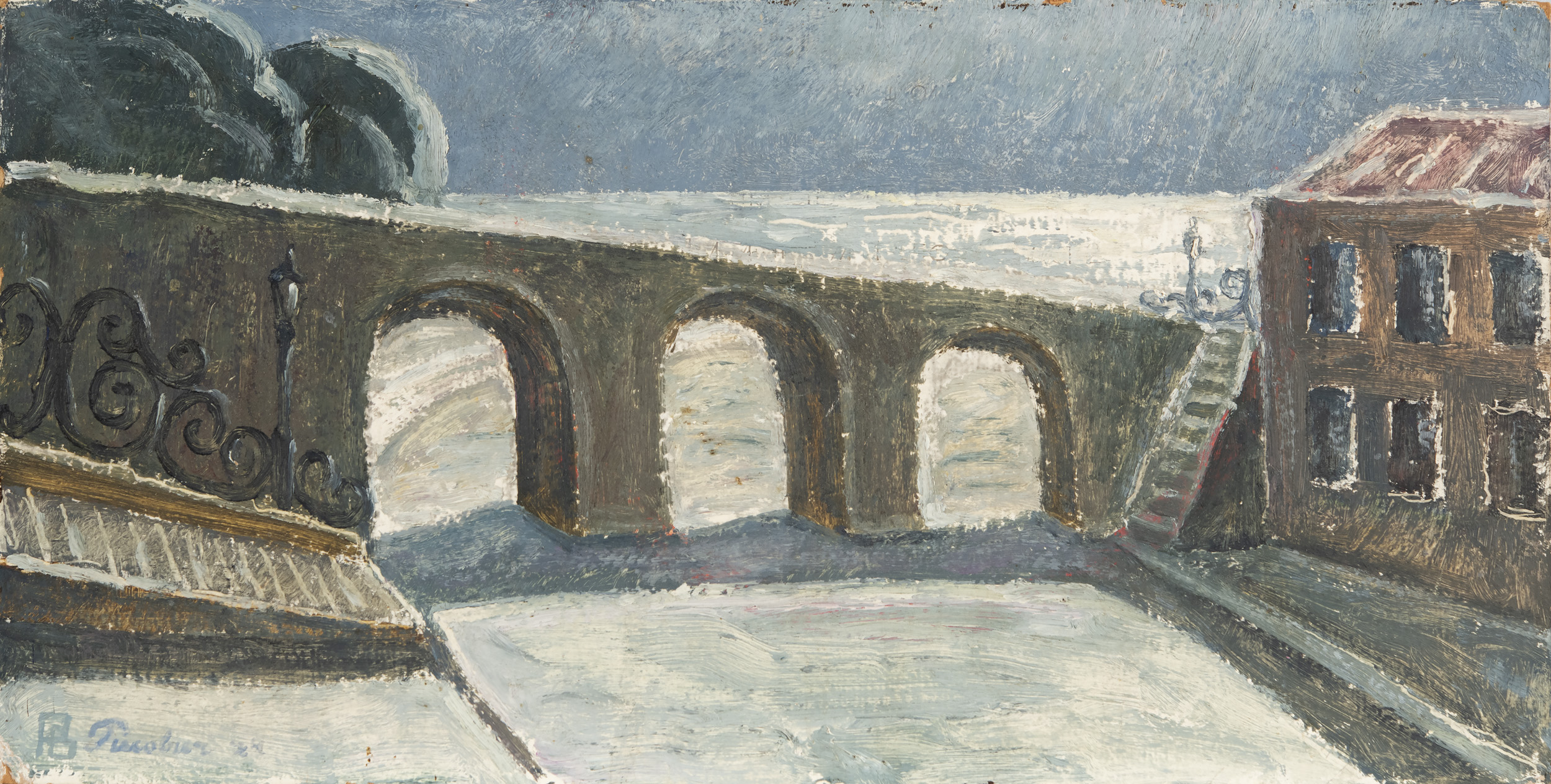
Moonlit Night, 1974. Oil on illustration board, 21.7 × 42.2 cm (8 9/16 × 16 5/8 in.). Norton and Nancy Dodge Collection of Nonconformist Art from the Soviet Union. D04645