
Viktor Kochetov
1947 — Kharkiv (Ukraine) | 2021 — Kharkiv (Ukraine)
A photographer and representative of the Kharkiv School of Photography, Victor Kochetov worked as a professional photographer and photojournalist for state institutions, while simultaneously creating an alternative, phantasmagoric, and ironic photographic chronicle of his era. In the early 1980s, Kochetov developed a method that he would continue to refine over the following decades: hand-coloring prints with aniline dyes, using a panoramic format, and focusing on unembellished and unstaged reality. From the 1980s onward, he worked in tandem with his son, Serhiy Kochetov (b. 1972).
Kochetov was an exceptional figure in the Kharkiv School of Photography, a significant underground photographic movement that emerged in the major industrial and university city in Ukraine in the mid-1960s. Unlike many photographers in this environment, Kochetov was not an engineer and is difficult to categorize within the three generations that structure the history of the Kharkiv school. Moreover, he rarely worked on project-based photography.
Initially, Kochetov planned to become a musician. He studied at the Borys Lyatoshynsky Music School in Kharkiv, playing percussion instruments and the xylophone, and worked as a sound engineer at the Automobile Transport Technical School. In the late 1960s, he became interested in photography, teaching himself the basics of the art through books. By 1973 he became a teaching master at the photographic laboratory of the Physics Department at Kharkiv University, by 1977 was a photography instructor at the House of Artistic Amateur Activities of the Trade Unions, and by 1979 started to work as a color print lab assistant at Oblfoto (the regional state photo-services enterprise). During this time, he also worked in a studio, fulfilling tasks such as taking passport photos and photographing weddings.
He began to think of photography as an art form after meeting Jury Rupin (1946–2008) and Oleksandr Suprun (b. 1945), members of the semiofficial Vremia (Time) group, which laid the foundations for the Kharkiv School of Photography and whose members are now considered its “first generation." Kochetov's new approach to photography was further shaped through close contact with Boris Mikhailov (b. 1938), who would go on to become one of the most recognized photographers of modern times. Together, they conducted "practical sessions"—joint shootings that became an ongoing activity. According to Kochetov, it was thanks to Mikhailov that he realized that "incorrect photographs are better and more interesting than correct ones."
Kochetov knew from personal experience how "correct" photographs were made in the Soviet Union. In 1974 he began working as a photographer for the Southern Railway Administration, where he spent a total of eleven years. Assigned to the Scientific-Technical Information and Propaganda department, he learned the procedures for creating a photograph for publication, including obtaining permission from the Party organizer and staging and supervising the shoot. At the same time, it was this official work that gave Kochetov the required credentials not only to shoot in public spaces without hindrance but also to photograph subjects that were off-limits to others—large gatherings such as parades or infrastructure such as railways. In the prevailing atmosphere of espionage and paranoia, this position gave him a unique opportunity to document aspects of Soviet life that were otherwise invisible in public representation.
It was within the framework of assignments for the Southern Railway Administration that Kochetov created many of the images that would later become part of the series Aniline Melancholy, or Incorrect Coloring. His first hand-colored photograph was Yellow Ribbons (1982)—a typical Soviet propaganda scene depicting a meeting between young people and World War II veterans. In it, he accentuated only the ribbons—a childish, colorful, frivolous element of the solemn ceremony. While such light, selective coloring would remain in Kochetov's practice, he also developed various types of color intervention that were more dense and saturated.
Hand-coloring photographs was a popular practice in the Kharkiv school. The aesthetic was based on traditional framed, retouched, and hand-painted commercial photographic portraits, sometimes posthumous, known in the Soviet Union as lurik. The first to introduce this vernacular tradition into his artistic practice was Mikhailov, who considered lurik the highest expression of kitsch, replacing icons for average Soviet people and answering a desire to combine the memory of loved ones with beauty and bright, cheerful colors. At the same time, colored photographs were not accepted at official photo exhibitions, as they were deemed “low” culture and synonymous with bad taste and vulgarity. However, while hand-coloring was used by Mikhailov only in the context of specific projects, it became the foundation of Kochetov's artistic method.
Color in Kochetov's work serves various functions. First, it injects a carnival-like note and baroque excess into the grayness of Soviet everyday life. Second, it offers an ironic response to Soviet journalistic photography: If only technically proper, visually pleasing images presenting an ideologically positive reality were deemed acceptable, then hand-coloring makes the photograph twice as good by applying the lurik aesthetic—-the vernacular, popular ideal of beauty. Finally, hand-coloring is a sly comment on photography’s inferior status to painting in the artistic hierarchy and its perception as a utilitarian tool for objectively reflecting reality.
Just as the Kharkiv photographers employed “incorrect” color to rupture the experience of photography as a transparent window onto life, they used the panoramic camera “incorrectly” for the same purpose. Much of Kochetov's work was done with the Horizon panoramic camera—which was one of the few original developments of the Soviet photographic industry and came onto the market in the early 1960s. However, while panoramic photographs in the official press clearly represented the foundational ideological myths of the Soviet state—vast spaces and orderly masses (see, for example, Yakov Riumkin [1913–1986])—Kochetov’s panoramas bent or curved the perspective, creating claustrophobic scenes densely filled with distorted figures with randomly cut-off legs and heads (see D10687, ZAM, 1983; D10690, ZAM, 1983).
Kochetov explored the artistic potential of not only "incorrect" techniques but also "incorrect" subjects. As indicated by the title of a retrospective exhibition of his works in 2019, Nothing Important, Nothing Significant, the workers whom Kochetov often photographed for his official employment rarely embody the central image of Soviet iconography: the heroic laborer. Instead, they are shown fishing, going on picnics, and generally at leisure, and when they do work, their gestures and poses lack theatricality and pathos. Some of the photographs show the author's openly ironic attitude toward this idealized motif (with titles such as At the Kupiansk station, two female railway workers portray the labor process for the photographer [1989]).
One of the main characters in Kochetov's photographs is Kharkiv itself, also depicted far from heroically. In Kochetov's urban photographs, Kharkiv is not the city of tourist postcards; he is not interested in iconic monuments such as the constructivist Derzhprom building. Instead, he focuses on industrial areas and residential complexes, and the garish decoration of these generally uncomfortable and faceless public spaces. In his prints, these places—the true centers of Kharkiv life—often transform into a phantasmagoric universe of magical realism.
The official Soviet taboo against depicting naked corporeality, a central theme for the rebellious Kharkiv photographers, was a compelling subject for Kochetov. However, he was little interested in normative, fit, disciplined bodies—the symbols of the Soviet ideal of health and bodies trained and shaped by state institutions and ideology. His subjects rarely appear in the few acceptable contexts for nudity in Soviet culture, such as athletic tension and rest after hard work. Instead, he was attracted to carefree leisure and domestic intimate scenes, focusing on relaxed, unguarded bodies that are nonconformingly real.
In Kochetov's images, public and private life intertwine, with a palpable presence of the photographer. Handwritten captions frequently appear on both the back and front of the prints, adding Kochetov’s voice—his story, testimony, and reflections—to the poetic, incomplete, open-ended scenes depicted. This connection between text and photography first appeared in the Kharkiv school in the work of Mikhailov through his association with Ilya Kabakov (1933–2023) and Moscow Conceptualism. For Kochetov, Mikhailov indeed remained an important figure, a colleague with whom he organized a joint exhibition, Overpainted Reality, in 1992.
Throughout the 1990s, following Ukraine's independence in 1991, Kochetov's work did not undergo a drastic change in aesthetics, a fact that is indicative of the deep and lasting effects of the Soviet system on the urban and social life of Kharkiv, and of Ukraine as a whole. One of the most renowned works by the Kochetov father-son duo, Reinforced concrete monument in front of the Vodiane station (1992), was created during this period: a photograph of a sculpture of two female athletes, whose jerseys have been inscribed "Kyiv" and "M.” The figure labeled “M” (for “Moscow”) has broken arms, and for Western critics of the time, the image became a metaphor for the profound rift between the two former Soviet republics.
During the 2000s Kochetov’s work took a new direction as he actively experimented with the technologies and kitsch of the digital era, drawing on its amateur, early-software aesthetic. Continuing to explore the interaction between text and image, he made intensive use of the recognizable fantasy fonts of early graphic editors (WordArt-like lettering, vivid gradients, and rudimentary 3D text), worked with the aesthetic of private snapshots in the context of the widespread availability of digital cameras, and also investigated the new phenomenon of visual pollution in outdoor urban spaces through uncontrolled advertising (e.g., My Billboards, 2003).
Although Kochetov's works had already attracted the attention of Western curators and entered prestigious museum collections in the 1990s, the true discovery of his oeuvre occurred in the late 2010s. The first publication of the Museum of Kharkiv School of Photography (MOKSOP), founded in 2019, was dedicated to Kochetov. That same year, his works were featured in the PinchukArtCentre's exhibition of the Kharkiv School of Photography. In 2022 Kochetov became part of the representative collection of Ukrainian contemporary art at the Centre Pompidou in Paris, and starting in 2023, his works have been included in the traveling European exhibition project Ukrainian Dreamers.
Nadiia Bernard Kovalchuk
Translated from Ukrainian by Ada Wordsworth

Holiday, 1983. Photograph enhanced with ink on paper, 18 × 38 cm (7 1/16 × 14 15/16 in.). Purchased with funds donated by Norton Dodge and Nancy Dodge. 1998.1367
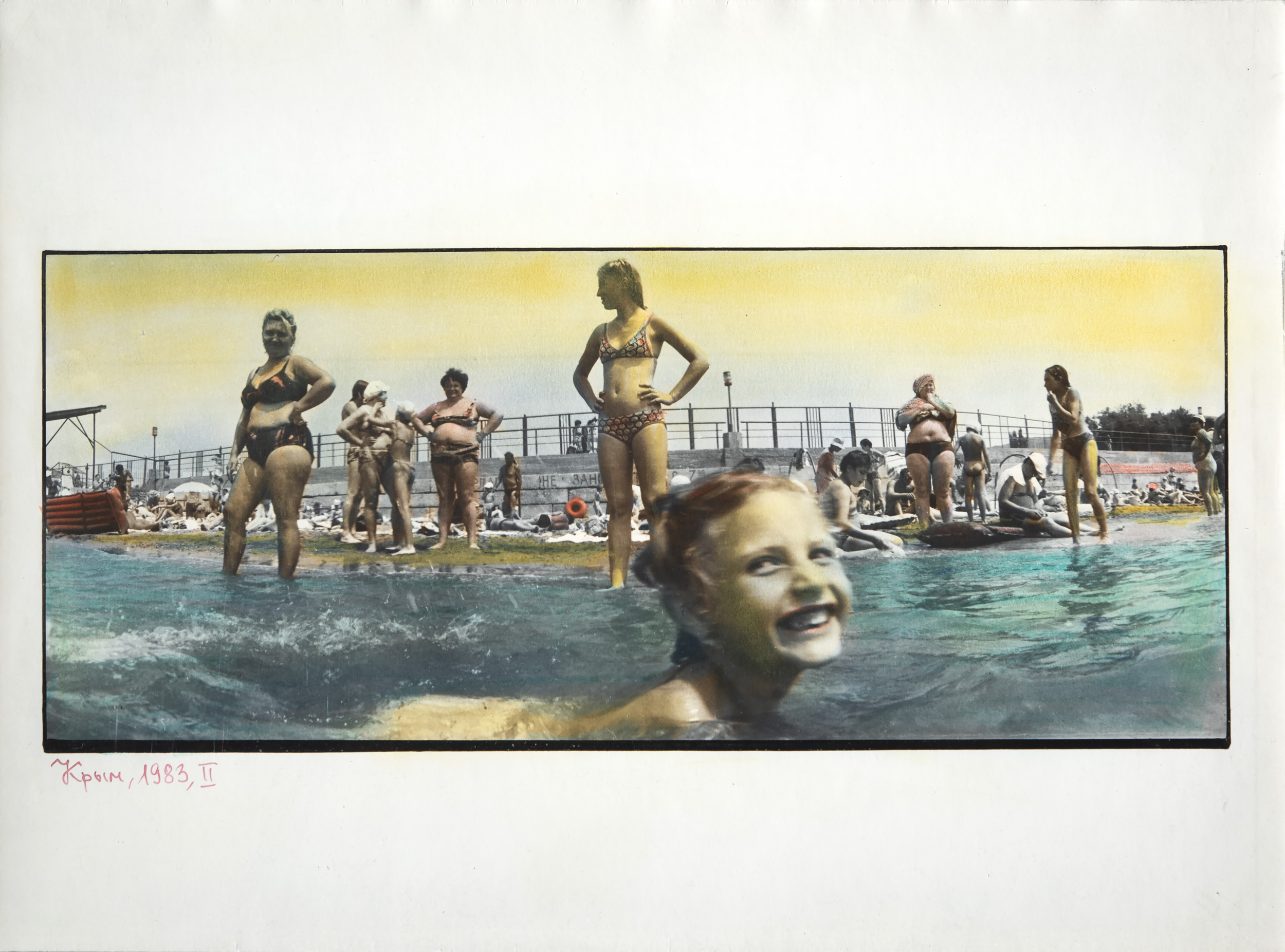
Crimea, 1983, II, 1983. Handcolored gelatin silver print on paper, 29.5 × 39.5 cm (11 5/8 × 15 9/16 in.). Norton and Nancy Dodge Collection of Nonconformist Art from the Soviet Union. D10687

View towards Romny from the Suly River, 1985. Handcolored photograph on paper, 29.5 × 39.5 cm (11 5/8 × 15 9/16 in.). Norton and Nancy Dodge Collection of Nonconformist Art from the Soviet Union. D10688
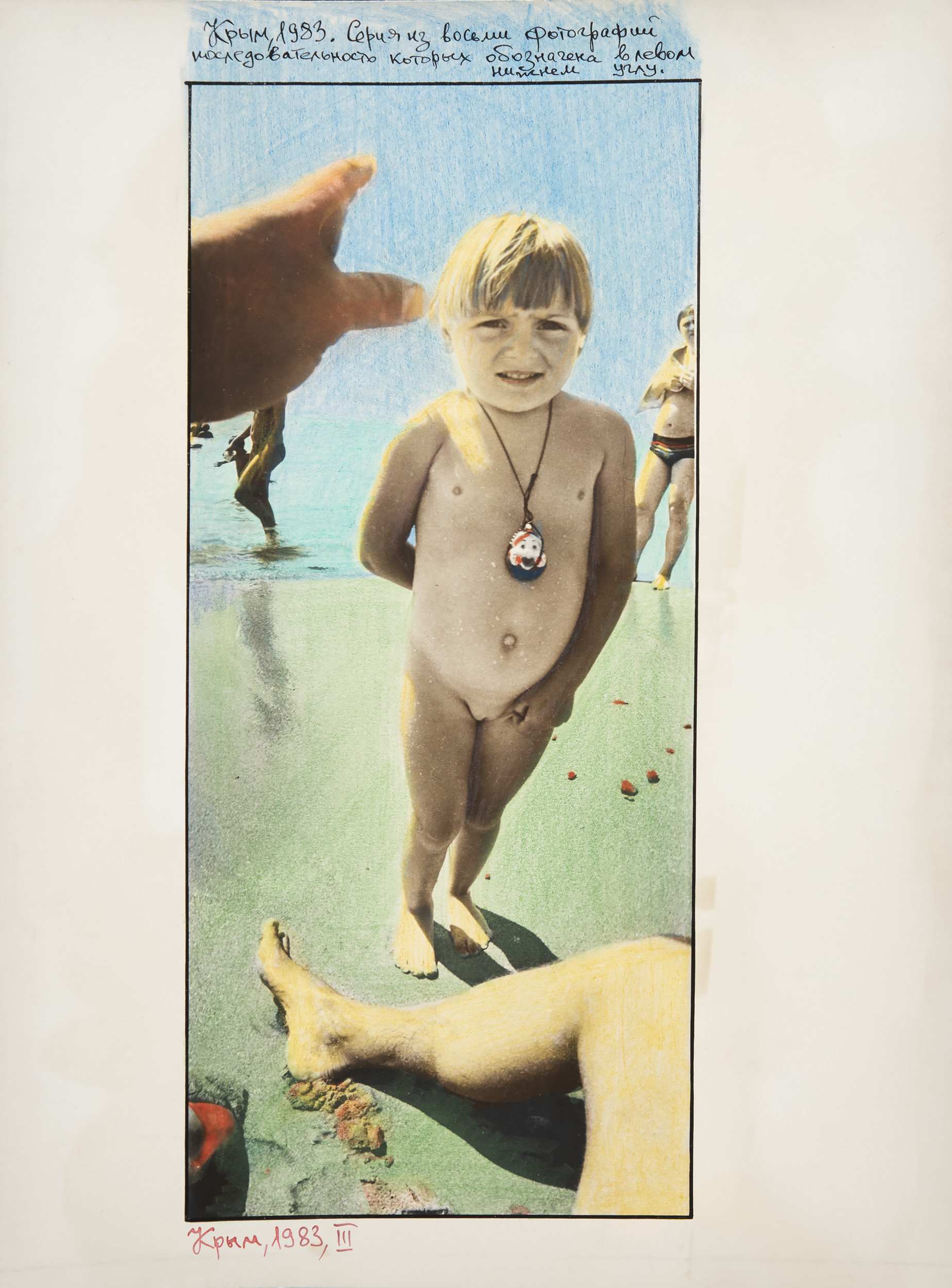
Crimea, 1983, III, 1983. Handcolored photograph on paper, 39.5 × 29.5 cm (15 9/16 × 11 5/8 in.). Norton and Nancy Dodge Collection of Nonconformist Art from the Soviet Union. D10689

Crimea, 1983, VIII, 1983. Handcolored gelatin silver print on paper, 29.5 × 39.5 cm (11 5/8 × 15 9/16 in.). Norton and Nancy Dodge Collection of Nonconformist Art from the Soviet Union. D10690

A Girl, Cheerful, 1974. Photograph on paper, 40 × 25.8 cm (15 3/4 × 10 3/16 in.). Purchased with funds donated by Norton Dodge and Nancy Dodge. 1998.1371