
Vello Vinn
1939 — Kaimri (Estonia). Lives and works in Tallinn (Estonia)
Vello Vinn was born in the village of Kaimri in the parish of Salme on the island of Saaremaa. He began his higher education by studying English philology at the University of Tartu between 1959 and 1962, but in 1963 switched to glass art studies at the State Art Institute of the Estonian SSR (now the Estonian Academy of Arts) in Tallinn. During his time at the academy, Vinn also became interested in printmaking and learned different techniques there with outstanding masters and tutors, such as Olev Soans (1925–1995). Whereas his diploma work in 1968 in stained glass techniques was a mere formality, Vinn’s further artistic path remained focused on graphic art. It is quite telling that he, as a recent alumnus of the academy, was accepted in the autumn of his graduating year to participate in an international exhibition that surveyed printmaking from the Baltic countries, entitled Present Day and Graphic Form. This was the first iteration of what became the significant tradition of the Tallinn Print Triennial—the oldest regular international exhibition of contemporary (print) art in the Baltic region.
All four works that Vinn displayed in the Present Day and Graphic Form exhibit were etchings, a technique that became one of his main printmaking practices. From this group, a work entitled Cat (1968, ZAM, D03635) stands out, as it contains many of the essential features of Vinn’s mature oeuvre. Among them are the masterful use of etching in its attention to every filigree line and a symmetrical composition, rich in detail, based on the play between images and words. In this world of cats, mice, and mousetraps, one can make out a bizarre abstract structure reminiscent of the game of cat’s cradle. Symmetry became a trademark of Vinn, and he uses it in his works with almost no exception, sometimes in bilateral (mirrorlike) compositions, and sometimes in more playful ones, building them on formal and conceptual affinities. In his multilayered, complex works, where a bigger image can consist of multitudes of smaller ones, symmetry helps to maintain a sense of a harmonious and balanced universe. An example is the etching Crawfish (1968, ZAM, D03986), in which the principal form is composed of a whole ecosystem of insects and animals but also includes a figure suggestive of Hindu deities.
Another important element in Vinn’s artistic method is wordplay, based not only on linguistic or phonetic connections but also on their conceptual associations. For instance, a winged clock in the etching Time I (from the Wings series, 1971, ZAM, D05551) refers to the saying “time flies,” suggesting commentary on our everyday hustle. In another example, while all the elements in the etching Silence (1970, ZAM, D03636)—seagulls, violins, matches, metronomes, and so forth—are capable of producing sound, the work appears to be more about the potential of giving voice; this is just silence before a storm. Silence’s composition comprises three identical symmetrical motifs, each printed from the same small plate and ranging horizontally across the paper, therefore conceptually using specifics of printmaking as a medium. The same concision in Vinn’s approach to printmaking was used in the triptych Station (1977), where we see complex compositions based on witty combinations of images from only two plates.
Vinn’s graphic works resemble allegories whose meanings remain ambiguous and often ambivalent. The fantastic worlds created by him remind one of science fiction, but it cannot be clearly said whether they depict utopias or dystopias. The artist often blends natural and mechanical elements into new forms or even organisms, but those hybrids can be both a positive vision of symbiosis, resulting in a “new nature,” as well as a warning against the invasion into nature and society of machines and technology. Looking at the etching Rockets (1971, ZAM, D09526), in which spaceships are composed of seashells, we may think of all the effort put into research relating to outer space, which, paradoxically, is explored much better than the seas and oceans of our home planet. However, the cunning cats sitting in niches in the rockets remind us that we should not take the issue too seriously.
Benevolent humor is what allows Vinn’s printmaking to raise a serious agenda without being too didactic. In this manner, his works have the agency to critique ecological and social problems, like the standardization of our living environment or the alienation of present-day urban society, but also to warn against global military conflicts. In the second half of the 1970s, the artist started to work with photo-based etching, producing hyperrealist-looking dystopian visions with discernible militaristic symbolism, such as the triptych Clock (1976, ZAM, D03844), where ticking clocks count minutes until an irreversible catastrophe. Raising issues decades ago that are even more topical today, Vinn’s works are still relevant in their philosophical and humanitarian approaches. In the 2000s, the artist began to utilize the drypoint technique, which is less complicated than etching but still demanding for a perfectionist who wants to achieve the results he always strives for. Vinn’s works from the last decades turn a lot to art history and, in particular, to ancient civilizations, in interpretations of which the mature artist tackles universal, eternal questions.
In addition to his printmaking oeuvre, Vinn is a remarkable and internationally acknowledged author of bookplates, in which his taste for play with words and images finds a fruitful realization. He has also produced original posters—often using printmaking techniques as well—for exhibitions of his own; of his wife, jewelry artist Raili Vinn’s (b. 1943); and of their close friends. In addition, he has generated some dedicated to an ecological agenda, in which he delivers messages in a more direct way, always with his signature humor and wordplay. An example is the poster Don’t Park in the Park (c. 1978). Vinn has designed illustrations for several children’s books, whose rich, fantastical, almost psychedelic imagery has influenced artists and creative people of several generations. Finally, the artist has also made souvenir items, such as calendar-towels and postcards, whose symmetry and bizarre worlds are immediately recognizable as his work, as Vinn has always remained himself in everything he does.
Elnara Taidre
Photo portrait: Vello Vinn and his etchings, 1978. Photographer unknown. Archive of Vello Vinn
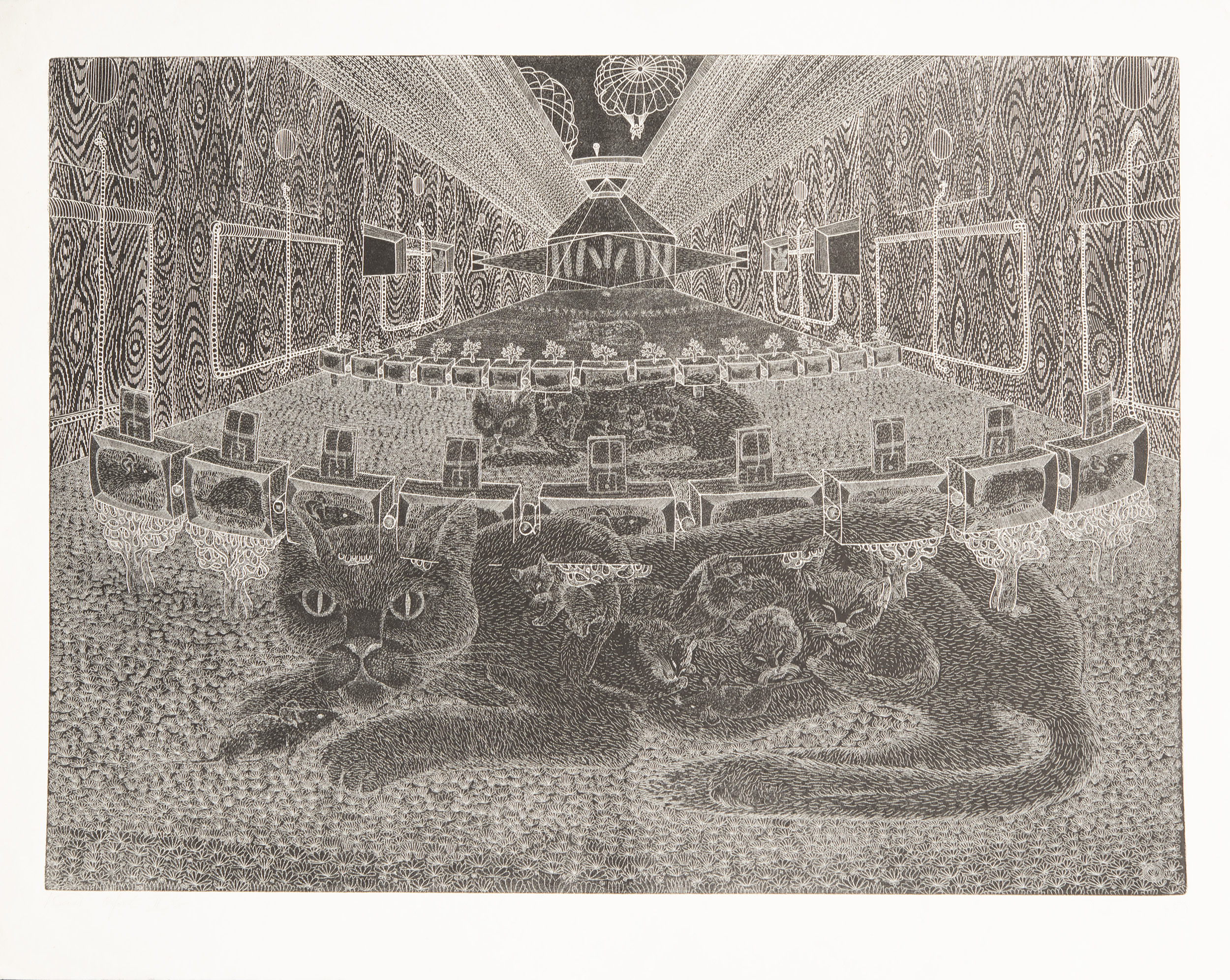
Cat, 1968. Etching on paper, Image: 48.9 × 64.5 cm (19 1/4 × 25 3/8 in.). Norton and Nancy Dodge Collection of Nonconformist Art from the Soviet Union. D03635
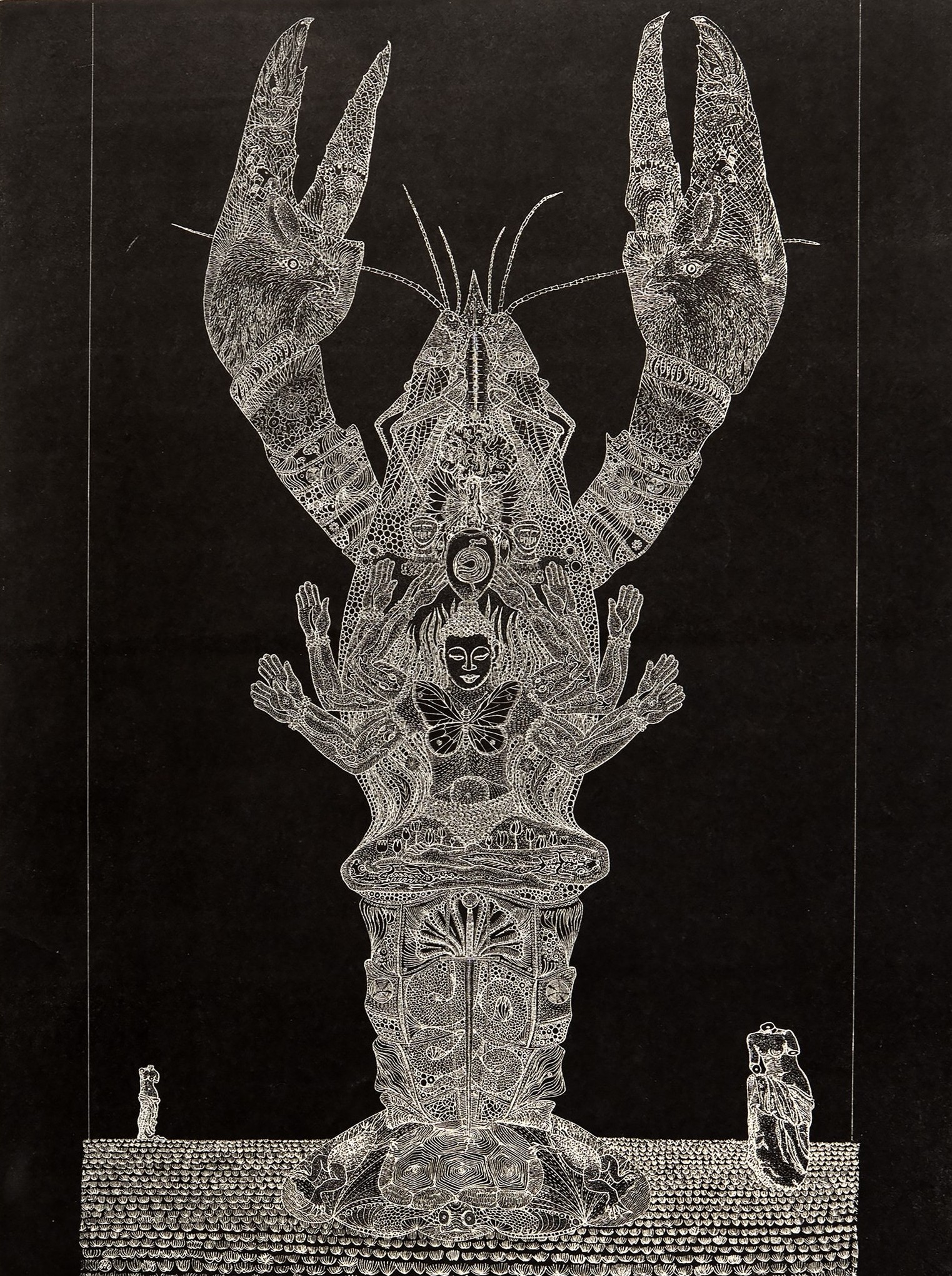
Crawfish, 1968. Etching on paper, 64.7 × 49.3 cm (25 1/2 × 19 7/16 in.). Norton and Nancy Dodge Collection of Nonconformist Art from the Soviet Union. D03986
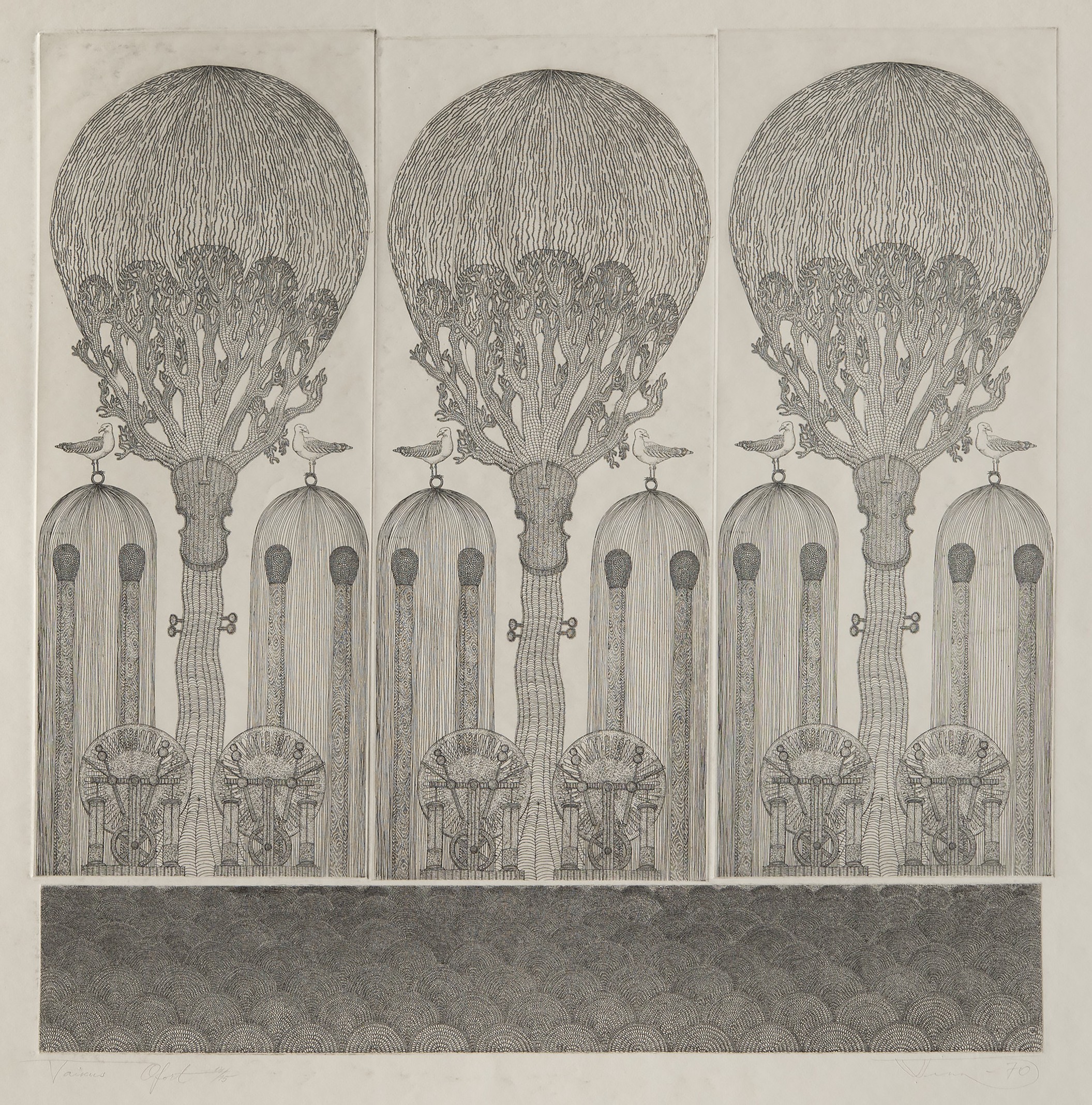
Silence, 1970. Etching on paper, 47.1 × 47.5 cm (18 9/16 × 18 11/16 in.). Norton and Nancy Dodge Collection of Nonconformist Art from the Soviet Union. D03636
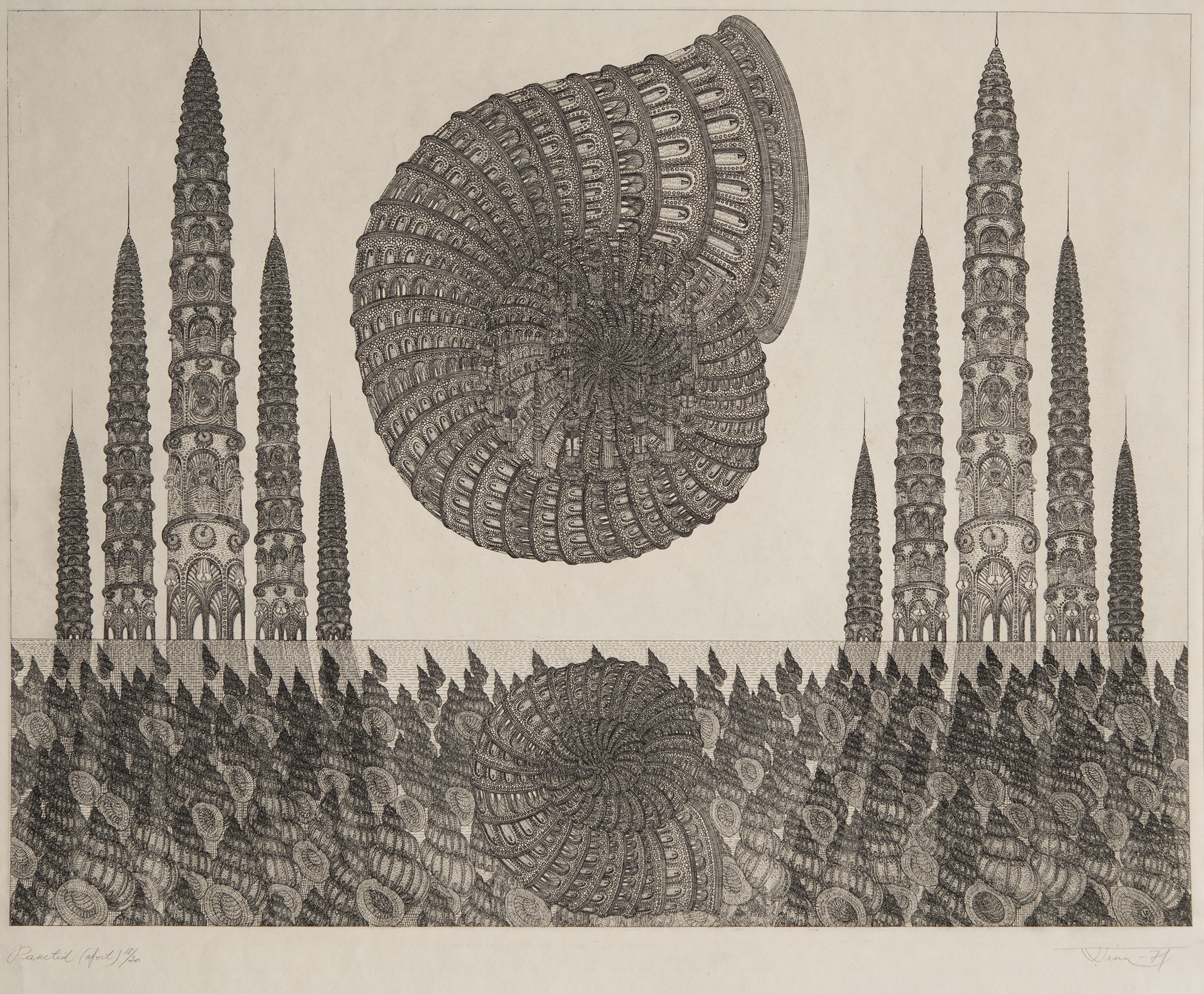
Rockets, 1971. Etching on paper, 47.3 × 64.5 cm (18 5/8 × 25 3/8 in.). Norton and Nancy Dodge Collection of Nonconformist Art from the Soviet Union. D09526
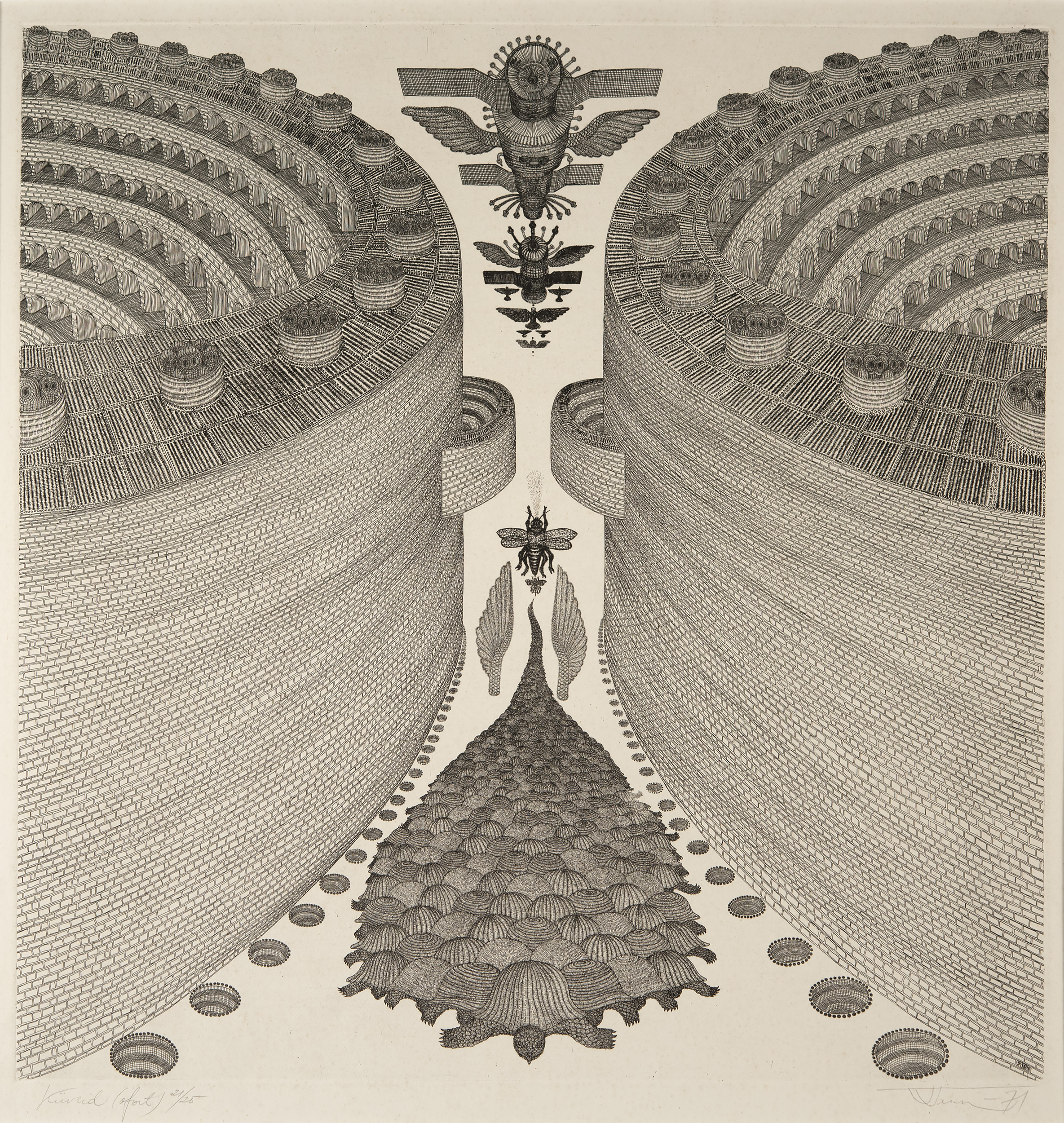
Helmets, 1971. Etching on paper, 49.5 × 48.5 cm (19 1/2 × 19 1/8 in.). Norton and Nancy Dodge Collection of Nonconformist Art from the Soviet Union. D05580
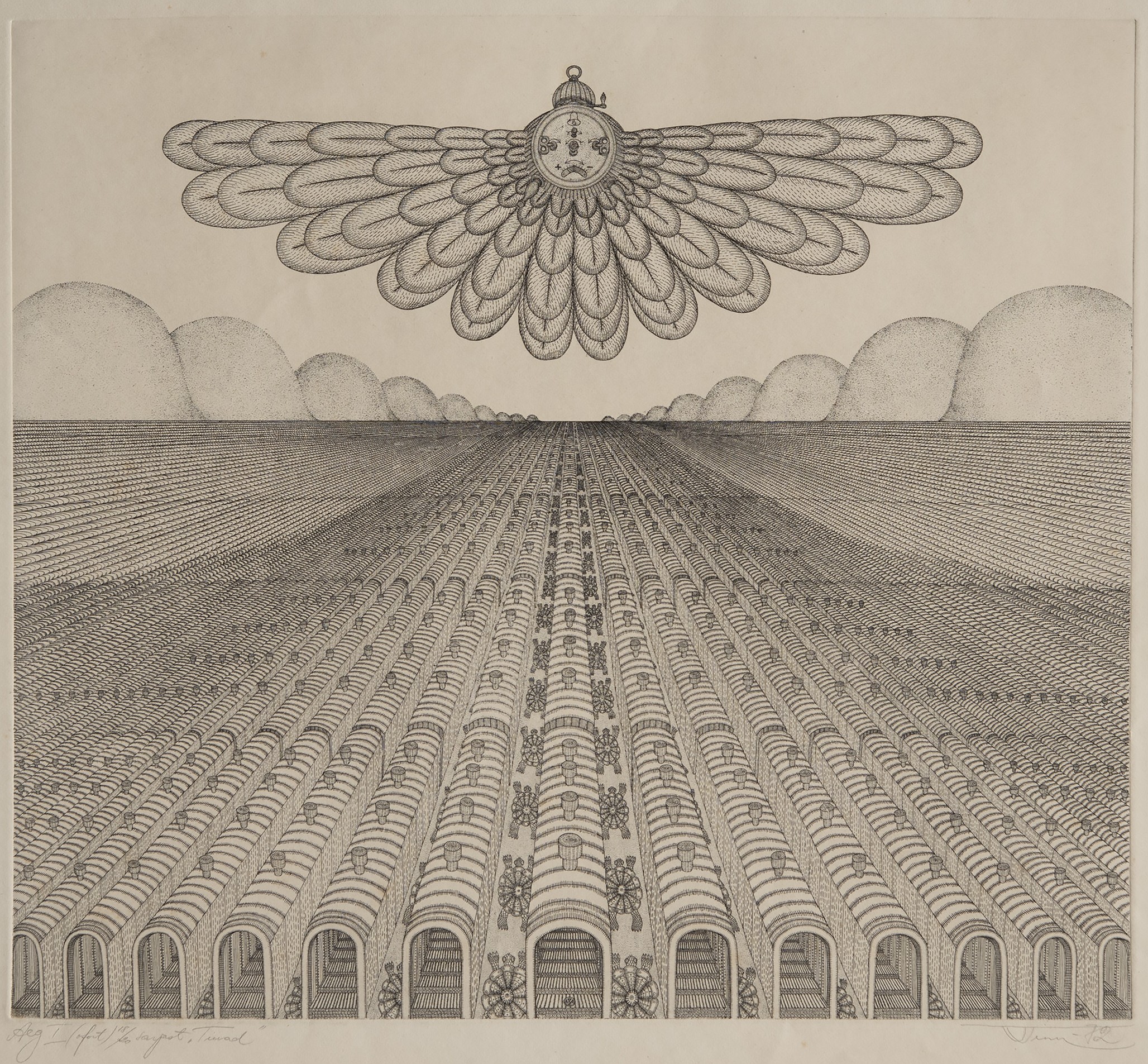
Time I from the series Wings, 1972. Etching on paper, 43.5 × 49.5 cm (17 1/8 × 19 1/2 in.). Norton and Nancy Dodge Collection of Nonconformist Art from the Soviet Union. D05551
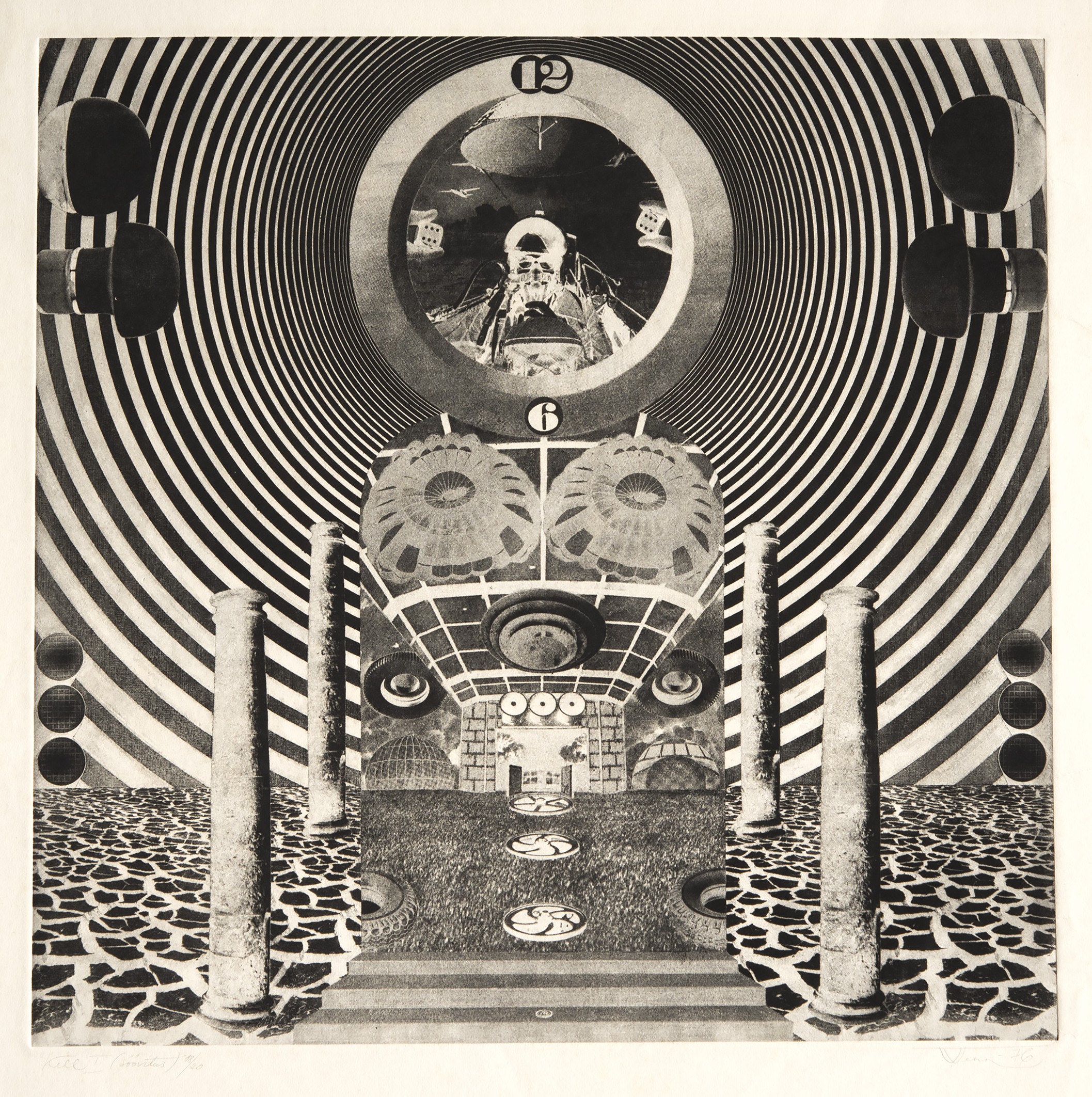
Watch I, 1976. Photoengraving on paper, 49.3 × 49.4 cm (19 7/16 × 19 7/16 in.). Norton and Nancy Dodge Collection of Nonconformist Art from the Soviet Union. D03844
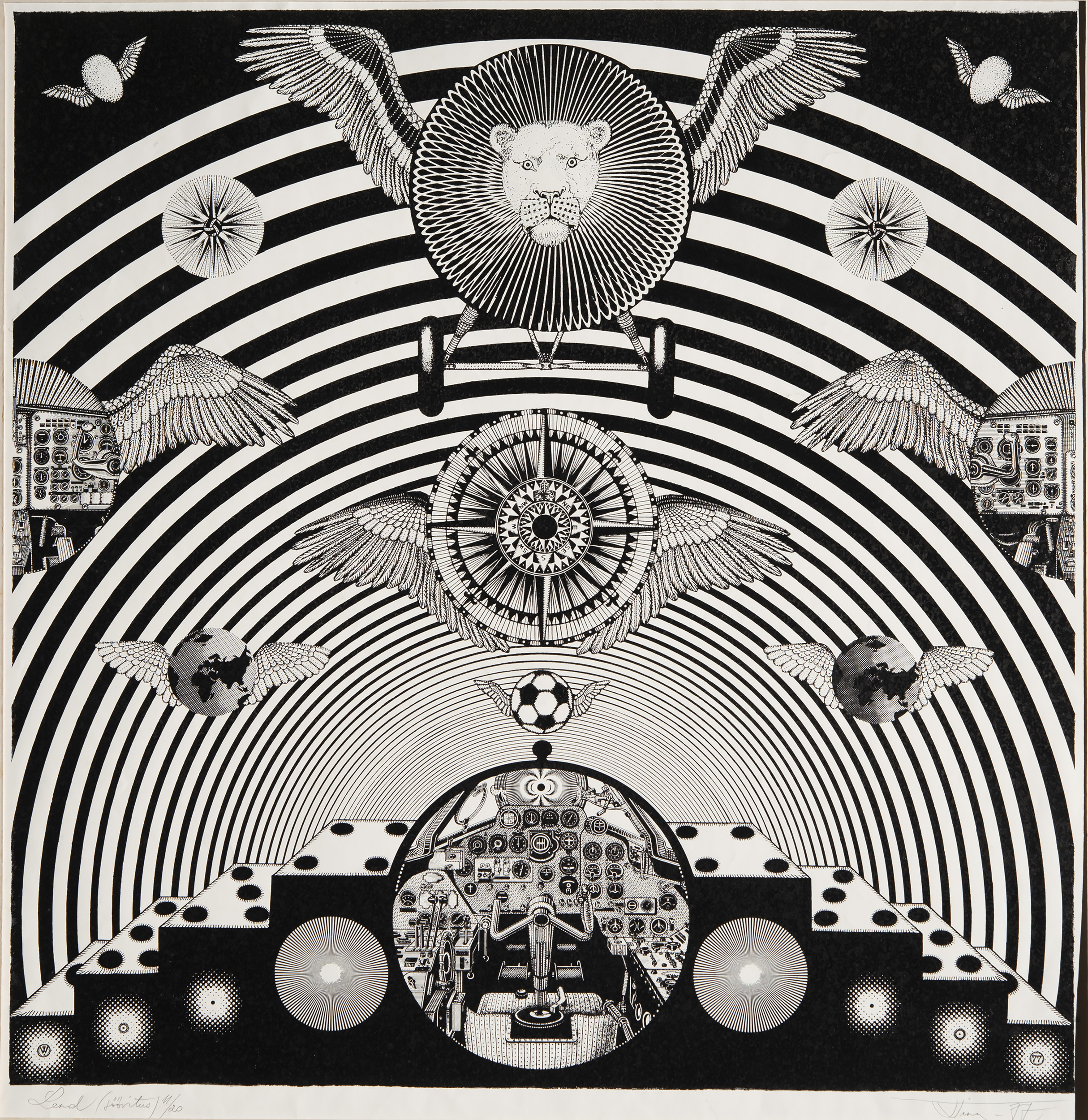
Flight, 1977. Etching on paper, 48.1 × 48.1 cm (18 15/16 × 18 15/16 in.). Norton and Nancy Dodge Collection of Nonconformist Art from the Soviet Union. D09525