
Vasily Sitnikov
1915 — Novo-Rakitino (Russia) | 1987 — New York, NY (USA). Worked in Kazan, Moscow (Russia), Vienna (Austria), New York, NY (USA)
Vasily Sitnikov—painter and graphic artist—was one of the most vivid and mythologized figures in Soviet unofficial art of the 1950s–70s. He managed to stand out even against the background of that “form of outward madness,” as the writer Yuri Mamleev defined it, adherence to which was a tacit law of the artistic underground. In a methodical and unquestionably talented manner, Sitnikov constructed a myth about himself as a rejected artist—a mad genius, a holy fool, the creator of his own school and sect. He transformed life into an endless performance, generously seasoned with the Russian holy fool tradition, or, in other words, into a happening titled The Hagiography of Vasil Yaklich Sitnikov, [1] which was composed of numerous submyths: how he lived in poverty but surrounded by ancient icons and Eastern carpets; how he expressed himself and wrote in his own, deliberately ungrammatical language, using garbled words; how he slept bandaged from head to foot to protect himself against bedbugs and cockroaches; how he taught art through shock therapy; how he painted with a shoe brush; how he went around in a sackcloth undershirt with picturesque holes in it. After turning himself into the figure of the holy-fool artist in life, “Vasil Yaklich” made himself the hero of his own “artistic hagiography” as well. In many of Sitnikov’s works, a “seff-portrait” (афтопортрет) appears, or rather, a “seff-caricature,” signifying an ironic distance with respect to the depicted subjects, be they numberless lubok-style monasteries or drawings parodying Russian-style metaphysical traditions (Отпустите Васю на Луну [Release to the Moon], 1975; Куда кривая выведет [Where the Crooked One Will Carry You], 1987).
Meanwhile, not just his mythologized “hagiography” but the actual biography of Vasily Yakovlevich Sitnikov was filled with dramatic events. He was born on August 19, 1915, in the village of Novo-Rakitino, in the Lebedyansky Uyezd in the Tambov Governorate of pre-Revolutionary Russia. Sitnikov failed to obtain a professional art education: in 1934–35, his applications were turned down at the Academy of Fine Art and the Moscow Art Institute, and his attempt to enter VKhUTEMAS in 1935 was also unsuccessful. He tried out numerous pursuits: in 1933, he studied at the Moscow Marine Engineering School; then he worked in metro construction, served as an animator and model-maker for the director A. L. Ptushko, and projected slide films during lectures for professors at the Surikov Art Institute in Moscow (whence comes his nickname “Vasya the lamplighter,” as well as his quite thorough academic knowledge of art history). In 1941, he was denounced and arrested but declared mentally ill and sent for compulsory treatment at the Kazan Psychiatric Hospital. There, he spent three nightmarish years, until 1944. Then he returned to Moscow.
Sitnikov’s main subjects, which were to characterize his entire body of work, appeared during his Kazan years. In 1942–43, he created a small series of drawings dedicated to the lives of the denizens of a madhouse. For the most part, these are laconic sketches on scraps of paper, notebook pages, and blank forms. The people in them, often devoid of any portrait features, are sitting, reclining, or sleeping. The captions on the drawings refer to the only events in this life, which has been put on hold: “before dinner,” “after dinner,” “waiting for dinner.” There are no dismal surreal signs of everyday existence in a psychiatric hospital; rather, the drawings offer a dispassionate record of silence, numbness, and emptiness. Emptiness, which constitutes the essence of this life, is the authentic face of madness that Sitnikov endeavors to capture.
The theme of mindlessness—the confinement of thoughts and the absence of words, in the literal sense of being without a voice—becomes a central one in such images of the clinic’s patients as Portrait of a Mental Patient in Kazan (1942, ZAM, D05918), whose gaze is aimed into empty space, beyond the viewer, and in place of whose mouth the paper has been left blank. Norton Dodge tells how this portrait ended up in his collection: “My visit to the apartment/studio of Vasilii Sitnikov … illustrates the excitement of tracking down a dissident artist in those times. Ironically, Sitnikov's apartment was located next to the headquarters of the KGB on Dzerzhinsky Square. As was often the case with nonconformist artists, his two rooms were in a crowded old communal apartment shared with several other families. In order to be alerted to arriving visitors, particularly foreigners, he dangled a string with a colorful tab out of his second-story window so that a bell in his room could be rung reliably. He would then meet the visitors at the door and carefully guide them through the apartment past his fellow tenants to his own rooms. I came away from my first visit with his drawing of a fellow patient in a mental hospital to which Sitnikov had been consigned as a consequence of his art. This image showed the patient confined in a strait-jacket. However, Sitnikov could never provide a mouth for this fellow sufferer, who had, in effect, been muted by his forced incarceration.” [2]
A madness without a territory or boundaries of its own, blended into the routine flow of life: this was Sitnikov’s existential experience and without exaggeration may be said to have been the main subject of his art, which found the most varied embodiments. In the second half of the 1940s, Sitnikov started searching for an artistic method suitable for this subject. His first life studies and portraits of the 1930s were still executed in the vein of the realist tradition—testament, evidently, to the influence of drawing classes at Dmitry Kardovsky’s (1866–1943) school (Portrait of the Artist's Mother, undated, ZAM, PG1990.1581; Classical Figure, 1934, ZAM, PG1990.1441). The system of academic drawing based on working with live models and painstaking graphic shading—which Sitnikov had gradually assimilated—went through a revision and in a modified form became the point of departure for the creation of his own painting method. At its foundation lay a special approach to constructing form in space. The traditional forms of academic drawing—cubes, spheres, cones, plaster heads and torsos—were replaced by Sitnikov with an alphabet of “image forms” of his own invention: “struts,” “little sausages,” and “glowing intestines,” for example. He abandoned contour drawing and mastered techniques that allowed him to work not with the line, but with the blot—drybrush, micro-pointillism. The work began with the creation of an environment within the painting by toning the paper and superimposing blots. The construction of volume proceeded from illuminated surfaces back into a shadowy depth: the form seemed gradually to condense in space, thickening into geometric planes and strange sexless figures with spherical heads (Урок Наташе Кистовой [Lesson for Natasha Kistova], 1961). For the students in the underground school Sitnikov had set up by this time, his system (generalization and fluidity of forms, lighting and the placement of highlights, the emergence of the object out of a “rarefied” background) became a propaedeutic course in drawing, which stood in opposition to academic studies (as Yuly Vedernikov, one of his students, recalled it, “objects had to be enveloped in space” [3]).
From 1951 on, the school that Sitnikov established in his communal apartment operated as an underground academy, a kind of artistic sect. By contrast with other artists from nonconformist circles who still had some kind of official place of work or occupation (illustrating children’s books or scientific magazines), Sitnikov was completely cut off both from the general public and from any benefits to which artists with an official status were entitled, such as their own studios. The students in his school would sit down right on the stairs in the entrance to his building. Legends were told about the school: about the students’ unquestioning obedience to their teacher, and about the extravagant teaching methods used by the guru to liberate the imagination of his adepts. (The same Vedernikov recalled how, during the first lesson, Sitnikov rubbed paint over a sheet with a shoe brush, transforming white paper “into a deep and bright space” before the eyes of the students.) Using a deliberately ungrammatical dialect of his own invention, Sitnikov wrote detailed instructions on the students’ drawings, corrected, and completed them, at times adding his own signature: the problem of authorship did not especially worry him. (Надо рисовать вместе с шеей, так сказать головошею единую с корпусом!!! [You have to draw together with the neck, so to speak, a neckhead united with the body!!!], 1982). For researchers, however, the attribution of Sitnikov’s works now constitutes its own scholarly problem. Artists associated with Sitnikov’s school at different times, both as students and through artistic contacts, included N. Sitnikov, V. Yakovlev, Yu. Vedernikov, M. Sterligova, V. Veysberg, A. Kharitonov, A. Kirtsova, V. Petrov-Gladkiy, and many others.
For the artist himself, the virtuoso technique of sfumato painting that he had developed was directly connected with his philosophy of art. He absolutized the artistic device that he had hit upon. His trademark and unmistakably recognizable method of disembodying forms in space served his central purpose: the affirmation of emptiness, which swallows up all visible forms, be they nudes, portraits, or landscapes. Sitnikov’s famous nudes—strange and seemingly hollow figures dissolved in a transparent, motionless medium—are far closer to metaphysical painting and surrealism than to their academic counterparts in the same genre. A similar phantomlike quality is exhibited by those erotic subjects of which Sitnikov was so fond (Ты моя фея [You Are My Fairy], 1985). His fondness for provocation expresses itself in his choice of frivolous motifs and risky angles, although clearly detectable behind this flirtation with kitsch is an infernal bent, a flavor of madness that connects him with the hallucinatory visions of Henry Fuseli (Единорог [Unicorn], 1985). The same oneiric motifs are evident in many portraits by Sitnikov, such as the female portrait in the Zimmerli Museum’s collection (1959, ZAM, D00429).
Emptiness turns out to be the central subject of Sitnikov’s landscapes as well. Their main features are monotony, dreariness, repetitiveness (Горизонт [Horizon], 1975). Landscape motifs are unexceptional and reduced to a minimum: abject hovels under a low gray sky, a lonely tree, a bench, tufts of grass. Sometimes, there is nothing but the sky and the earth, “without form and void.” These landscapes are often without people, but if the artist has tossed in the tiny figure of a horseman or a vagabond, it is only in order to underscore their homelessness, their sense of being lost in a boundless space (Всадник в степи [Horseman in the Steppe], 1949; Благодарственная молитва освобожденного человека [Thanksgiving Prayer of a Liberated Man], 1944). It is evident that these horizonless landscapes for Sitnikov were an ideal metaphor for Russia, “the horror of the native landscape.” With his love for juxtaposing clashing genres, Sitnikov sometimes placed within these metaphysical spaces staffage figures of caricature-like peasants traveling to unknown destinations for unknown reasons, or characters distinctly recognizable as self-portraits. This resulted in ironic varieties of his landscape manner: Песня жаворонка [Song of the Skylark] (undated, D02822) in the Zimmerli Museum’s collection, the endless variations on the theme of “where the crooked one will carry you,” and Всю то я вселенную объехал!" (автопортрет с балалайкой) [I’ve Been All Around the Universe! (Self-Portrait with Balalaika)], 1981. The resulting effect of “diminishing” the epic, as it were, by retelling it in day-to-day language, recalls the poetic intonations of Vsevolod Nekrasov:
And I Too Will Speak of the Cosmic
Will I fly or not, I can’t tell
To the moon or to a star
But the moon I tasted on my tongue
In Kazan’ in ’41
darkness
war
nevertheless
moon
white
glow
white
snow
white
bread
there is no
no bread at all
I have long since returned to Moscow
And I dine almost every night
But the moon looked like it tasted good
And the moon tasted white [4]
Or:
Storm clouds go
From there
From somewhere
To there
To somewhere
Go
Storm clouds go
They see
A miracle
And I
Want to go there
Standing apart in Sitnikov’s body of work are paintings depicting Moscow’s monasteries, which he made into a special genre of golden-domed, fairy-tale gingerbread houses in the midst of a snowy Russian winter. In the first examples of this genre (Монастырь [Monastery], 1967), there is an obvious echo of the painter Boris Kustodiev (1878–1927), but later paintings increasingly tend to turn into modern-day lubok pictures with aspects of social satire and the grotesque. By contrast with Sitnikov’s other works, these pieces are so densely populated that one is tempted to regard this dubious genre as a way of escaping from the obsessive image of an empty, boundless space. Teeming outside the walls of the “monasteries” are the motley townsfolk of urban modernity: cops on motorbikes; peasant men in quilted jackets, felt boots, and ear-flaps; stylish girls in high heels; women in kerchiefs; members of the Politburo; recruits in gray overcoats; drunks at beer stalls; children; cats and stray dogs (Moscow, 1973). Images in the genre of the social grotesque, depicting the picturesque brewing of impoverished Soviet life, are inserted into an updated lubok print. The trademark of these monastery-themed works were hundreds of minutely executed snowflakes. These latter were often completed by students, as was, later on, production of the “kremlins” and “monasteries” themselves. Because a significant commercial demand had arisen among Western buyers, an assembly line was established in which the teacher’s hand was no longer distinguishable from his “school” (hence another of Sitnikov’s nicknames: “Vas’ka—the Russian souvenir”). It is quite possible that Sitnikov came up with his Rasputin image in part with foreign buyers in mind, who were the intended audience of his so-called dipart, that is, “art for selling to diplomats.” In the end, however, it was not his forays into Russian exoticism that were most sought after, but those works that embodied the theme of psychological “liminality” so highly relevant for the twentieth century—the theme of not easily discernible madness spilling over everything and imperceptibly undermining reality. To this genre belong all the pieces in the Zimmerli Museum’s Sitnikov collection.
In 1975, Sitnikov emigrated to Austria, and in 1980 to the United States. He gave the most valuable part of his icon collection to the Andrey Rublev Museum of Ancient Russian Culture and Art. Many of Sitnikov’s works have become dispersed almost without a trace, apart from the pieces in American museums (the Museum of Modern Art, New York, and the Zimmerli Art Museum) and private collections. After he left the Soviet Union, Sitnikov continued to paint and to take part in several exhibitions of Soviet nonconformist art (in Vienna, London, Paris, Berlin, Tokyo, Venice), but he did not have any success even remotely resembling his fame in Moscow bohemian circles from the 1950s to the 1970s.
Vasily Sitnikov died in New York in 1987.
Ekaterina Vyazova
Translated from Russian by Ilya Bernstein
Photo portrait by Igor Palmin. ZAM, D09161.
Notes:
1. Kuzminsky, K. K. , and EKP, comps., Zhitie Vasil Yaklicha Sitnikova, napisannoe I narisovannoe im samim [The life of Vasily Sitnikov, written and drawn by himself (1985–2009)]. Moscow: Lordville, 2009–10.
2. Dodge, Norton T. “Istorija nashei kollekzii s 1960s i po sei den’ “[The history of our collection from the 1960s to the present day]. In Pinakotheke, no. 22/23 (2006): 87.
3. Yuly Vedernikov (1943–2013), a painter, one of the first students of Vasily Sitnikov, who later left written recollections of Sitnikov’s school.
4. Nekrasov, Vsevolod. I Live I See: Selected Poems of Vsevolod Nekrasov, translated from the Russian by Ainsley Morse and Bela Shayevich. New York: Ugly Duckling Presse, 2013: 53–54.
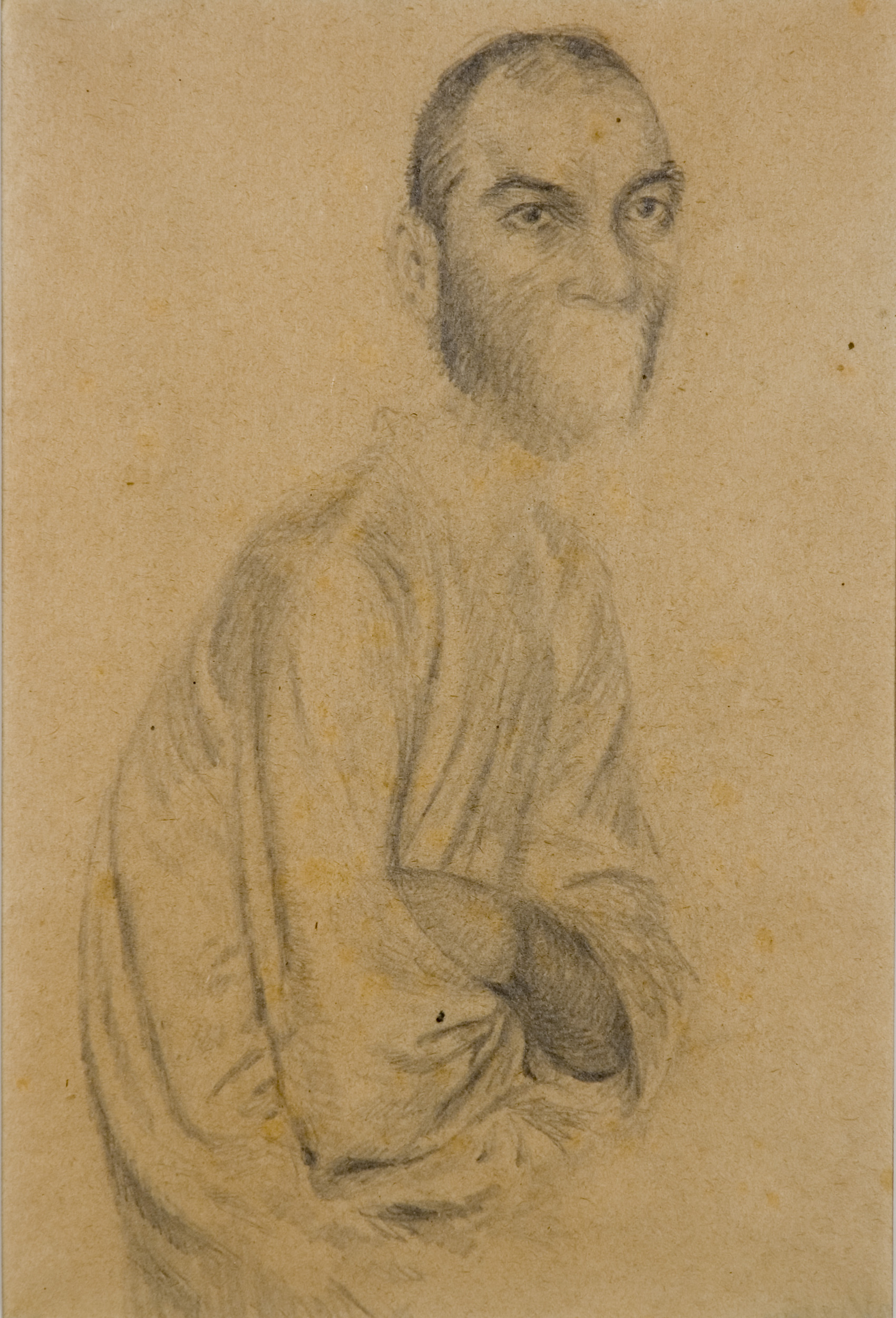
Portrait of a Mental Patient in Kazan, 1942. Graphite on paper, 26.4 × 17.1 cm (10 3/8 × 6 3/4 in.). Norton and Nancy Dodge Collection of Nonconformist Art from the Soviet Union. D05918
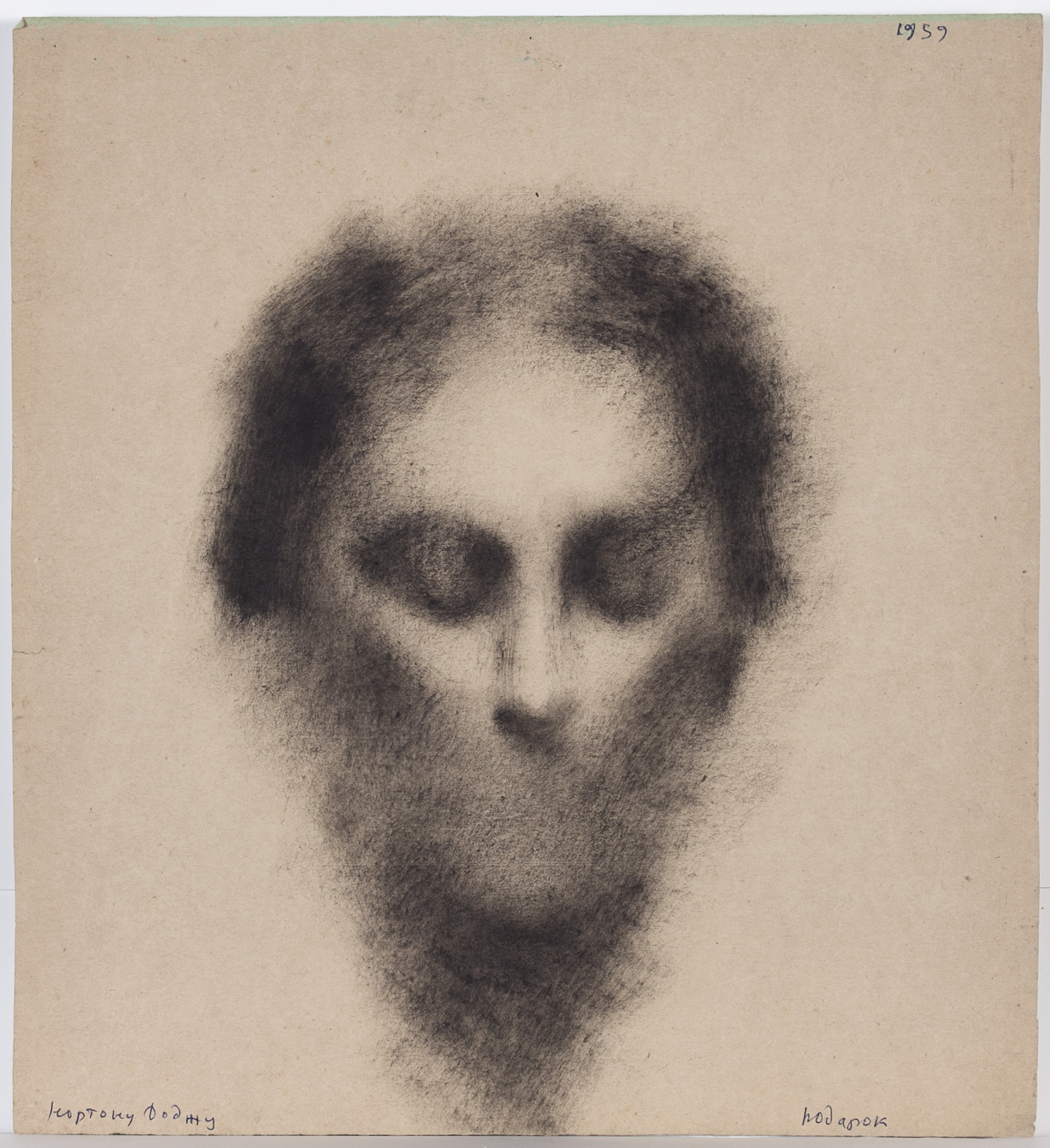
Untitled, 1959. Graphite on paper, 36.2 x 33.3 cm (14 1/4 x 13 1/8 in.). Norton and Nancy Dodge Collection of Nonconformist Art from the Soviet Union. D00429
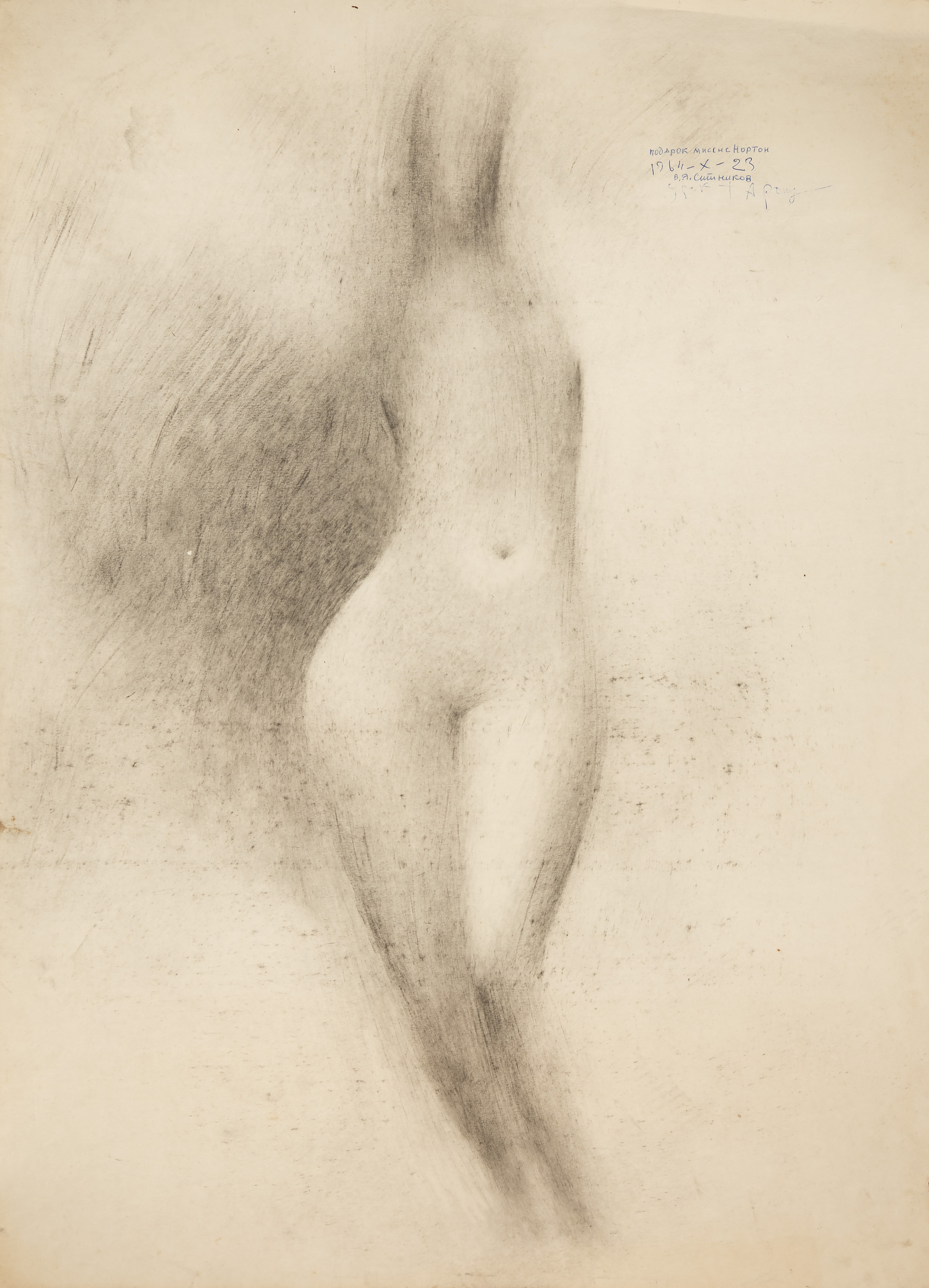
Lesson to Taron, 1964. Graphite on paper, 83.5 × 59.5 cm (32 7/8 × 23 7/16 in.). Norton and Nancy Dodge Collection of Nonconformist Art from the Soviet Union. 2001.1330
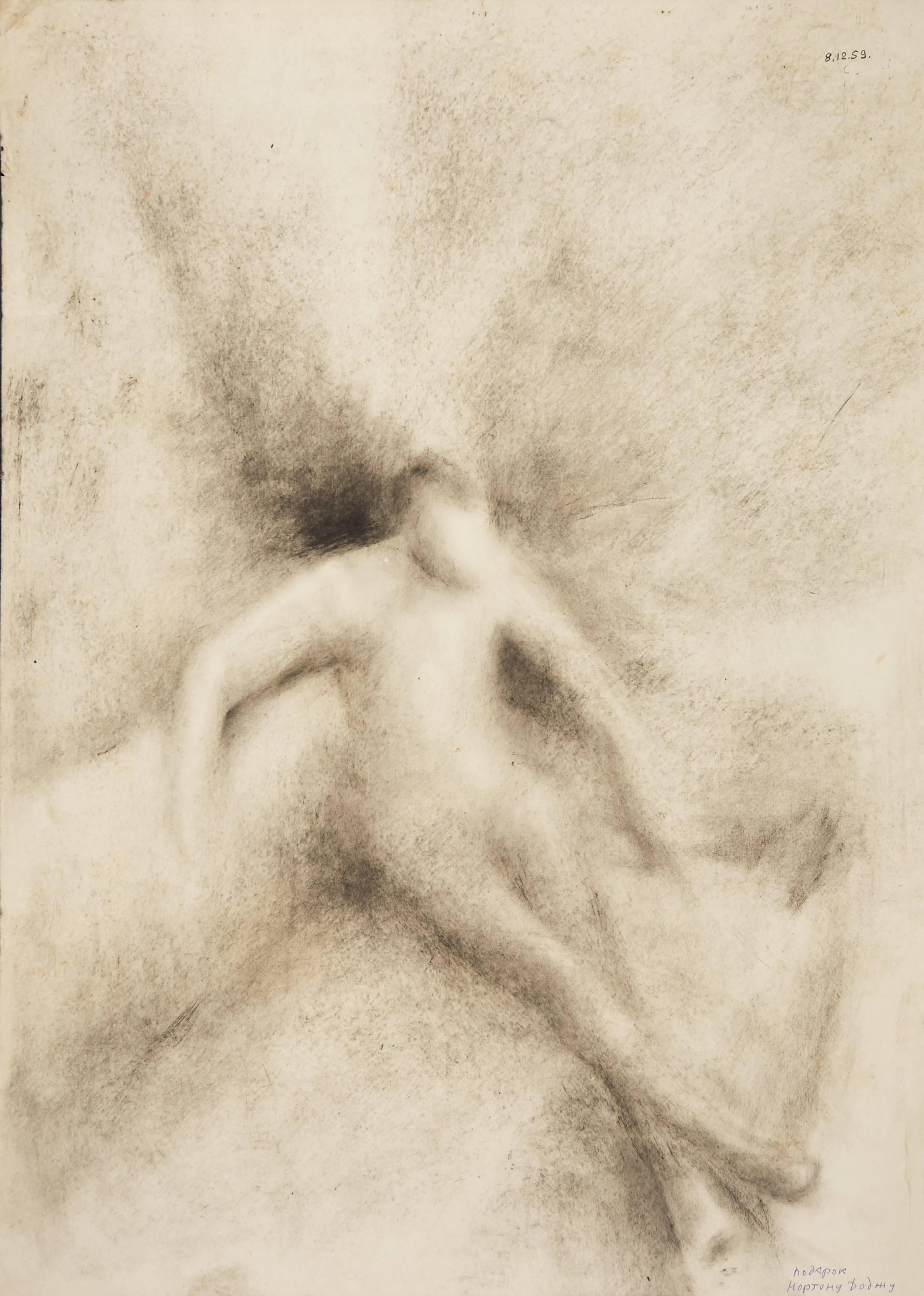
Untitled, 1959. Graphite on paper, 81.3 x 57.6 cm (32 x 22 11/16 in.). Norton and Nancy Dodge Collection of Nonconformist Art from the Soviet Union. D00025

Untitled, undated. Ink, gouache, and chalk on wood, 48.3 × 54.7 cm (19 × 21 9/16 in.). Norton and Nancy Dodge Collection of Nonconformist Art from the Soviet Union. D05063
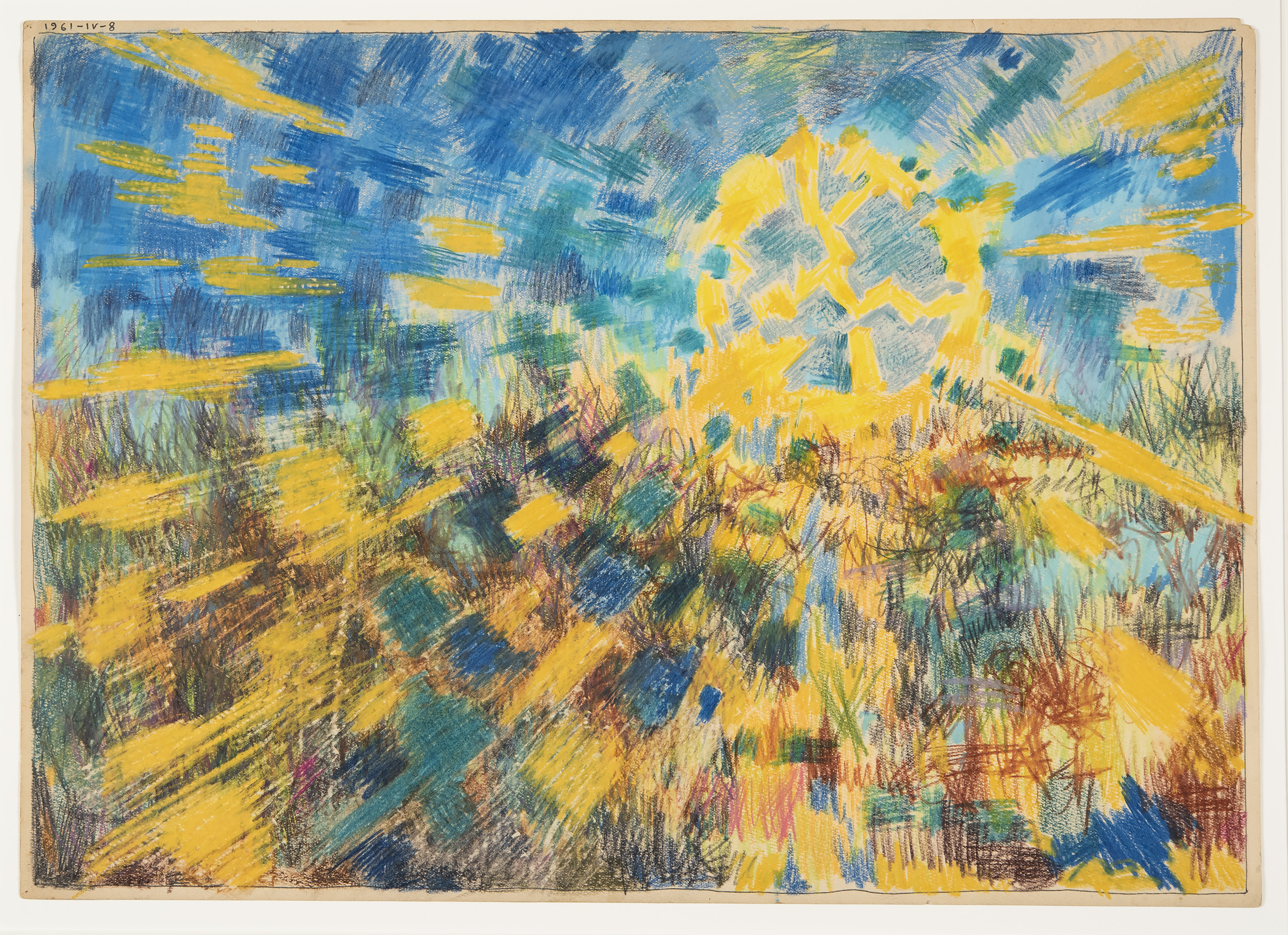
Untitled, 1961. Oil pastel and pastel on paper, 43 × 59.7 cm (16 15/16 × 23 1/2 in.). Norton and Nancy Dodge Collection of Nonconformist Art from the Soviet Union. D11244