
Valery Slauk
1947 — Kakhanava (Belarus). Lives and works in Minsk (Belarus)
Valery Slauk was born in the urban settlement of Kakhanava, Talachyn district, Vitebsk region, BSSR, now Belarus. He became interested in drawing during his school years, but it was only after graduating from a vocational school for agricultural mechanization and then serving in the army that he enrolled in the Belarusian State Theater and Art Institute (now the Belarusian State Academy of Arts), where he studied under the tutelage of Vasily Sharangovich (1939–2021) and Pavel Lyubomudrov (1916–1984). After graduating from the institute in 1977, he began participating in art exhibitions and working with various graphic techniques.
Slauk is one of the few Belarusian graphic artists whose work unites exceptional technical precision with rich, multilayered imagery. His handling of etching, ink, and drawing demonstrates a jeweler-like exactness—in line, tone, and texture—achieved through a near-craftlike meticulousness. This is graphic work where mastery does not overshadow imagination but deepens it. His themes explore his internal freedom and imaginative risk: fairy-tale, mythological, and at times pagan narratives, through which he constructs a highly personal world of fantastic figures, metaphorical scenes, and symbolic detail, all rendered through carefully controlled, detail-driven technique. Slauk works in drawing, watercolor, etching, lithography, easel painting, and is a master of ex libris (bookplates).
Slauk’s primary work, however, is in book graphics, creating iconic illustrations that have become popular with publishers and readers alike, earning him widespread recognition. Especially noteworthy are his designs for Belarusian Folk Tales (1977–80), The Son Pilipka and Kurachka Riaba (1983), Listen to the People and Have Your Own Opinion (1988), Alenka (1989), The Golden Bird (1993), collections of fairy tales such as Uladzimir Karatkevich’s Spring in Autumn (2000), and Yesenia Stepanova’s Kupalinka (2007, 2010). Here, the artist’s special interest in Belarusian folk tales and Slavic mythology is evident, and it has become one of the main themes of his work. He has developed a recognizable graphic and narrative style, using lacy strokes and textures to depict details of fantastical universes filled with mythical creatures, symbols, allegories, and metamorphoses.
The artist’s attachment to mythological themes is evident already in his early work. This interest also extends to illustration of science fiction, where Slauk’s imagination comes into play. He illustrated the science fiction novel Aelita by Alexei Tolstoy (1978) and designed Walter Scott’s Ivanhoe (1978), Mikhail Goncharov’s The Spaceship (1979), Aeneid Upside-Down: Taras on Parnassus (1982), Yan Barscheuski’s The Nobles of Zavalnia, or Belarus in Fantastic Stories (1990), and Magical World: From Belarusian Myths, Legends, and Tales (2008, 2010). In these works, he skillfully combines the real and the fictional, delving deeply into the essence of literary works and creating his own aesthetic and imaginative worlds for them. The artist transforms mythical plots, endowing the fictional characters of fairy tales and myths, animals, and imaginary creatures with human traits. Not only the animals and various insects but also the villains are given a bright, emotional coloring in his work. His illustrations for the two-volume encyclopedic edition Belarusian Folklore (2005–2006) were also popular, providing iconic images of Belarusian mythical creatures: Vawkalak, Klikun, Zazovka, Vuzhalki, Volat, Yadzerki, Khikhitoon, Khapun, Talaka, Rusaliki, and Laznik. These and other creatures created by the artist mesmerize, impress, and force the viewer to carefully examine the meticulously crafted details of the images.
Slauk’s creative style, influenced by his admiration for Dürer and the northern print tradition, is characterized by meticulous attention to detail, precision, and the sophisticated storytelling of his imagery. His pen-and-ink drawings are modeled with detailed light strokes, creating elaborate elements of hair and fur, branches and grass, and other surfaces. To enhance the ornamental effect, he often multiplies similar characters and objects. His etchings have depth and texture with the effect of stars; his aquatint is snowlike. Many of his ink drawings are underpainted with watercolor.
Slauk’s work usually has a cheerful and upbeat quality that transports the viewer into a fantastical world where humans are sometimes merged with mythological creatures. However, in the etching series Conflicts (1984), this unity turns into antagonism, and the world is disrupted by false technocratic interference. Here, using his familiar techniques, he intensifies the opposition between the organic and the technocratic, the mythological and the mechanical. His studio works are characterized by a generalized depiction of everyday objects and their surrounding environment—Tales of a Summer Day (1975), After the Storm (1979), Berry Picking (1980), In the Pasture (1981), Early June (1983), Winter (1987), White Cat (1995), Unicorn and Twilight (1997), and Slow Motion, Paradise, and Transformation (all 1998).
Since 1997, Slauk has taught material work, applied graphics, and composition at the Belarusian State Academy of Arts, where he is professor in the Department of Graphics. He has received numerous awards for his work, including the State Prize of the Republic of Belarus in Literature, Art, and Architecture (2000) for a series of graphic works based on Belarusian fairy tales created between 1995 and 1998; the Best Illustrator of the Year award (Minsk, 2008); the Golden Foliant award in the category of Best Master at the National Competition Art of the Book—2008; the diploma of the Republican competition Artist and Book in the category of Best Artist (Minsk, 2009); and the diploma of the I degree of the International Competition Art of the Book (Moscow, 2009). He was awarded the Francysk Skaryna Medal in 2009 and the Medal for Merits in the Field of Fine Arts by the Belarusian Union of Artists in 2010, and was named Honored Artist of the Republic of Belarus in 2015.
Sergey Shabohin
Photo portrait by Alexey Stolyarov (2022). Source.
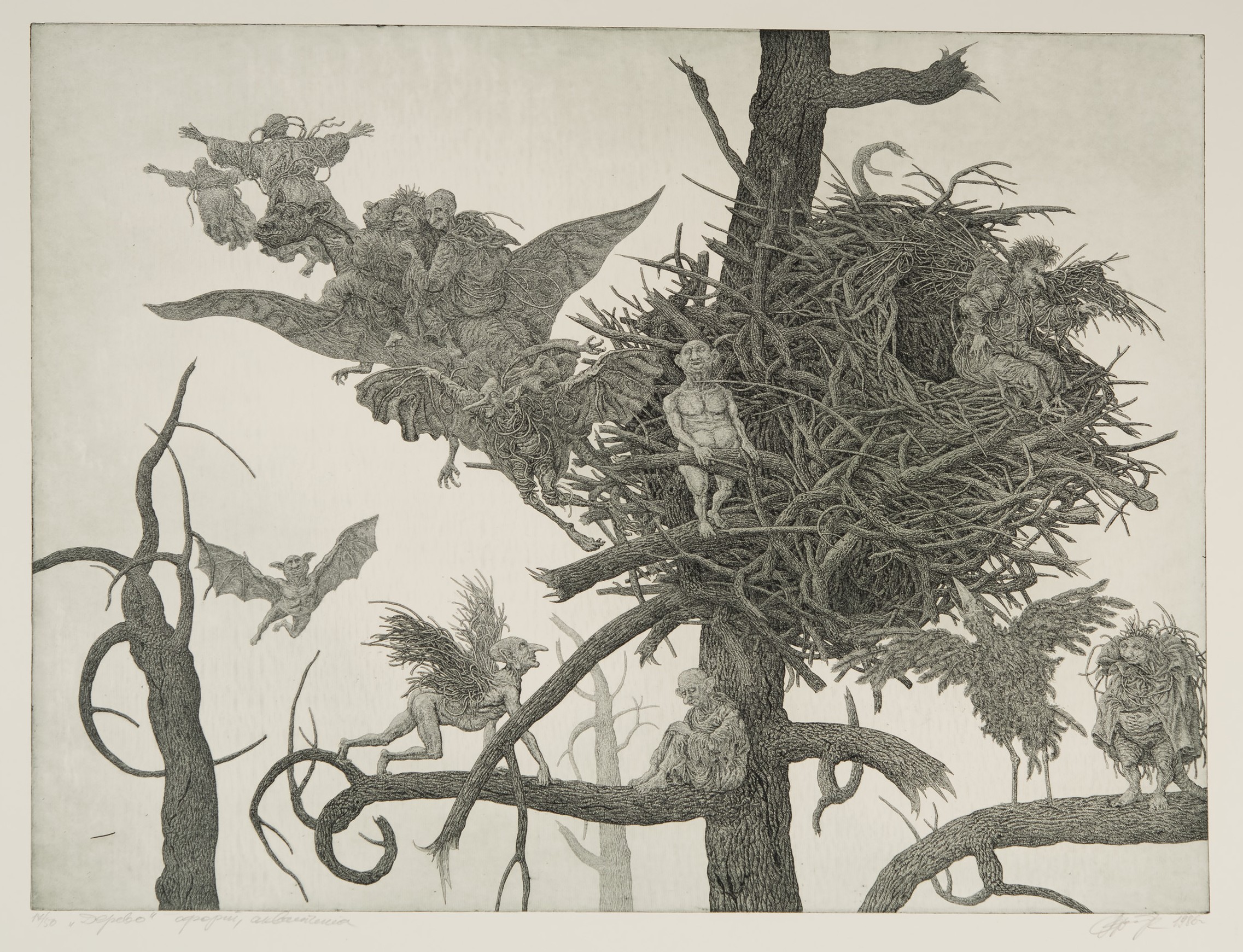
Tree, 1986. Etching and aquatint on paper, 49.8 × 64.5 cm (19 5/8 × 25 3/8 in.). Norton and Nancy Dodge Collection of Nonconformist Art from the Soviet Union. D18473
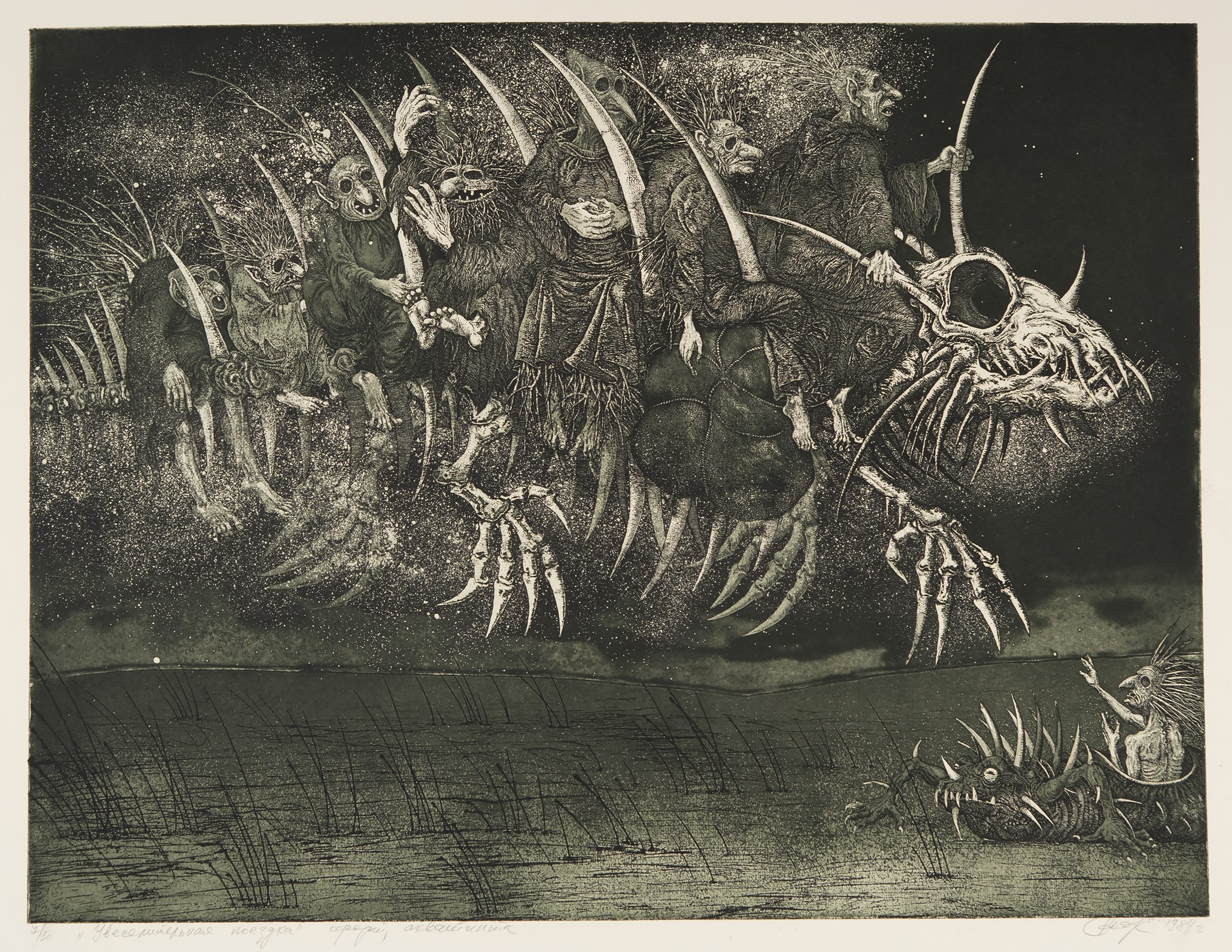
Funny Trip, 1984. Etching and aquatint on paper, 50 × 64.4 cm (19 11/16 × 25 3/8 in.). Norton and Nancy Dodge Collection of Nonconformist Art from the Soviet Union. D18470
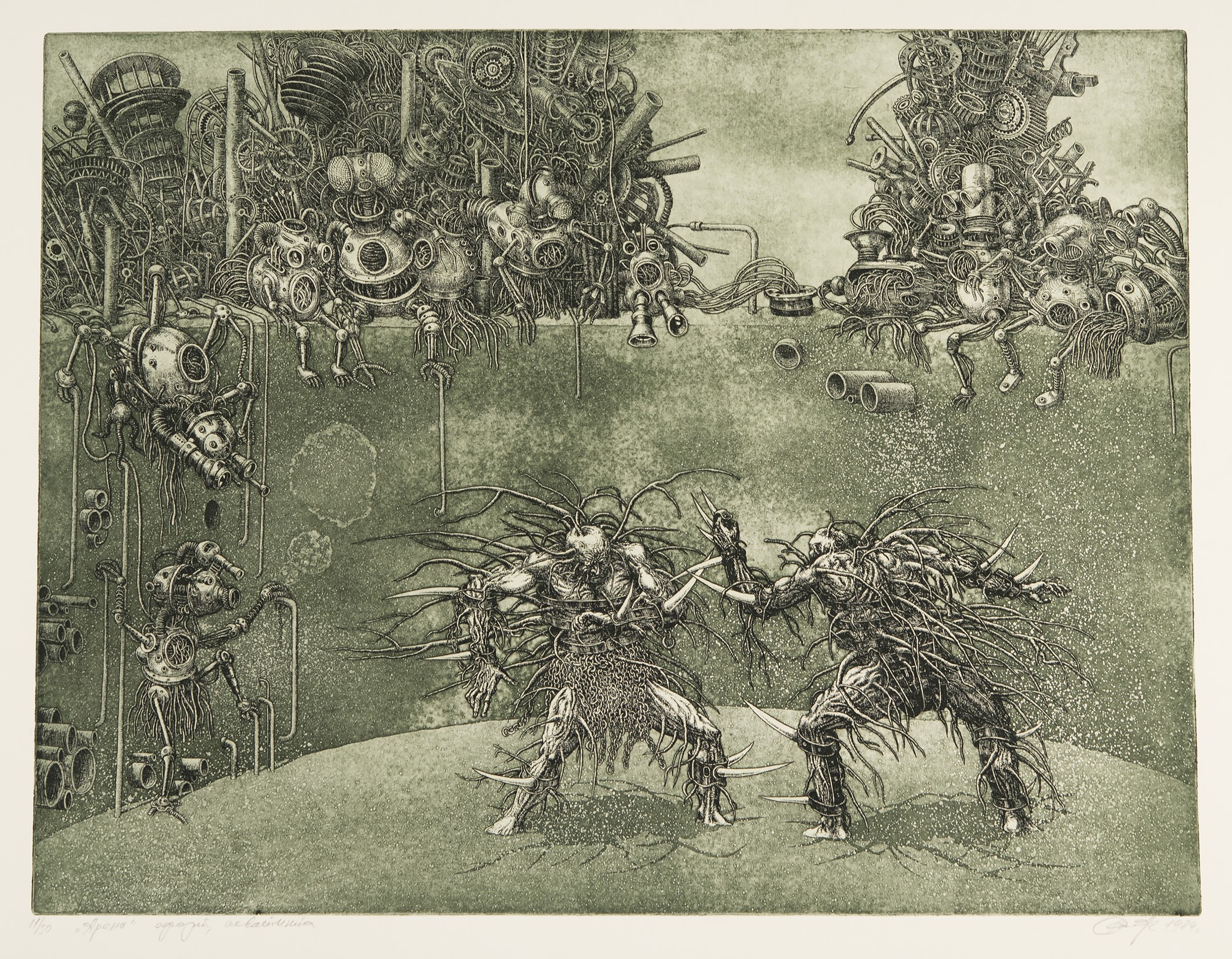
Arena, 1984. Etching and aquatint on paper, 49.8 × 64.6 cm (19 5/8 × 25 7/16 in.). Norton and Nancy Dodge Collection of Nonconformist Art from the Soviet Union. D18695
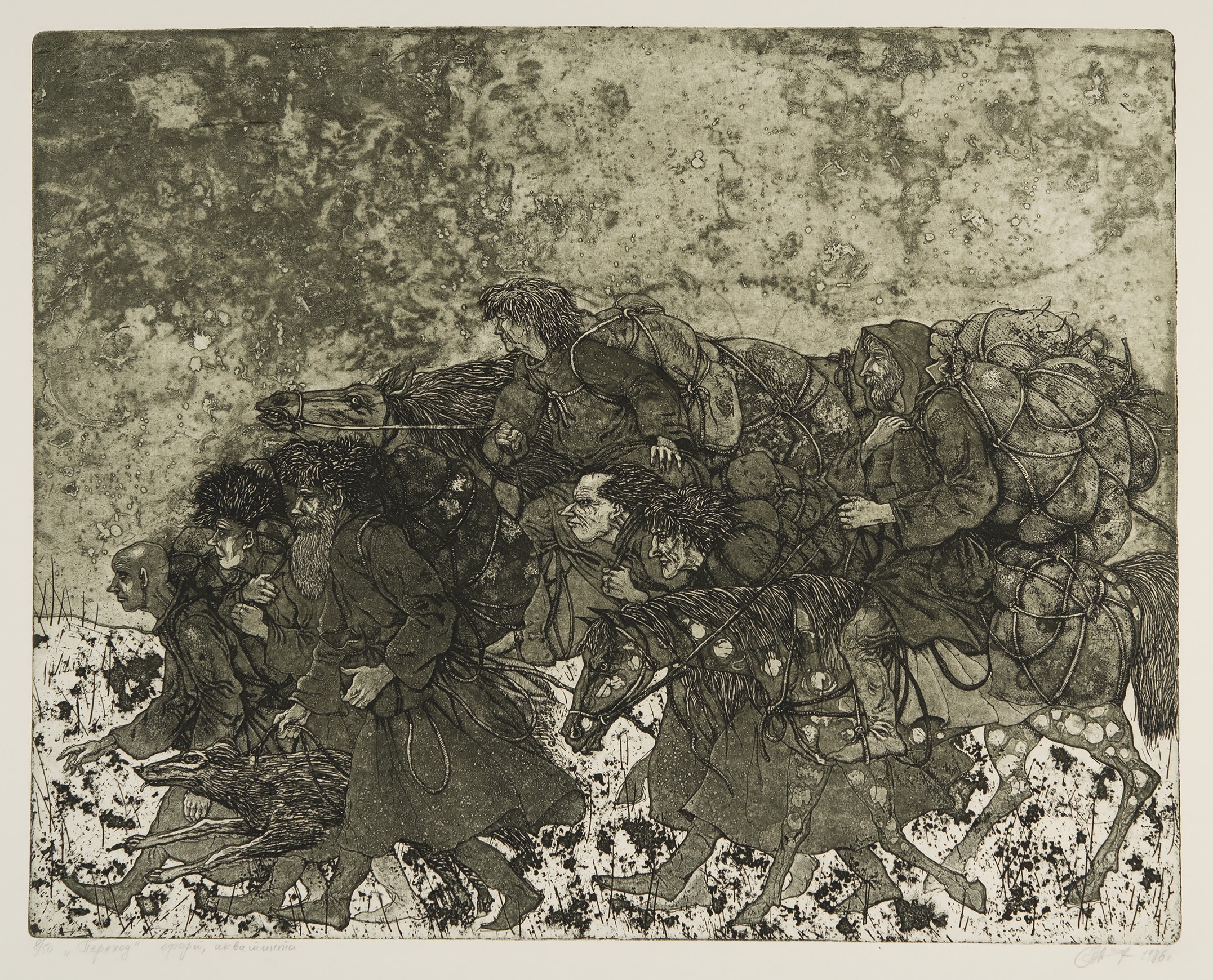
Crossing, 1986. Aquatint and etching on paper, 49.5 × 61.7 cm (19 1/2 × 24 5/16 in.). Norton and Nancy Dodge Collection of Nonconformist Art from the Soviet Union. D18571
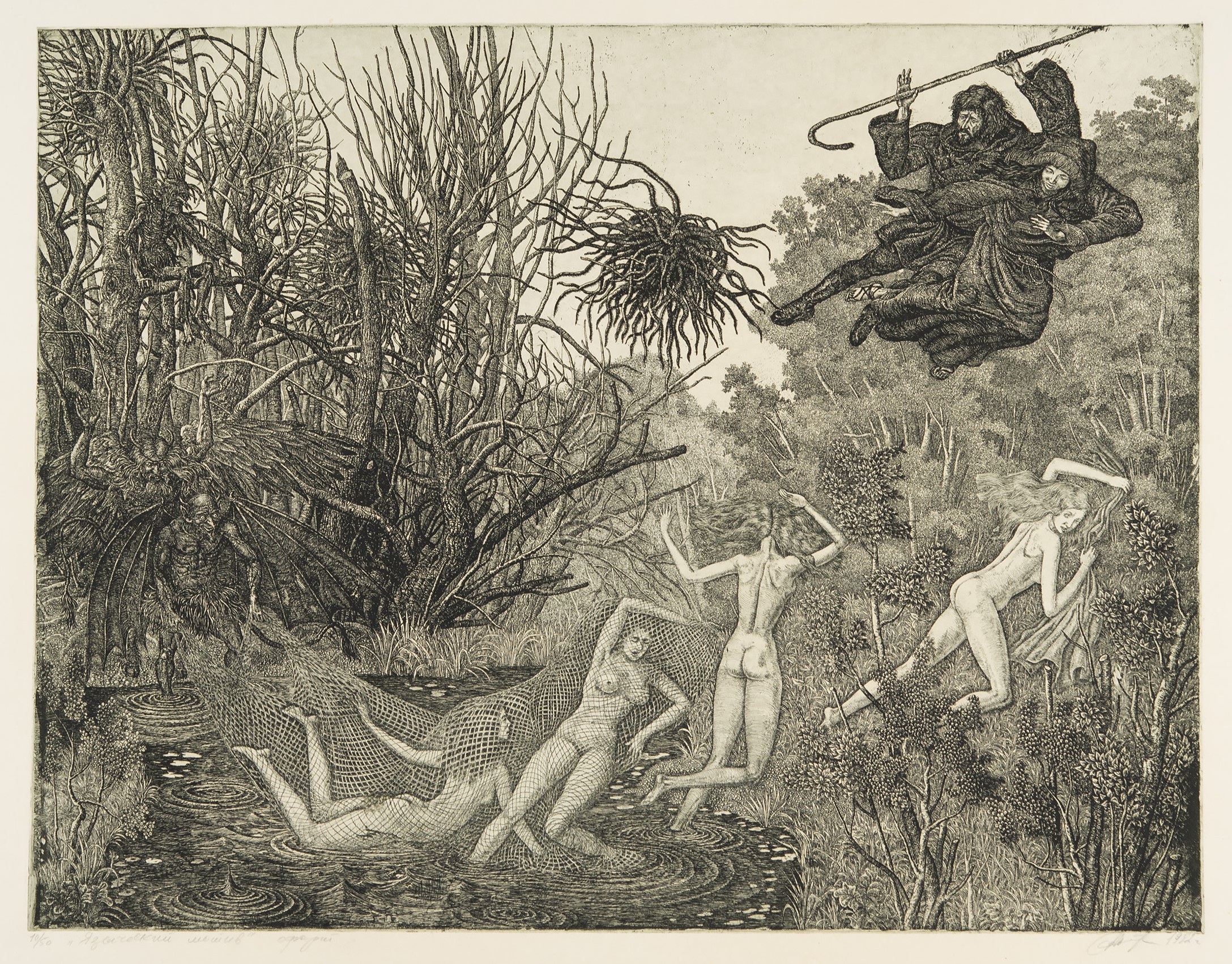
Pagan Motif, 1982. Aquatint and etching on paper, 49.1 × 62.6 cm (19 5/16 × 24 5/8 in.). Norton and Nancy Dodge Collection of Nonconformist Art from the Soviet Union. D18572